Transport in Indonesia: Every Way to Travel Between the Islands
By Blaise Jaeger · Updated August 16, 2026
Why Getting Around Indonesia Needs Its Own Plan
Indonesia is not a country you cross. It is a country you hop across. More than 17,000 islands stretch over 5,100 kilometers from west to east — roughly the distance from Lisbon to Moscow — and no single mode of transport covers all of it. A trip that looks like a three-hour drive on a map can turn into a flight, a ferry and a two-hour transfer on a road that stops being a road halfway through.
That is the part most itineraries get wrong. Travelers plan the destinations first and the transport afterwards, then lose two days of a two-week trip to connections nobody warned them about. Getting around Indonesia well is mostly about knowing which of the six real options fits each leg — plane, train, ferry, bus, car with driver, or scooter — and roughly what each one actually costs in hours.
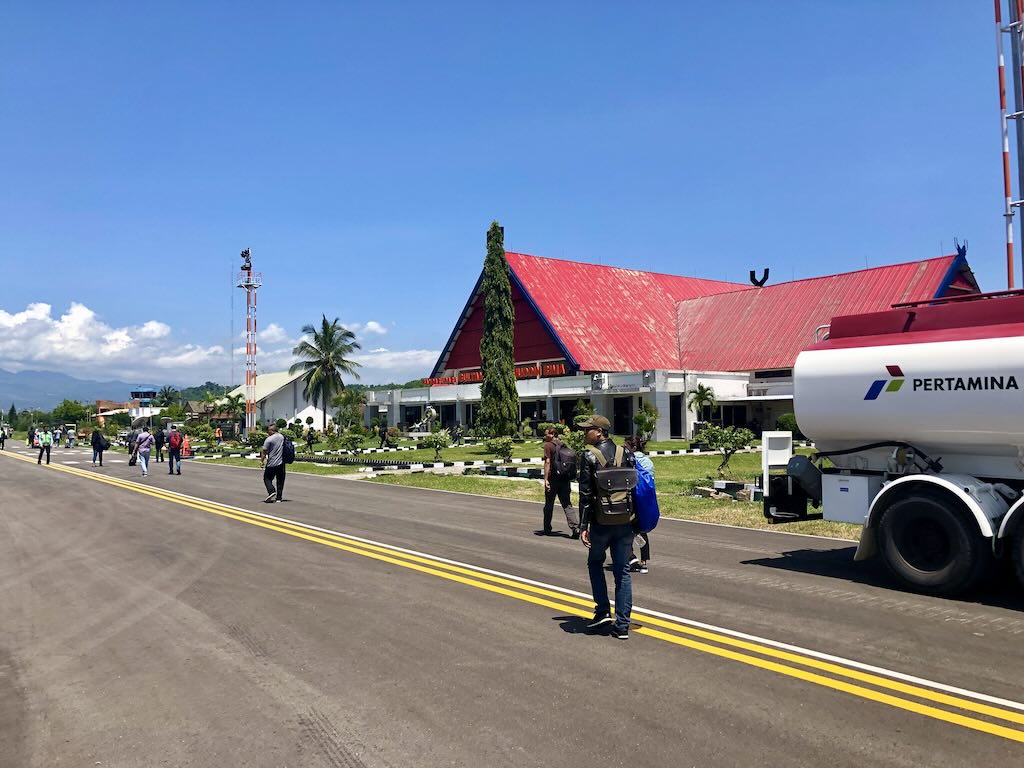
This guide covers moving around the country once you have arrived. If you are still working out how to reach Indonesia in the first place — international routes, visa on arrival, entry requirements — that is a separate guide: how to get to Indonesia.
Indonesia Transport at a Glance
- Country span — about 5,100 km west to east, across three time zones (WIB, WITA, WIT)
- Airports — over 670 airfields, of which roughly 30 handle regular jet services useful to travelers
- Railways — Java has the only dense network; Sumatra has four disconnected regional lines; South Sulawesi has a short new line. Everywhere else has none.
- Roads — around 548,000 km, plus roughly 2,400 km of toll expressway, almost all of it on Java and Sumatra
- Ferries — ASDP for the short crossings, Pelni for long-haul, dozens of private fast-boat operators for the tourist routes
- Fastest way between islands — a domestic flight, almost always
- Cheapest way between islands — a ferry, almost always, at roughly a tenth of the airfare
- Best way within one island — a car with a driver, for anything over two hours
- Booking platform that covers nearly everything — 12Go, for trains, buses, ferries and fast boats in a single search
- Payment — cards work in cities and at airports; carry cash for ferries, terminals and rural transport
- Apps worth installing before you land — Grab, Gojek, Access by KAI, Ferizy
What Six Years of Getting Around Indonesia Taught Me
I moved to Indonesia in 2020 and have been traveling inside it ever since. In that time I have taken almost every form of transport the country offers — domestic flights on every major carrier, overnight ferries, Javanese trains, minivans I would not repeat, and more scooter hours than I can count. What follows in this guide is not a summary of schedules. It is what I would tell a friend arriving next month.
Three journeys taught me most of it. The first was a minivan from Probolinggo to Bali. There was no terminal and no schedule — the van collected passengers from their home addresses, one by one. I waited three hours before being picked up late at night, then spent the journey in an overcrowded vehicle with a driver who overtook on blind bends and stopped constantly to drop people off. A friend took the identical route on a 40-seat VIP bus for a little more money, had two seats to himself and slept the whole way. Same road, same night, completely different trip.
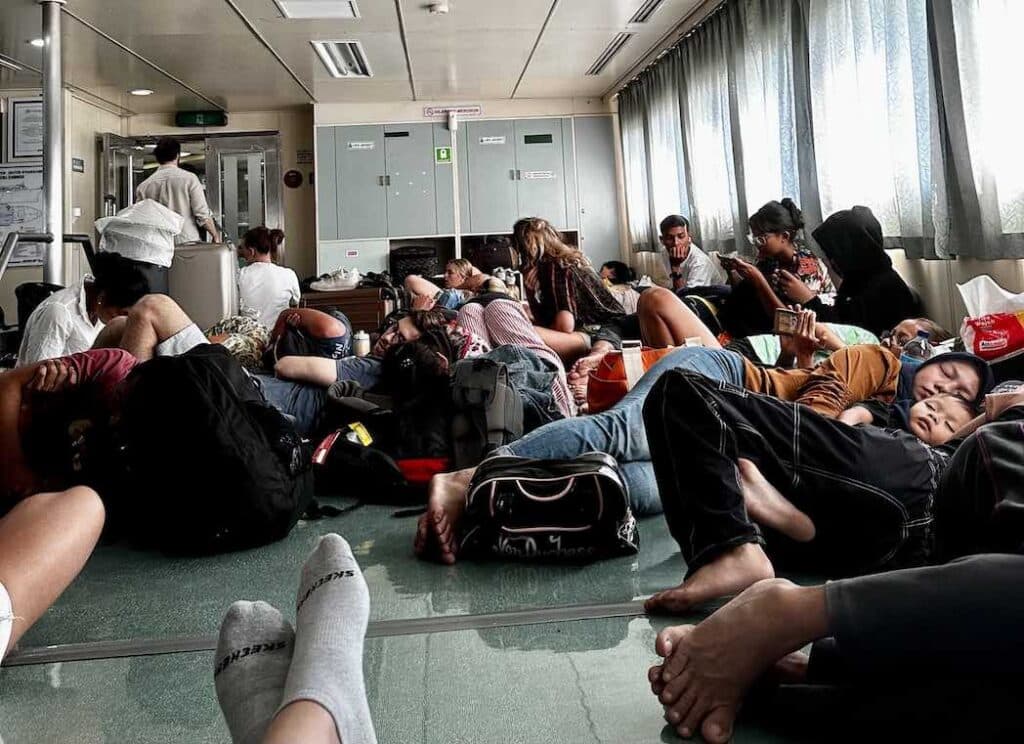
The second was a ferry from Lombok back to Bali. Rough seas had canceled the fast boats and I was stuck on the island for two days. When the crossing finally reopened, the slow ferry was the only way back: eight hours instead of two. Most passengers ignored the seats entirely and stretched out on the padded floor mats in the main hall, which turned out to be the right call.
The third taught me the opposite lesson. I took a train from Yogyakarta to Probolinggo on the way to Mount Bromo, expecting the same chaos, and it was genuinely pleasant — punctual, comfortable, cheap, with rice terraces going past the window. Indonesian transport is not uniformly difficult. It is uneven, and the difference between a good day and a bad one is almost always a decision you made when booking.
Flying Between Islands in Indonesia
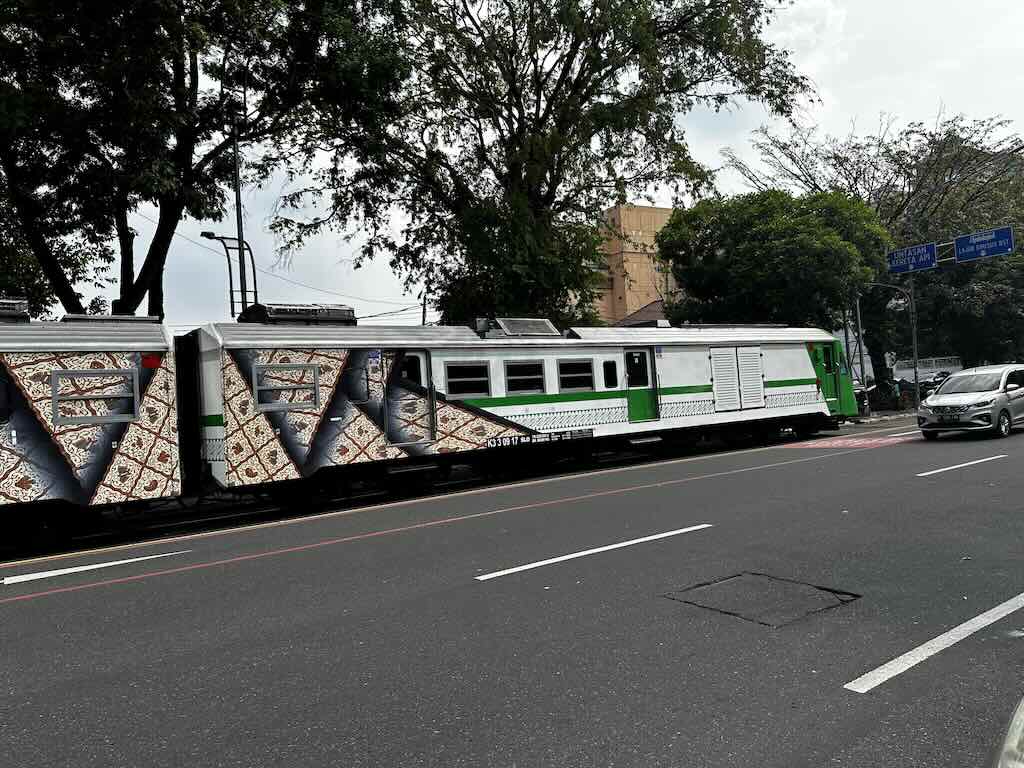
For any journey that crosses open sea, flying is usually the only sensible choice. Indonesia has one of the busiest domestic aviation markets in Asia, and fares are low by international standards — Jakarta to Bali often sits between $45 and $80 one way if you book a couple of weeks ahead. The trade-off is reliability, not safety.
The domestic airlines, and what each one gives you
Garuda Indonesia is the flag carrier: full service, checked bag included, the most consistent schedule, and the highest fares. Citilink is its low-cost subsidiary and a good middle ground. The Lion Air group — Lion Air, Batik Air and Wings Air — carries the largest share of domestic traffic and reaches the most remote airstrips; Batik Air is the more comfortable of the three. Newer entrants have widened the field: Super Air Jet targets younger budget travelers, Pelita Air has grown into a credible full-service alternative on trunk routes, and TransNusa covers eastern Indonesia. AirAsia Indonesia handles regional and some domestic links.
For the small strips — Sumba, parts of Papua, remote Kalimantan — Wings Air turboprops and Susi Air are often the only scheduled option, and they carry strict, low baggage limits.
Booking domestic flights, and what baggage really costs
Domestic fares are cheapest on Indonesian platforms — Traveloka and tiket.com — which often undercut international search engines, and they accept foreign cards. Book two to four weeks out for the best prices; fares climb steeply in the last week and around Eid, Christmas and the June to August school vacation.
Read the baggage line carefully. Low-cost carriers sell tickets with cabin baggage only, and adding 20 kg at the airport costs far more than adding it online. Surfboards, dive gear and anything oversized are charged separately and the policies differ by airline — check before you book, not at the counter.

Delays are normal — plan for them
Service quality on Indonesian carriers is generally good, but punctuality is not their strength. Assume an hour of slippage on any domestic flight and never book a same-day international connection on a separate ticket. If you must connect, leave four hours, and treat anything tighter as a gamble.
Occasional incidents do make headlines — in January 2024 both pilots of a Batik Air flight from Sulawesi to Jakarta fell asleep for 28 minutes mid-flight, which was investigated and widely reported. It is worth knowing about, but it is an isolated case rather than a pattern: I have personally flown with every airline listed above, many times, and never had a problem beyond a delay.
The airports that matter for connections
Four hubs carry most of the useful connections. Jakarta’s Soekarno-Hatta (CGK) is the main gateway and the widest network. Bali’s Ngurah Rai (DPS) connects across the east and to most international destinations. Surabaya’s Juanda (SUB) covers eastern Java and beyond. Sultan Hasanuddin (UPG) in Makassar is the hub for eastern Indonesia — if you are heading to Tana Toraja, the Maluku islands or Papua, you will probably route through it.
Trains in Java and Sumatra
Indonesia’s railways are the country’s most underrated form of transport, and its best-value one. They are also almost entirely confined to Java. If your trip includes Java, build it around the trains; if it does not, you will barely use them.
Where the network actually goes
The dense network runs the length of Java, linking Jakarta to Bandung, Semarang, Solo, Yogyakarta, Surabaya and on to Banyuwangi at the eastern tip, where the ferry to Bali leaves. Sumatra has four separate regional networks that do not connect to each other, the most useful being the line from Medan to its airport and the southern line around Palembang. South Sulawesi has a short modern line that is not yet very useful to visitors. Everywhere else — Bali, Lombok, Flores, Kalimantan, Papua — has no passenger rail at all. Indonesia’s wider transport network is documented in detail on Wikipedia.
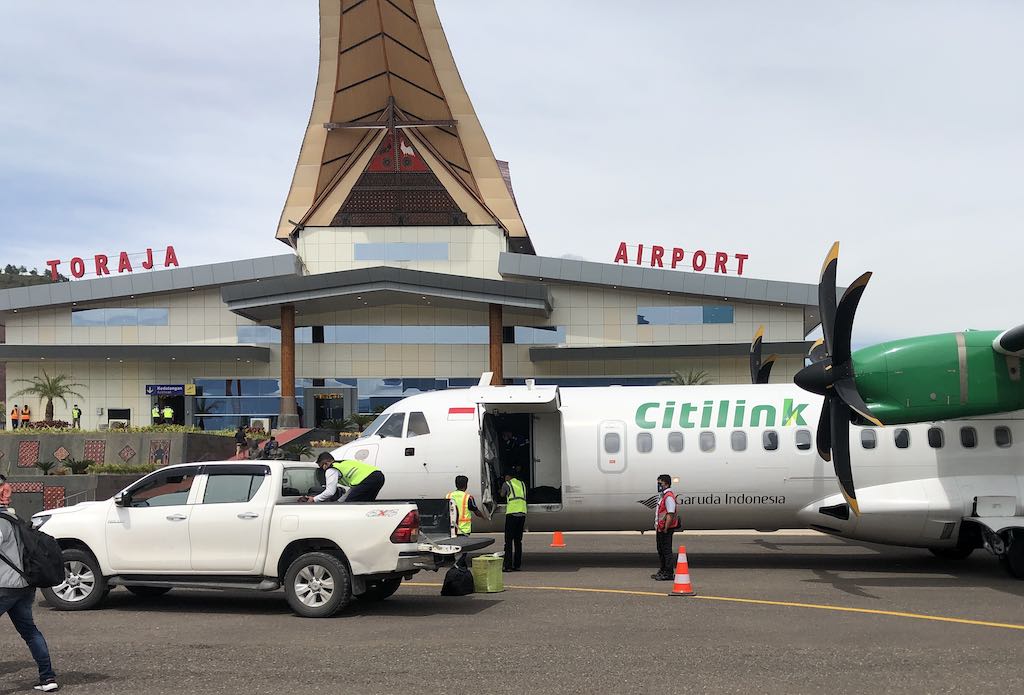
The scenery is a genuine reason to choose the train. The Jakarta–Yogyakarta and Yogyakarta–Surabaya runs cross terraced rice fields and volcanic foothills for hours. In Solo, the line runs along a city street on dedicated tracks, next to the bus route.
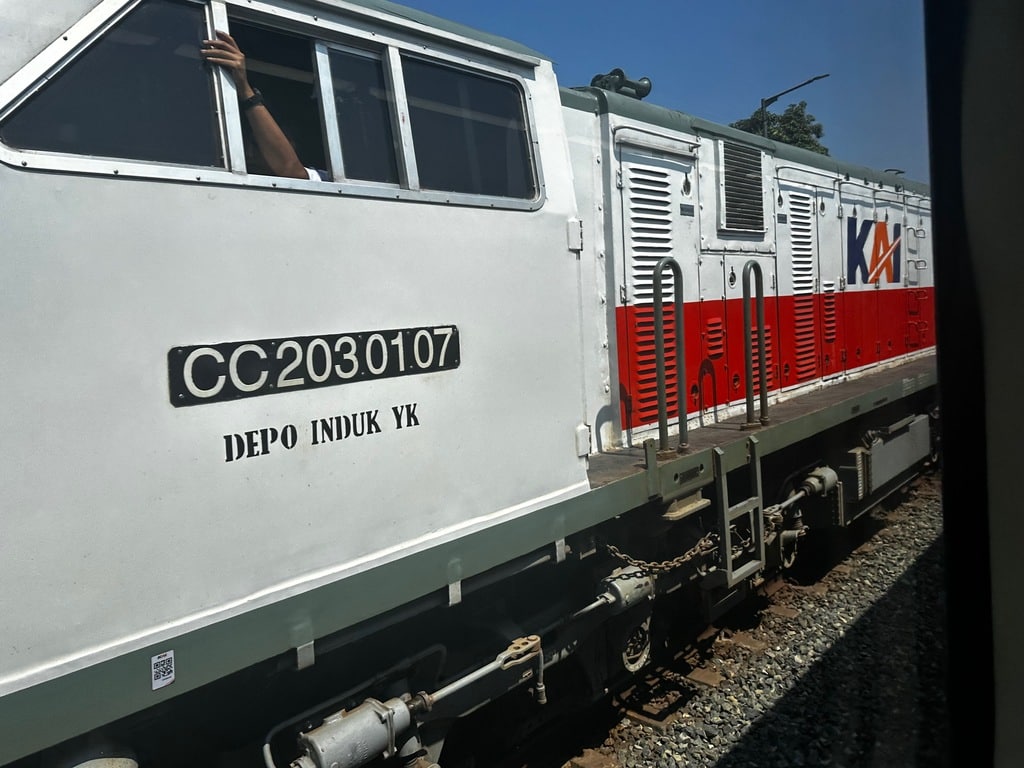
Whoosh, Southeast Asia’s first high-speed line
The Jakarta–Bandung high-speed railway, branded Whoosh, opened commercially in October 2023 and was the first high-speed service in Southeast Asia. It covers 142 km at up to 350 km/h and cuts the Jakarta–Bandung journey from around three hours to about 45 minutes.
It has become a genuine mass-transit line rather than a showpiece. Operator KCIC reported passing 12 million passengers by October 2025, with a peak of 26,770 riders in a single day in June 2025 and on-time performance of 99.9 percent. Foreign travelers have taken to it too: 866,458 international passengers had used it by June 2026, of whom 184,740 in the first half of 2026 alone — the largest single group being Malaysians heading to Bandung. An extension eastwards toward Surabaya, and possibly Banyuwangi, has been announced by the government but has no confirmed schedule.
One practical catch: the Jakarta end is at Halim, not the central stations, and the Bandung end is at Tegalluar or Padalarang rather than the city center. Factor in the connecting transfer at both ends before assuming it beats the conventional train.
The three classes, and which one to book
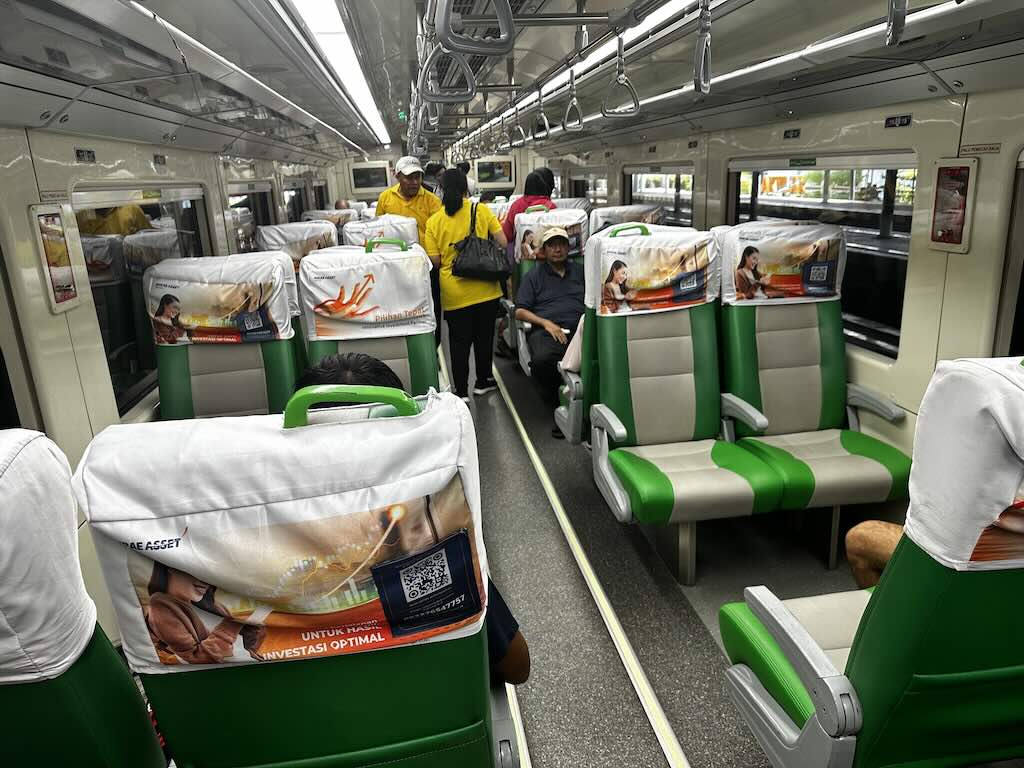
Conventional Indonesian trains run in three classes. Ekonomi is basic but air-conditioned and perfectly fine for journeys under three hours. Bisnis adds legroom and better seats. Eksekutif gives reclining seats, generous space, stronger air conditioning and sometimes a meal service — worth it on anything overnight or over five hours.
Operator KAI has also introduced upgraded rolling stock on the busiest routes, along with premium options such as panoramic carriages and private compartment suites on selected services. For a Jakarta–Yogyakarta run, Eksekutif is the sweet spot: it is still inexpensive by European standards and turns a long day into a comfortable one.
Booking Indonesian trains
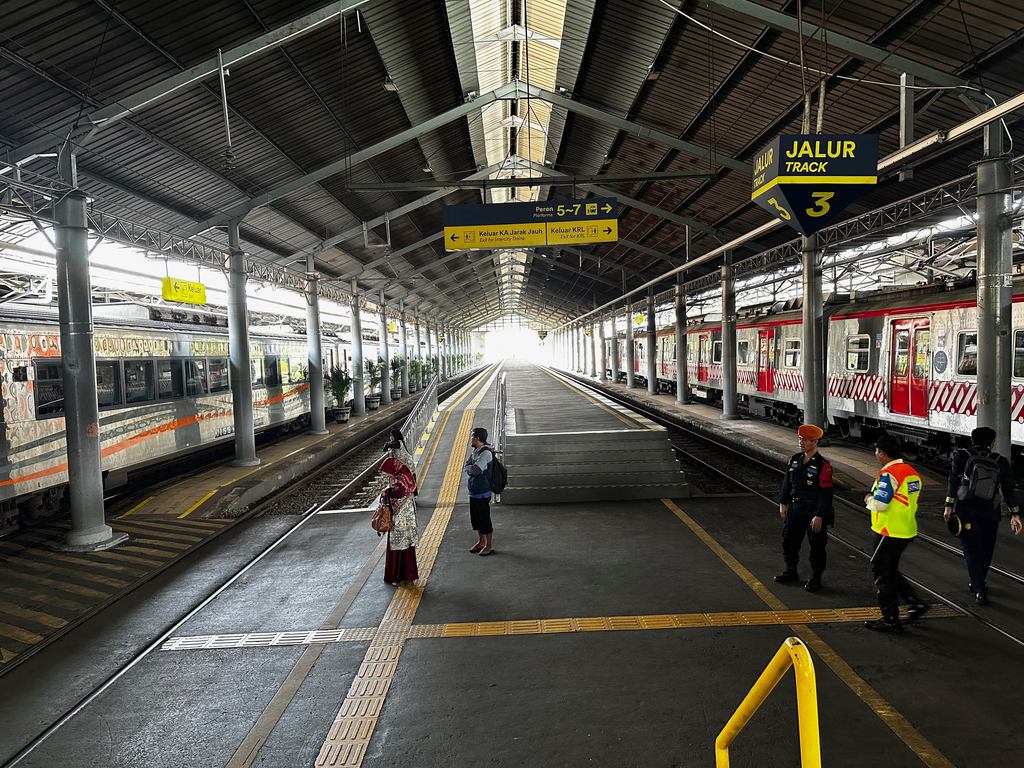
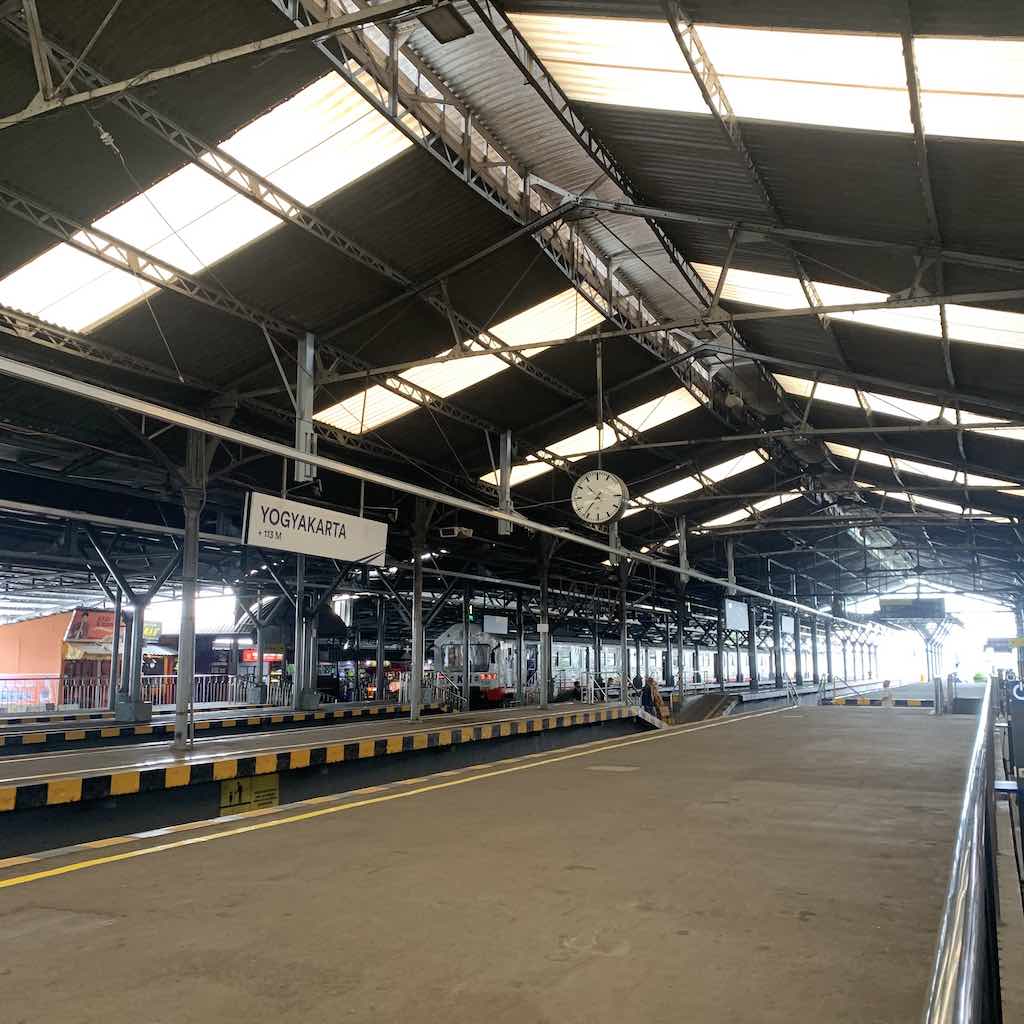
Tickets go on sale up to 45 days ahead and popular routes genuinely sell out, especially around holidays. The official channel is KAI and its Access by KAI app, which accepts foreign passport numbers at booking — bring the same passport to the station. If the app rejects your card, 12Go sells the same seats with an international payment flow and an English interface, which is the simpler route for most visitors.
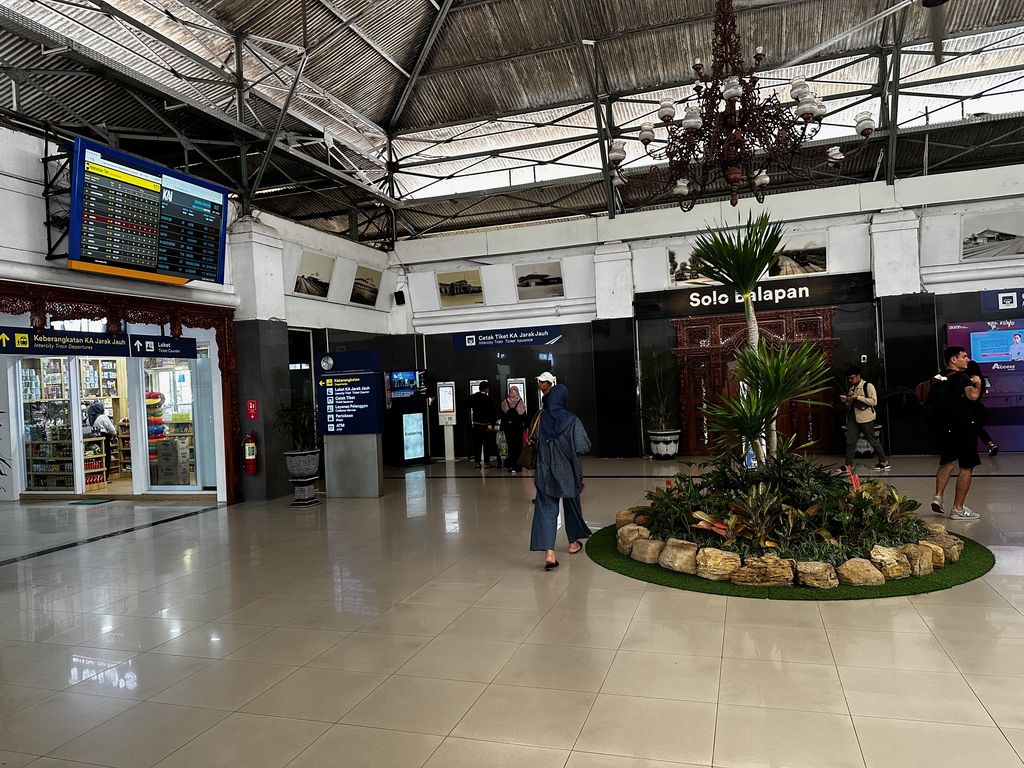
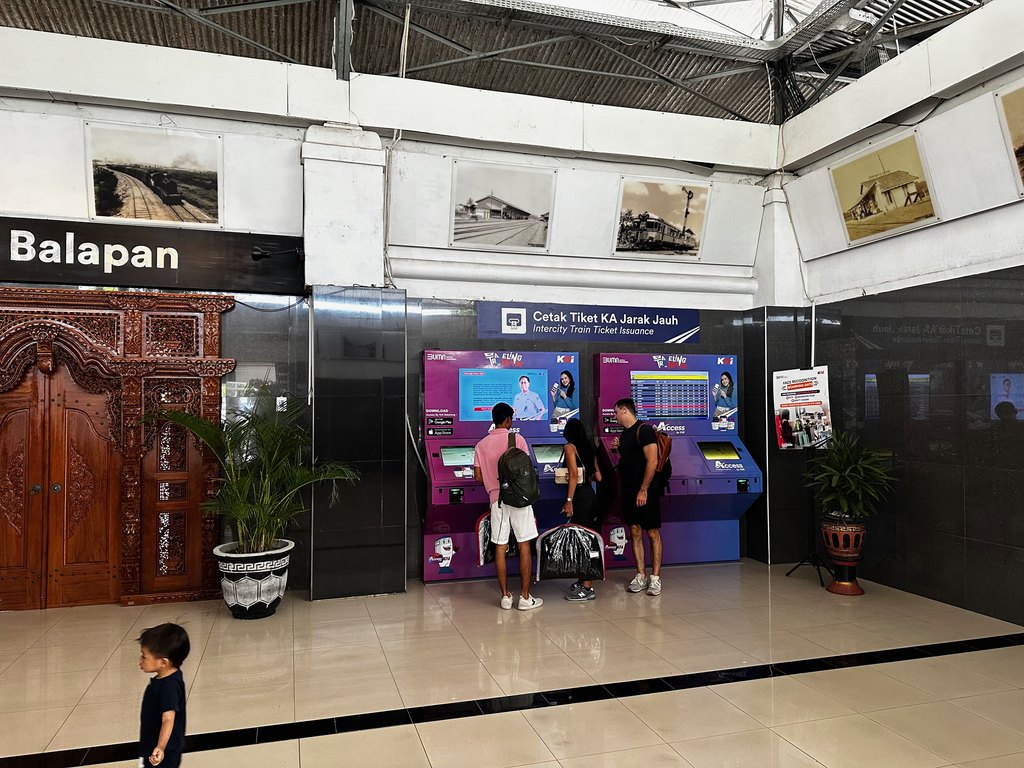
Whichever way you book, you collect the physical ticket from a self-service kiosk in the station hall. They are labeled in both languages — Cetak Tiket KA Jarak Jauh, Intercity Train Ticket Issuance — and you need the booking code and the passport you booked with.
Ferries and Boats Between Indonesian Islands
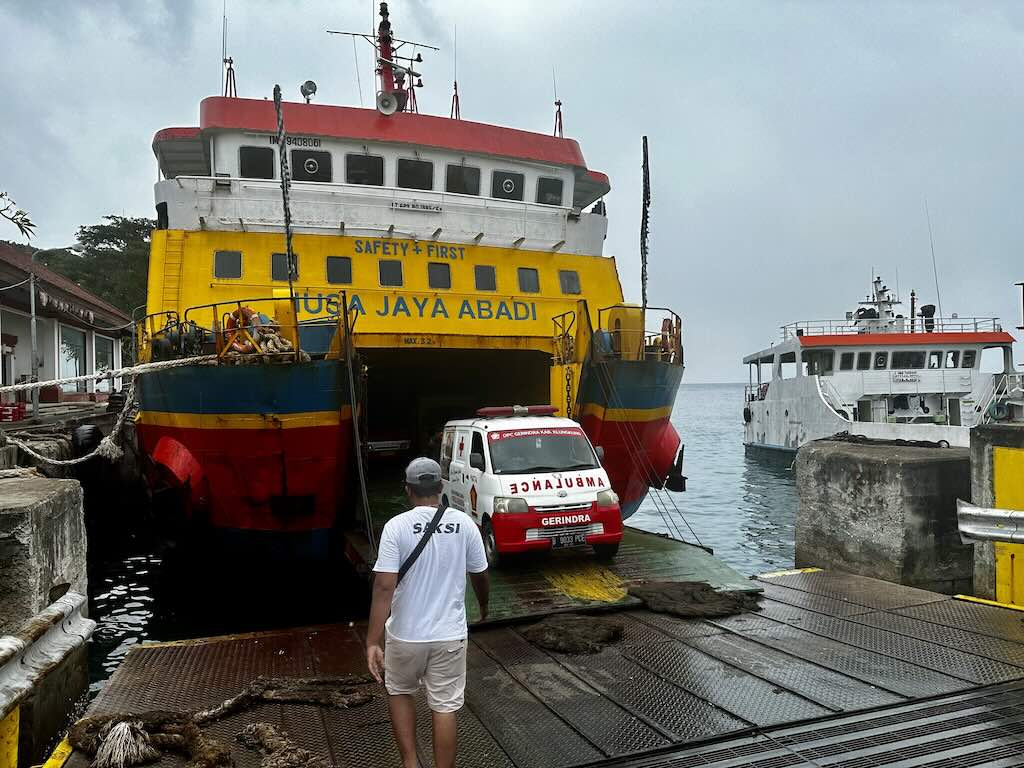
Ferries are how Indonesia actually moves. They are cheap, they go where planes do not, and they operate on a logic of their own — which is fine once you stop expecting them to behave like trains. They are also infrastructure rather than tourism: on an island with no bridge, the ferry carries the trucks, the deliveries and the ambulances.
The short crossings: ASDP, and the Ferizy rule
State operator ASDP runs the roll-on roll-off ferries on the strategic short crossings: Merak–Bakauheni between Java and Sumatra, Ketapang–Gilimanuk between Java and Bali, Padangbai–Lembar between Bali and Lombok, and Kayangan–Pototano between Lombok and Sumbawa. These run around the clock and cost very little.
The rule that catches travelers out: ASDP has made online booking compulsory at its main ports through the Ferizy platform, to stamp out ticket touting. You cannot simply turn up and pay cash at the window at the busiest terminals. Book on Ferizy before you get to the port, and arrive with the QR code on your phone.
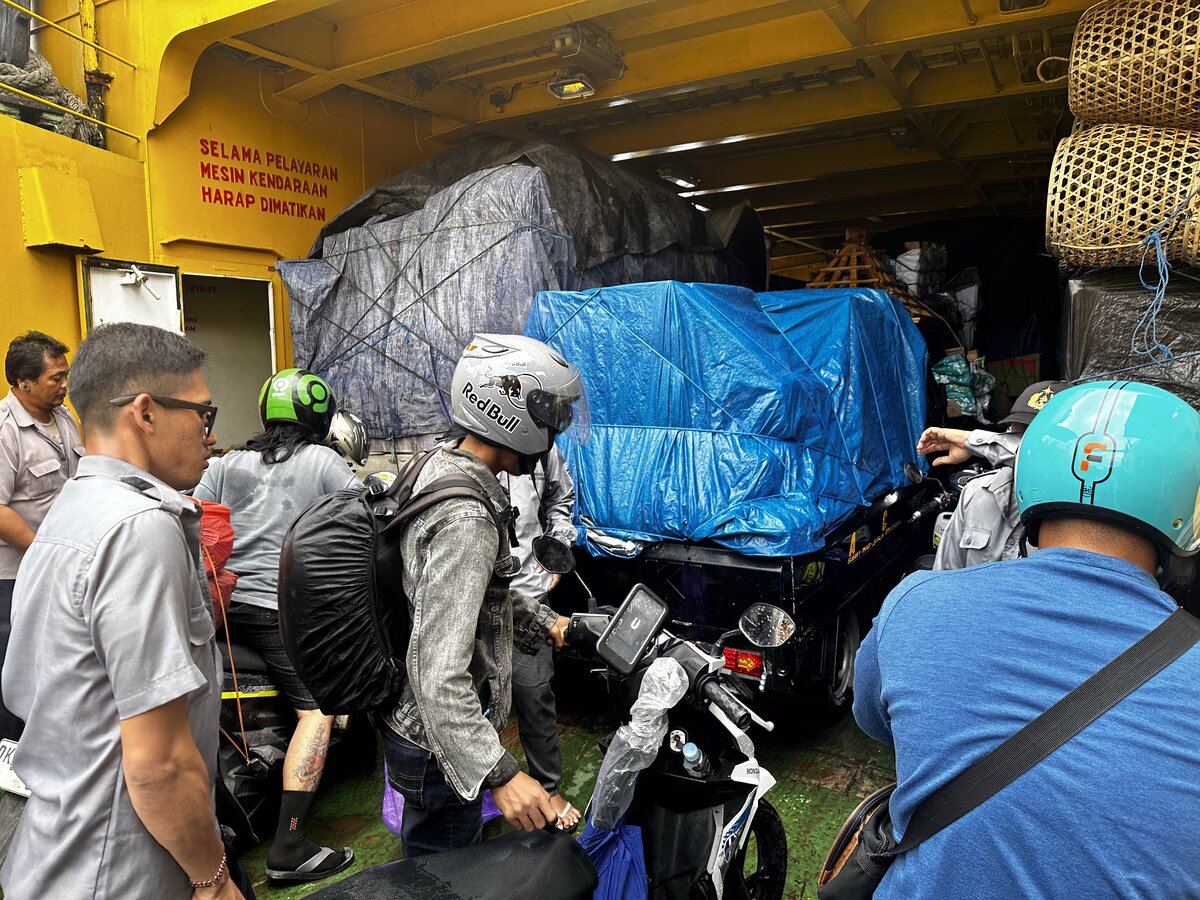
These crossings also take vehicles, which is what makes overland travel between Java, Bali, Lombok and Sumbawa possible at all. Motorbikes ride straight onto the vehicle deck alongside the trucks and cars, and the fare for a scooter and rider is a couple of dollars.
Fast boats to the tourist islands
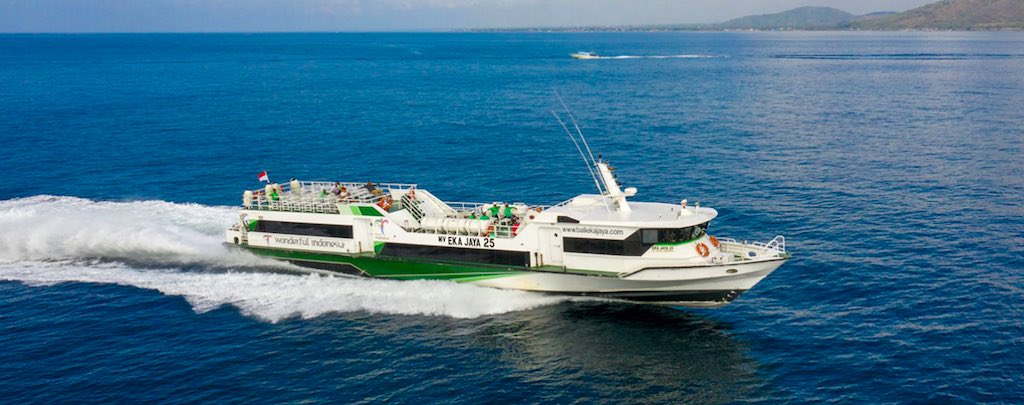
On tourist routes, private fast boats are the practical option: Bali to Lombok and the Gili Islands, or Bali to Nusa Penida. They are far quicker than the ferry, they run to a published schedule, and they are generally punctual — two hours instead of eight on the Bali–Lombok run.
They are also the first thing canceled when the sea gets rough, particularly between December and February. Never book a fast boat on the same day as an international flight home.
Pelni, the long-haul network
For the long crossings, national line Pelni connects more than 95 ports, from Aceh to Papua, on a rotation of roughly two to four weeks. Surabaya to Makassar takes 18 to 22 hours; Surabaya to Sorong in Papua takes four to five days; the Surabaya–Kupang service calls at Sumba and Flores along the way.
Cabins run from open dormitory economy up to private air-conditioned VIP. Economy on Surabaya–Makassar sits around IDR 250,000–350,000; a two-berth first-class cabin costs roughly four to five times that, and is still cheap. Book on the Pelni website, through an agent in the port city, or at the terminal window, with passport in hand.
The one firm rule with Pelni: never plan a tight onward connection off a long crossing. Schedules move.
What a rough crossing is actually like
When the fast boats stop, the slow ferry becomes the only way across, and it is a different experience entirely. The one thing nobody tells you is that a slow ferry has two completely different worlds on board, and picking the wrong one costs you the whole crossing.
Inside, the main hall is air-conditioned and genuinely comfortable. There are seats, but on my eight-hour Lombok–Bali crossing in heavy seas almost nobody used them: the padded floor mats were the better spot, and every Indonesian on board knew it except me. People spread out, sleep, and arrive rested.
Outside, the open deck is the opposite: benches, sea air, no air conditioning and no shortage of company. It is the better choice on a calm daytime crossing, when the alternative is several hours under fluorescent light — and the worse one when the sea picks up.
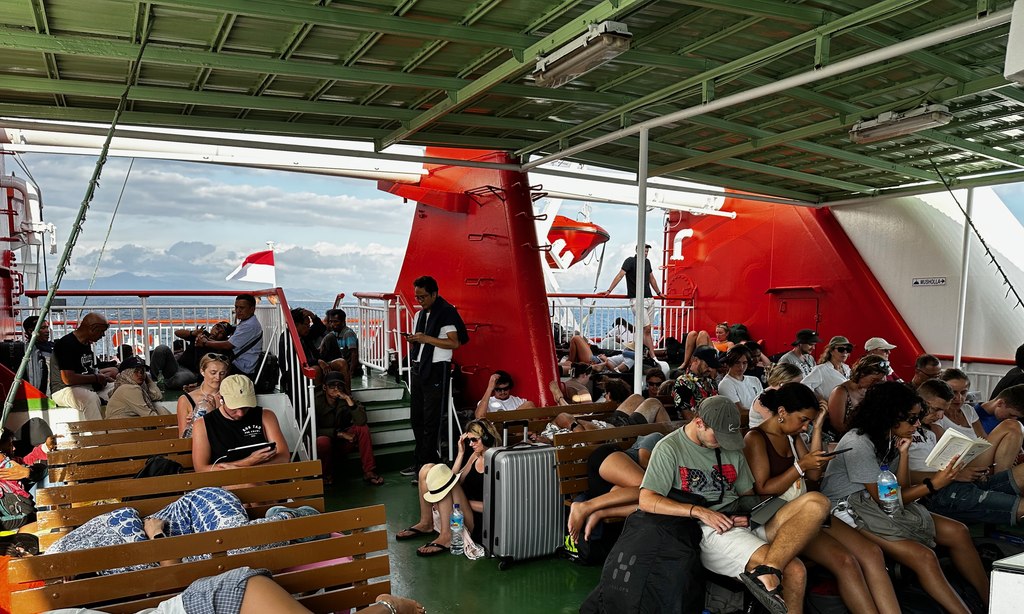
Either way, bring a sarong, water and something to sleep on, and treat the ferry as part of the trip rather than a transfer.
Long-Distance Buses and Minibuses in Indonesia
Buses reach places nothing else does, and they cost very little. The gap between the best and worst bus journey in Indonesia is, however, larger than for any other mode — and it is decided entirely at booking.
VIP buses versus economy
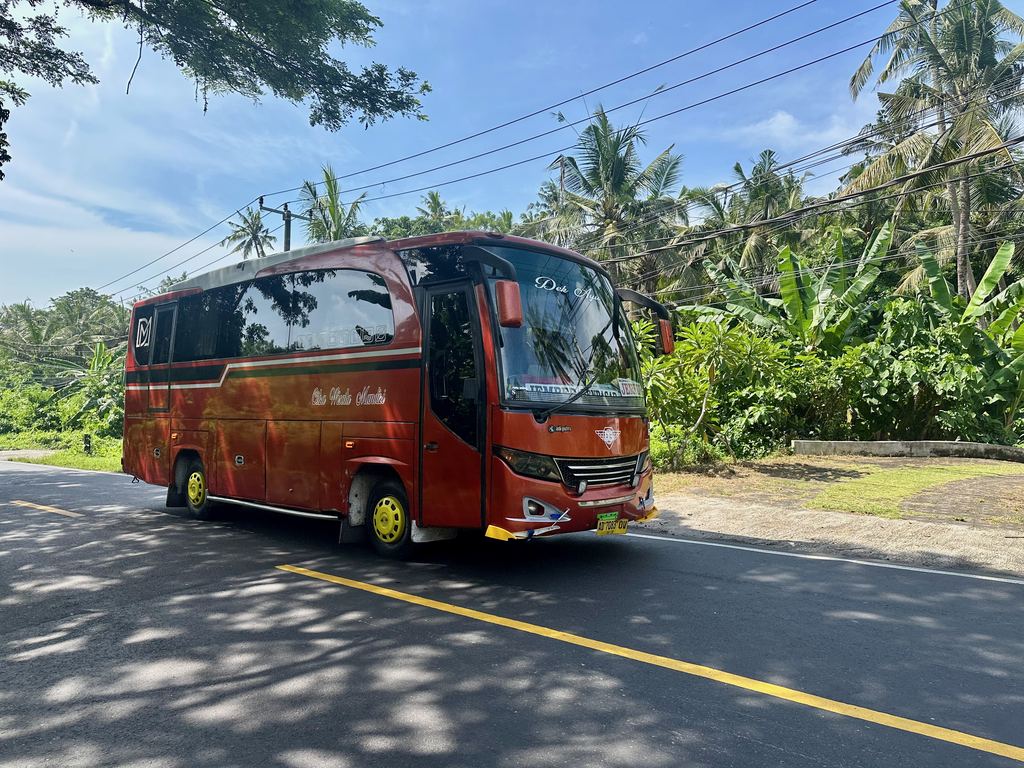
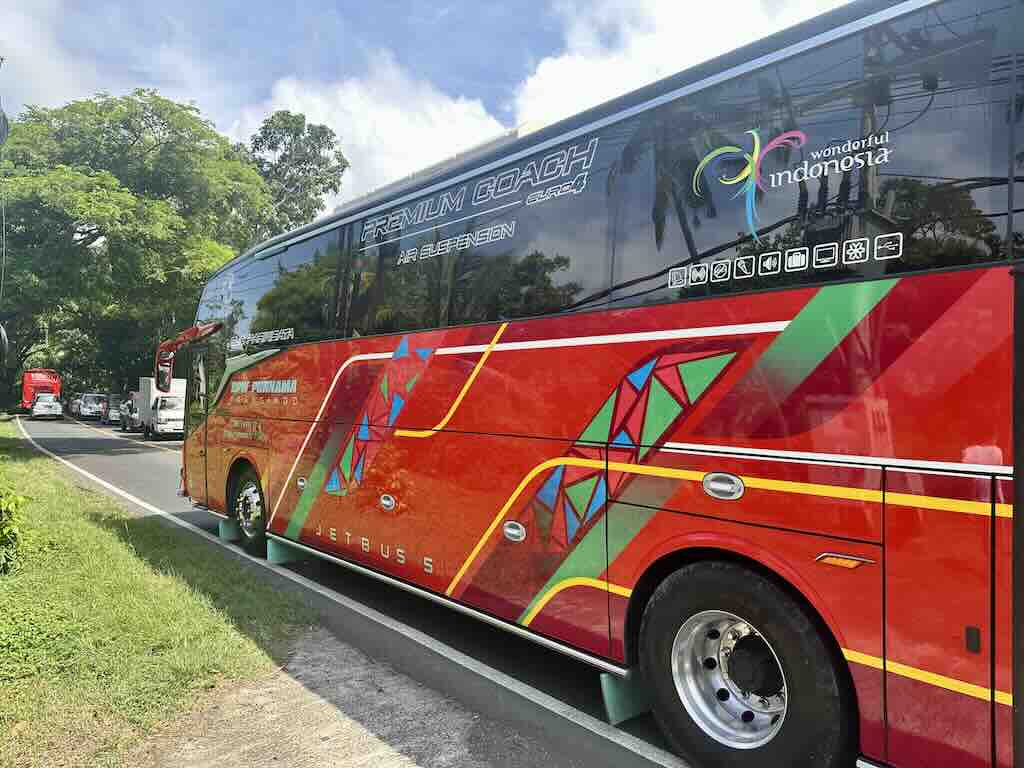
At the top end, “VIP” or “executive” buses have 30 to 40 reclining seats, air conditioning, a toilet and often a meal stop. On Java’s toll network they are fast, and on an overnight run you will genuinely sleep. At the bottom end, economy buses are crowded, hot and slow, with no fixed departure time.
The price difference between the two is usually a few dollars. Pay it every time.
The minivan trap
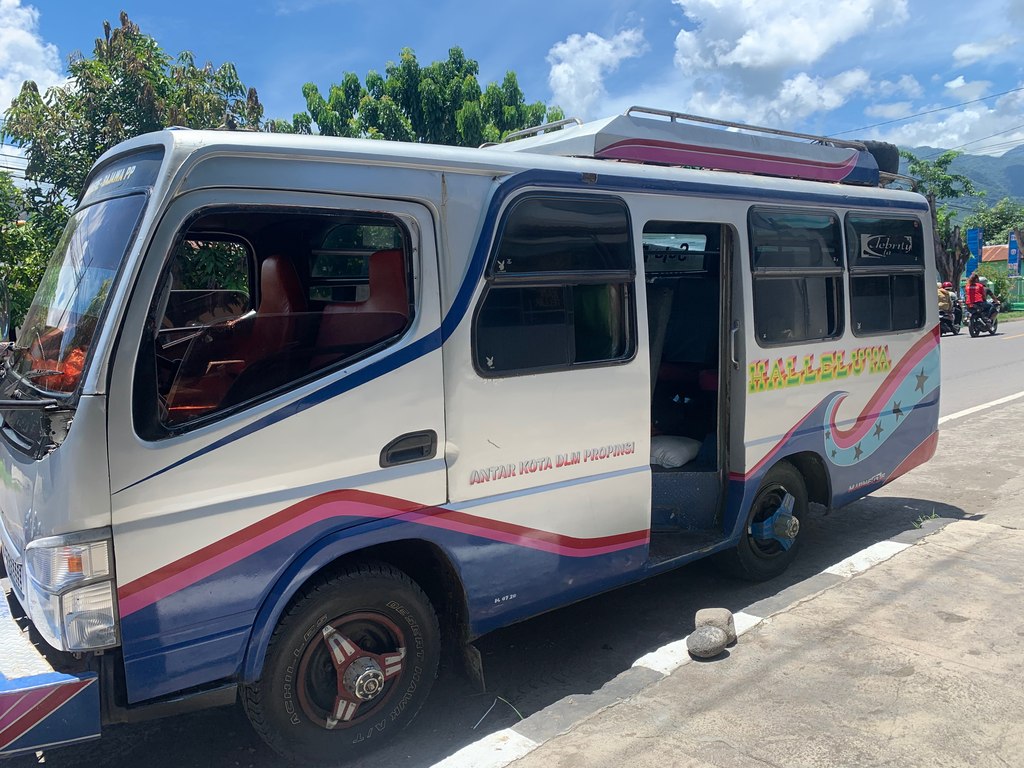
Six- and seven-seat minivans look like a shortcut and are usually the opposite. There is often no terminal and no schedule: the van collects passengers from their home addresses and leaves when it is full. My Probolinggo–Bali van picked me up three hours late, at night, already overloaded, then stopped repeatedly to drop passengers at their doors. The friend who took the VIP bus on the same route arrived earlier and rested.
If a minivan is the only option, ask two questions before paying: how many passengers, and does it drop people at individual addresses. The answers tell you what the night will be like.
Booking buses in Indonesia
Booking a long-distance bus in advance also lets you see what you are actually buying — operator, seat layout and departure time — instead of finding out at the terminal. 12Go lists most intercity operators with photos of the interior, which is the quickest way to tell a VIP bus from an economy one.
Renting a Car in Indonesia, With or Without a Driver
For exploring a single island, a car beats everything else — and in Indonesia the real question is not which car, but whether you drive it yourself.
Why a car with a driver usually wins
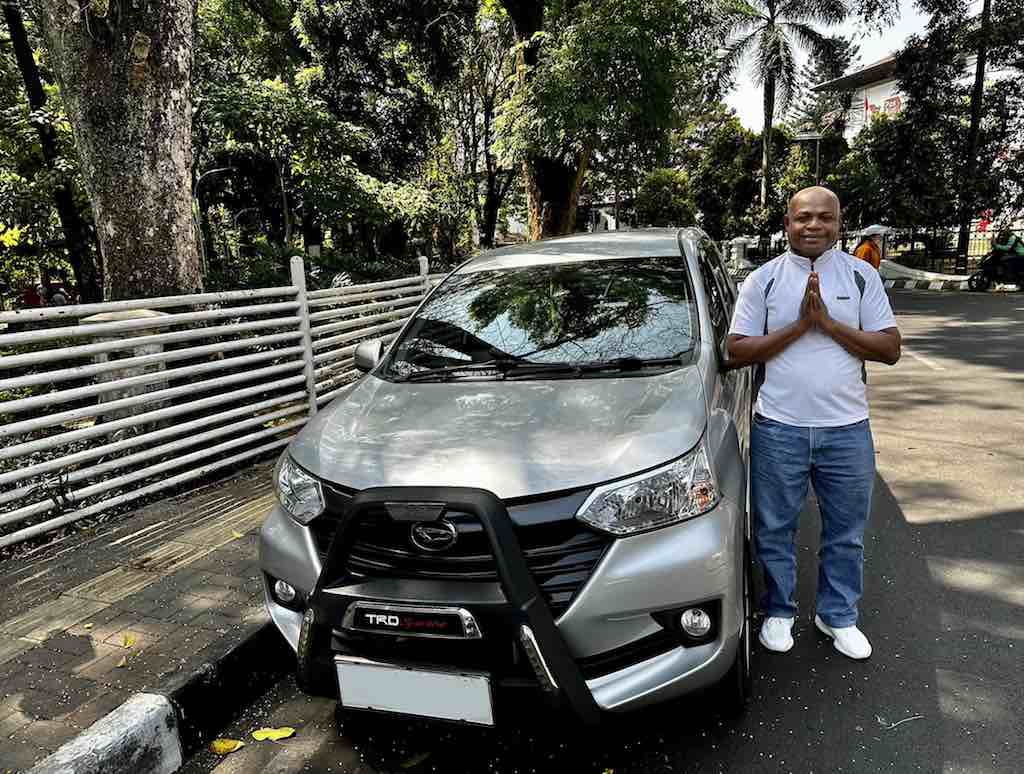
Hiring a car with a driver is the single best decision you can make for any journey over two hours, and it is the standard local option rather than a luxury. You are not paying only for the driving. You get someone who knows which road floods, which junction is gridlocked at 5 PM, where to stop for lunch and which viewpoint is worth the detour. On long Java or Sulawesi drives that knowledge is worth more than the car.
Expect roughly $40 to $60 a day for a car with a driver and fuel, depending on the island and the distances. If you want a recommendation for a reliable driver, message me and I will pass on a contact.
What self-drive really involves
Self-drive is possible and occasionally the right call — quiet islands, flexible schedules, early starts. But Indonesian traffic is genuinely demanding. Overtaking into oncoming traffic is routine, lane discipline is loose, and trucks will come at you in your own lane on a bend. If you have never driven in Southeast Asia, this is not the place to start.
Legally you need your home license as a physical card plus an International Driving Permit if you are not from an ASEAN country. Speed limits run 40–60 km/h in towns and 80–100 km/h on highways, seatbelts are compulsory and there is zero tolerance on alcohol.
Comparing car rental prices in Indonesia
If you do want to drive yourself, compare before you land rather than at the arrivals hall — airport desks at Ngurah Rai (DPS) and Soekarno-Hatta (CGK) are the most expensive way to rent. Compare car rental prices across Indonesia on DiscoverCars, which aggregates the international suppliers and the local ones in one search, with free cancellation. Rates start around $16 a day for a small car.
Two things to check on any rental: that the insurance excess is covered, and that the car is permitted on the ferry if you plan to cross between islands. Many rental agreements forbid it.
Motorbikes and Scooters in Indonesia
A scooter is how most of Indonesia gets around, and for short distances on the right island it is genuinely the best way to travel. It is also the way most travelers get hurt.
Where a scooter makes sense
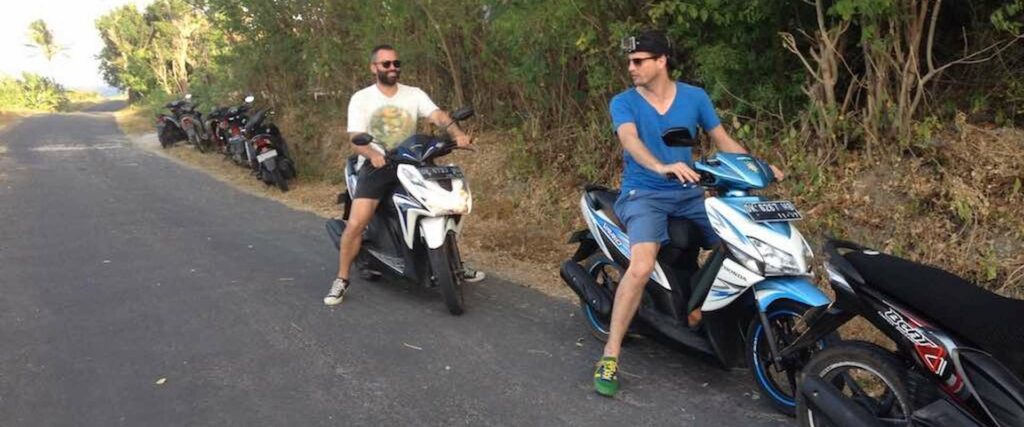
On Bali, Sumbawa, Sulawesi and Flores, roads are generally in good condition and a scooter gives you real freedom — beaches and viewpoints that no driver would think to stop at, on your own timing. Rental runs roughly $5 to $8 a day, less by the week. It works best for short hops; anything over an hour in heat and traffic stops being fun.
License, IDP and the insurance trap
The legal position is stricter than most rental shops suggest. If you are not from an ASEAN country you need an International Driving Permit alongside your physical home license — and crucially, the IDP must carry the motorcycle category. A car license does not entitle you to ride a scooter, in Indonesia or on your IDP.
This matters far beyond the roadside fine. Riding without the correct category can void both your rental insurance and your travel insurance, which turns a minor accident into a very expensive one. Get the IDP before you travel — it takes ten minutes at your national automobile association — and make sure the motorcycle box is ticked.
Scooter safety
Wear a helmet, every time, including for a two-minute ride. Avoid riding at night on unlit rural roads, keep to the left, and assume that anything larger than you will not give way. Check the brakes and tires before you leave the shop, and photograph any existing damage.
City Transport: Grab, Gojek and Taxis
In any Indonesian city, ride-hailing has replaced haggling. Grab and Gojek both run cars and motorbike taxis, show the price before you accept, and remove any negotiation. They are usually cheaper than a metered taxi and far cheaper than a hotel car.
Gojek also delivers food and parcels, which makes it the more useful of the two if you are staying anywhere for a while. Both accept foreign cards, and both work best if you install and register before you arrive — verifying a phone number is easier on home wi-fi than in an airport line.
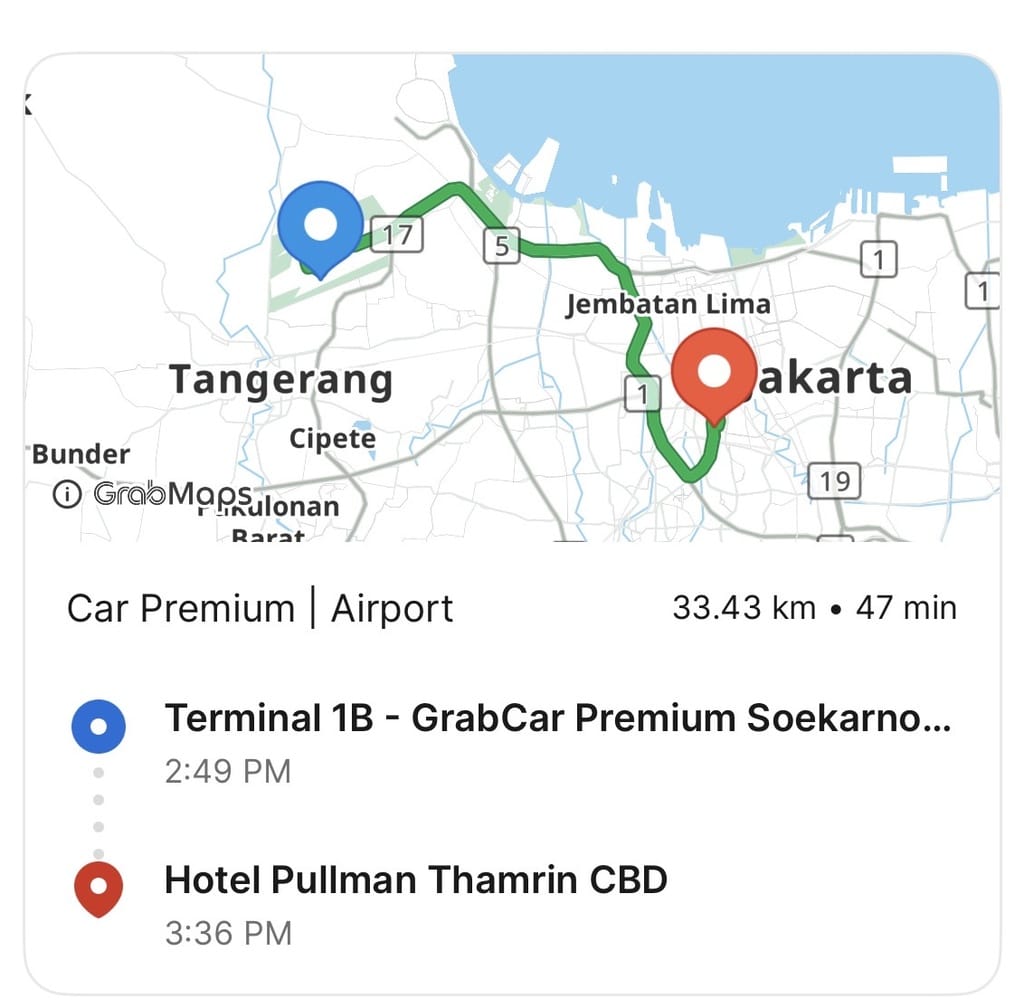
The saving on an airport transfer is where this shows up most clearly. A premium GrabCar from Terminal 1B at Soekarno-Hatta to a hotel in central Jakarta — 33 km, about 47 minutes in traffic — came to Rp 298,200, roughly $18. A hotel car for the same run typically costs two to three times that. A metered Blue Bird on the same run, on another morning, came to about Rp 200,000 including tolls; I compare all three options, train included, in getting from Jakarta airport to the city.
Where metered taxis are the better option — outside airports, or where ride-hailing pickups are restricted — Blue Bird is the one to look for. It is the most reliable operator in the country and I use it by preference. Insist the meter is running before you set off; if the driver proposes a fixed price instead, take a different taxi.
Jakarta is the one city with real public transport: an MRT line, an LRT, and the extensive TransJakarta bus rapid transit network, all cheap and all far faster than the traffic above ground during rush hour.
Bicycles are worth a mention for short distances. In Ubud on Bali or around Yogyakarta, renting a bike for a day is a genuinely pleasant way to see rice fields and villages at your own pace, and rental costs a couple of dollars.
Getting Around Each Main Indonesian Island
Each island has its own rhythm. Here is the short version — each of these destinations has, or will have, its own detailed guide.
Bali
No trains, no useful public transport, heavy traffic in the south. Scooters for short distances, Grab and Gojek in the towns, a car with a driver for day trips to the east or the north. Traffic between Canggu, Seminyak and Ubud is worse than the distances suggest — allow double what the map says. Bali has enough transport quirks to need its own guide, and it has one: how to get around Bali.
Java
The one island where you should build the trip around the train. Jakarta, Bandung, Yogyakarta, Solo, Surabaya and Banyuwangi are all on the network, and the Trans-Java toll road makes buses fast between them. Use a car with a driver only for the volcanoes — Mount Bromo and Ijen need pre-dawn starts no schedule will give you.
Lombok and the Gili Islands
Fast boats from Bali, or the slow ASDP ferry Padangbai–Lembar when the sea is rough. On Lombok itself, a scooter or a car with a driver; the island is bigger than it looks and the north takes time. On the Gili Islands there are no motor vehicles at all — you walk, cycle, or take a horse cart.
Flores and Komodo
Fly into Labuan Bajo or Maumere, then drive: the Trans-Flores highway is spectacular and slow, and a car with a driver is close to essential. Boats out of Labuan Bajo handle Komodo and the surrounding islands, from day trips to multi-day liveaboards.
Sulawesi
Fly into Makassar or Manado. The road north to Tana Toraja takes eight to nine hours by car or overnight bus, and the new Makassar–Parepare rail line only covers part of it. Distances on Sulawesi are consistently underestimated: the island’s shape means very few journeys are direct.
Sumba, Sumbawa and the far east
Fewer flights, fewer roads, more planning. Sumbawa is reached by ferry from Lombok or by air to Bima; Sumba by air from Bali or Kupang. For Raja Ampat, fly to Sorong and take the public ferry to Waisai. In all of these, hire a car and driver on arrival — self-drive on unfamiliar roads with no phone signal is not worth the saving.
How Long Journeys in Indonesia Actually Take
Realistic journey times
- Jakarta → Bandung — 45 min by Whoosh, 3 h by conventional train, 3–5 h by road
- Jakarta → Yogyakarta — 1 h by air, 7–8 h by train
- Yogyakarta → Surabaya — 4–5 h by train
- Bali → Lombok — 2 h by fast boat, 4–5 h by ASDP ferry plus transfers, 30 min by air
- Bali → Labuan Bajo (Flores) — 1 h 15 by air; there is no practical surface route
- Makassar → Tana Toraja — 8–9 h by road
- Surabaya → Makassar — 1 h 15 by air, 18–22 h by Pelni ferry
- Surabaya → Sorong (Papua) — 4 h by air, 4–5 days by Pelni ferry
Three routes that work
Two weeks, Java and Bali — fly into Jakarta, Whoosh to Bandung, train to Yogyakarta, train east to Probolinggo for Bromo, continue to Banyuwangi, ferry to Bali. Almost no flying, and the transport is half the experience.
Ten days, Bali and the islands east — Bali, fast boat to Lombok and the Gilis, fly to Labuan Bajo for Komodo, fly back. One flight in, one out, everything else short.
Two weeks, Sulawesi and diving — fly into Makassar, drive to Tana Toraja, back to Makassar, fly to Manado for the Bunaken reefs. See diving in Indonesia for how the dive regions connect.
The mistake almost everyone makes
Trying to see too many islands. Every island change costs the better part of a day once you count transfers, check-in and the drive at the far end. Three islands in two weeks is comfortable. Five is a transport itinerary with some sightseeing attached.
Practical Tips for Traveling Around Indonesia
Best time to travel
The dry season, roughly April to October, makes everything easier: fast boats run, mountain roads are passable, and flights are less disrupted. December to February brings heavy rain and rough seas, and sea crossings are the first casualty. Avoid traveling during Eid al-Fitr, when the entire country moves at once and every seat on every mode sells out weeks ahead.
Money and paying for transport
Flights, trains and booking platforms take foreign cards. Ferry terminals, local buses, scooter rental and rural transport are cash. Withdraw rupiah at bank ATMs rather than the standalone machines in tourist areas, which charge more and cap withdrawals lower.
Safety on the move
The real risks in Indonesian transport are road accidents and overloaded boats, not crime. Wear a helmet on any scooter, prefer daytime road travel where you can, and if a boat looks dangerously full, wait for the next one. Keep your passport with you rather than in checked luggage — it is required for ferry and train boarding.
Apps to install before you arrive
Grab and Gojek for city transport, Access by KAI for trains, Ferizy for ASDP ferries, and 12Go as the single English-language search across trains, buses, ferries and fast boats. Download offline maps too — signal disappears fast outside the main islands.
Booking Your Transport in Indonesia
Whatever the mode, booking ahead is what separates the good journeys from the bad ones. 12Go is the most reliable platform across Southeast Asia and the simplest option for visitors: it compares prices, schedules and operators for trains, buses, ferries and fast boats in one place, takes international cards, and issues a digital ticket. For car rental, DiscoverCars compares local and international suppliers with free cancellation.

Read More About Indonesia
How to Get to Indonesia
International routes, entry requirements and visa on arrival — everything you need before the flights inside the country. Read more
Getting Around Bali
Scooters, drivers, ride-hailing and the traffic nobody warns you about — the detailed guide to moving around Bali. Read more

Nusa Penida Travel Guide
Discover where to stay in Nusa Penida, the island’s most beautiful beaches, top viewpoints, manta ray snorkeling, practical travel tips, and detailed itineraries to plan the perfect trip. Read more
Frequently Asked Questions About Getting Around Indonesia
What is the best way to get around Indonesia?
Fly between islands and use a car with a driver within them. Domestic flights are the only practical way to cover long distances across the archipelago, and a hired car with a driver is the most efficient way to explore any single island. Trains only make sense on Java, and ferries are the cheap alternative when you have time to spare.
Is it easy to travel around Indonesia independently?
Yes, with planning. Booking apps are in English, take foreign cards and cover most routes, and English is widely understood in tourist areas. The difficulty is not language but distance — journeys take longer than the map suggests, and connections between islands rarely line up neatly.
Do I need an International Driving Permit in Indonesia?
Yes, if you are not from an ASEAN country. You need your physical home license plus an International Driving Permit, and for a scooter the IDP must include the motorcycle category — a car license is not enough. Riding without the correct category can void both your rental and your travel insurance.
How much does it cost to get around Indonesia?
Far less than most of Asia. A domestic flight typically runs $45–$80, a train across Java $10–$30 depending on class, a car with driver $40–$60 a day, a scooter $5–$8 a day, and a ferry crossing a few dollars. Transport is rarely the biggest line in an Indonesian travel budget.
Are there trains in Indonesia?
Yes, but almost entirely on Java. Java has a dense network linking Jakarta, Bandung, Yogyakarta, Solo, Surabaya and Banyuwangi, plus the Whoosh high-speed line to Bandung. Sumatra has four disconnected regional lines and South Sulawesi has one short new line. Bali, Lombok, Flores and the eastern islands have no passenger rail.
Can you take a ferry between all the Indonesian islands?
Between most of them, yes. ASDP runs the short crossings, Pelni connects more than 95 ports on long-haul rotations of two to four weeks, and private fast boats cover the tourist routes. Some remote islands are only served every few weeks, so check the rotation before relying on one.
Do I need to book Indonesian ferries in advance?
For ASDP crossings, yes — online booking through the Ferizy platform is now compulsory at the main ports and you cannot simply pay cash at the window. Fast boats and Pelni can often be booked on the day outside peak periods, but holiday weeks sell out.
Is Grab or Gojek better in Indonesia?
Install both. Prices and availability vary by city and time of day, and having both means you always have a ride. Gojek is the more useful of the two if you are staying somewhere for a while, because it also handles food and parcel delivery.
Is it safe to fly with Indonesian domestic airlines?
Yes. Indonesia’s major carriers meet international standards and the country’s airlines have been cleared for European airspace since 2018. The realistic frustration is delays, not safety — assume an hour of slippage and never book a tight same-day connection on separate tickets.
How many islands should I visit in two weeks?
Three at most. Each island change costs the better part of a day once transfers, check-in and the onward drive are counted. Two islands explored properly beats five glimpsed from a departure lounge.
What is the cheapest way to travel around Indonesia?
Ferries and economy-class trains. A Pelni economy berth from Surabaya to Makassar costs around IDR 250,000–350,000 for an 18–22 hour crossing, roughly a tenth of the airfare. Economy trains on Java and local buses are similarly cheap; the trade-off is always time and comfort.
When is the worst time to travel around Indonesia?
Eid al-Fitr, by a wide margin. The whole country travels at once and flights, trains, buses and ferries sell out weeks ahead at inflated prices. December to February is the second worst, when heavy rain and rough seas disrupt fast boats and mountain roads.
Hey! I would like to travel from indonesia to malaysia by ferry. I already heats about a ferry from jakarta to singapore and than to malaysia bit couldn‘t find anything in the pelni app, at 12goasia or at easybook. I just found your website and your information sounds like you could help me with my problem. So do you know a way to travel from indonesia to malaysia? It doesn‘t matter from which city to which one in malaysia. I just don‘t want to fly so I‘m looking for another option. Looking forwward to hearing from you! Enjoy your day!
Sonja
Hello Sonja,
There are several options to take a ferry from Indonesia. You can for example take a ferry from Dumai in Sumatra to Malacca (Melaka) with the ferry company indomal fast ferry (https://www.indomalfastferry.com/). There is one ferry every day that takes 3h30 to cross the Malacca straight. There are options from Jakarta (Port of Tanjung Priok) to Singapore through Tanjung Balai Karimun but it will be very long (more than 2 days). Feel free to ask if you have more questions about how to travel in Indonesia.
Blaise