What to Do on a Layover in Singapore, from Changi to Marina Bay
By Blaise Jaeger · Updated August 27, 2026
Singapore is the layover that people actually look forward to. The city-state covers just 700 km² — about a tenth of Bali — yet Changi handles more connections between Europe, Australia and Southeast Asia than almost anywhere else, which means millions of travellers a year land here with somewhere between three hours and a full night to fill.
I have counted 34 trips through Changi, and I still find the same thing every time: the question is never what is there to do in Singapore. It is how much can I fit into the hours I have without missing my flight. That is what this guide answers first, and it is the part most articles skip.
So we start at the airport, with what you can do without leaving the transit area and what changes the moment you clear immigration. Then the city itself — Marina Bay, Gardens by the Bay, Chinatown, Sentosa — because if you have the hours, Singapore rewards them. And we finish where we started, with the arithmetic of layover lengths: what is genuinely possible in 4, 6, 8 or 12 hours, and when you should simply stay air-side and enjoy the butterfly garden.
Singapore Layover at a Glance
| Airport | Changi (SIN), four terminals plus Jewel |
| Airport to Marina Bay | About 50 minutes by MRT, about 30 minutes by taxi |
| Minimum layover to leave | Around 5 hours to see Jewel comfortably, 5.5 hours for the free city tour |
| Entry formalities | SG Arrival Card, free, within 3 days of arrival — not required if you stay air-side |
| Visa | Not required for EU, UK, US and most Western passports |
| Free at the airport | Butterfly Garden, movie theatre, cactus garden, snooze lounges — all 24 hours |
| Paid at the airport | Rooftop pool 25 S$, shower 20 S$ in the transit lounge, baggage storage from 6 S$ |
| Currency | Singapore dollar (S$). Contactless cards work on the MRT and almost everywhere else |
| Language | English is an official language and is spoken everywhere |
Thirty-Four Trips Through Changi
I have been coming to Singapore since the early 2010s, at first for work — in July 2012 I spent a week here leading a group of senior executives from a French industrial group — and now two or three times a year since I moved to Bali. I have counted 34 trips through Changi.
My pattern is almost always the same. Heading to Europe, I have a few hours to kill before a night flight to Paris, so I spend them in transit or over at Jewel. Coming back, I stay with family in Singapore and take an afternoon flight to Bali the following day. That rhythm — a few hours out, a night in — is why I know the transit side of this airport far better than I know its hotels.
Some of those trips were not layovers at all. I flew up from Bali specifically to see Coldplay at the Singapore Indoor Stadium on 31 January 2024, and again for the Grand Prix on 22 September 2024, which I watched with my cousin. On 30 May 2024 I did the free city tour that Changi runs for transit passengers, and I am probably one of the few people writing about it who has actually sat in the minibus. I was in Chinatown on Chinese New Year’s Eve in 2024, which is where I finally tried durian — and not just any durian, the Musang King.
None of that makes me a Singapore resident, and I will not pretend otherwise. What it does mean is that everything below has been walked, ridden, queued for or eaten, and that when I tell you five hours is not enough for something, it is because I have tried it with five hours.
Singapore Changi Airport
Changi is routinely ranked among the best airports in the world, and it deserves it. It is close to being a small city: hotels, a rooftop pool, a movie theatre, a butterfly garden, gardens on several floors, and duty-free on a scale that borders on absurd. The four terminals are linked by a free Skytrain that runs both air-side and land-side from 5:00 AM to 2:00 AM, and when it stops, the walkways between T1, T2 and T3 stay open around the clock.
What You Can Do Without Leaving the Transit Area
If your layover is under four hours, do not fight it: stay air-side. You lose nothing, and Changi has more to offer inside the security zone than most airports have in total.
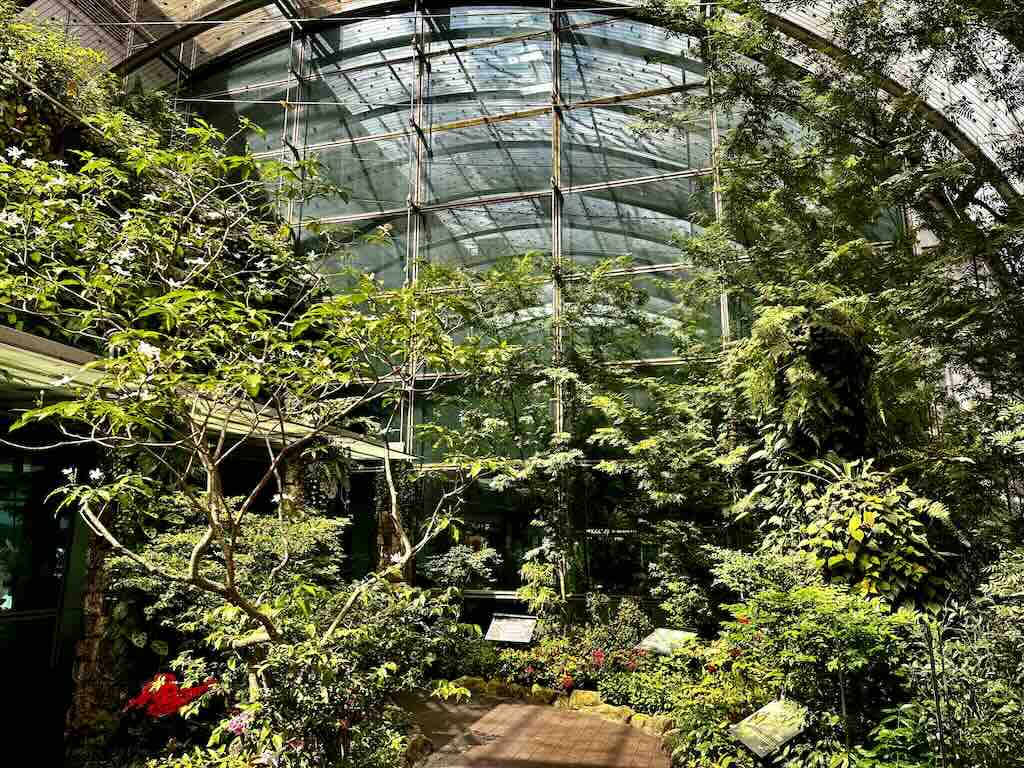
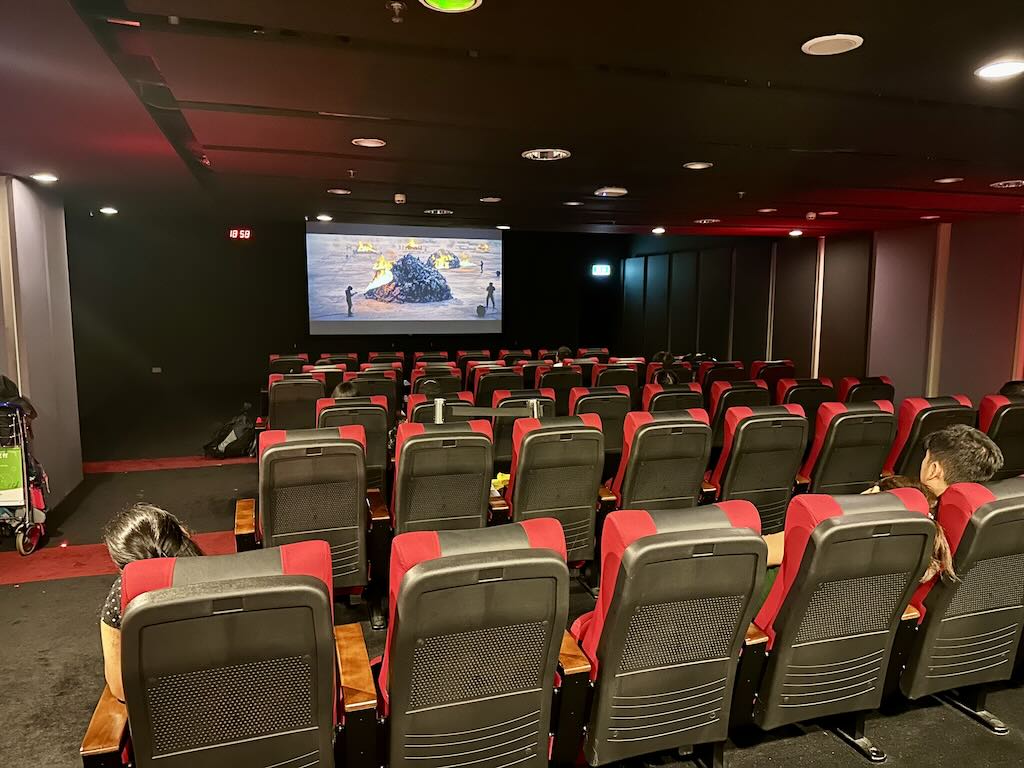
Free, and open 24 hours. The Butterfly Garden in Terminal 3 (levels 2 and 3) holds more than a thousand butterflies across some forty species, around a six-metre grotto waterfall — it was the first butterfly garden in any airport in the world. The movie theatre, also in T3 on level 3 next to the transit hotel, seats about fifty and screens films in English or with English subtitles; you can bring food and drink in. The Cactus Garden is on the T1 rooftop, level 3, with a bar attached. T2 has the Sunflower Garden and the Enchanted Garden. And every terminal has snooze lounges — proper reclining seats with power sockets, free, open to every passenger regardless of airline or class.
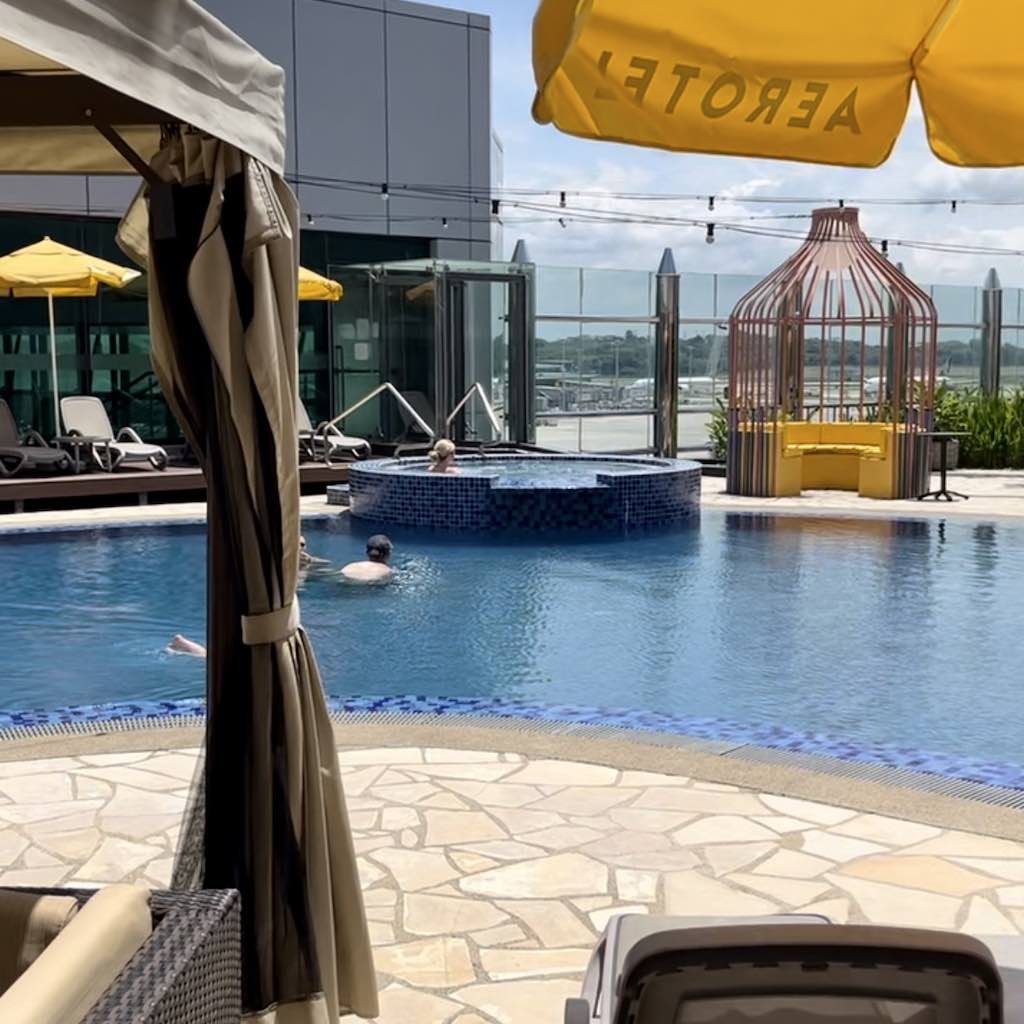
Worth paying for. The rooftop pool and jacuzzi in Terminal 1 transit, near the D gates, costs 25 S$ for adults and opens from 10:00 AM to 10:00 PM — towels and showers included, and it is free if you are staying at the transit hotel. If you only want to feel human again, the Ambassador Transit Lounge in T2 and T3 sells a shower on its own for 20 S$, or three hours in the lounge for 55 S$. Baggage storage runs 24 hours in every terminal, from 6 S$ per 24 hours for loose items to 16 S$ for a large bag.
Immigration and the SG Arrival Card
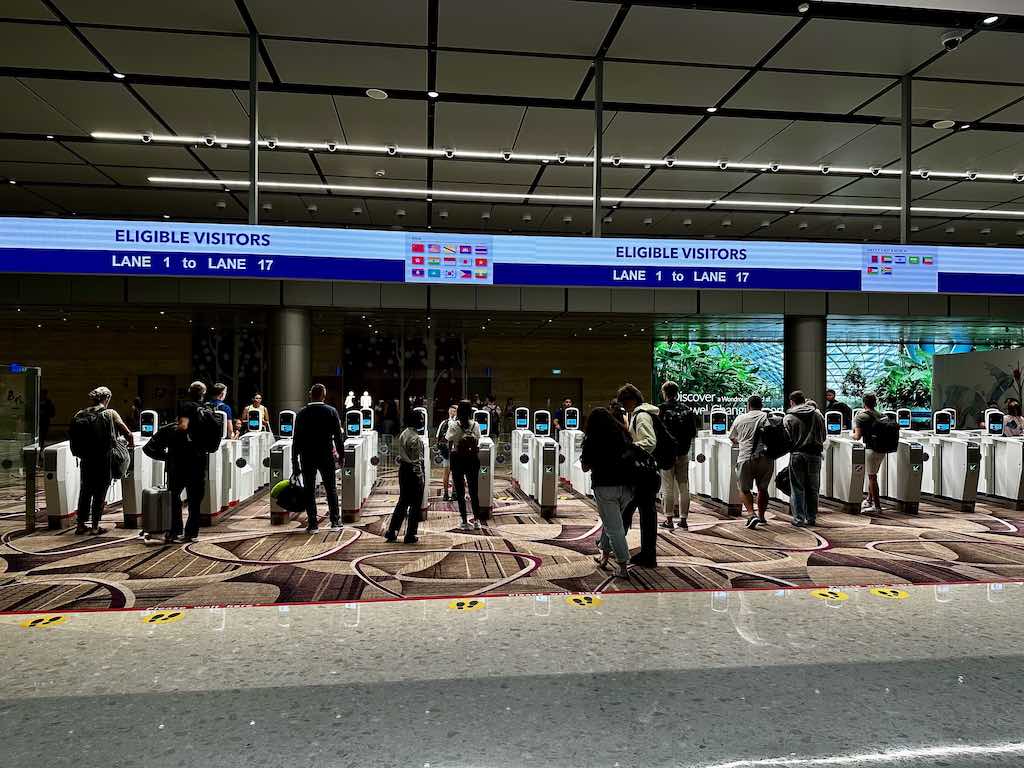
Clearing immigration at Changi is genuinely fast. Dozens of automated lanes in each terminal read biometric passports directly — iris, face and fingerprints — and they are open to every foreign visitor from the age of six, with no prior enrolment. Take off sunglasses, caps and masks and it takes minutes, in either direction.
Before you arrive you need to file the SG Arrival Card. It is free, it takes a few minutes, and it can only be submitted within the three days before arrival, the day of arrival included. File it on the official ICA site or through the MyICA Mobile app — and ignore the commercial sites that offer to do it for you for a fee. The ICA states plainly that it neither endorses nor is affiliated with any of them, and Singapore’s High Commission in London calls them scam websites outright.
If you stay air-side, you do not need it at all. Passengers transiting without seeking immigration clearance are exempt. EU, UK, US and most Western passports need no visa; the period of stay is not fixed in advance but decided by the officer and printed on your e-Pass, which is comfortably more than any layover requires. Your passport must be valid for at least six months.
Jewel Changi Airport
Jewel is not a shopping centre with a waterfall in it. It is a destination in its own right, and it is the single best reason to clear immigration on a medium-length layover.
And that is the catch nobody tells you: Jewel is land-side. If you are transiting, you must clear arrival immigration to reach it — file the SG Arrival Card, go through passport control, then come back through security and immigration afterwards. Changi says so explicitly. Half the travel blogs describing Jewel as a way to kill a two-hour transit have simply never checked.
The Rain Vortex
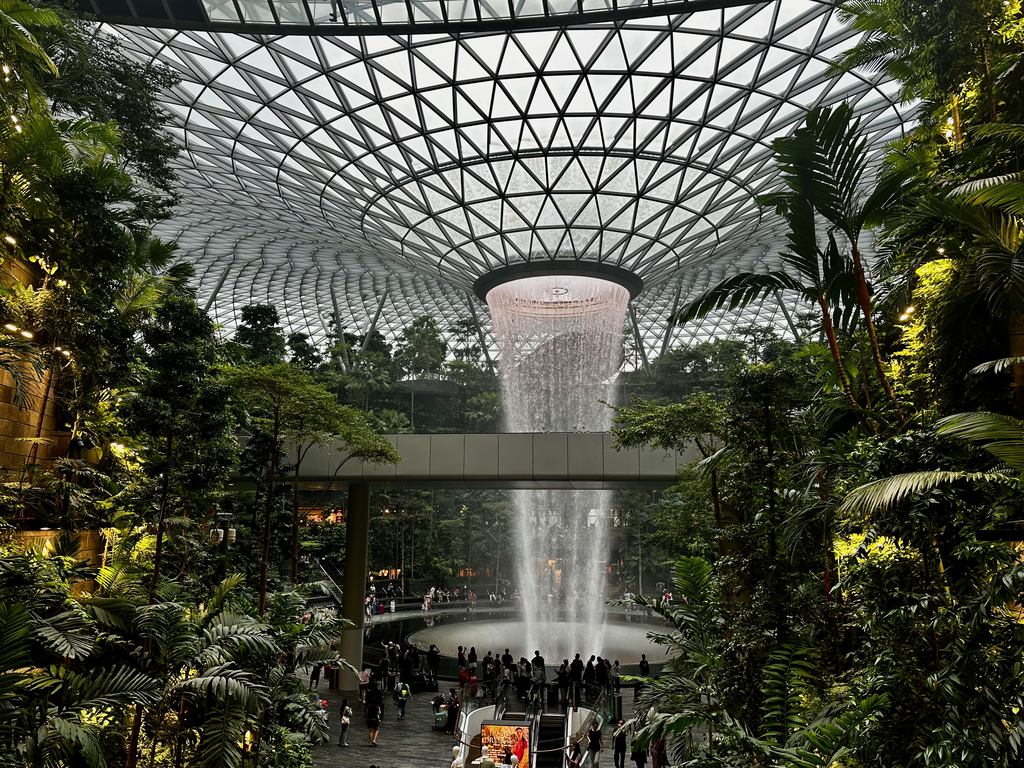
The Rain Vortex falls 40 metres through seven storeys, from the oculus in the glass roof down to the basement, and it is the tallest indoor waterfall in the world. It runs from 10:00 AM to 10:00 PM, and it is free — you watch it from the walkways of Forest Valley, the indoor garden wrapped around it.
After dark there is a light and music show at 7:30 PM, 8:00 PM and 9:00 PM every night, with a fourth showing at 10:00 PM on Fridays, weekends, public holidays and their eves. If your flight allows it, that is the version to see.
Canopy Park and the Rest of Jewel
Level 5 holds Canopy Park, which costs 8 S$ and includes the Discovery Slides, the Foggy Bowls, the Petal Garden and the Topiary Walk. The Canopy Bridge, the hedge and mirror mazes and the bouncing net are extra on top. It opens at 10:00 AM and closes at 9:00 PM Monday to Thursday, 10:00 PM from Friday to Sunday, with last admission half an hour before. Your ticket allows same-day re-entry.
Jewel connects to the arrivals hall of Terminal 1 directly, and to T2 and T3 by covered walkways in five to ten minutes. From T4, take the free shuttle. There is paid baggage storage on level 1, which matters if you are carrying cabin bags around.
Jewel itself recommends at least five hours of layover before attempting it, and reminds you to be back for check-in two hours before departure. I would treat both as minimums, not targets.
Eating at Jewel
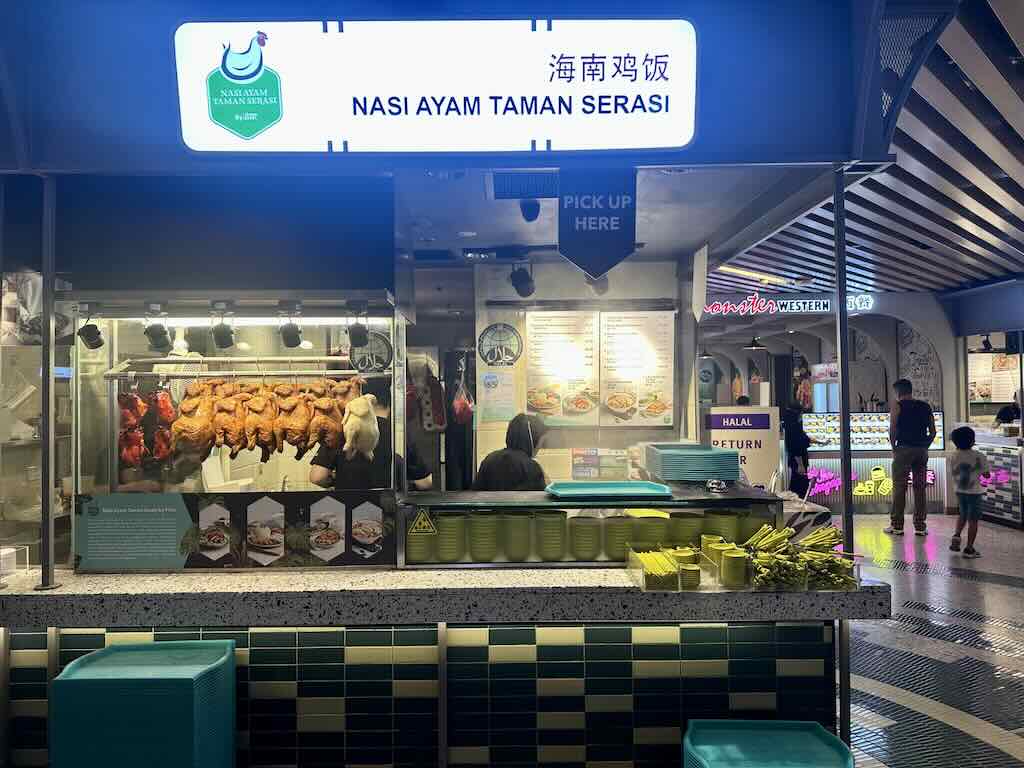
There are more than 280 shops and a great many places to eat, from international chains to Singaporean food stalls. Two habits of mine, for what they are worth. I like a drink on the top level, in one of the cafés that look straight down into the waterfall — you can watch the little train shuttling between terminals while you sit there. And I go down to the basement food court for chicken rice at Nasi Ayam Taman Serasi, which is the meal I have eaten more often in this airport than any other.
The Free Singapore Tour
Changi runs free guided tours of the city for transit passengers. Not discounted — free. It is one of the most generous things any airport does anywhere, and it is chronically under-used because people do not know the conditions.
The Four Tours
There are four circuits, each lasting 2.5 hours: the Heritage and Culture Tour, the City Sights Tour, the Singapore River and Marina Bay Sands Tour, and the Sentosa Discovery Tour, which was added in July 2025. Seven departures run through the day, from 10:00 AM to 7:00 PM.
City Sights takes you around Marina Bay with a stop at the Merlion and another at Gardens by the Bay. The Heritage tour covers Chinatown and Kampong Gelam, passing Marina Bay, the business district and the Singapore River. Sentosa Discovery crosses to the island.
How to Sign Up
Your layover must be between 5.5 and 24 hours. In practice, budget six: each departure requires you to report 90 minutes beforehand, and your onward flight must leave at least two hours after the bus returns.
The counters are in the Departure Transit Hall of Terminals 2 and 3 — T2 on level 2 near gate F50, T3 on level 2 near gates A1 to A8 — open from 8:00 AM to 7:00 PM. You can book online up to 50 days ahead, one tour per person, or take your chances on the spot; places go first come, first served. Your checked bags must be tagged through to your final destination, and you have to clear arrival immigration to join.
What It Is Actually Like
I did the City Sights tour on 30 May 2024, and my honest verdict is this: it is excellent if you have a genuinely long layover and want someone else to handle everything, and it is free — but the front end is more demanding than people expect.
You have to get there early to register. You have to put everything in baggage storage, because you are not allowed to take cabin bags, wheeled luggage, alcohol or duty-free purchases with you; only your electronics stay with you. That is time and faff before you have gone anywhere. But once you are on the minibus, and right through to the moment it drops you back, it is completely effortless.
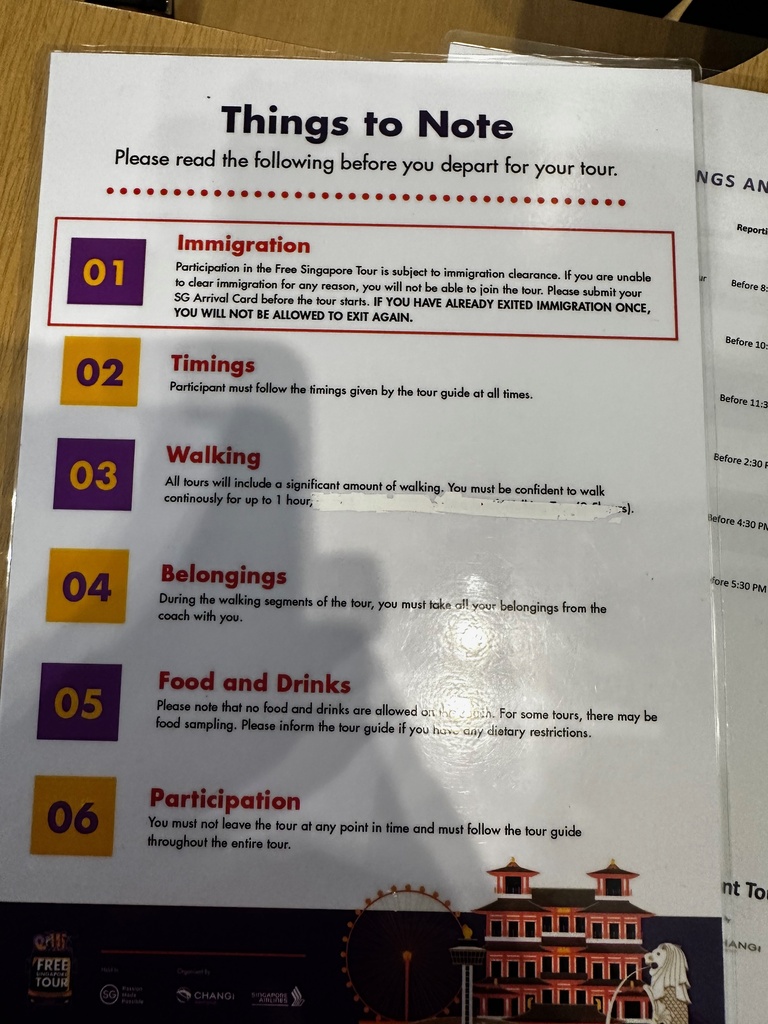
One rule on the briefing sheet deserves to be in bold, because I have never seen it written anywhere else: if you have already exited immigration once, you will not be allowed to exit again. So you cannot pop out to Jewel and then join a tour later in the same layover. Choose one. You are also asked to file your SG Arrival Card before the tour departs, not when you get to the counter.
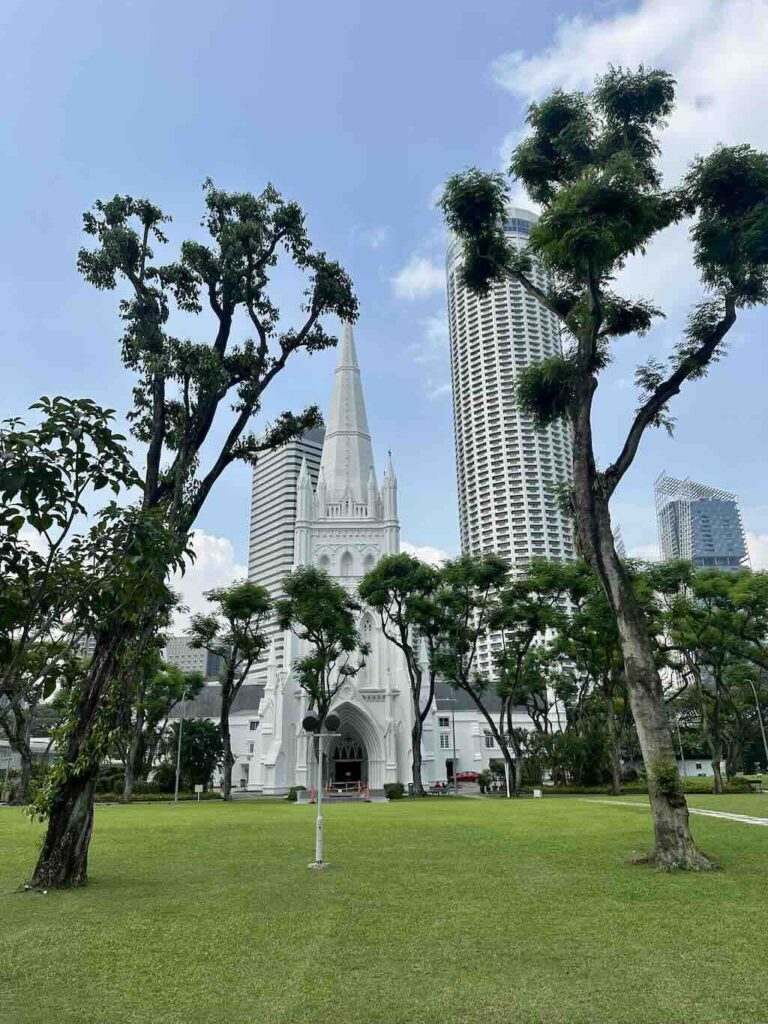
What to See in Singapore
If your layover runs long, or you are staying a night or more, this is where Singapore stops being an airport and starts being a city. What follows is ordered by how much it repays a short visit.
Marina Bay Sands
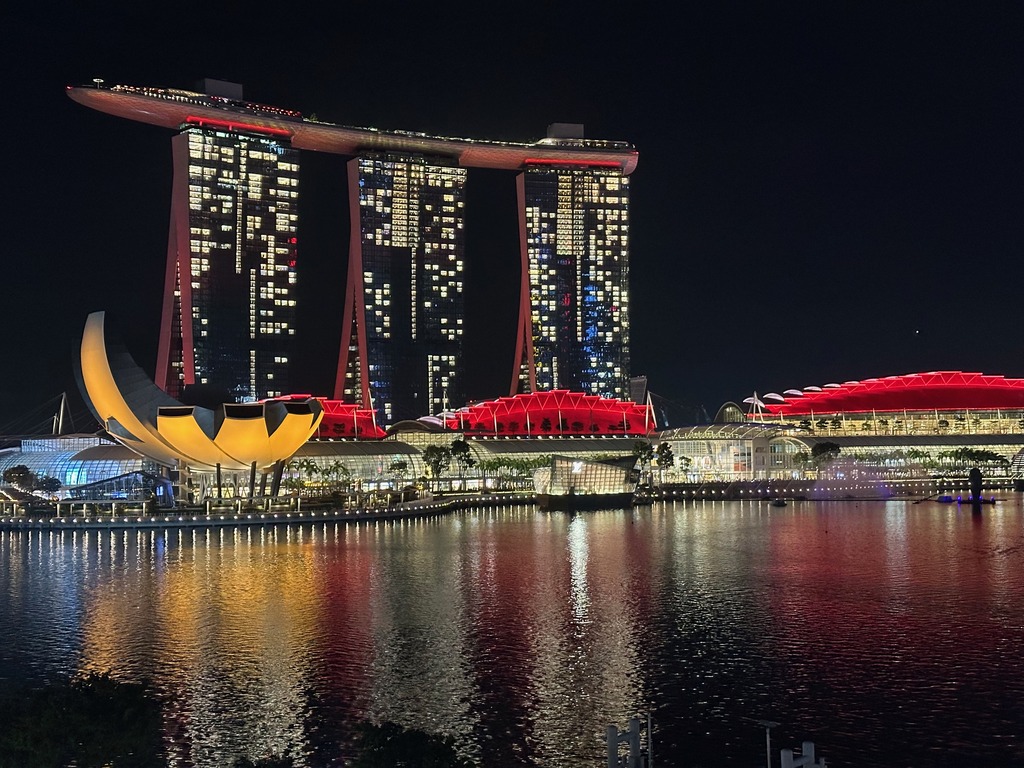
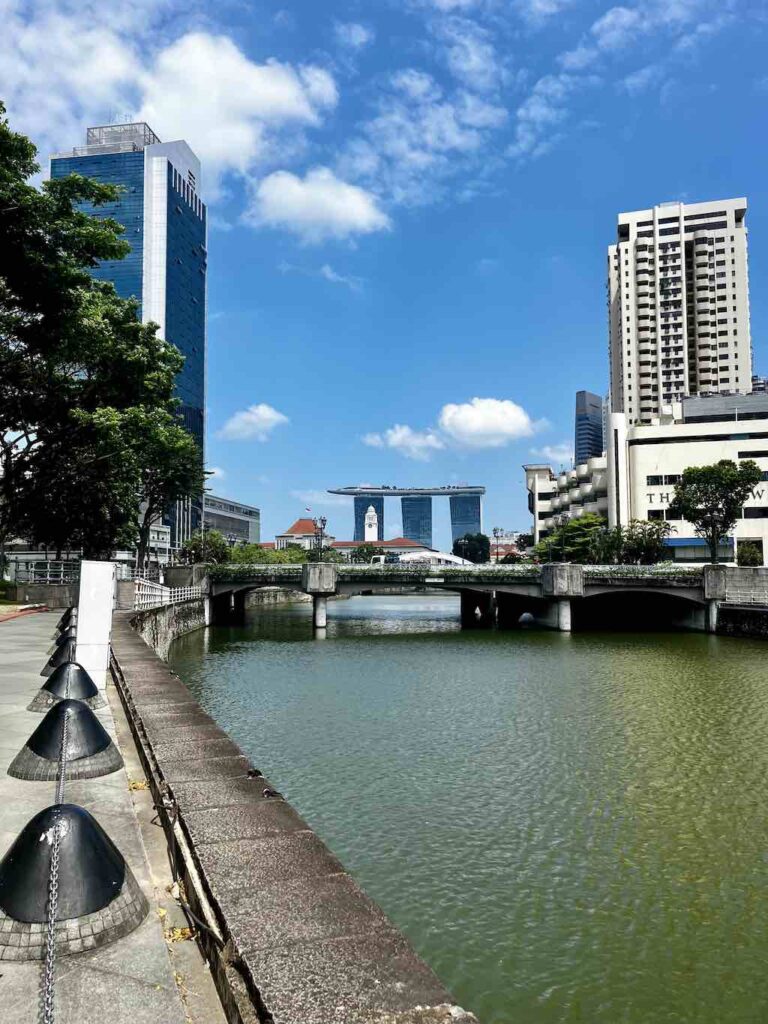
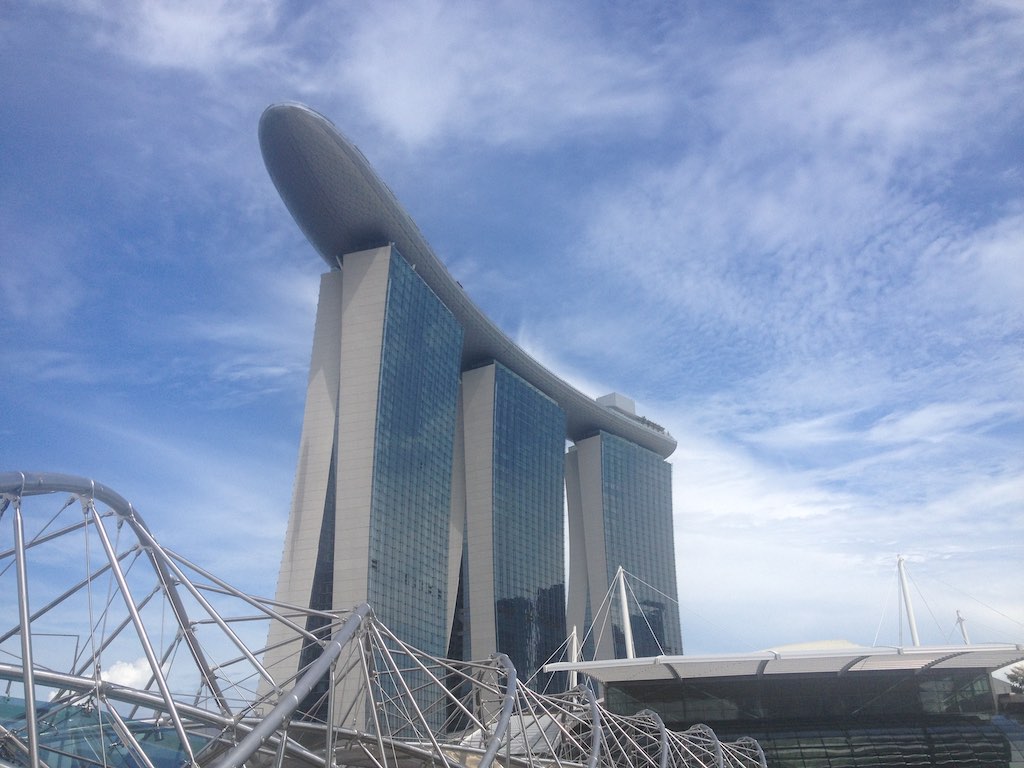
If you only have one afternoon, walk around Marina Bay. The hotel has become the icon of the city the way the Eiffel Tower is the icon of Paris: three 55-storey towers carrying a boat-shaped terrace, the Sands SkyPark.
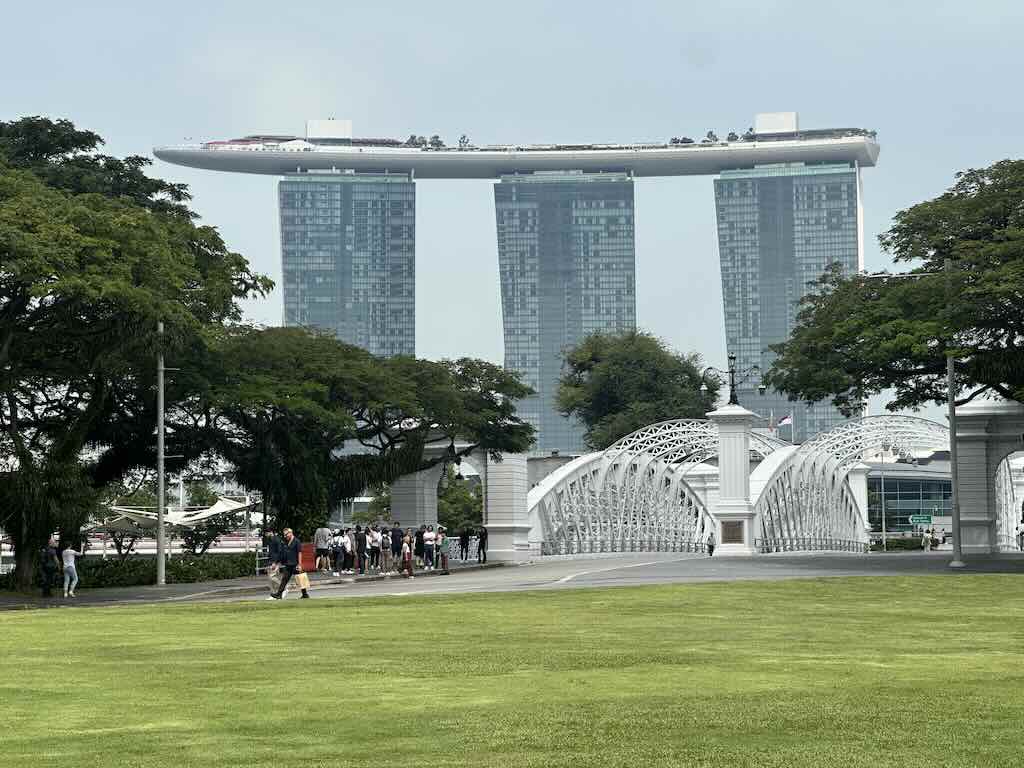
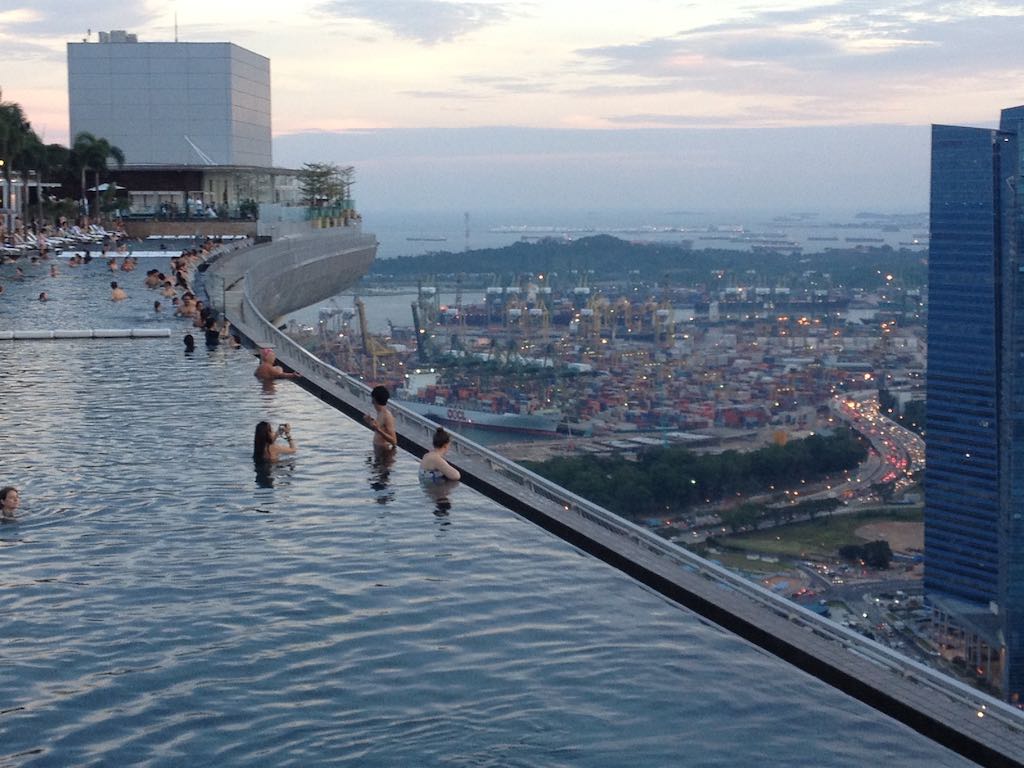
The terrace holds the longest rooftop infinity pool in the world — 150 metres of it, 200 metres up — but the pool is for hotel guests only. Everyone else can still go up for the view, with a drink or a meal in one of the bars and restaurants on the roof. The hotel has over 2,500 rooms and they are not cheap.
Gardens by the Bay
Right beside Marina Bay Sands, Gardens by the Bay covers more than 100 hectares and holds close to 20,000 plant species. Walking into the gardens is free, including the Supertree Grove — you only pay for the conservatories and the elevated walkway.
The combined ticket for the Flower Dome and Cloud Forest is 46 S$ for adults and 32 S$ for children, and since May 2025 the Cloud Forest ticket also includes Jurassic World: The Experience. The OCBC Skyway, a 128-metre walkway strung 22 metres up between two Supertrees, is 14 S$ and takes about fifteen minutes. Both conservatories open 9:00 AM to 9:00 PM; last admission to the Cloud Forest is 8:00 PM, an hour before it closes. Entry tickets can be booked ahead here, which is worth doing at weekends.
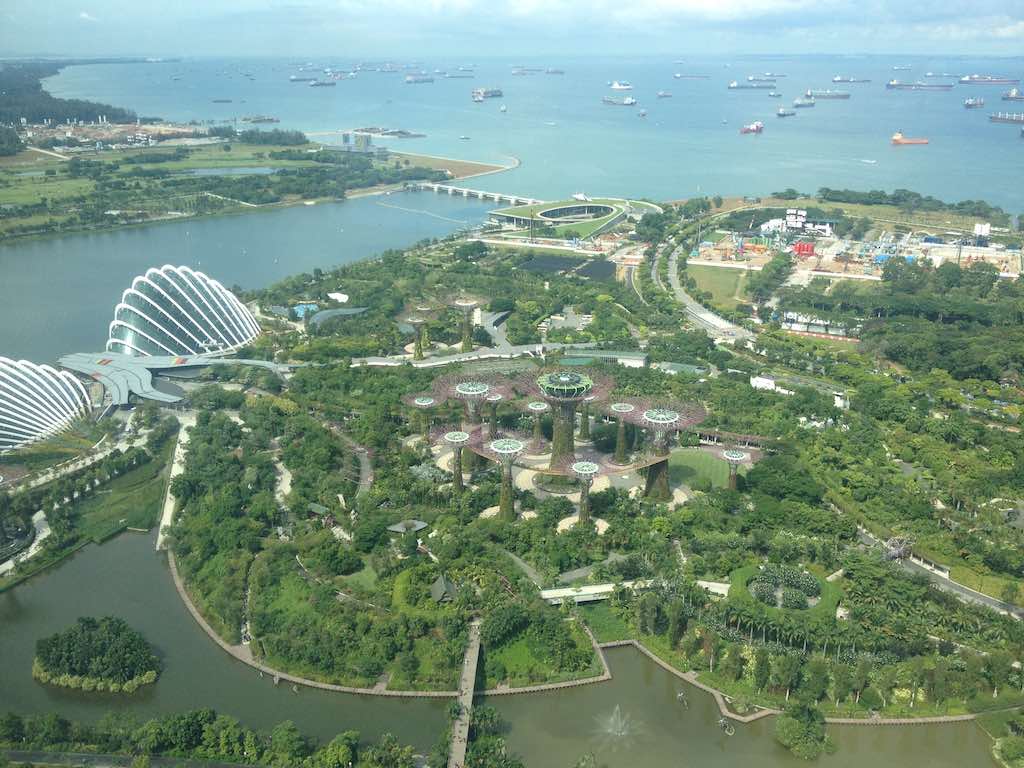
The best thing here costs nothing. Garden Rhapsody, the sound and light show in the Supertree Grove, runs twice a night at 7:45 PM and 8:45 PM, is free, and is the single strongest argument for leaving the airport on an evening layover. The outdoor gardens stay open until 2:00 AM; the Supertree lights go out at 11:30 PM.
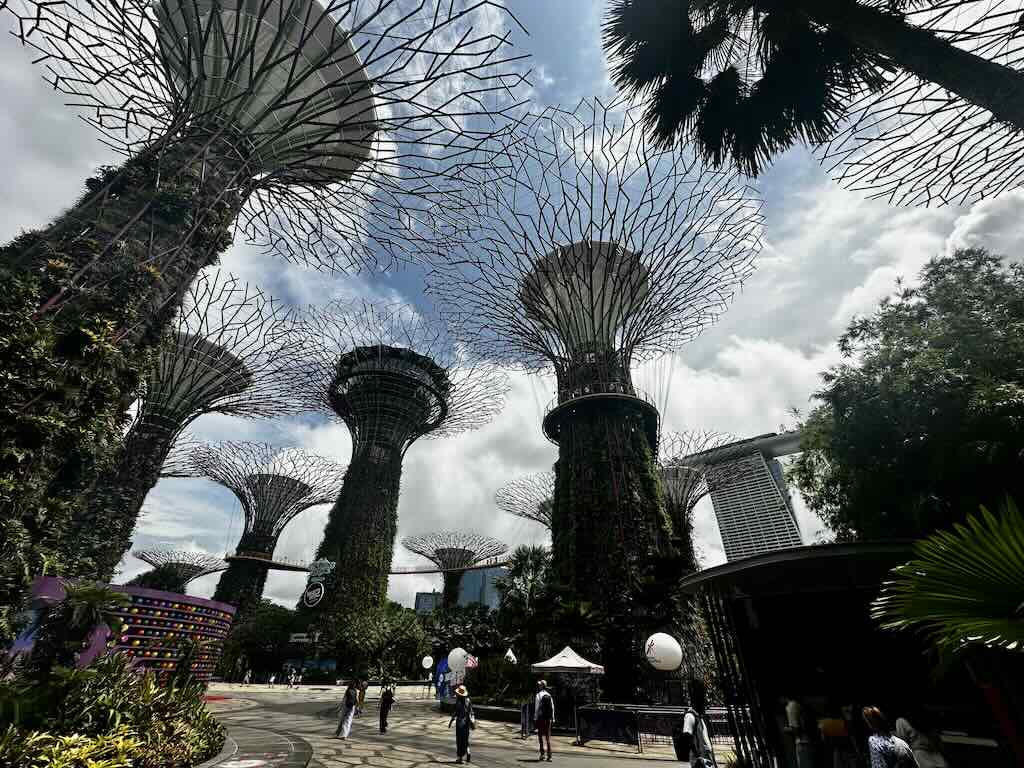
One thing to check before you go: one conservatory closes for maintenance each month, never both at once. The dates are published on the Gardens by the Bay site.
The Merlion
Half fish, half lion, the Merlion has been the emblem of Singapore since 1964. The lion’s head refers to the animal Prince Sang Nila Utama is said to have seen when he came upon the island in the eleventh century; the fish tail refers to its fishing past, when it was called Temasek. Sang Nila renamed it Singapura — the Lion City, from singa and pura in Sanskrit.
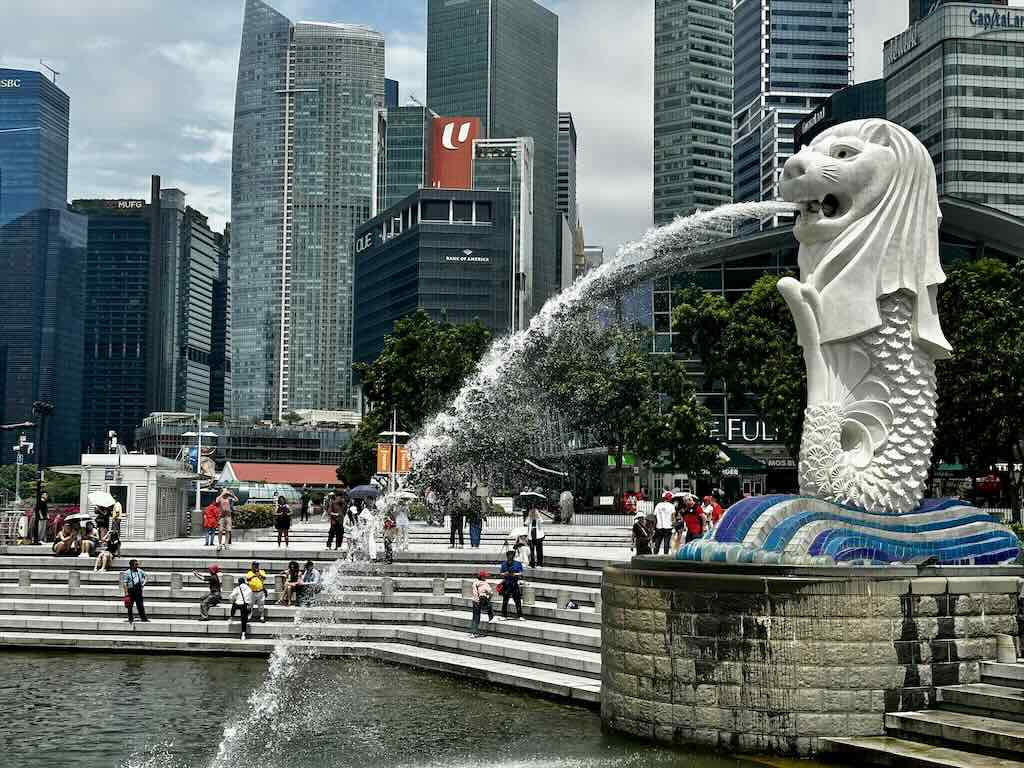
Frankly, the statue itself is unremarkable. What it gives you is the view: Marina Bay Sands on one side, the towers of the financial district on the other. It also works as the start of a walk up to Clarke Quay, or towards the museums — the National Gallery is my favourite, and its temporary contemporary exhibitions are usually worth the detour.
Chinatown
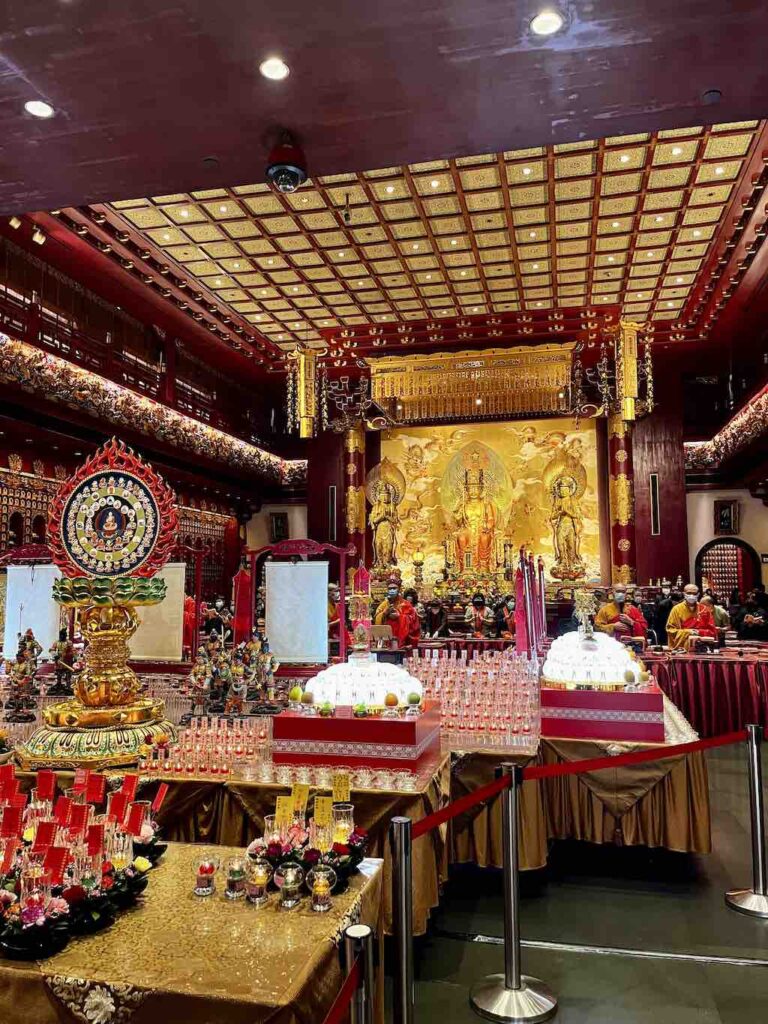
Walking into Chinatown after the skyscrapers of Marina Bay feels like changing countries. Shophouses, temples, fruit stalls, small restaurants, and the Buddha Tooth Relic Temple anchoring the whole quarter. It is compact enough to see properly in ninety minutes, which makes it the best single neighbourhood for a short visit.
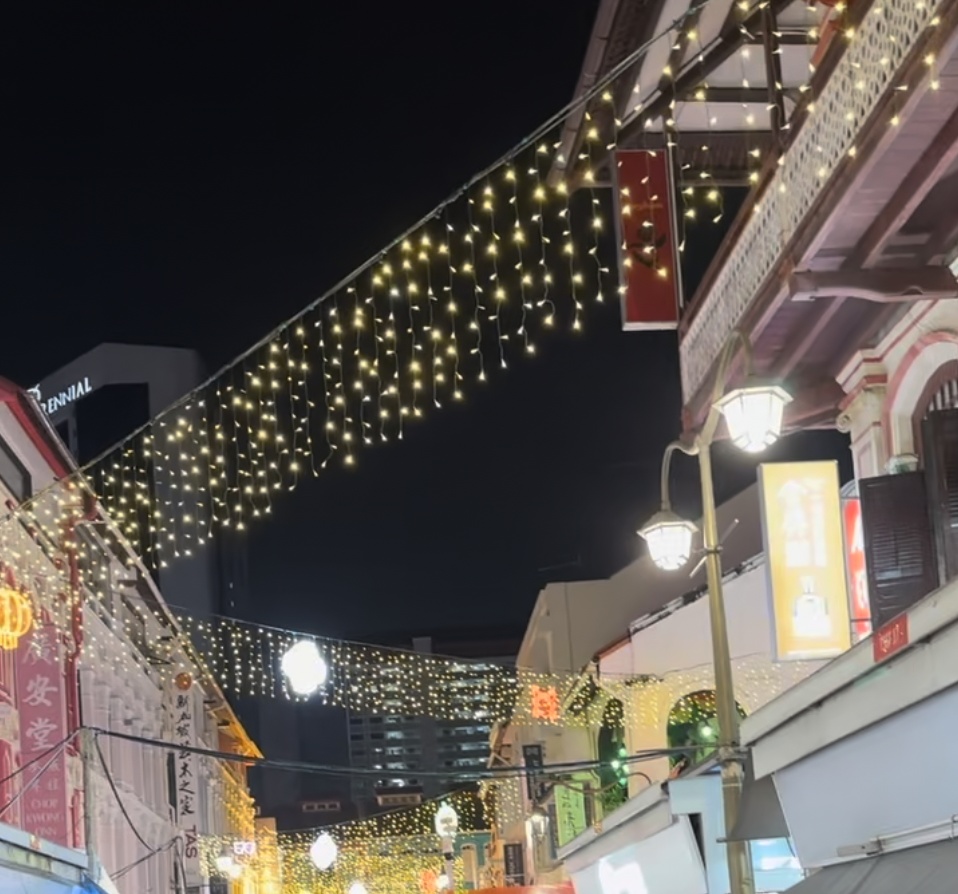
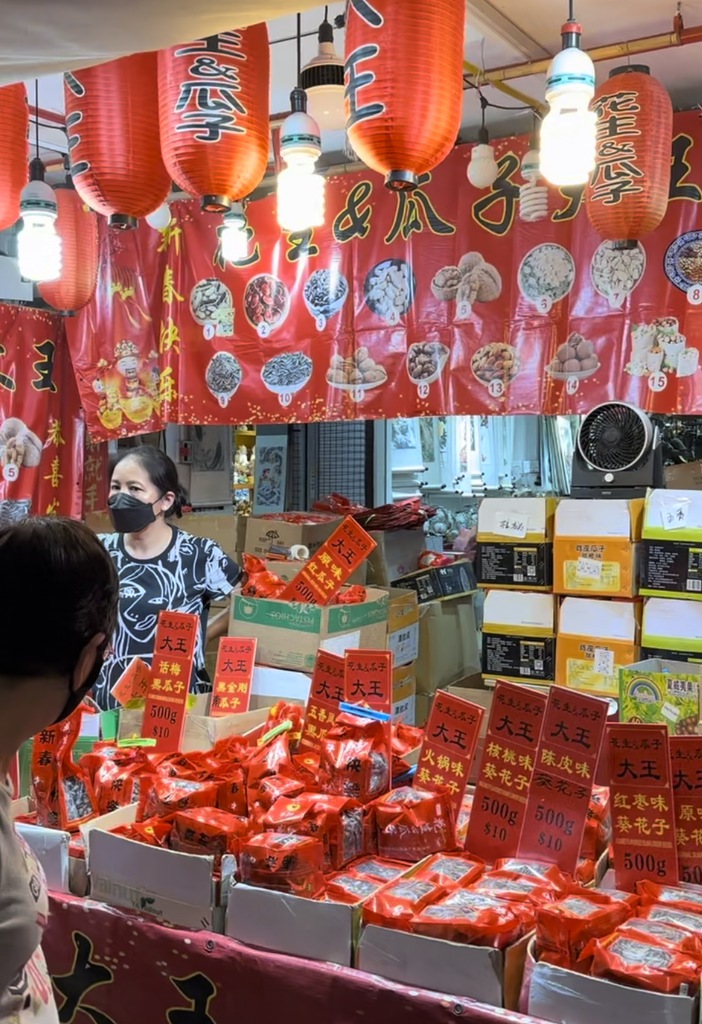
If your layover falls in the weeks before Chinese New Year, go. I was there on New Year’s Eve in 2024, and the whole quarter was strung with lights, the street market running the length of Pagoda Street, and stalls selling nothing but seeds, dried fruit and nuts by the 500-gram bag.
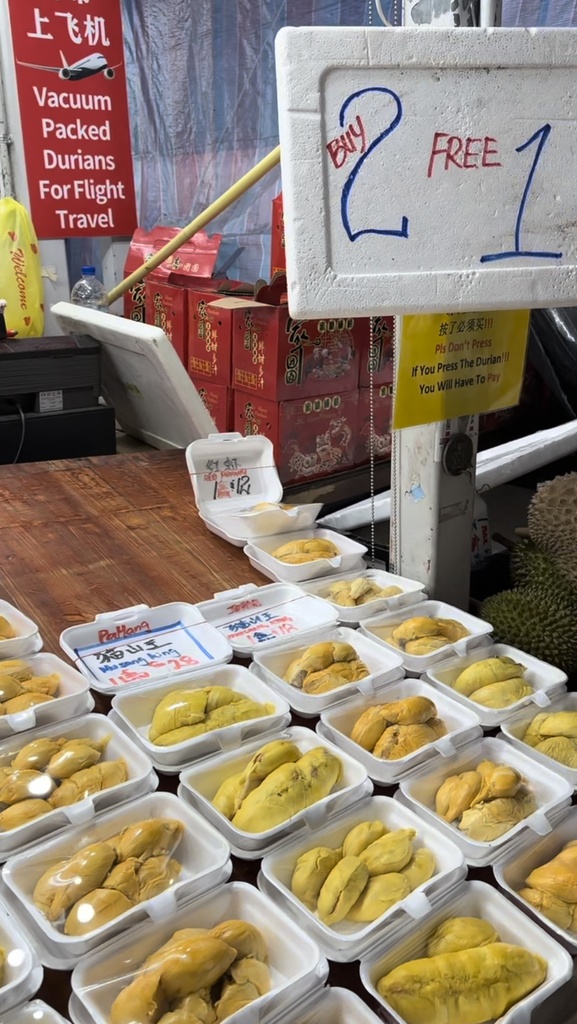
It is also where I tried durian for the first time, and not the entry-level kind: the Musang King, the Rolls-Royce of durians, sold by the tray from Pahang. People either love it or cannot stay in the room with it, but nobody is indifferent. The smell is strong enough that most hotels and every airline in Asia ban it outright — which is exactly why the stall next door advertises vacuum-packed durian for flight travel.
Little India
Little India is the other great neighbourhood of the city: busy markets, Hindu temples, spice shops, streets that smell of curry, and shopfronts stacked with saris. It is a genuine cultural immersion and it is a short MRT ride from the centre. If you have to choose between the two on a single layover, though, take Chinatown — it is more central and it packs more into less walking.
Sentosa
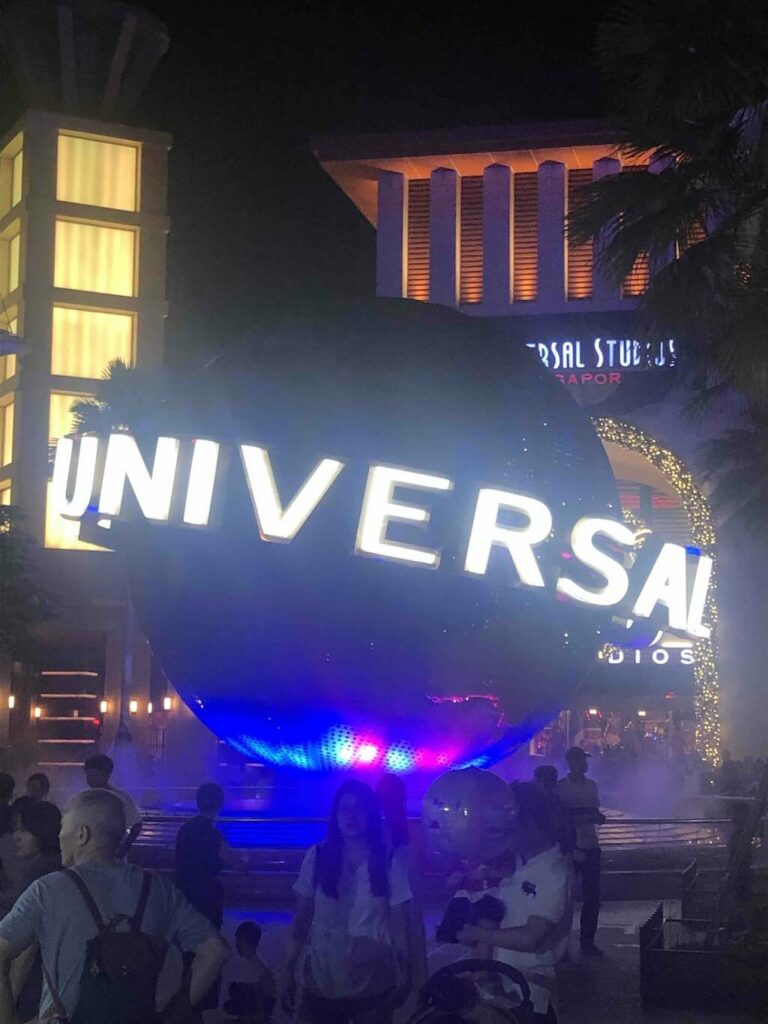
Singapore is a city of contrasts, and Sentosa is the proof. A short crossing from the mainland takes you to beaches, marinas and Universal Studios — a whole island given over to leisure, at the opposite end of the register from the financial district. Since July 2025 it also has its own Free Singapore Tour circuit, the Sentosa Discovery Tour, which is the easiest way to see it on a layover.
Museums, Concerts and the Grand Prix
Singapore takes culture seriously, and a good deal of it sits within walking distance of the Merlion — which makes it unusually easy to fit into a few hours off a flight.
Museums
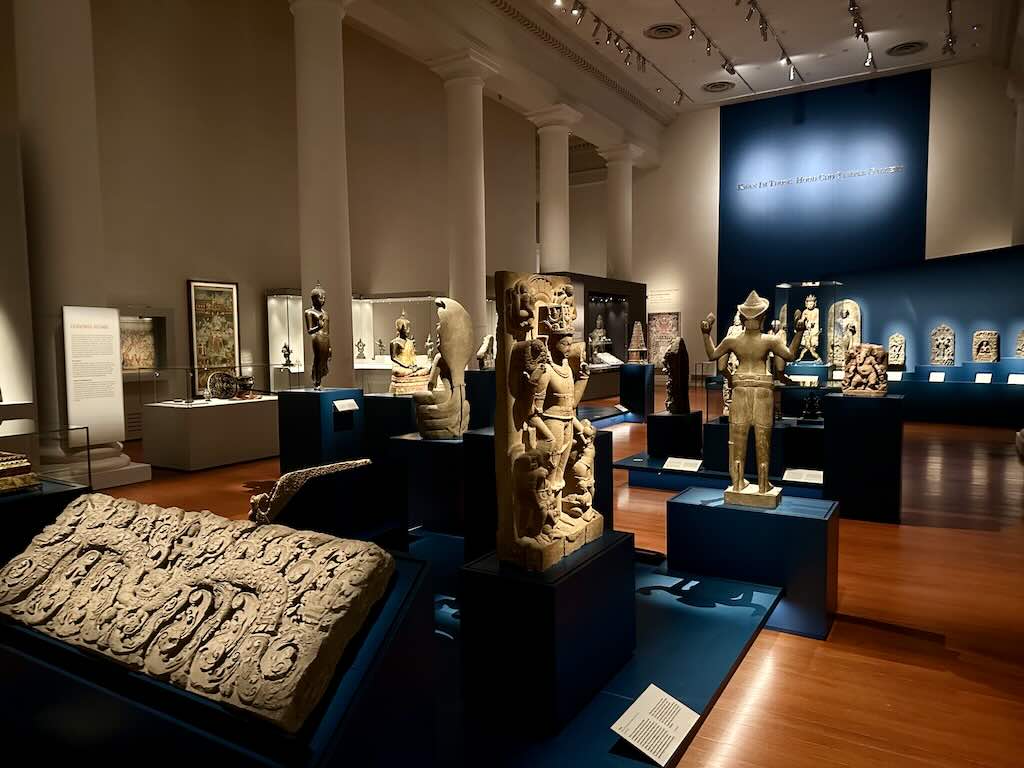
The National Museum of Singapore covers the country’s history properly, and the Asian Civilisations Museum on the river is excellent. My own favourite is the National Gallery, housed in the former Supreme Court and City Hall, whose temporary contemporary shows are consistently better than they need to be. The city also hosts the Singapore Biennale and the Affordable Art Fair.
Concerts
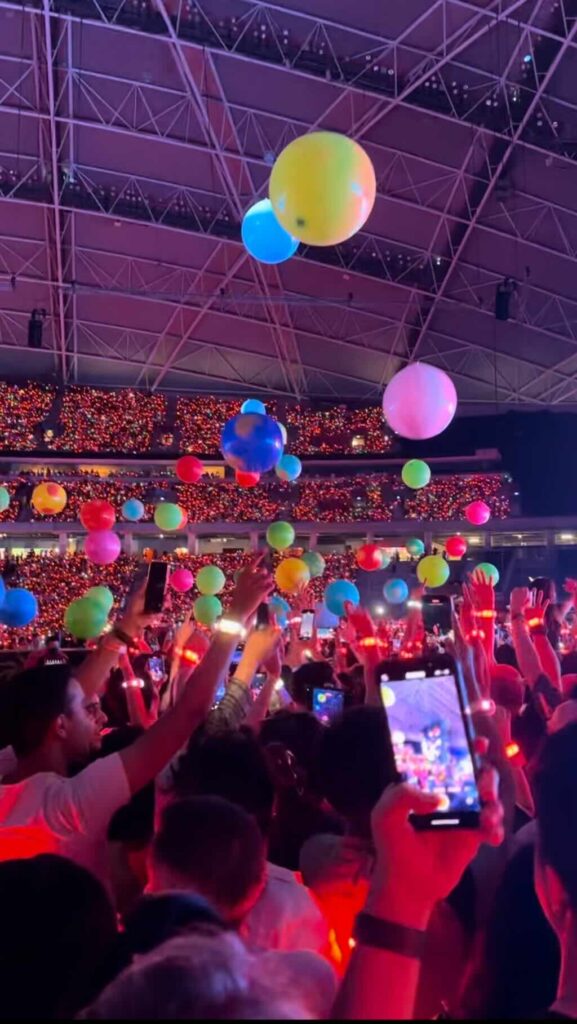
Between the Esplanade — Theatres on the Bay, the Singapore Indoor Stadium and Marina Bay Sands, the city pulls in the international touring circuit in a way its size would not suggest. I flew up from Bali specifically to see Coldplay at the Indoor Stadium on 31 January 2024. The show was excellent and the organisation was flawless, which in my experience is the Singaporean default rather than a happy accident.
The Singapore Grand Prix
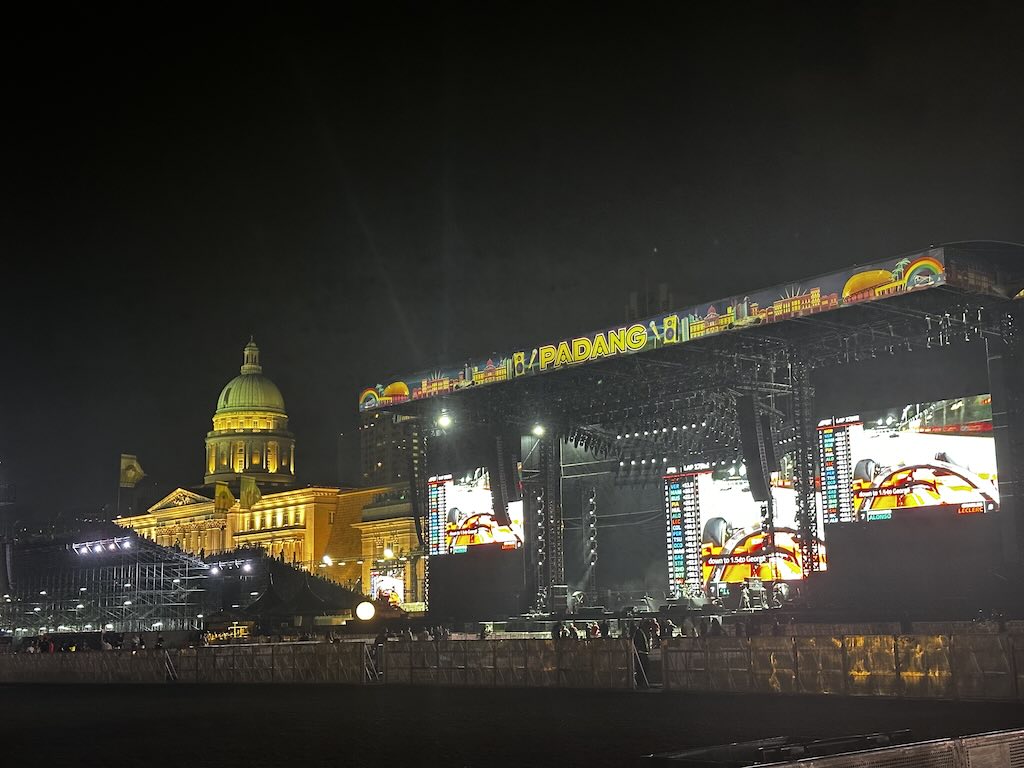
The Singapore Grand Prix is not really a race, it is a week. Formula 1 under floodlights on the Marina Bay street circuit, with the skyline as a backdrop, and around it a programme of concerts, pop-up parties and food festivals that would justify the trip on its own.
I went on 22 September 2024 with my cousin: Kylie Minogue one night, Lenny Kravitz the next. If your travel dates fall anywhere near the Grand Prix, book accommodation early — the whole city prices accordingly.
Getting from Changi to the City
How you get into town decides how much of Singapore you actually see. On a layover, the difference between the train and a taxi is roughly forty minutes each way — which on a seven-hour stop is the difference between one site and none.
MRT
Changi Airport station (CG2) serves all terminals. You have to change at Tanah Merah onto the East West Line — there is no direct train to the centre, whatever older articles say. Reckon about 50 minutes to Marina Bay and roughly 2.50 S$. First train around 5:30 AM; the last one that still connects leaves at 11:18 PM. Contactless bank cards work directly at the gates, so you do not need a transit card.
An extension of the Thomson-East Coast Line will eventually give a direct run from the airport to the centre in about forty minutes, and the current Changi–Tanah Merah stretch will be converted to it. That is a mid-2030s project, alongside Terminal 5. For now, plan on the change.
Taxi and Ride-Hailing
A metered taxi to the city takes about 30 minutes and costs 25 to 45 S$, plus an airport surcharge of 8 S$ between 5:00 PM and midnight and 6 S$ the rest of the day. Between midnight and 6:00 AM there is a 50 % night surcharge on the meter, which is worth remembering before you plan a late return.
Grab, Gojek, Tada and several others operate from marked pick-up points in every terminal. Prices float with demand, so I will not quote a figure. Changi also runs a fixed-price private transfer at 70 S$ per trip for up to four people, which makes sense with luggage and a group, and rarely otherwise.
Where to Stay in Singapore
On a layover the question is not which neighbourhood you like. It is whether you are willing to clear immigration to reach your bed — because that single decision changes everything about what is available to you.

Sleeping Without Clearing Immigration
Two hotels sit inside the transit area, so you never touch passport control. Changi Transit Hotel Terminal 1 — the one everybody still calls the Aerotel — books by the block of hours and includes the rooftop pool. Ambassador Transit Hotel — Terminal 2 does the same in T2.
Honest disclosure: I have never used either. Before my family moved to Singapore I looked into it more than once, and what stopped me every time was the price for what is, in the end, a few hours of sleep. If I were doing it tomorrow, I would take a lounge instead — the Ambassador Transit Lounge charges 55 S$ for three hours or 97 S$ for five, with a shower, a bed of sorts in the Nap Suites, food and a workspace. For a night flight connection that is the calculation I would make.
And the free option is genuinely good: the snooze lounges in every terminal have proper reclining seats and power, and a shower at the transit lounge costs 20 S$ on its own. For a six-hour overnight connection, that combination beats paying for a room you will be in for four hours.
At the Airport, Landside
Clear immigration and two more options open up, both a few minutes from the terminals. YOTELAIR Singapore Changi Airport Landside is inside Jewel itself, which means you can be at the Rain Vortex in two minutes and back at check-in in fifteen. Crowne Plaza Changi Airport by IHG is the comfortable choice, connected to Terminal 3 and regularly voted one of the best airport hotels anywhere.
In the City
If you have a night or more, stay in town — the airport is 30 to 50 minutes away and Singapore is a genuinely good city to wake up in.
On a budget. Ibis Singapore on Bencoolen is central, reliable and walkable to Bugis and Little India. The Pod at Beach Road is a well-run capsule hotel and the cheapest way to sleep centrally.
Mid-range. YOTEL Singapore Orchard Road puts you on the shopping spine with compact, well-designed rooms. The Sultan occupies a row of restored shophouses in Kampong Glam, which is the most characterful part of the city to sleep in.
Boutique and luxury. The Warehouse Hotel is a converted 1895 godown on the river and the most interesting building of the lot. The Fullerton Bay Hotel sits on the water with the skyline in front of it. And Marina Bay Sands is the only way to get into that infinity pool.
How Long Does a Singapore Layover Need to Be?
This is the question the whole page exists to answer, so here it is as arithmetic rather than opinion. Three things are fixed no matter what you do: immigration takes ten to twenty minutes each way, you must be back at check-in two hours before departure, and the round trip to Marina Bay is 1 hour 40 by MRT or about 1 hour 10 by taxi.
Under 4 Hours: Stay Air-Side
Do not leave. The return trip alone eats everything you have. Go to the Butterfly Garden in T3, watch a film, find a snooze lounge, or pay 25 S$ for the rooftop pool. All of it is inside security and none of it needs a form.
4 to 5 Hours: Jewel, and Nothing Else
Enough to clear immigration, walk to Jewel, see the Rain Vortex, eat something, and come back. Jewel itself advises five hours as the comfortable minimum and I would not argue. Remember it counts as your one exit.
5.5 to 6 Hours: The Free Tour
This is Changi’s own threshold for the Free Singapore Tour, which makes it the most defensible number on this page — it comes from the airport, not from a blog. The tour absorbs 90 minutes of reporting time plus 2.5 hours of touring, leaving a margin of an hour and a half to two hours. It is also the option that requires the least thinking, which after a long flight counts for something.
6 to 8 Hours: One Site, by Taxi
With seven hours you can do Gardens by the Bay properly: out of immigration by 0:30, at Marina Bay by 1:10 in a taxi, two hours twenty on site for the Cloud Forest, the Flower Dome and the Supertree Grove, back by 4:10 — leaving nearly three hours before departure. The same plan by MRT cuts your time on site to about ninety minutes and makes the margin uncomfortable. Under seven hours, the taxi is not a luxury, it is what makes the trip possible.
8 Hours and Over, and Overnight
Two or three sites become realistic: Marina Bay, Gardens by the Bay and Chinatown or Little India sit close enough together to chain. Past twelve hours, a transit hotel or a Nap Suite starts to make sense.
On an overnight layover, Garden Rhapsody at 7:45 PM or 8:45 PM is free and the outdoor gardens stay open until 2:00 AM — but the last MRT that still connects leaves at 11:18 PM, and after midnight the taxi meter carries a 50 % surcharge. Coming back late has a price; just know it in advance.
Where to Go From Singapore
Changi is one of the best-connected airports in Asia, which is what makes it a good place to build a trip around rather than merely pass through. Nearby, Malaysia is reachable by bus, ferry or the Johor–Singapore Causeway, and the Indonesian islands of Bintan and Batam are a short ferry ride away.
Further out, direct flights put a great deal within a few hours: Bali, Phuket, Koh Samui, Bangkok and Sabah in Malaysian Borneo. If you are assembling a longer route, my ten best dive sites in Southeast Asia and my five favourite places in Southeast Asia both start from here more often than not.
Read More about Southeast Asia
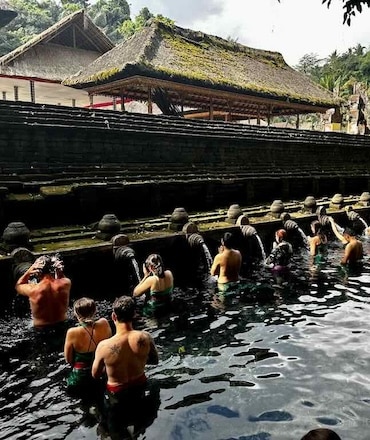
Bali Travel Guide
Where to stay in Bali, the best experiences, hidden corners, practical tips and a ten-day itinerary. A little over two hours from Singapore. Read more
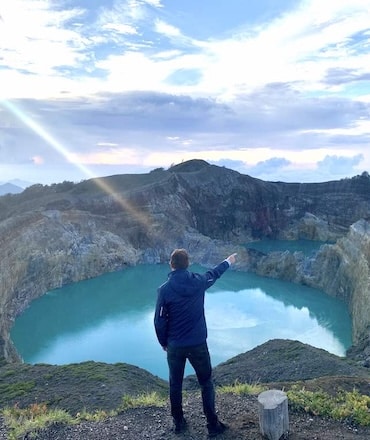
Indonesia Travel Guide
From Bali to Java, Flores and Raja Ampat — the best places to visit in Indonesia and how to plan a multi-island trip. Read more
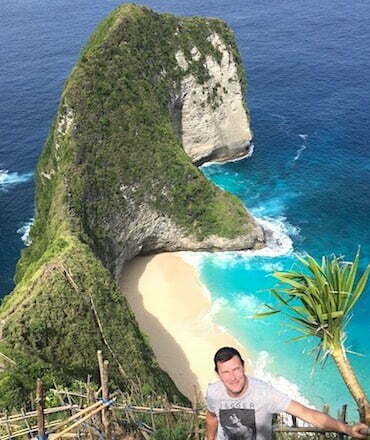
Nusa Penida Travel Guide
Where to stay in Nusa Penida, the island’s most beautiful beaches, top viewpoints, manta ray snorkeling, practical travel tips, and detailed itineraries to plan the perfect trip. Read more
Frequently Asked Questions About a Singapore Layover
Can you leave the airport during a layover in Singapore?
Yes, provided you clear immigration and your passport does not require a visa — which it does not for EU, UK, US and most Western travellers. You need to file the free SG Arrival Card within the three days before you land. One important limit: you may only exit immigration once per layover, so you cannot visit Jewel and then join a city tour on the same stop.
How long a layover do you need to leave Changi Airport?
Around five hours to see Jewel comfortably, and 5.5 hours to join the free city tour — that is Changi’s own minimum. Under four hours, stay in the transit area. The three fixed costs are immigration in both directions, the two hours you must allow for check-in, and the round trip to town, which is 1 hour 40 by MRT.
Is the Free Singapore Tour really free?
Yes, genuinely free. Changi runs four circuits of two and a half hours each, seven departures a day, for passengers with a layover between 5.5 and 24 hours. You register at the counters in Terminal 2 or Terminal 3, up to 50 days ahead online or on the spot. You must report 90 minutes before departure and put your cabin bags in storage.
Can you visit Jewel while in transit?
No — not without clearing immigration. Jewel is landside, so you have to formally enter Singapore to reach it, then pass back through immigration and security. This is the single most common mistake in articles about Changi. Allow at least five hours of layover.
Do you need the SG Arrival Card for a transit?
Not if you stay inside the transit area. Passengers transiting without seeking immigration clearance are exempt. If you plan to leave the airport for any reason, you do need it. It is free, it takes minutes on the ICA site or the MyICA app, and it can only be submitted within three days of arrival. Ignore any site that asks you to pay for it.
What can you do at Changi Airport for free?
Quite a lot. The Butterfly Garden and the movie theatre in Terminal 3, the Cactus Garden on the Terminal 1 roof, the Sunflower and Enchanted Gardens in Terminal 2, and snooze lounges with reclining seats and power in every terminal — all open 24 hours, all inside the transit area, all free and open to any passenger.
How do you get from Changi Airport to Marina Bay?
By MRT from Changi Airport station, changing at Tanah Merah: about 50 minutes and roughly 2.50 S$, with contactless bank cards accepted at the gate. By taxi it is about 30 minutes and 25 to 45 S$ on the meter, plus an airport surcharge of 6 to 8 S$ and a 50 % night surcharge after midnight.
Where can you sleep during a layover in Singapore?
Four options, in ascending order of cost. The free snooze lounges in every terminal, with a 20 S$ shower at the transit lounge if you want one. A lounge for a few hours — 55 S$ for three hours at the Ambassador Transit Lounge. A transit hotel inside the security zone, so no immigration. Or a hotel landside, at Jewel or beside Terminal 3, which does require clearing immigration.
Is Gardens by the Bay free?
The outdoor gardens are free, including the Supertree Grove and the Garden Rhapsody light show at 7:45 PM and 8:45 PM. You pay only for the conservatories — 46 S$ for the combined Flower Dome and Cloud Forest ticket — and 14 S$ for the OCBC Skyway walkway between the Supertrees.
Is Singapore expensive?
Accommodation and alcohol are expensive by Southeast Asian standards. Almost everything else is not: hawker food is excellent and cheap, public transport costs a couple of dollars, and the best things on this page — the airport gardens, the Supertree light show, walking Chinatown, the free city tour — cost nothing at all.
When is Terminal 5 opening?
Construction began in May 2025 and Changi is targeting the mid-2030s, with no firmer date announced. The first phase is designed for about 50 million passengers a year and will connect to Terminal 2 by an underground automated people mover.