Labuan Bajo & Komodo National Park Travel Guide
By Blaise Jaeger · Updated August 9, 2026
Why Visit Labuan Bajo?
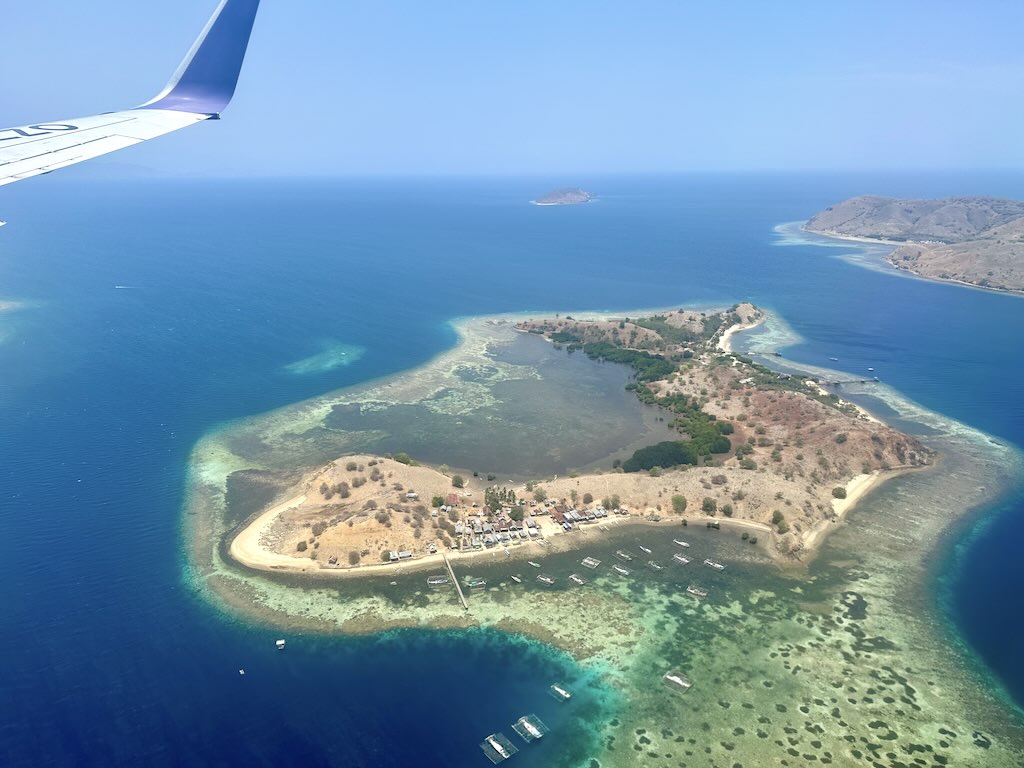
Labuan Bajo sits on the western tip of Flores, in the province of East Nusa Tenggara, and it exists today for one reason: it is the door to Komodo National Park. Twenty years ago it was a fishing harbour with a handful of guesthouses and a few dive shops serving people who had heard about the currents out west. Today it has a rebuilt marina, daily flights from Bali, Jakarta and Surabaya, and a hillside covered in hotels that all face the same sunset. The town has changed fast, and not everyone likes what it has become. But the reason to come has not changed at all — everything worth seeing is offshore, and you reach it by boat.
What makes this corner of Indonesia unusual is how many different things it does well at once. There is the wildlife: Komodo dragons live wild here and nowhere else on earth, and you walk among them with a ranger rather than looking at them through glass. There is the landscape: bare, tawny hills dropping straight into turquoise water, islands that look scorched in October and green in February, and viewpoints like Padar that have become some of the most photographed places in the country. And there is what happens below the surface, which is the part most visitors never see and the part I keep coming back for. Komodo has more than forty dive sites, strong tidal currents that feed enormous quantities of fish, manta rays, sharks, and reefs that stay dense and healthy because the water never stops moving.
The other thing worth saying early is that Labuan Bajo does not have to be the beginning of your trip. Most people fly in, spend three days on boats and fly out. That works. But Flores is a long, mountainous, deeply underrated island, and arriving in Labuan Bajo by road from the east — after the crater lakes, the weaving villages and the empty beaches of the south coast — turns the town into an arrival rather than a departure. I have done it both ways, twice by land and twice by air, and the land version is the one I recommend to anyone with a week to spare.
Labuan Bajo at a Glance
If you only read one section before booking, read this one. It answers the questions that decide the shape of a trip: where the town actually is, how you get in, what you have to pay for, and how long to stay.
- Where it is: the western end of Flores island, in West Manggarai Regency, East Nusa Tenggara — roughly 500 km east of Bali as the crow flies, in the Lesser Sunda chain.
- Airport: Komodo Airport (LBJ), a ten-minute drive from the waterfront. Daily flights from Bali (Denpasar), Jakarta and Surabaya, plus a small number of limited international connections.
- Park access: only by boat, from the Labuan Bajo marina. There is no road, no bridge and no ferry service to the islands — every visit to Komodo National Park is a boat trip, whether it lasts nine hours or five days.
- Fees: the park charges an entrance and conservation fee per person, collected per day, with different rates on weekdays, weekends and public holidays, and separate charges for ranger fees and specific activities such as diving. Rates have been revised more than once in recent years, so confirm the current amount with your operator when you book rather than relying on an older figure.
- Best season: dry season runs from April to November, wet season from December to March. July to September gives the most reliable combination of calm crossings, good underwater visibility and clear skies.
- How long to stay: three days minimum, four or five to do it properly, and four to seven if you are here to dive.
- Money: the currency is the Indonesian rupiah (IDR). There are ATMs in town, but they can run dry in high season and card payment is far from universal once you leave hotels and the bigger restaurants. Draw cash before you board any boat — there are no machines in the park.
- Getting around town: the centre is walkable end to end, though the hill is steep. Scooter rental and ojek motorbike taxis cover everything else, and hotels arrange airport transfers.
My Four Trips to Labuan Bajo
I have been to Labuan Bajo four times, in four different formats, and that is the main thing I can offer that most guides cannot. I came first as a diver on a liveaboard, before I had ever set foot in the town. I came twice overland from the far east of Flores, once with a driver and once on a motorbike. And I came back most recently for a short, dense stay that mixed one day of diving with one day on a standard tourist boat. Those are the three ways people experience Komodo, and I have done all three. They produce completely different memories of the same place.
September 2016 — first contact, from a liveaboard
My first sight of Komodo was not from the harbour front but from a boat deck, on a diving cruise in September 2016. That is a strange way to meet a destination. You never really see the town; you see channels, headlands and mooring spots, and you learn the geography of the park through tides rather than through roads. A liveaboard schedule is built around slack water, so your day is organised by the sea: an early dive before breakfast, a second one mid-morning, a third in the afternoon, sometimes a night dive, and long stretches of motoring between sites while you eat, sleep and dry your gear.
What that first trip gave me was scale. From the water you understand that Komodo is not one island with lizards on it but a whole archipelago of bare volcanic ridges scattered across a strait, with the sea pouring between them twice a day. It also gave me the north of the park, which is where the fish are and where the currents are serious, and it set the bar for everything I have dived in Indonesia since.
March 2021 — arriving overland from Maumere, with a driver
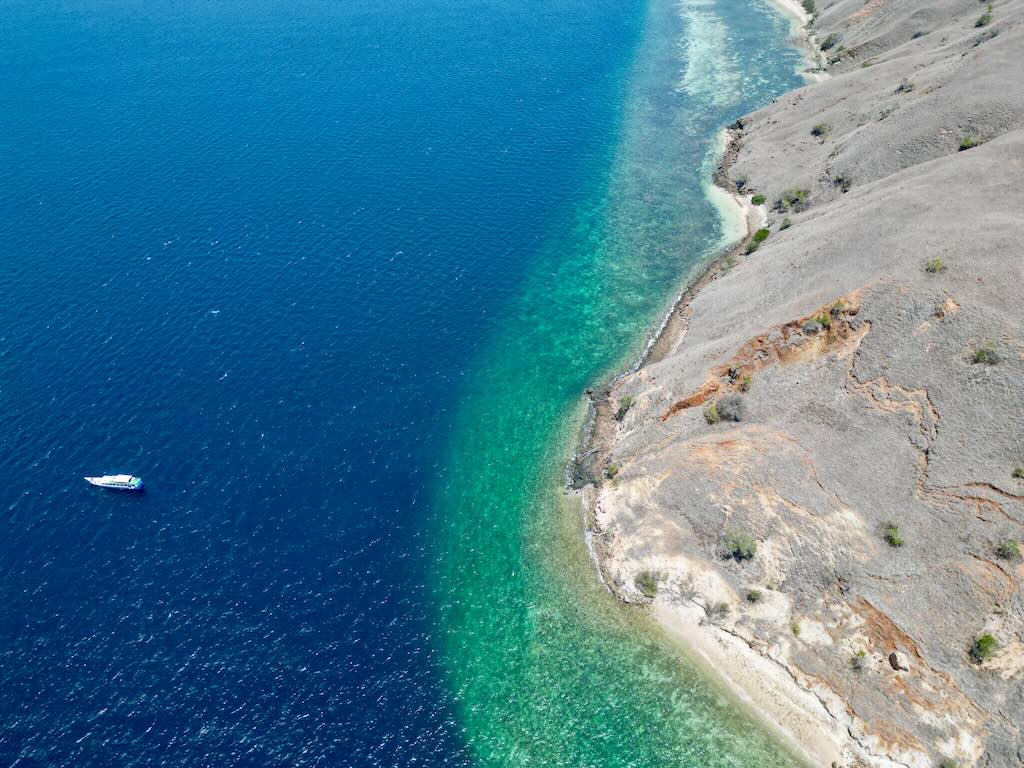
I have been based in Indonesia since 2020, which changed how I travel here: instead of flying between highlights I started crossing islands. In March 2021 I drove the length of Flores from Maumere in the east, with a driver, and arrived in Labuan Bajo at the end of it. That crossing is one of the best road trips in the country. It takes in the empty crescent of Koka Beach, the small mountain town of Moni, and a pre-dawn climb to watch the sun come up over the coloured crater lakes of Kelimutu, before the road turns west and spends two more days climbing and dropping through the ranges.
Doing it that way completely reframes Labuan Bajo. You do not land in a tourism hub; you come down out of the hills into a harbour town after days of villages, coffee, rice terraces and hairpins, and the sudden concentration of dive shops, boat touts and sunset bars feels like a small city. It also means you already know that Flores is far more than its western tip, which is not something you learn in three days of boats.
June 2021 — the same road, on a motorbike
Three months later I did the identical route again, from Maumere to Labuan Bajo, this time on a motorbike. Same road, entirely different trip. On a bike you stop where you want, you feel every change of altitude and climate, and you get pulled into far more conversations than you do behind a windscreen. You also carry your own risk: the Trans-Flores road is narrow, it winds relentlessly, and sections of it can be broken up by landslides in the wet months. If you are considering it, treat it as a proper multi-day ride rather than a shortcut, and give yourself more days than the map suggests.
The reason I mention both crossings is that they are the argument for treating Labuan Bajo as an arrival. Fly in and out and Flores is a boat terminal. Ride or drive across it and Labuan Bajo becomes the last chapter of something much bigger.
October 2024 — one day diving, one day on a tourist boat
My most recent stay, in October 2024, was short and deliberately split in two. One day was a diving day-cruise; the next was a standard tourist boat tour of the kind almost every visitor books — Padar, the dragons, Pink Beach. I wanted to see the mainstream circuit for myself rather than judge it from the deck of a dive boat, and I am glad I did. The classic tour is busier than the diving version and it moves on a fixed schedule, but the sequence works: a sharp climb at dawn for the Padar viewpoint, a ranger walk among the dragons in the heat of the morning, then swimming and snorkelling in the afternoon. If you have two days, doing one of each is the best value combination there is.
I stayed at the Blue Parrot, a tiny place with only three rooms, one of which has a genuinely beautiful view over the bay. The welcome there was as warm as anywhere I have stayed in Indonesia. It is not a resort and it does not pretend to be — it is the kind of small, family-run address that is getting harder to find in Labuan Bajo as the hillside fills up.
The Cauldron, also called Shotgun — the dive I still think about
Across all four trips, and across dives in the north, the centre and the south of the park, one site stands above everything else for me: The Cauldron, which most people here call Shotgun. It sits in the north of the park, in the passage between Gili Lawa Laut and Gili Lawa Darat. The topography is what makes it: a bowl-shaped depression that narrows into a channel, and when the tide runs, the whole volume of water crossing between the two islands is forced through that gap.
You drop in away from the constriction and work your way across the bowl, and for a while it is an ordinary, very good Komodo dive — coral, schooling fish, the usual traffic. Then the bottom rises and the channel closes in, and there is no more swimming to be done. The current takes you, accelerates, and fires you out the other side. That is where the name comes from, and it is accurate: you are expelled, exactly like something shot out of a barrel, into open blue water on the far side of the pass. The whole passage takes seconds. It is the closest thing to flying I have experienced underwater.
What makes it more than a fairground ride is what waits in the flow. Sharks and rays hold station in the moving water on either side of the gap, facing into the current, barely moving, letting it do the work. You come through at speed and they are simply there, holding position while you are swept past them. It is worth saying plainly that this is not a beginner’s site. It is dived on specific tides, with a guide who knows the timing, and getting the timing wrong is what makes current diving dangerous rather than exhilarating. If you have the experience for it, put it at the top of your list.
Komodo National Park: What Makes It Unique
Komodo National Park was created in 1980, initially to protect the Komodo dragon, and it was inscribed on the UNESCO World Heritage list in 1991 once it became clear that the marine environment around the islands was as exceptional as the reptile that had made them famous. The park covers the three main islands of Komodo, Rinca and Padar, plus a scattering of smaller islands and a large area of surrounding sea. Protection here is not a formality: most of the park’s surface is water, and the marine zone is as actively managed as the land.
Geography explains almost everything about the place. The islands sit in a strait between Sumbawa and Flores, on the line where water masses from the Pacific and the Indian Ocean meet and squeeze through a series of narrow passages. Twice a day, enormous volumes of water are pushed north and then pulled south through those gaps. That constant flushing brings cool, nutrient-rich water up from depth, which feeds plankton, which feeds everything else. It is the reason a set of dry, apparently barren islands is surrounded by some of the densest reef life in Indonesia — and the reason the diving here demands respect.
Above water, the contrast is what strikes people first. These are savannah islands, not jungle islands: open grassland, lontar palms, rock, and hills that burn gold by the end of the dry season and turn briefly green after the rains. There are no permanent rivers on most of them, and very little shade. It looks like a landscape that should be empty, and instead it holds the largest lizard on earth, wild horses, deer, water buffalo and a long list of birds. Below water, the same islands are ringed by more than forty named dive sites, hard and soft coral, and a fish population that runs from thumbnail nudibranchs to manta rays with wingspans wider than a car. You can read the full ecological picture on the Komodo National Park entry and on Wonderful Indonesia, the national tourism board’s site.
One practical consequence of all this: the park is a working conservation area with a limited number of landing points, ranger posts and marked trails. You cannot wander. Where you go on land is decided by the park authority and enforced by rangers, and where you go on water is decided by your captain and the tide. That is a good thing, and it is the reason the place still works after two decades of growing visitor numbers.
Komodo Dragons: Where and How to See Them
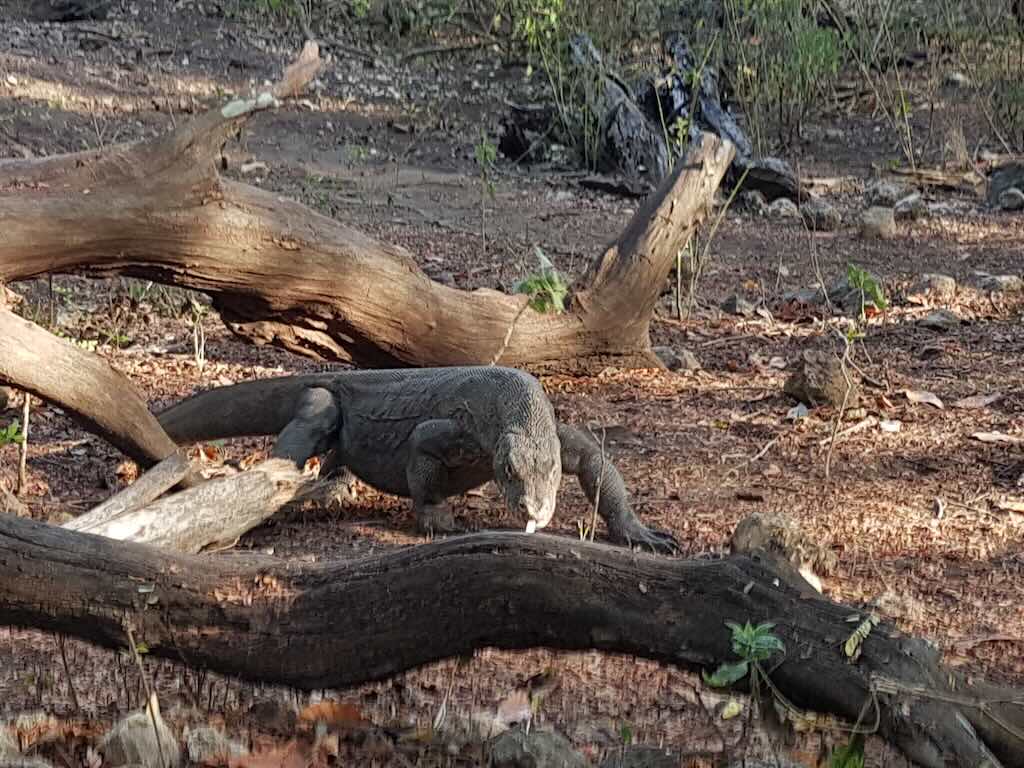
Varanus komodoensis is the largest living lizard, reaching around three metres — ten feet — from nose to tail tip in the biggest males, and it lives wild only on a handful of islands in this part of Indonesia. Seeing one is not like seeing a big lizard in a zoo. They are heavy-bodied, slow-looking animals that can move very quickly over short distances, and the sensation of standing on an open trail with one twenty metres away and no barrier between you is not something a photograph conveys.
Komodo Island or Rinca Island?
There are two places on the standard circuit where you land and walk with a ranger to look for dragons: Komodo Island itself, at the Loh Liang ranger post, and Rinca Island, at Loh Buaya. Most tour operators visit one or the other depending on the length of your trip and the day’s sea conditions; longer trips visit both.
Komodo Island is the bigger name and the one people picture, with longer trails and a genuine sense of remoteness. Rinca is closer to Labuan Bajo, which makes it the usual choice on a single-day trip, and in practice dragons are often easier to see there — animals congregate around the ranger area and the surrounding dry riverbeds, and sightings tend to be quicker and more reliable. Rinca also has the more striking scenery of the two in my view: bone-dry hills, lontar palms and long views over the bays, with short hikes that climb high enough to be worth the sweat. If you only have one dragon stop, Rinca does the job. If you are on a three-day boat, do both, because the walks are different.
Rangers, safety and the rules that matter
You cannot walk on either island without a certified park ranger. This is not an upsell — it is a park requirement, and it is there because the animals are genuinely dangerous. A Komodo dragon’s bite is venomous, and their behaviour is unpredictable; they are ambush predators that can stay motionless for long periods and then move fast. Attacks on people are rare, but they happen, and every one of them involves someone who was too close, moved wrong, or wandered off.
The practical rules are simple and worth taking seriously. Stay behind your ranger and keep the group together. Keep the distance you are told to keep, including when the animal looks asleep. Do not run, do not crouch to get a lower camera angle without permission, and do not step between a dragon and the shade or water it is heading for. Wear closed shoes — the ground is rocky and there are snakes. And tell your guide before the walk if you have an open wound, because dragons track blood over long distances.
Timing helps too. Sightings are best in the dry season, from April to November, when the animals are more active around the trails and water sources are concentrated. Mornings are better than midday, both for the dragons and for you: there is almost no shade on either island, and by 11 AM the heat on those trails is punishing.
Diving in Komodo: Sites, Currents and Seasons
This is the part of Komodo that justifies the journey for me, and the part that gets least attention in most guides. The park has more than forty dive sites, and unusually for a single destination they cover almost the whole spectrum: high-voltage current diving with pelagics in the north, easy coral gardens and manta cleaning stations in the middle, and cold, plankton-heavy water with big manta aggregations and excellent macro in the south. Very few places let you do all of that from the same harbour, which is why Komodo sits near the top of any list of the best diving in Indonesia.
Before the sites, the currents. Everything here is tidal, and the difference between a superb dive and a frightening one is timing. Sites are dived at specific points in the tidal cycle, briefings are longer than you may be used to, and negative entries, reef hooks and drift procedures are standard rather than exotic. Down-currents exist and are the real hazard, not the horizontal drift. None of this should put you off — it should tell you to choose your operator on the quality of their briefings and their willingness to change the plan, not on price. Ask how they decide the day’s schedule. A good Komodo guide will answer with tide tables.
North Komodo: exposed, fast and full of fish
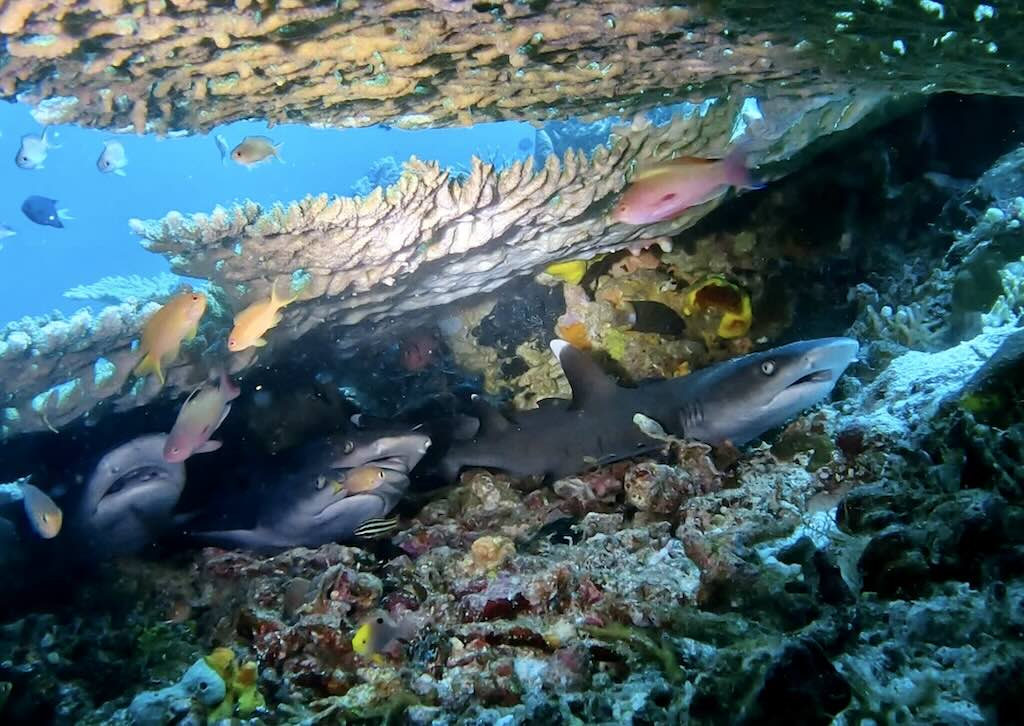
The north of the park faces the Flores Sea and takes the full force of the tidal exchange. Water is generally warmer than in the south, visibility is often better, and the sites are built around seamounts and passages where the current concentrates fish into dense, static formations. This is experienced-diver territory, and operators will ask about your logbook before they take you there.
Castle Rock is the headline site: a submerged pinnacle that you approach with a negative entry and hook onto while grey reef sharks patrol the up-current side and giant trevally and tuna hunt through schools of fusiliers above your head. It can be spectacular and it can be blown out; that is the nature of the place. Crystal Rock is its near neighbour and slightly more forgiving, a pinnacle that breaks the surface, with reef sharks, huge schools of anthias and fusiliers, and beautiful hard coral on the shallower shoulders where you finish the dive. And The Cauldron, or Shotgun, in the channel between Gili Lawa Laut and Gili Lawa Darat, is the drift dive described earlier — a bowl narrowing into a gap that accelerates you through and out the other side, with sharks and rays holding in the flow.
Central Komodo: the balanced middle
The central sites, closer to Labuan Bajo, are where most day-trip diving happens, and they are the reason Komodo is not only a destination for hardened current divers. Conditions are more moderate, boat rides are shorter, and the reefs are outstanding. Advanced open water is the sensible minimum here, with a handful of dives in mild current behind you.
Batu Bolong is the one everybody talks about, and rightly. It is a small rock in the middle of a channel with reef running down both flanks, and because the current splits around it there is a sheltered side at any given moment. The coral coverage and the sheer density of life on that pinnacle are hard to overstate — it is one of the most concentrated reefs I have dived anywhere. Mawan is a manta cleaning station over a sandy slope, an easy dive by Komodo standards, where you settle at a respectful distance and wait for mantas to queue up over the cleaning stations. Tatawa Besar is a long, relaxed drift along a slope carpeted in orange soft coral, the kind of dive where you barely finish a tank because you are doing nothing but floating.
South Komodo: cold, green and full of mantas
The south of the park is a different ocean. It faces the Indian Ocean, and upwelling brings water that is noticeably colder and thick with plankton. Visibility drops, the colour of the water turns green, and you will want more exposure protection than you packed — a 5 mm suit is not overkill. In exchange you get biomass. Manta rays gather in numbers here, most famously at Manta Alley, where they use a channel and a set of rocks as a cleaning and feeding station and can appear in large aggregations rather than ones and twos. The south is also the best macro area in the park, with rare critters on the darker slopes for divers who like to hunt slowly with a torch.
The catch is access. The southern sites are far from Labuan Bajo, exposed to swell, and frequently unreachable on a day trip. The best conditions run from December to March — which is the wet season, when the surface crossing is at its roughest. That trade-off is exactly why the south is mostly the preserve of liveaboards and longer charters, and why manta season and comfortable boat weather do not overlap.
Across all three zones, the season logic is simple. April to November is the reliable window for the north and centre, with July to September the sweet spot for calm seas and visibility. December to March favours the south and the mantas, at the cost of rougher crossings and more cancelled days. Whichever window you pick, build in a spare day: weather changes plans here more often than anywhere else I dive in Indonesia.
The Islands: Padar, Pink Beach, Kalong and Beyond
The islands are what fills the gaps between dives, and for non-divers they are the trip. Almost every itinerary out of Labuan Bajo is built from the same three or four landings, arranged in a sequence that follows the light: a climb at dawn, a walk in the morning, a swim in the afternoon, and something on the water at sunset.
Padar Island and its three bays
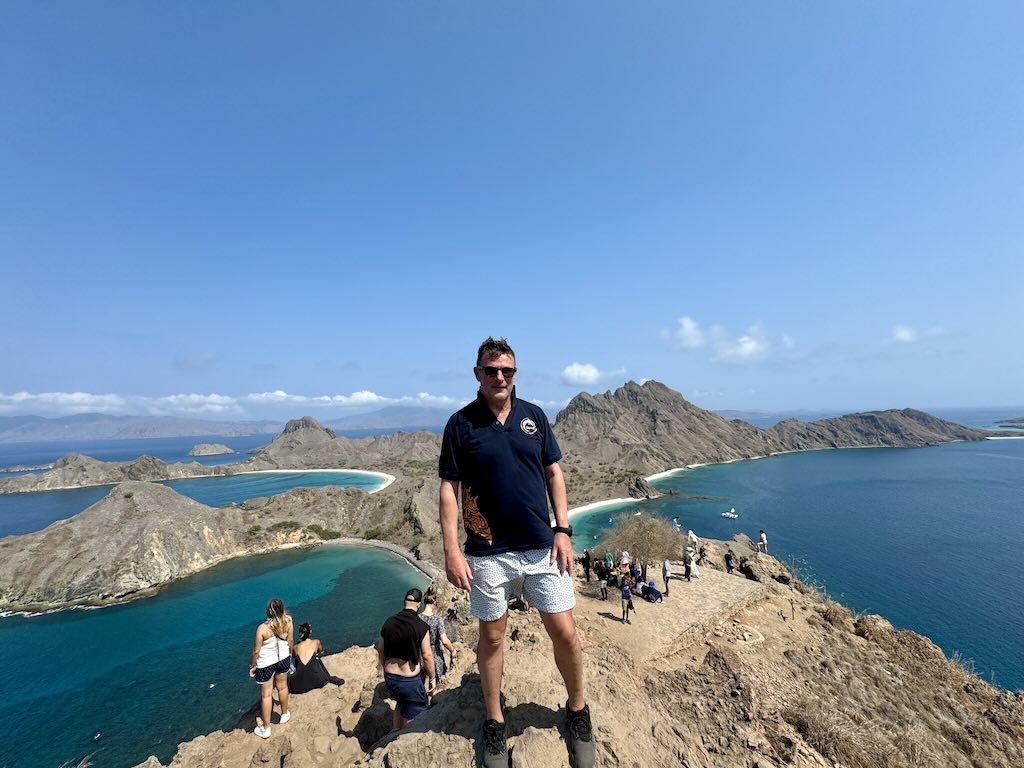
Padar is the image that sells Komodo: a ridge overlooking three crescent bays that curve away in different directions, each with a different sand colour — white, black and pink. The climb from the landing jetty is short but genuinely steep, on steps and packed earth, and it is done before sunrise on almost every organised tour, which means you are climbing in the dark in a queue of head torches. It is not a hike in any technical sense; it is fifteen to thirty minutes of steady effort depending on which viewpoint you stop at, and the lower platforms already give you most of the composition.
Two practical notes. Take water, even at 5 AM, because there is no shade and you will be back down in full sun. And accept that you will not have it to yourself — Padar at sunrise in July is a crowded place. It is still worth it: the shape of that island from above is unlike anywhere else in Indonesia, and photographs, including the ones you take yourself, do not really explain it.
Pink Beach
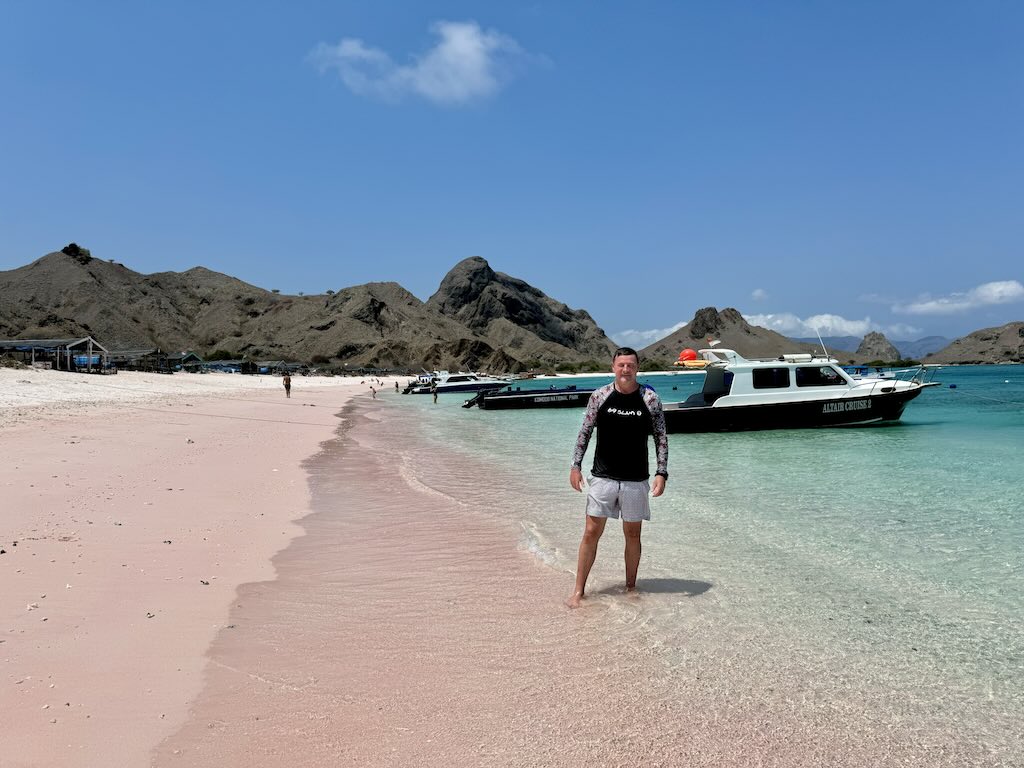
The colour is real, and it has a straightforward explanation: fragments of red coral broken down by the sea and mixed into the white sand. The intensity varies with the light and with how wet the sand is — at the water’s edge in the middle of the day it can look almost salmon, and further up the beach in flat afternoon light it fades back towards cream. It is not a trick of photo editing, but it is not neon either, and knowing that in advance saves disappointment.
Pink Beach was named the 7th most beautiful beach in the world in 2024 by The World’s 50 Best Beaches, which has done nothing to make it quieter. Come early or late if your boat allows it, and get in the water: the snorkelling straight off the sand is good, with coral starting close to shore, and most people spend their whole visit standing on the beach photographing it instead.
Kalong and the flying foxes at dusk
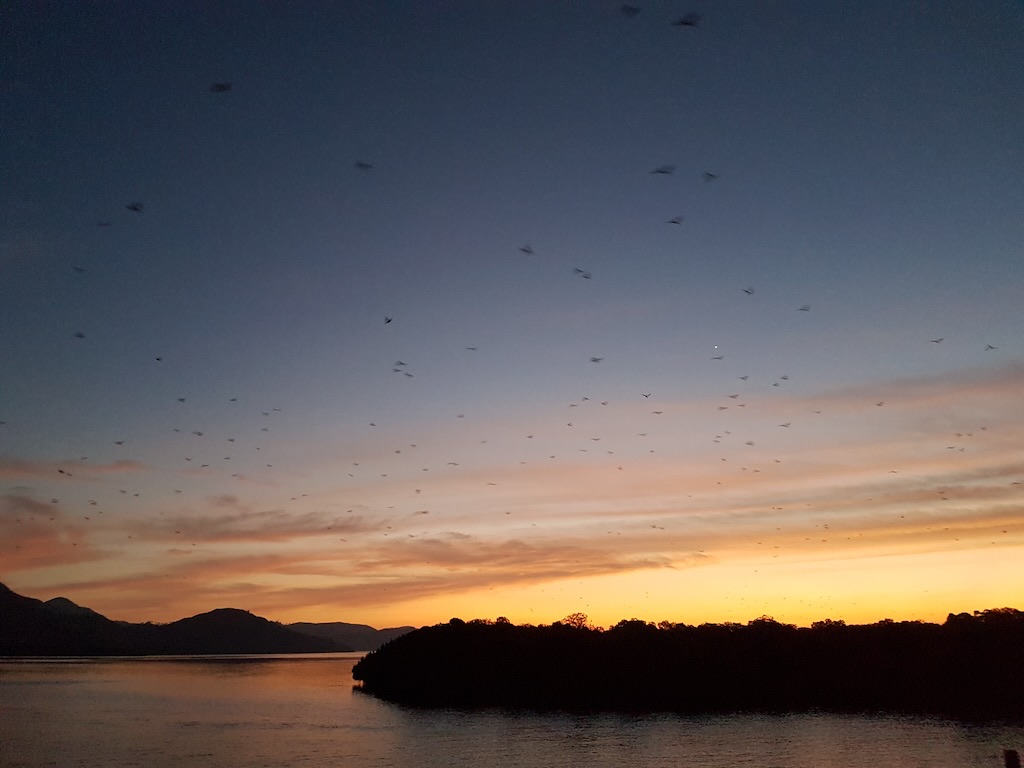
Kalong is the quietest highlight of the whole park and the one people remember longest. It is a mangrove island, and every evening at sunset thousands of flying foxes — large fruit bats — leave the mangroves and stream out towards the neighbouring islands to feed. The departure builds slowly: a few individuals, then dozens, then a continuous river of bats crossing the sky above your boat for a long time, silhouetted against whatever colour the sunset is doing.
It is reached by boat from Labuan Bajo and is usually tacked onto a sunset cruise or slotted in as the last stop of a day trip before the run home in the dark. There is nothing to do there but sit still with the engine off and watch, which is precisely the appeal after a day of climbing and swimming.
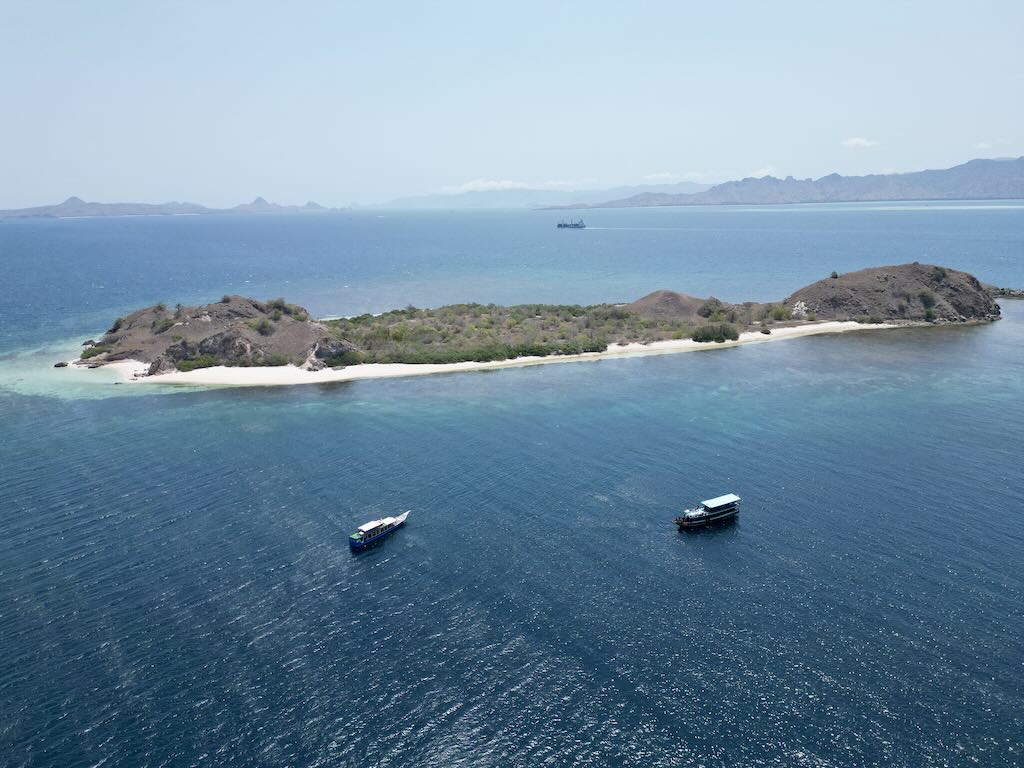
Beyond those three, the islands you actually land on are Komodo and Rinca for the dragon walks, and a rotating cast of smaller snorkelling stops — sandbars that appear and disappear with the tide, shallow reefs, and beaches that only fit one boat at a time. Which ones you get depends on your captain, the tide and the swell rather than on a brochure, so treat the extra stops as a bonus rather than a checklist.
Komodo Boat Tours: Day Trip, 2D1N, 3D2N or Liveaboard
There is no way to see Komodo National Park except on a boat, so choosing the boat is the single biggest decision of your trip. Four formats dominate, and they suit genuinely different travellers. The differences are not only about duration — they change which parts of the park you can physically reach, how crowded your stops are, and whether you sleep on the water or in town.
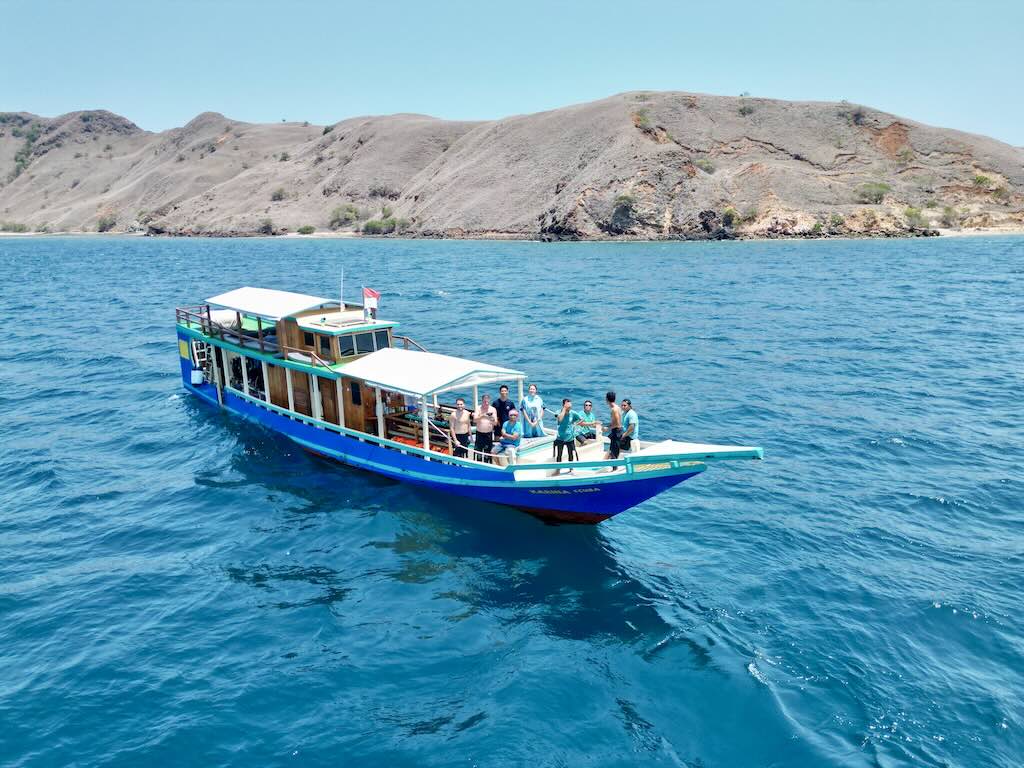
The day trip leaves the marina early, usually between 5 and 6 AM, and returns after dark. In one long day you can typically fit Padar at sunrise, a dragon walk on Rinca, Pink Beach, a snorkelling stop and sometimes Kalong on the way home. It is efficient and it is the cheapest way in, but you are moving constantly and you are travelling at the same time as everyone else who chose the same option. Boats range from shared speedboats, which cover more ground, to slower wooden boats, which are more comfortable but cut stops from the list.
The 2D1N adds one night at anchor and immediately fixes the worst thing about the day trip: the rush. You reach the same core sites but you arrive at some of them outside peak hours, you get an evening on the water, and the second morning starts where the first day ended rather than back at the marina. It is the best upgrade per rupiah spent on the whole list.
The 3D2N is the classic sightseeing cruise format, and the one I know from my own trips. Two nights on board let the boat range further, usually adding Komodo Island itself alongside Rinca, more snorkelling, and enough slack in the schedule that a change of weather does not destroy the itinerary. Sleeping arrangements vary enormously between operators, from open deck mattresses to private cabins with air conditioning — ask specifically, because this is where cheap boats and comfortable boats diverge most.
The liveaboard is the diving version, and a different animal altogether. Trips typically run from a few days to a week or more, the schedule is built around dives rather than viewpoints, and the boat goes where the diving is — including the far south, which day boats generally cannot reach. If you dive, this is the format that unlocks the whole park, and my first Komodo trip in 2016 was exactly this. I have written more about how these trips work, what they cost in effort and what to look for in a boat, in my guide to taking a diving cruise in Indonesia.
Whichever you choose, two things matter more than the brochure. First, safety equipment and crew: ask about life jackets, radio, a tender, and whether there is a second engine, because these are open crossings and breakdowns happen. Second, group size, which determines everything about your day — a shared boat with thirty passengers and a private charter with six will visit identical places and produce completely different trips.
Things to Do in Labuan Bajo Town
The town itself is small enough to understand in an afternoon. Essentially there is one street that loops through it, and the loop divides into two worlds. The lower part, at harbour level, is where the working town is: the port, the boat agents, and most of the dive centres, all within a few minutes’ walk of each other. The upper part, on the hillside, is where the restaurants and the hotels with bay views are, and where everybody drifts at the end of the day because the sunset over the islands is the best free thing in Labuan Bajo. The renovated marina at the bottom is the departure point for every tour and every liveaboard, and it is worth a walk in the early morning simply to watch the fleet leave.
Two short excursions are easy to do on a spare afternoon or on a weather day. Bukit Sylvia is a hill right above town with a panorama over Labuan Bajo, the bay and the islands beyond; it is a short climb or a quick scooter ride, and it comes into its own at sunset. Batu Cermin — the name means “mirror rock” — is a cave a few kilometres inland, with stalactites, resident bats and a well-known light effect: at certain times of day the sun enters through a fissure in the roof and strikes the wet limestone, which reflects it around the chamber. Go with a guide, wear shoes with grip, and expect a modest, quick visit rather than a major cave system.
Goa Rangko, the hidden saltwater cave
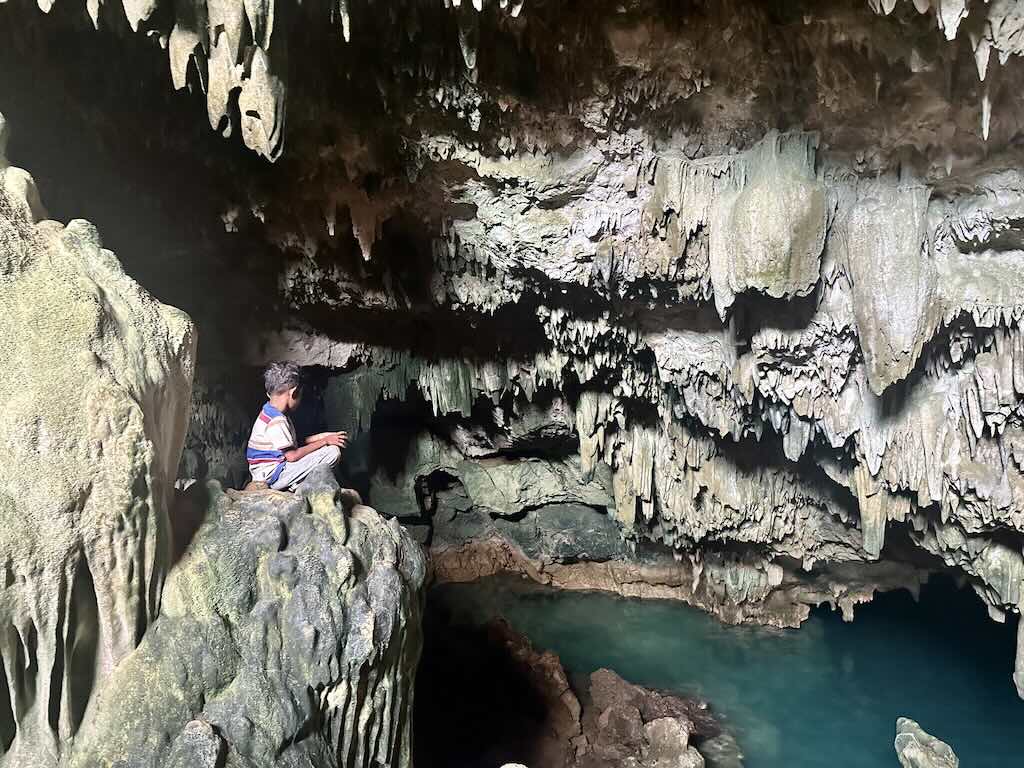
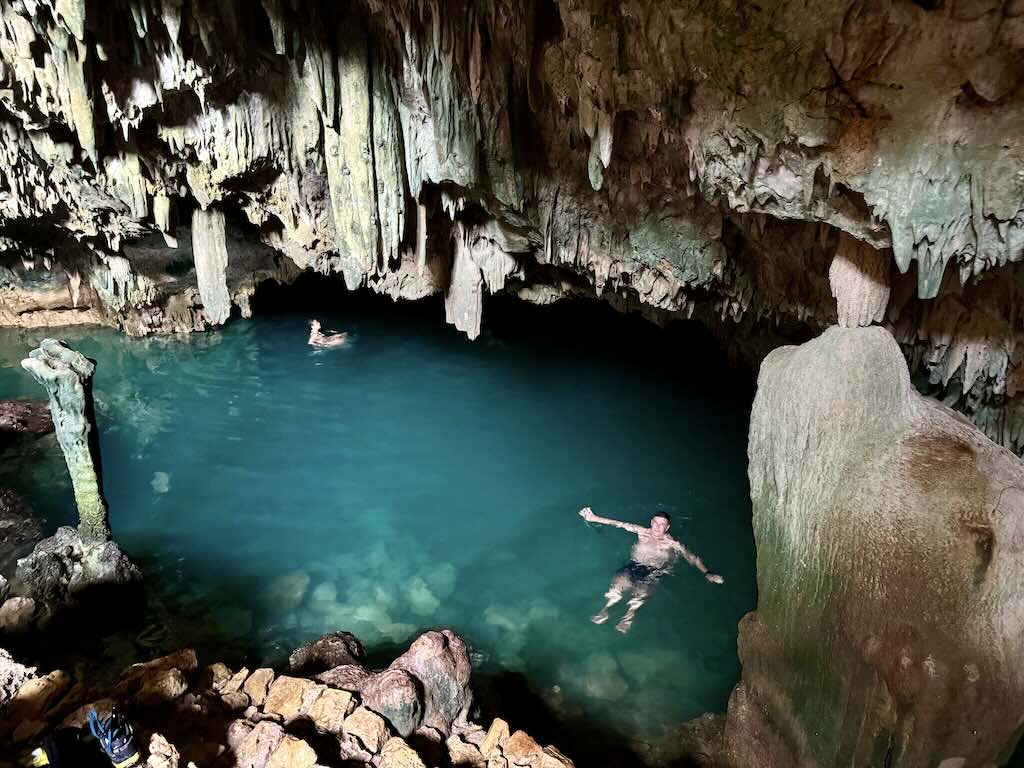
Rangko is the excursion I would push hardest if you have half a day and want something that is not on the standard boat circuit. Goa Rangko is a cave containing a natural saltwater pool, hidden in the limestone north of town. Getting there is part of it: you travel to the village of Tanjung Boleng, take a small boat for about twenty minutes, and then walk five minutes up a path to the entrance. A private boat for two costs around 250,000 IDR, plus a 50,000 IDR entrance ticket per person.
Inside, you climb down into a chamber with clear, cool salt water and you can swim. The timing that matters is the light: go in the afternoon, when the sun angle sends a shaft into the cave and lights the pool from above. Earlier in the day it is a swim in a dark cave, which is fine but far less striking. Bring a dry bag, footwear you can get wet, and something to dry off with, because there are no facilities.
How Many Days, and a Suggested Itinerary
Three days is the honest minimum, and it only works if none of them is eaten by a flight. Four to five days is the right number for most people: it covers the park properly, leaves room for the town and Rangko, and absorbs one bad-weather day without ruining the trip. Divers should plan on four to seven days, because dive days come in pairs and threes and the good northern sites are a long way out. If you are also crossing Flores by road, add three to four days on top for the drive from or to Maumere.
Here is the four-day shape I would use, based on how my October 2024 trip was organised.
- Day 1 — arrival and orientation. Fly in, settle, walk the loop from the marina up to the top of the hill, book or confirm your boat, and take the short climb up Bukit Sylvia for sunset. Eat on the water.
- Day 2 — the classic boat tour. Out before dawn for Padar at sunrise, a ranger walk with the dragons on Rinca in the morning, Pink Beach and a snorkelling stop after lunch, and Kalong at sunset on the way back if the schedule allows.
- Day 3 — the water day. A diving day trip to the central sites — Batu Bolong, Mawan, Tatawa Besar are the usual trio — or, if you do not dive, a snorkelling day on the same reefs, which are shallow enough to be genuinely rewarding from the surface.
- Day 4 — Rangko and the town. Morning free, then Goa Rangko in the early afternoon for the light, Batu Cermin on the way back, and a last dinner on the hill.
If you have five days, the best single change is to replace Day 2 with a 2D1N boat, which lets you sleep at anchor and reach Padar and the dragons ahead of the day-trip fleet. If you have a week and you dive, swap the whole middle of the trip for a liveaboard and keep two land days at either end.
Where to Stay in Labuan Bajo
Where you sleep in Labuan Bajo comes down to a simple trade-off between the harbour and the hill. Staying low, near the port and the marina, means you can walk to your boat at 5 AM without arranging anything, and you are among the dive centres and the agencies — convenient, functional, and noisier. Staying high, on the hillside, buys you the view: bay, islands and sunset from your own terrace, at the cost of a steep walk or a scooter ride down every morning. There is a third option a few kilometres north and south of town, where the larger beachfront properties sit away from the centre; quieter, but you will be dependent on transfers.
My own choice on my last trip was the Blue Parrot, and I mention it because it is the kind of place this town is losing. Three rooms, that is all — and one of them has a genuinely beautiful view over the bay. The welcome was exceptionally warm, the sort where you end up talking on the terrace instead of going out. It is small enough that availability is a matter of luck rather than planning, so treat it as a happy find rather than a guaranteed booking.
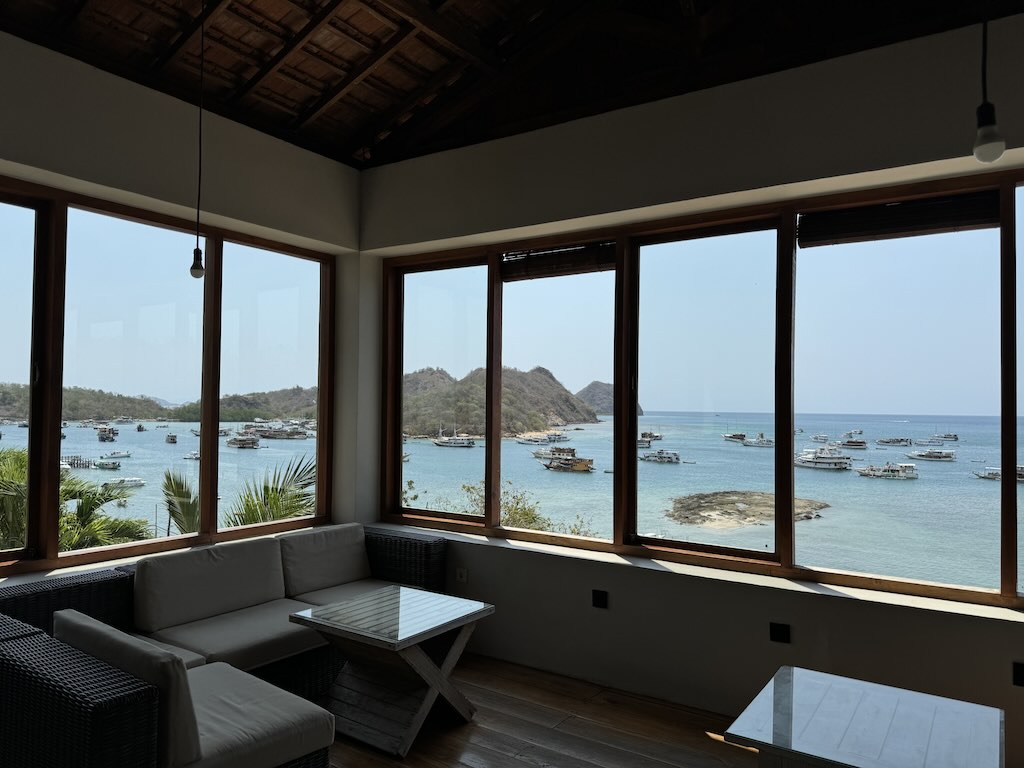
Six Labuan Bajo hotels worth checking
Labuan Bajo fills up fast between June and September, and the good rooms go first. The six addresses below cover the usual range of needs. I have deliberately framed them by what you might need rather than by star ratings — prices, availability and room types change constantly here, so check the current rates and read recent reviews before you commit.
- Seaesta Komodo Hotel & Hostel — the option to look at if you are travelling on a tight budget or solo and want a mix of dorm and private rooms in one place. Check current rates and what is included.
- Puri Sari Beach Hotel — worth checking if you would rather be on a beach than in the middle of town, and are happy to use transfers to reach the marina.
- Loccal Collection Hotel Komodo — a name to compare if the hillside sunset view is your priority. Look closely at which room categories actually face the bay.
- Bintang Flores Hotel — one of the larger, more conventional hotels in the area, useful if you want a pool and predictable facilities after days on a boat.
- Elang Hillside Bamboo Villas — for travellers who want something with more character than a standard hotel room, up on the hillside rather than at harbour level.
- Laprima Hotel — a mid-range option to price up when you want to be within reach of the waterfront without paying resort rates.
Two booking habits that pay off here. Book your first and last nights before you arrive and leave the middle flexible, because your boat schedule may shift with the weather. And confirm the airport transfer in writing — taxis at Komodo Airport are limited, and arriving at midday with no ride and no working data connection is an avoidable start to a trip.
Where to Eat in Labuan Bajo
For a town of its size, Labuan Bajo eats well, largely because everybody arrives hungry off a boat at the same hour and the restaurants have organised themselves around sunset. Three addresses stand out from my stays.
Le Bajo sits at the end of a jetty, out over the water, which makes it the obvious choice for sunset drinks or dinner with the islands in front of you. Taman Laut is where to go for Indonesian food — the cooking is the point rather than the setting, and it is a useful correction after a few days of boat catering. Baccala serves Italian food at a fair price, at the foot of the Triple A hotel, and it is the place I would send anyone who has reached the stage of a trip where they want a plate of pasta and no negotiation about it.
Beyond those, the evening ritual worth joining is the night market on the waterfront, where grilled fish is chosen from the ice, weighed and cooked in front of you, and eaten at long shared tables. It is the cheapest good meal in town and the most sociable. Agree the price before the fish goes on the grill, bring cash, and expect it to be busy from around 6 PM onwards.
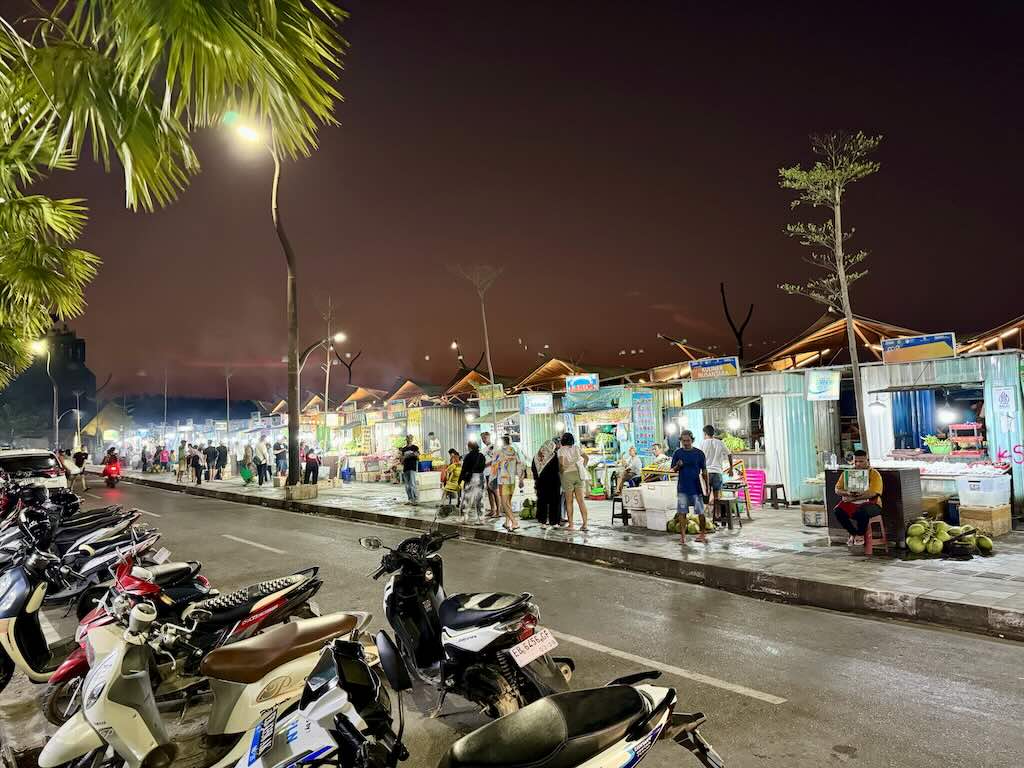
Practical Tips: Getting There, Fees, Best Time
Getting there. Almost everyone flies. Komodo Airport (LBJ) has daily flights from Bali (Denpasar), Jakarta and Surabaya, plus a small number of limited international connections, and the Bali route is short enough that a morning flight leaves you a usable afternoon in town. Book early for July and August, when seats and prices both move against you. If you would rather compare flights, buses and boats on the same screen, you can check routes and fares from Bali to Labuan Bajo on 12Go. For the wider picture of arriving in the country and moving between islands, see my guides on how to get to Indonesia and how to get around Indonesia.
The overland alternative. The other way in is by road across Flores from Maumere, which takes three to four days at a sensible pace and is a genuine highlight rather than a transfer. You can do it with a driver, as I did in March 2021, or on a motorbike, as I did in June 2021. Either way, allow more time than the distances suggest: the Trans-Flores road climbs and turns constantly, and average speeds are low.
Park fees and tickets. Entry to Komodo National Park is charged per person and per day, with separate rates for weekdays, weekends and public holidays, and additional charges for ranger fees and for activities such as diving. The structure has been revised more than once in recent years, so ask your operator for the current, itemised total when you book, and check whether it is included in the tour price or collected separately on the day. Carry cash for anything collected on site.
Best time to visit. The dry season runs from April to November and gives calmer seas, better underwater visibility and clear skies — the conditions most people are picturing when they book. The wet season, December to March, greens the islands, brings the manta season in the south of the park, and delivers rougher crossings and more cancelled boat days. If you can choose freely, July to September is the optimum for both diving conditions and comfort on a boat; if mantas in the south are your priority, accept the swell and come in the wet months instead.
Booking and logistics. Reserve tours well in advance in high season, particularly liveaboards and private charters, which sell out months ahead. For any island walk, carry more water than you think you need, plus a hat and sunscreen — there is no shade on Padar, Rinca or Komodo, and the heat there is a real factor rather than a caution.
Behaving well. Around the dragons, follow your ranger’s instructions without improvising; the rules exist because the animals are dangerous. In the water, do not touch or stand on coral, and keep your distance from mantas rather than swimming at them. Everywhere, take your rubbish back with you — the park has no waste infrastructure on the islands, and what gets left there stays there. None of this is difficult, and all of it is the price of the place staying as good as it is.
Read More About Flores and Indonesia
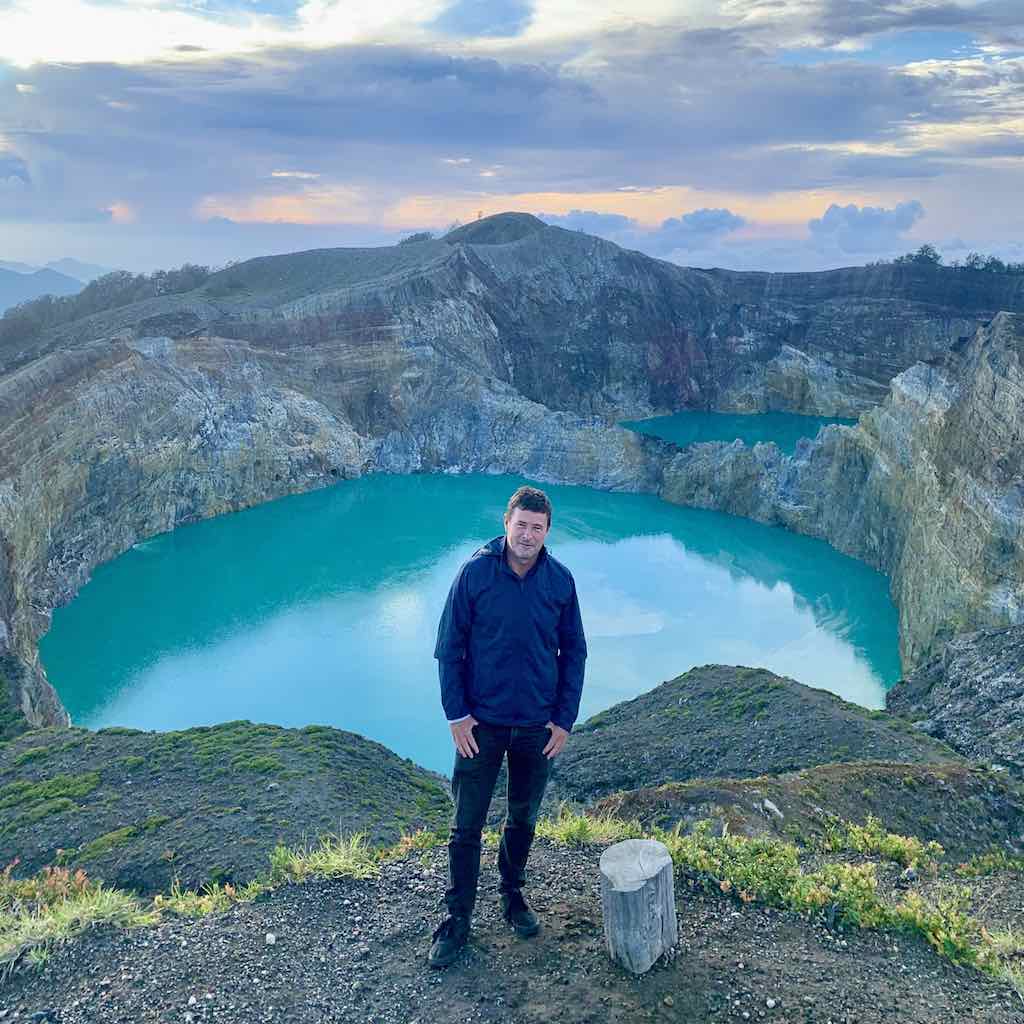
Kelimutu
The three coloured crater lakes above Moni, and the pre-dawn climb that anchors any crossing of Flores.
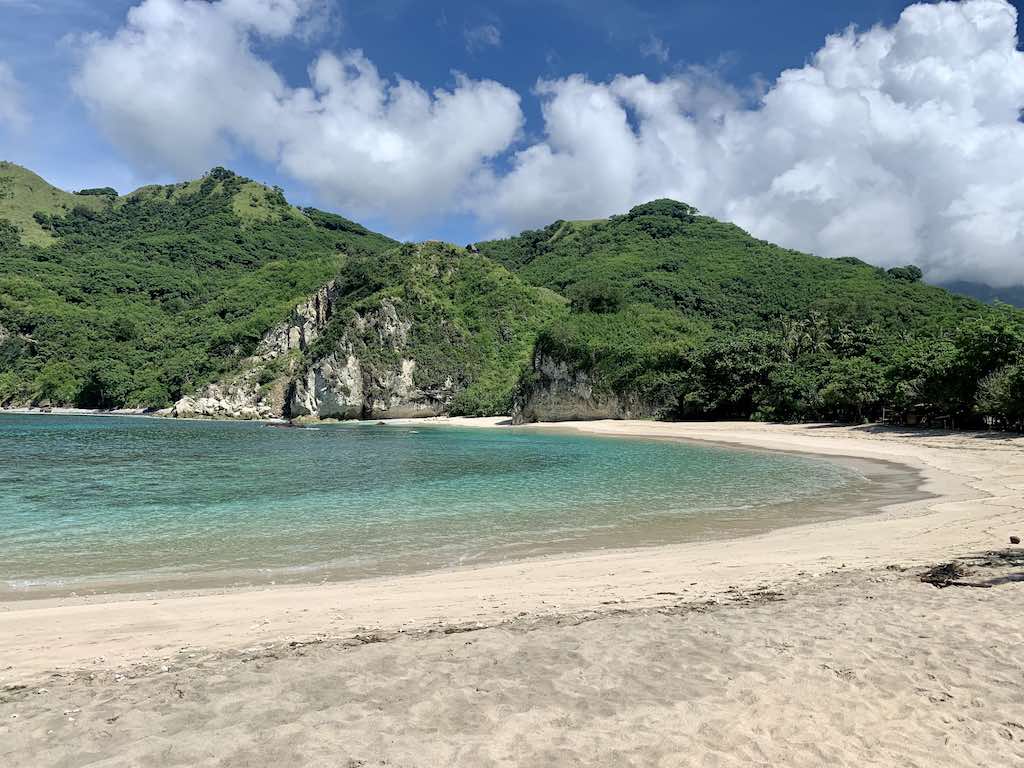
Koka Beach
Two empty crescents of white sand on the south coast, and the best swim stop on the road west from Maumere.
Best Diving in Indonesia
How Komodo compares with Raja Ampat, Bali and the rest of the country’s dive regions, region by region.
Frequently Asked Questions About Labuan Bajo and Komodo
Where is Labuan Bajo?
Labuan Bajo is a harbour town on the western tip of the island of Flores, in West Manggarai Regency, in the Indonesian province of East Nusa Tenggara. It faces the strait that separates Flores from Sumbawa, and the islands of Komodo National Park lie directly offshore to the west. It is roughly 500 km east of Bali, served by its own airport, and it is the only practical base for visiting the park. You can find the geographical detail on the Labuan Bajo entry.
How do you get to Labuan Bajo from Bali?
The simplest way is to fly from Denpasar to Komodo Airport (LBJ), a short domestic hop with several departures a day. Book early for the July–September peak, when both seats and fares tighten. The alternative is to fly to Maumere at the eastern end of Flores and cross the island by road to Labuan Bajo, which takes three to four days and turns the journey into part of the trip — that is how I arrived in March and June 2021.
What is the best time to visit Labuan Bajo?
July to September is the best overall window, combining calm seas, good underwater visibility, clear skies and reliable dragon sightings. The wider dry season runs from April to November and works well throughout. The wet season, from December to March, brings greener islands and the manta season in the south of the park, but also rougher crossings and a higher chance of a cancelled boat day.
How many days do you need in Labuan Bajo?
Plan a minimum of three days, and four to five to see the park without rushing. Three days lets you do one full boat tour, one water day and the town. Four or five adds Rangko, Batu Cermin and a buffer against bad weather. Divers should allow four to seven days, since the best northern sites require full days at sea and you will want a surface interval before flying.
How far is Komodo Island from Labuan Bajo?
Komodo Island is a boat journey of roughly two to four hours from Labuan Bajo depending on the vessel and the sea state, with fast boats at the short end and traditional wooden boats at the long end. Rinca Island, the other dragon-viewing island, is significantly closer, which is why single-day tours usually go there instead. There is no road, bridge or scheduled ferry — every visit to the park is a chartered or shared boat trip from the marina.
Where can you see Komodo dragons?
Within the park you see them on guided ranger walks at two places: Komodo Island, at the Loh Liang ranger post, and Rinca Island, at Loh Buaya. Rinca is closer to town and sightings there are often quicker and more reliable, so it is the standard choice on a day trip. Longer 2D1N and 3D2N tours usually include both. A certified ranger is compulsory on every walk, on both islands.
Are Komodo dragons dangerous?
Yes. They are venomous, powerful and unpredictable, and although attacks on visitors are rare, they do occur. That is precisely why the park requires every group to be accompanied by a certified ranger and why the walks follow fixed trails. Keep the distance you are told to keep even when an animal appears to be asleep, never run, stay with the group, and tell your guide before setting off if you have an open wound.
Is Komodo good for beginner divers?
Parts of it are, and parts of it are firmly not. The central sites around Batu Bolong, Mawan and Tatawa Besar are the accessible end of the park and are typically run for advanced open water divers with some current experience. The northern sites — Castle Rock, Crystal Rock and The Cauldron — involve strong, fast-changing tidal currents and are not beginner dives under any circumstances. If you are newly certified, do a couple of easier days first and let your guide gauge you before you go north.
Should you book a day trip or a liveaboard?
Book a day trip or a 2D1N if you are here for the landscapes, the dragons and the beaches, and a liveaboard if you are here to dive. Day boats cover the classic circuit — Padar, Rinca, Pink Beach, Kalong — efficiently and cheaply, while a liveaboard is the only realistic way to reach the far south of the park and to dive three or four times a day. The best compromise on a short stay, and the one I used in October 2024, is one day of diving followed by one day on a standard tourist boat.
Is the hike up Padar Island difficult?
No, but it is steeper than most people expect. It is a short climb of roughly fifteen to thirty minutes on steps and packed earth, with no technical difficulty and no shade, and the lower viewpoints already deliver the famous three-bay panorama if you would rather not go all the way to the top. Most tours do it before sunrise, so bring a head torch, closed shoes and water even at that hour.
How much does a trip to Labuan Bajo cost?
The honest answer is that it varies more than in most Indonesian destinations, because boats set the budget. The fixed costs are your flight, your accommodation, the park entrance and conservation fees charged per person per day, and your boat — and the boat can range from a shared seat on a day trip to a private liveaboard cabin, an order of magnitude apart. Ask any operator for an itemised quote that states clearly whether park fees, ranger fees, equipment and meals are included, and budget cash on top for what is collected on site, including small excursions such as Goa Rangko, where a private boat for two runs around 250,000 IDR plus a 50,000 IDR entrance ticket.