Mount Bromo, Indonesia: The Complete Travel Guide
By Blaise Jaeger · Updated August 10, 2026
Why Visit Mount Bromo?
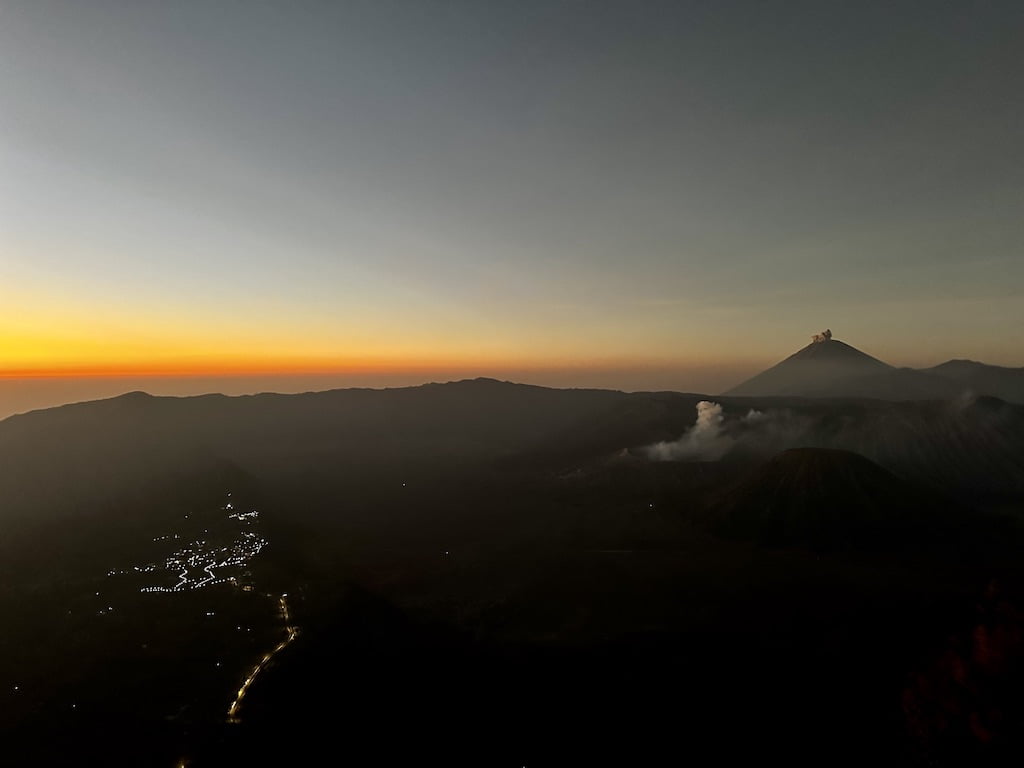
Mount Bromo is not the tallest volcano in Java, not the most active, and not the hardest to reach. It is simply the most photographed, and for once the photographs are honest. You stand on the rim of an old caldera ten kilometres across, and below you three volcanoes rise out of a flat grey plain of volcanic sand: Bromo itself, steaming constantly; Batok beside it, extinct and fluted like a closed umbrella; and behind them, Semeru, the highest mountain in Java, which puffs out an ash cloud roughly every twenty minutes.
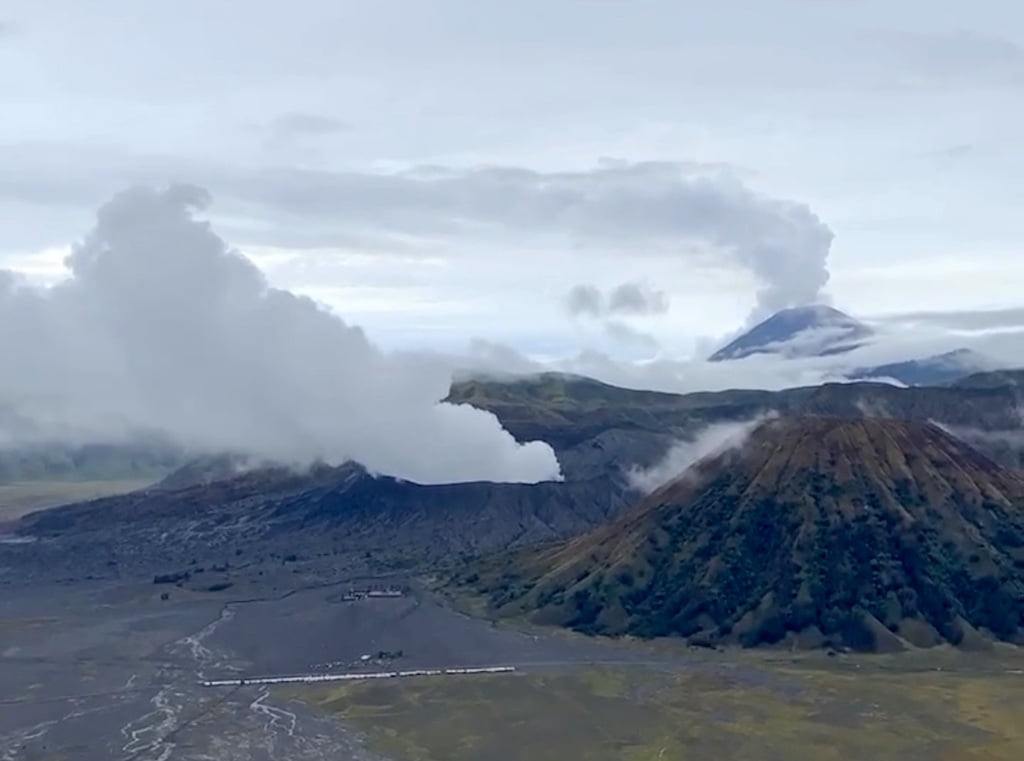
That is the view, and it explains why several hundred jeeps climb to the viewpoints every night. What the photographs do not tell you is the rest of it: that you will be woken at three in the morning, that it will be close to freezing, that you may see nothing at all, and that the walk to the crater rim across the sand is the part most people remember afterwards.
This guide covers all of that. I have been to Bromo twice, in January 2021 and September 2023 — once in the rain and once under a clear sky — and the difference between those two mornings is the reason this article exists. Most Bromo guides describe the perfect sunrise. This one also describes the other one.
Mount Bromo at a Glance
- Where it is: Bromo Tengger Semeru National Park, East Java, Indonesia, inside the Tengger caldera — a crater roughly 10 km across
- Height: 2,329 m — modest for a Javanese volcano, but it sits on a caldera floor already above 2,000 m
- Is it active? Yes. Bromo has been at alert level II (Waspada) since 13 December 2023 and vents gas continuously
- Entrance fee: Rp 255,000 for foreign visitors, flat rate, weekday or weekend (Rp 54,000 / Rp 79,000 for Indonesians), plus Rp 10,000 per vehicle
- Booking: online only, in advance — there is no ticket window at the gate
- Nearest bases: Cemoro Lawang on the caldera rim, Sukapura and Ngadisari on the slope below, Probolinggo on the coast, Malang to the west
- Temperature before dawn: 3–5 °C at the viewpoints in the dry season; the weather station recorded 1.6 °C in July 2026
- Best time to go: May–June and September–October — dry skies without the July–August crowds
- Time needed: one night is enough; two if you want a second chance at the sunrise
My Two Visits to Mount Bromo: 2021 and 2023
I came the first time on 4 January 2021, in the middle of the pandemic, and the second time on 27 September 2023. The two mornings could not have been less alike, and between them they taught me most of what is in this guide.
January 2021: the sunrise that did not happen
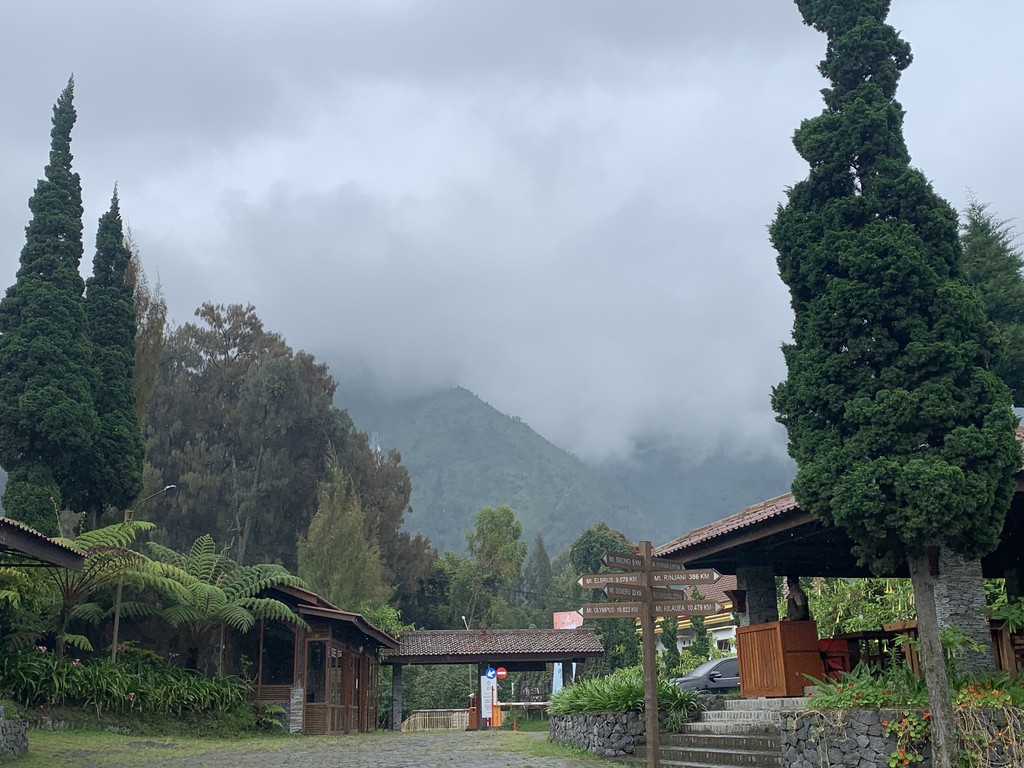
I arrived by train from Yogyakarta, not from Surabaya. It is a long ride — a little over eight hours on the slow economy service — and it drops you in the middle of Probolinggo in the afternoon, which is exactly the right time to get up to the mountain before dark. I slept at the Jiwa Jawa Resort Bromo, which is not in Probolinggo town at all but up in Sukapura, on the slope, in the regency of the same name. That distinction confuses a lot of people booking from abroad: “Probolinggo” on a hotel listing can mean a hotel two hours from the crater or twenty minutes from it.
It was raining when we left, and it was still raining at the viewpoint. There was no sunrise — no horizon line, no volcanoes, nothing but grey. What there also was, and this was the one advantage of travelling in January 2021, was almost nobody. The pandemic had emptied the place. Where there are normally several hundred people jostling for the railing, there were a handful of us standing in the wet.
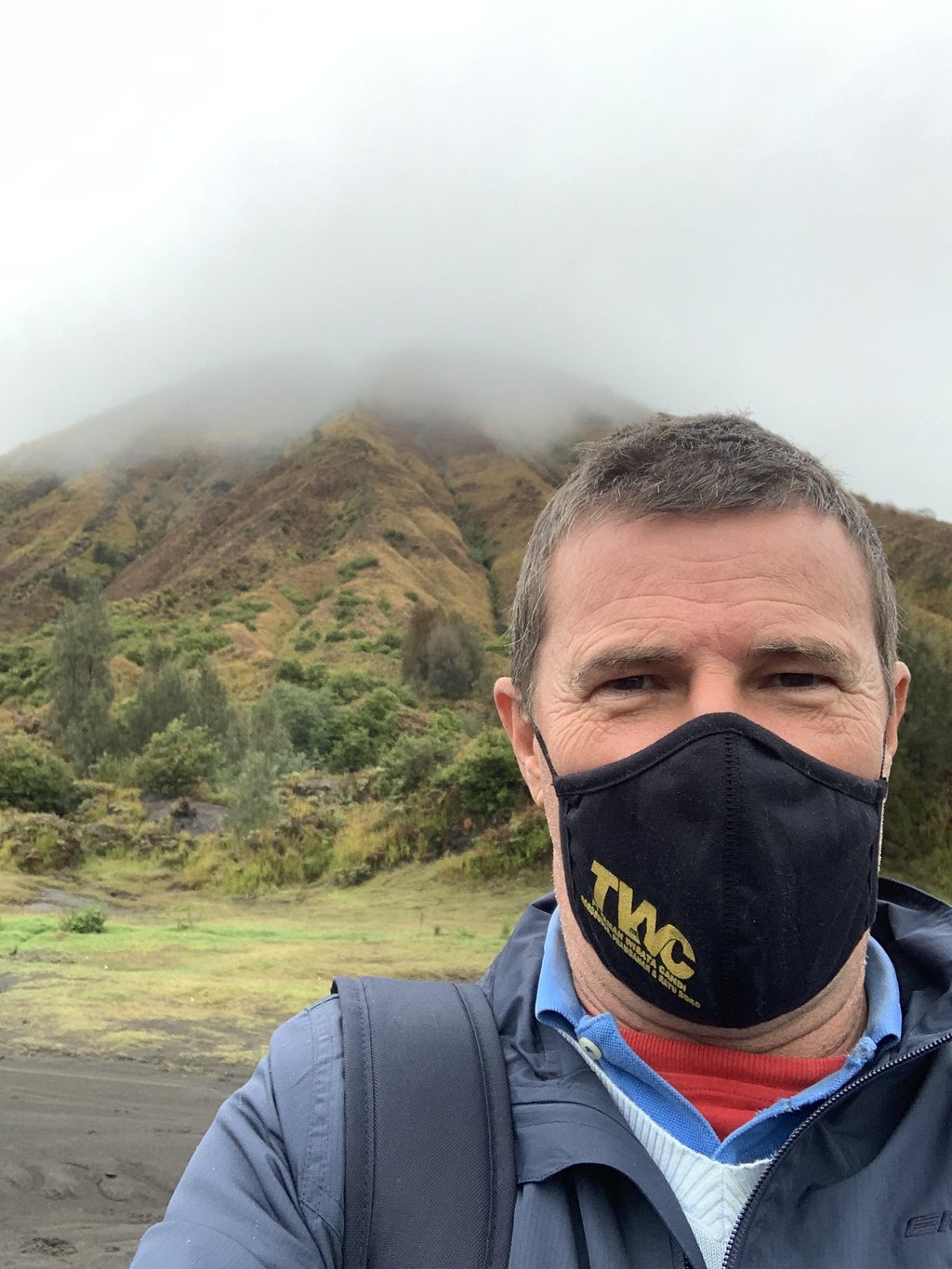
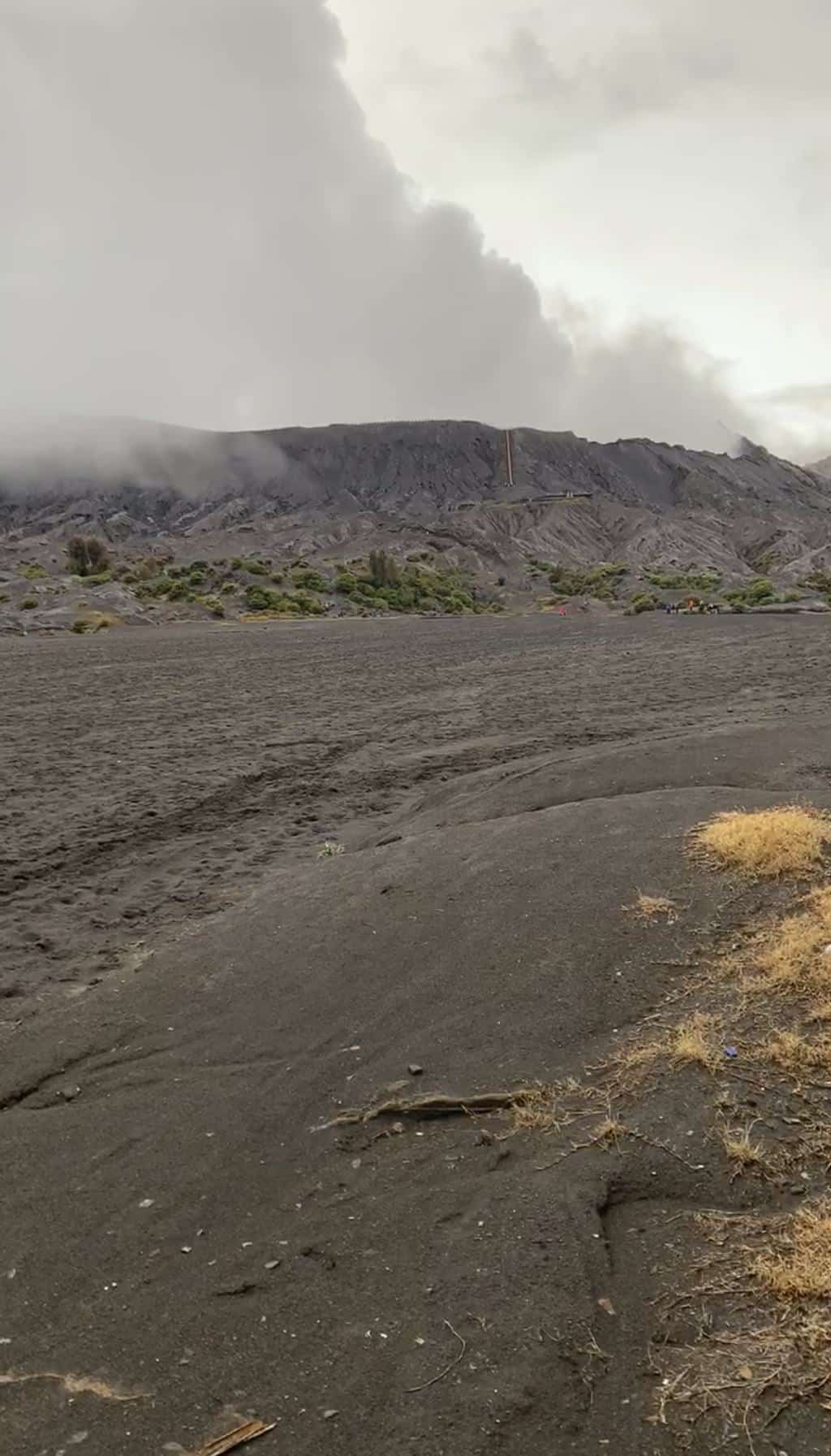
Then, an hour or two after the sun should have appeared, it began to clear. We drove down to the foot of Bromo and the cloud lifted enough to see the cone. I did not climb the stairs that morning — nobody was climbing them, and we were told not to go up. I cannot tell you whether that was an official closure or a decision taken locally that day; I have never found a record of a formal closure in January 2021, so I will describe it as what it was, which is what I saw. We went on to Seruni Point instead, on the Probolinggo side, and from up there the caldera finally opened out.
September 2023: the sunrise from the postcards
The second time was the opposite in every respect. End of September, the dry season, a completely clear sky. We booked the jeep the evening before through the hotel — which is how almost everyone does it, and it is easier than arranging anything in advance from abroad. The volcanoes came out of the dark one after the other, Batok first because it is closest, then Bromo with its plume, then Semeru far behind, and the light went from grey to orange to gold in about fifteen minutes.
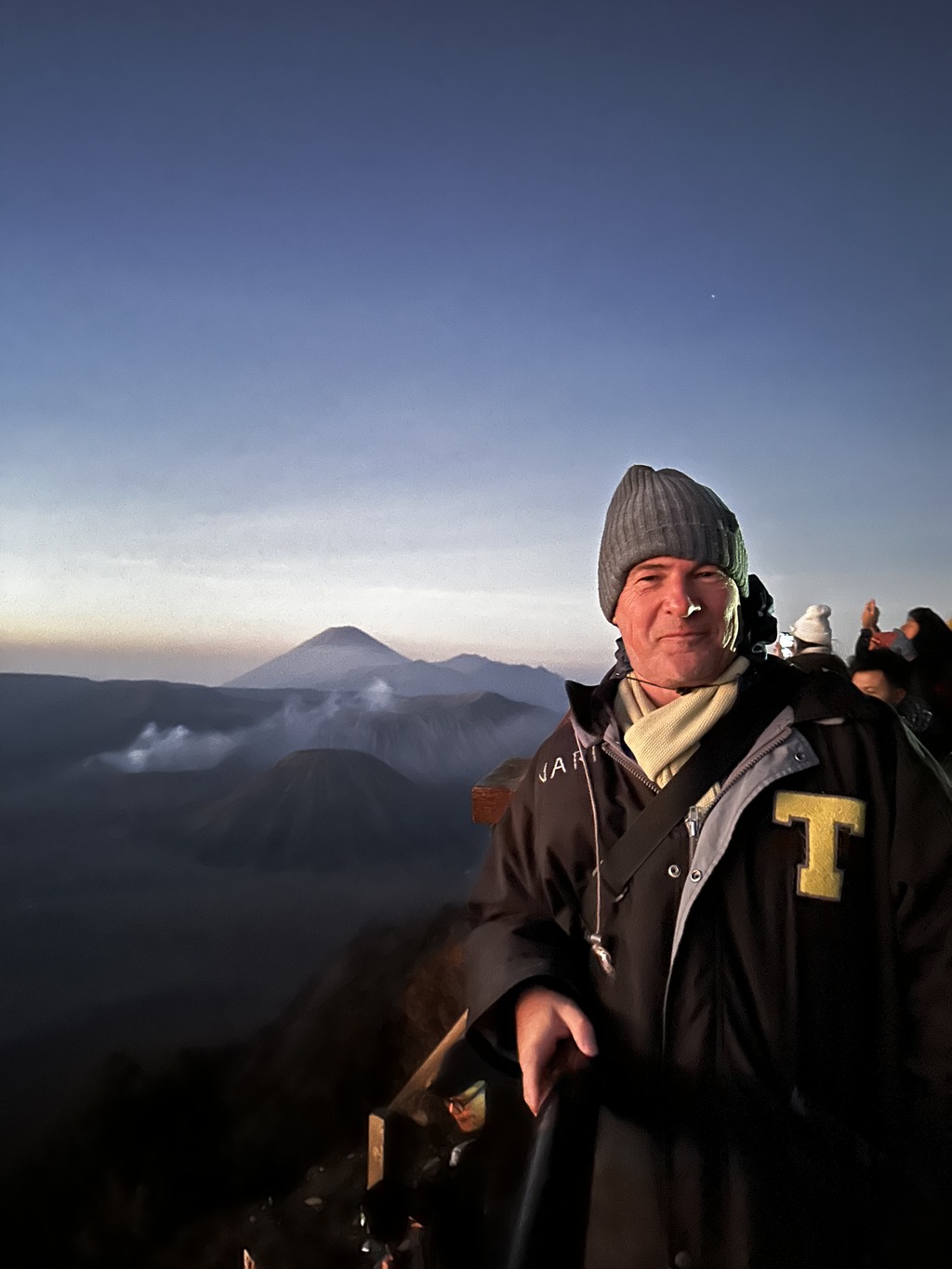
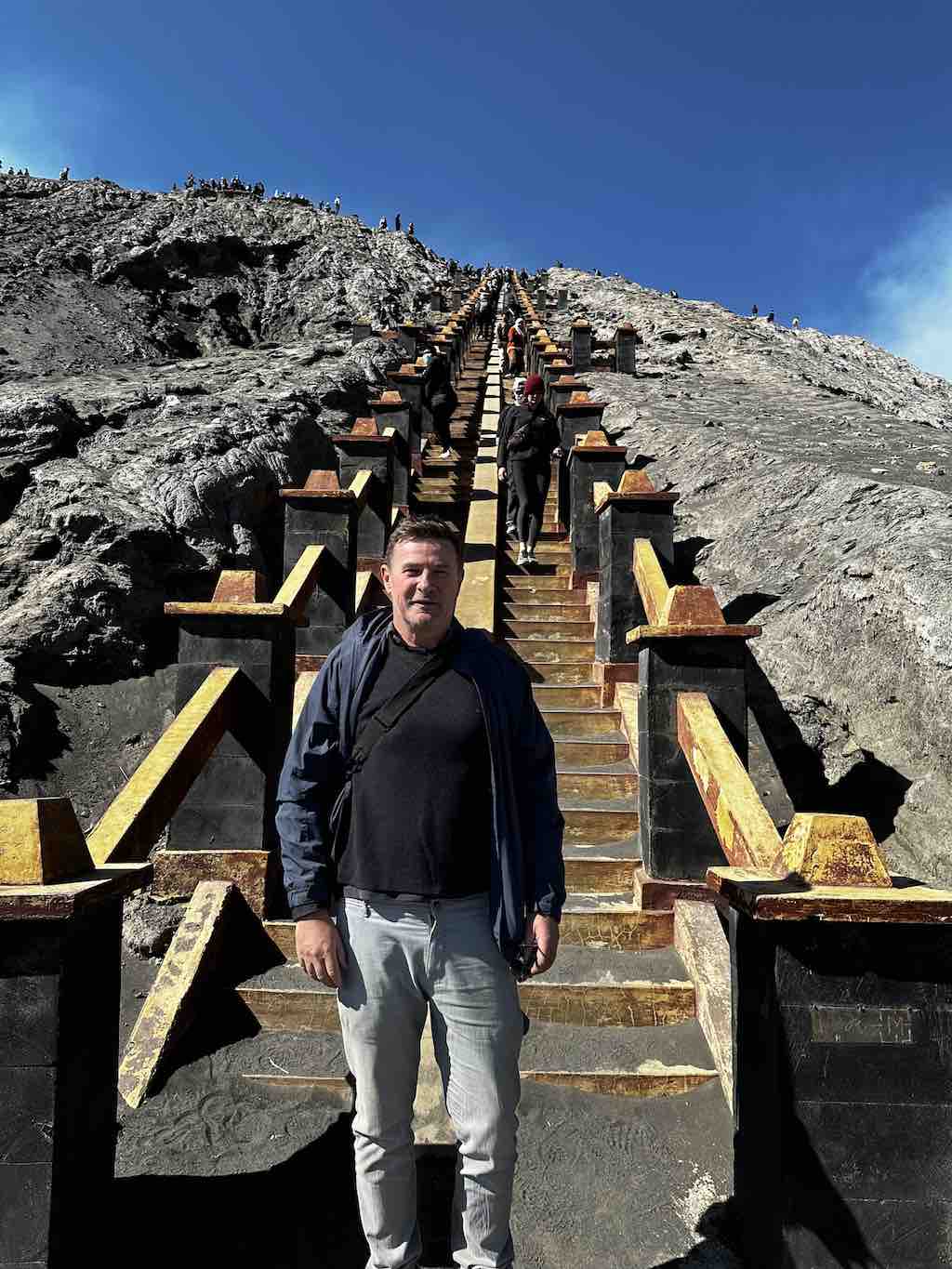
That morning I walked across the sand and climbed the stairs to the crater. I passed the horses on the way — they wait at the bottom of the steps and their owners will offer you a ride across the sand — and I turned them down, which I would do again. The walk is the good part.
The one thing both mornings had in common
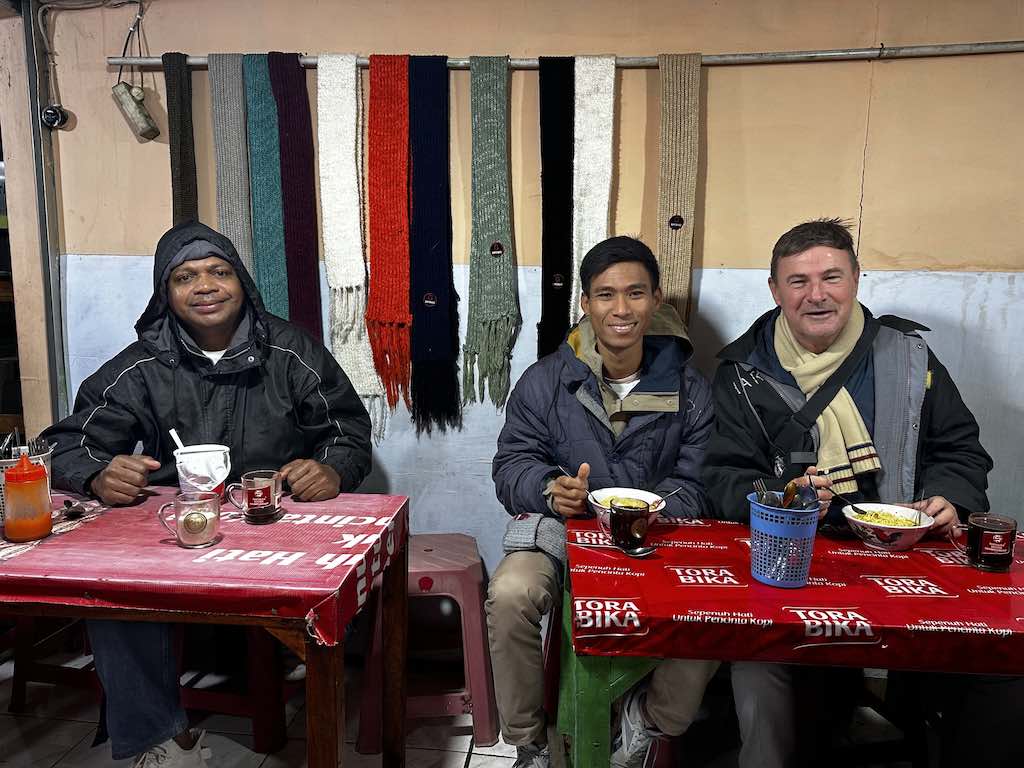
It was brutally cold, both times. I had not brought a coat either time, which was careless, and it did not matter either time, because there are stalls at every viewpoint and every jeep stop renting out thick padded parkas for around Rp 30,000–50,000. Take one. Everybody takes one. You will be standing still in the dark at over 2,000 metres for an hour, in temperatures that regularly sit between 3 and 5 °C — the weather station at Bromo recorded 1.6 °C on the night of 12–13 July 2026, the coldest reading it has ever logged. The photographs of people wrapped in identical dark green parkas are not a tourist gimmick. That is just what the mountain is like at four in the morning.
Is Mount Bromo Open? Alert Level, Closures and the 2026 Wildfire
This is the question to settle before you book anything, because Bromo closes more often than most people expect — and not usually for the reason they expect.
Right now: closed after the August 2026 fire
A wildfire that started on 3 August 2026 spread through the caldera, the savannah and the Caldera Loop Trail. It burned around 10 hectares in the first two days and roughly 520 hectares within a week. On 8 August 2026 at 22:00, the park authority closed all five entrance gates — Cemoro Lawang, Wonokitri, Jemplang, Coban Trisula and Senduro — for an indefinite period.
If you hold a ticket, the park is offering a full refund or a reschedule up to 31 December 2026, and the request has to go through its official channels. Check the current position on the park’s own site before you assume anything: the official domain is bromotenggersemeru.org. Be careful here — the address bromotenggersemeru.id, which blogs were still citing as official in 2026, is now an online casino.
This is not a freak event. In September 2023, a flare set off during a pre-wedding photo shoot at Bukit Teletubbies burned 50 hectares and closed the park for about twelve days. Fire is now a recurring risk at the end of the dry season.
The volcano itself
Bromo has been at alert level II, Waspada, since 13 December 2023. That is the second of four levels, and it comes with an official recommendation to stay one kilometre away from the active crater — a line marked in practice by the Pura Luhur Poten temple on the sand.
There is an obvious tension here, and it is worth stating plainly rather than glossing over: that one-kilometre recommendation would rule out the staircase, and yet the staircase has been open and busy throughout 2024, 2025 and 2026. I have not been able to find any dated official notice lifting the restriction. Treat the crater rim as what it is — an active vent with a standing advisory — and follow whatever the park and your driver tell you on the day.
The real documented danger at Bromo is more mundane. The recorded fatalities in recent years have been on the access roads, not at the crater: a jeep crash on the “Letter S” bend near Wonokitri killed two people on 29 May 2026, and a tourist coach accident on the approach road killed eight.
The scheduled closures
Beyond fires and eruptions, the park closes on fixed dates every year for Tenggerese religious observance and for ecosystem recovery. In 2026 those were 17–18 January (the end of Wulan Kapitu, the fasting month), mid-March for Nyepi, 6–12 April after the Idul Fitri peak, 30 May to 2 June for the Kasada ceremony, and 8–9 December for the start of Wulan Kapitu again. The dates shift each year and are published in a decree towards the end of the preceding year.
Tickets: online only
Since October 2024 you cannot buy a ticket at the gate. Registration is online, payment is by virtual account and has to be completed within two hours of booking. The current price for foreign visitors is Rp 255,000, flat, weekday or weekend, since the new tariff took effect on 30 October 2024. Indonesian visitors pay Rp 54,000 on weekdays and Rp 79,000 at weekends, and every vehicle pays Rp 10,000.
A large number of sites still quote Rp 220,000 and Rp 320,000 for foreigners. Those figures are two years out of date. There is also a daily visitor quota — the only published figure is 3,752 per day during the 2024–25 New Year period, which was described as a thousand above the usual cap.
Choosing Your Sunrise Viewpoint
Almost every article about Bromo talks about “the sunrise viewpoint” as if there were one. There are five, they are at different altitudes, they are reached differently, and the gap between them in the number of people you will share them with is enormous.
Penanjakan 1 — the famous one
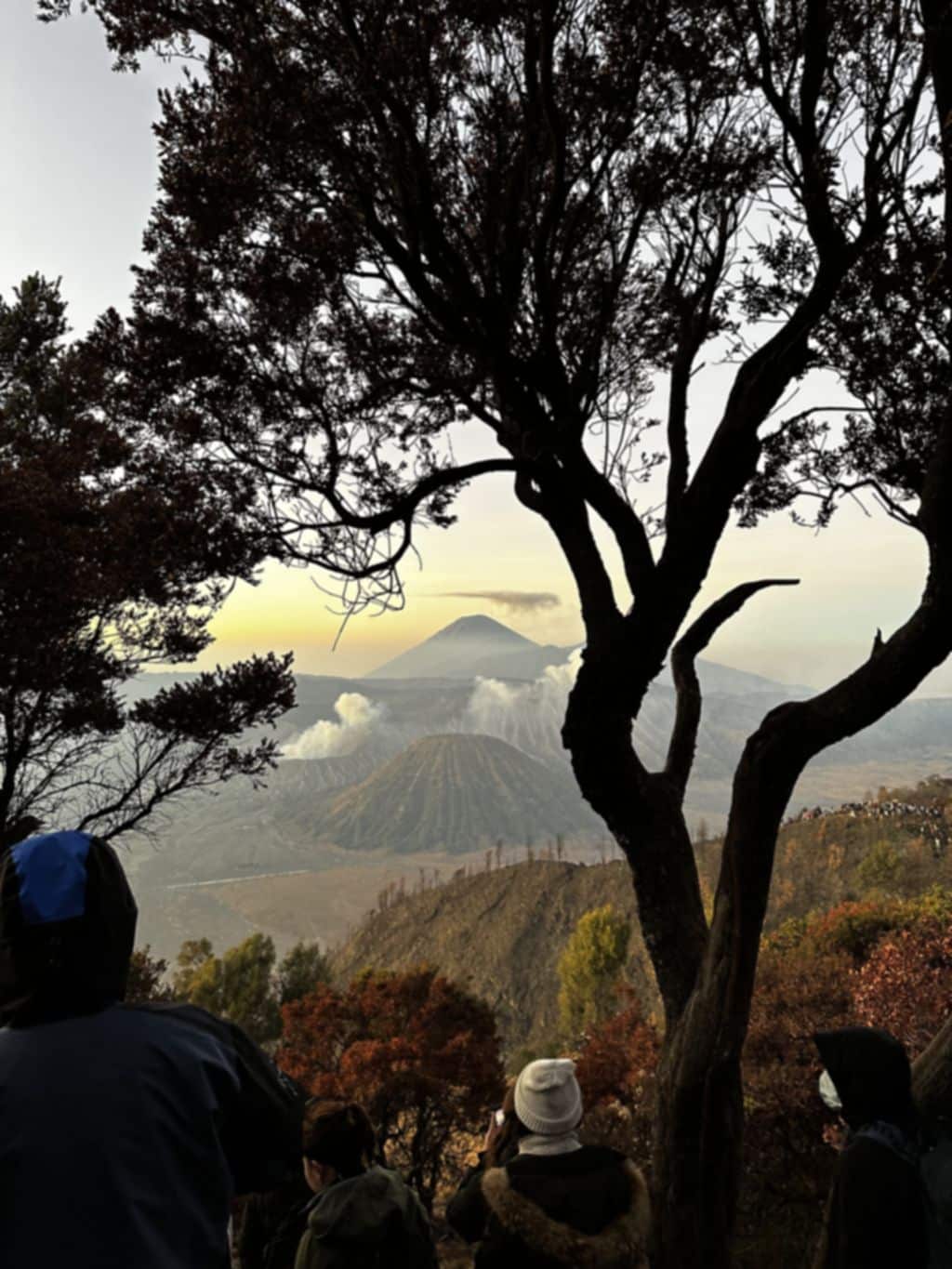
At 2,770 m, on the Pasuruan side above Wonokitri, this is the postcard: Bromo, Batok and Semeru lined up in a single frame. It is also where roughly 80 % of all park visitors go. The road up is steep and narrow, so a jeep is compulsory, and from the car park it is a short walk or a Rp 10,000 ojek ride to the foot of the steps. In high season you want to be there by 03:30–04:00, and even then the parking area will be full and the railing three deep.
Bukit King Kong — the sensible compromise
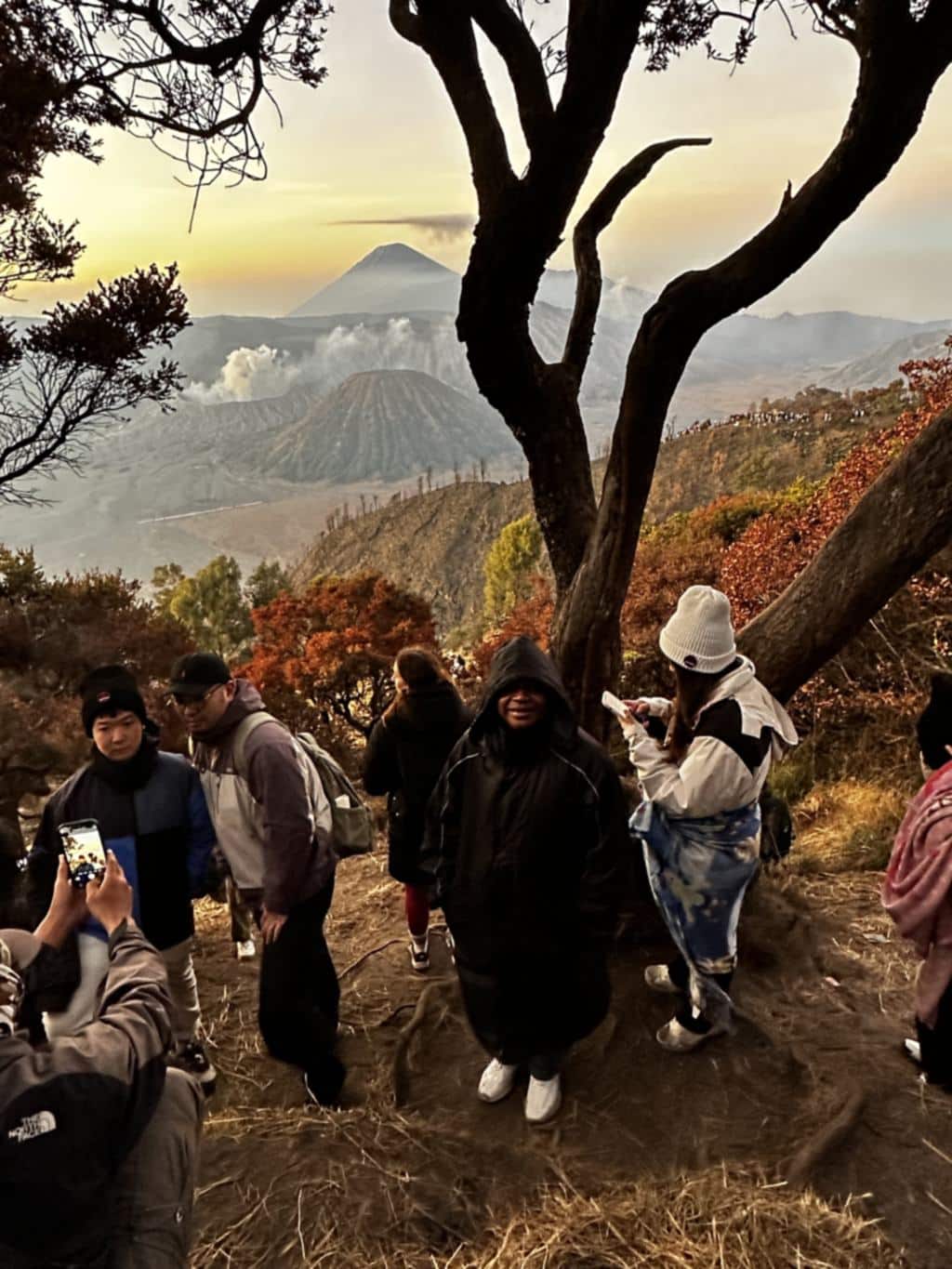
Also called Bukit Kedaluh, at roughly 2,600–2,700 m, a couple of kilometres below Penanjakan 1 on the same road. The jeep drops you at the roadside and you walk a hundred or two hundred metres on a paved path. You still get all three volcanoes, from slightly lower and closer to eye level, and with a fraction of the crowd. There are warungs, toilets and a small prayer room. If your driver offers it as an alternative when Penanjakan is packed, say yes.
Seruni Point — the Probolinggo side
Sometimes called Penanjakan 2, at around 2,400 m. This is the viewpoint reached from Cemoro Lawang and Sukapura, and it is where I ended up on my first visit. The important detail, which almost no one mentions before you go: the jeep does not take you to the top. It stops at a car park, and from there it is a steep path and 256 steps through pine trees, about forty minutes at a walking pace, with seven shelters on the way to catch your breath. There is an ojek for Rp 25,000 that covers half of it, and horses for Rp 100,000–200,000, but the last stretch of stairs is on foot whatever you do. There is a small local ticket of Rp 5,000 on top of the park fee.
Bukit Cinta and Bukit Mentigen — the quiet two
Bukit Cinta, at about 2,680 m near King Kong, is free to enter and functions mostly as an overflow when Penanjakan saturates. You get Bromo, Semeru and Arjuno from it.
Bukit Mentigen is the one worth knowing about if you are travelling on a budget or without a jeep. At 2,200–2,300 m, it is the only viewpoint you can reach on foot from Cemoro Lawang — about a kilometre, fifteen to thirty minutes uphill, leaving around 04:00. The angle is closer and more plunging: Batok, the crater, the Pura Luhur Poten temple on the sand, Semeru behind. Barely anyone is there.
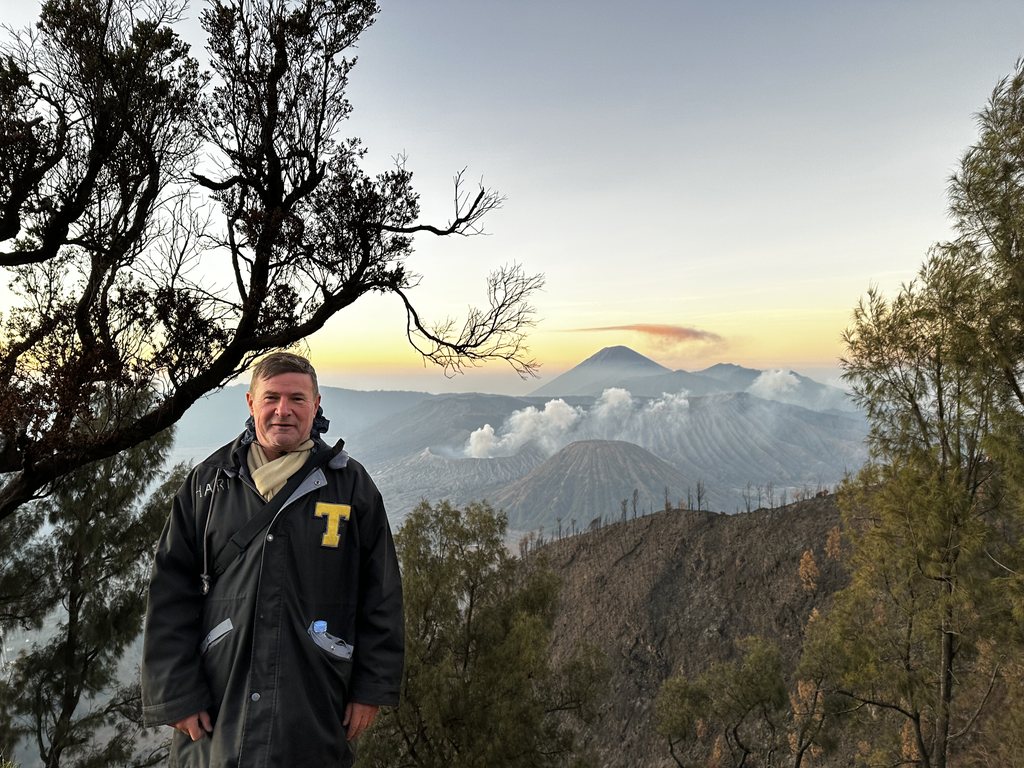
Whichever you choose, look for Semeru. At 3,676 m it is the highest mountain in Java, it is visible from every one of these viewpoints, and it is far more active than Bromo — it has been at alert level III since October 2025 and produced over 2,800 recorded eruptions during 2025 alone. The ash plume you see drifting above the far ridge at dawn is not Bromo’s. It is Semeru’s.
What to Do When the Sunrise Is Clouded Out
Nobody writes this section, and it is the one I needed on 4 January 2021.
If you come in the rainy season — broadly November to March, with January and February at the core of it — the honest expectation is that you will probably not see a sunrise. Low cloud sits in the caldera and the horizon simply is not there. If you come in the dry season you will very likely be fine, but a bad morning is still possible.
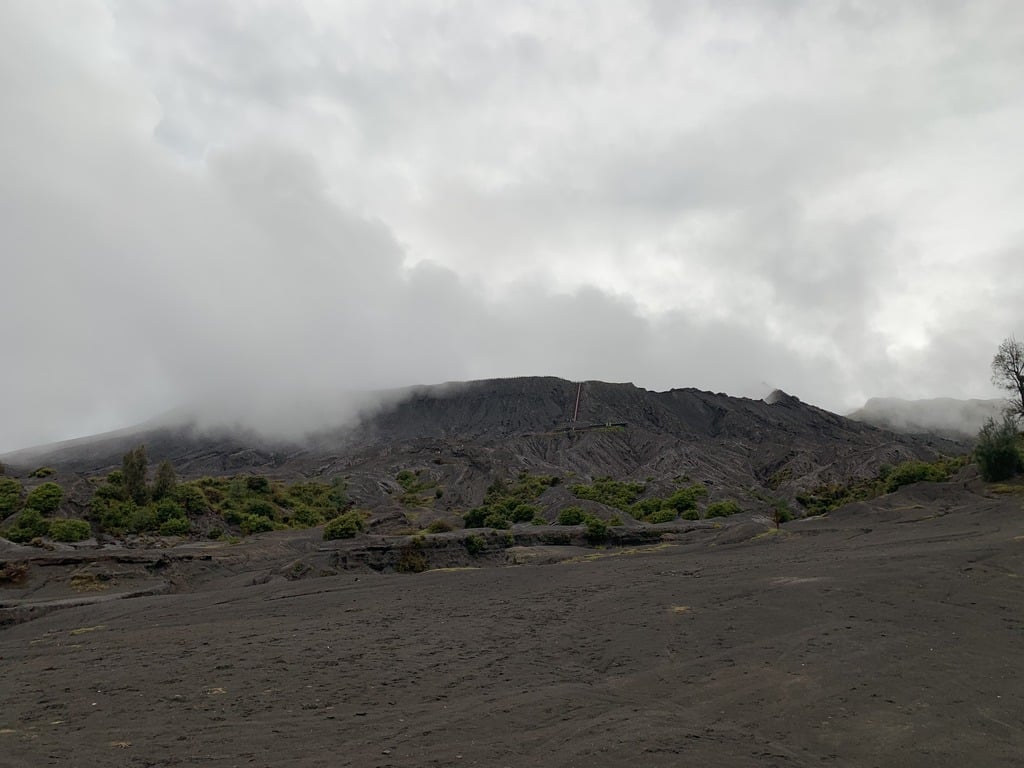
Here is what actually works when the viewpoint gives you nothing.
- Wait, then go down. Cloud at 2,700 m does not mean cloud at 2,300 m. On my first visit the viewpoint was hopeless and the caldera floor, an hour and a half later, was open. Ask your driver to take you down to the sand rather than straight back to the hotel.
- Do the sand and the savannah instead of the panorama. The Whispering Sands and the green hills to the south are at their best under a flat grey sky — they look like a different planet rather than a postcard, and the light does not matter.
- Swap viewpoints. If Penanjakan is buried, Seruni Point and Mentigen sit several hundred metres lower and sometimes sit below the cloud base.
- Give yourself two mornings. This is the only genuine insurance. A second night at Cemoro Lawang costs very little, and a second jeep can be arranged at the hotel the evening before. If the sunrise matters to you, budget for two attempts rather than one.
- Do not pay for a “sunrise guarantee”. Nobody can sell you one, and any operator implying otherwise is selling you weather.
One consolation, if you do land in January: the crowds go with the weather. My worst sunrise was also the emptiest mountain I have seen, and the drive down through cloud to a slowly clearing caldera is a better memory than another photograph of the same three volcanoes.
Climbing to the Crater
After the sunrise, every jeep drives down into the caldera and parks on the sand. From there the crater is reached on foot.
What the walk actually involves
From the jeep park to the foot of the stairs is 1.5 to 2 km across the sea of sand, which takes thirty to forty-five minutes on foot. The sand is fine, deep and constantly kicked up by horses and motorbikes, and this stretch is dustier and more tiring than the climb itself. Then come the steps — around 250 of them, concrete, fifteen to thirty minutes depending on your legs and the altitude. Allow an hour and a half to two and a half hours for the whole round trip from the jeep.
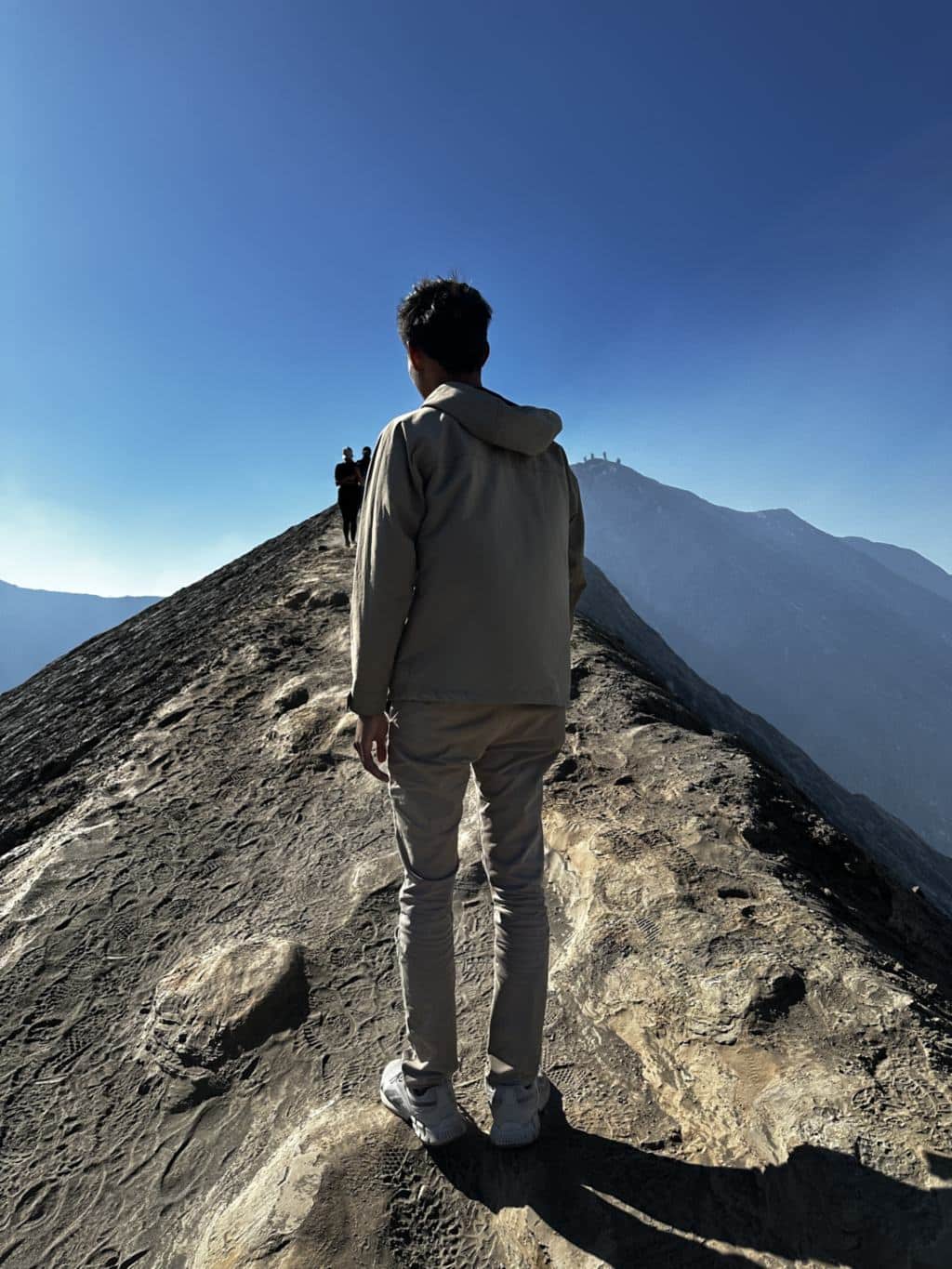
The rim itself is a narrow ledge above a smoking hole. There is a railing along part of it, but not the whole way round, and the drop on the inner side is real.
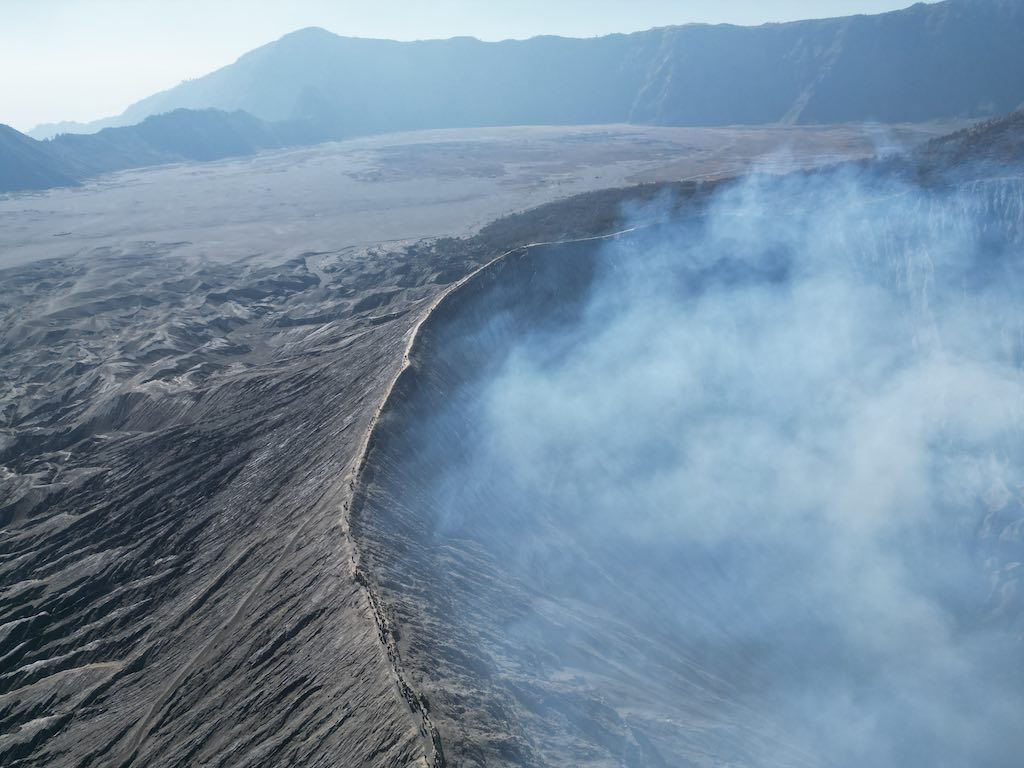
The horses
Tenggerese horsemen wait on the sand and will ride you across it for roughly Rp 150,000–250,000 return, negotiable, and thirty to fifty per cent more in high season. Two things to know. The horse stops at the bottom of the staircase — the 250 steps are on foot either way. And the price is not an official tariff; the park’s own charge for a horse is Rp 1,500 a day, which tells you the rest is a negotiation.
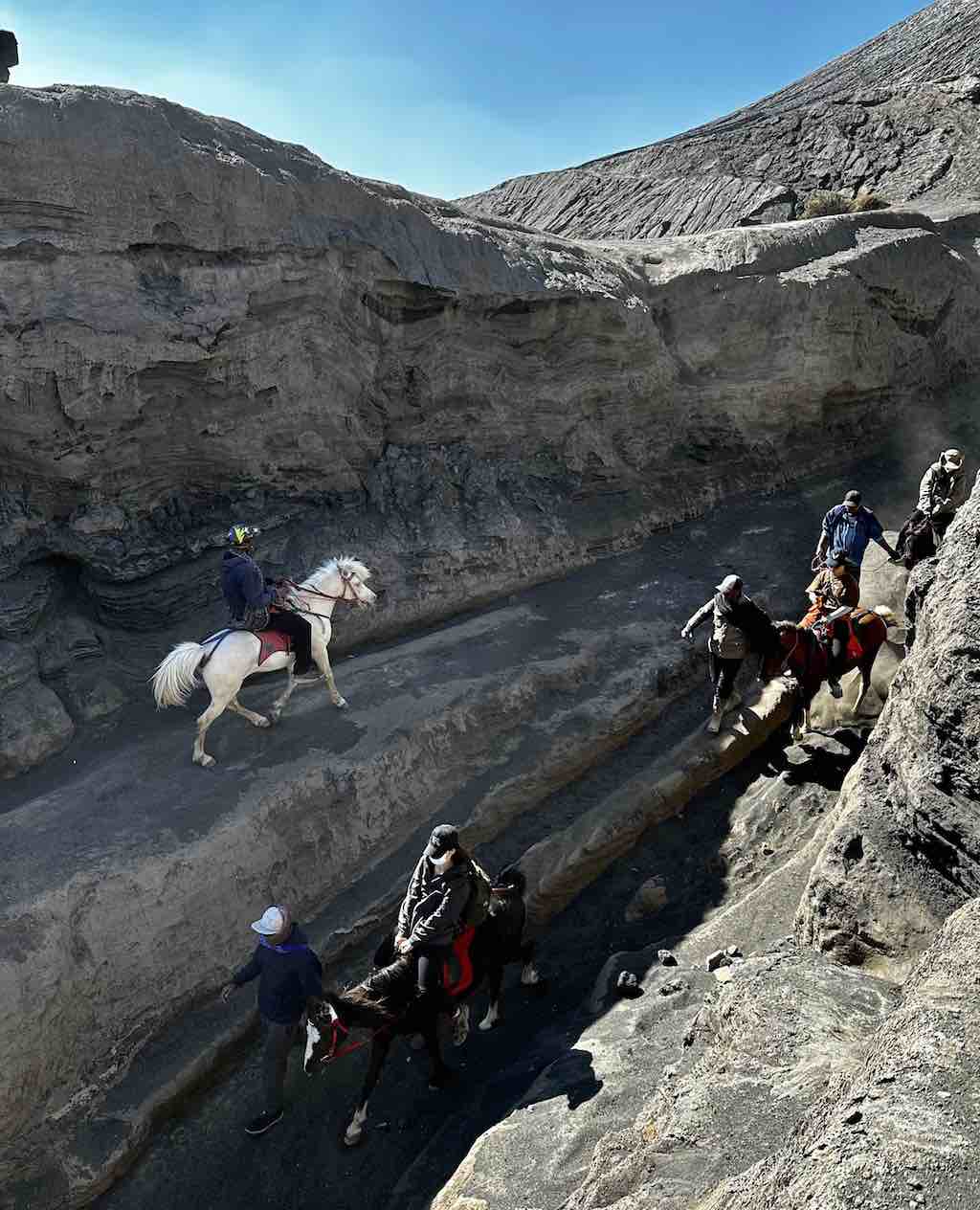
What to bring up
A mask or a scarf for the dust and the sulphur, closed shoes rather than sandals, and water. The sun on the sand after eight in the morning is much stronger than the four o’clock cold suggests, so the parka you were grateful for at the viewpoint becomes something you carry. And do not underestimate the gas: on a still morning it blows straight across the rim path and it stings.
The Sea of Sand, the Whispering Sands and the Savannah
The caldera floor is a landscape in its own right, and it is what most people underrate when they plan a single sunrise stop and leave by nine.
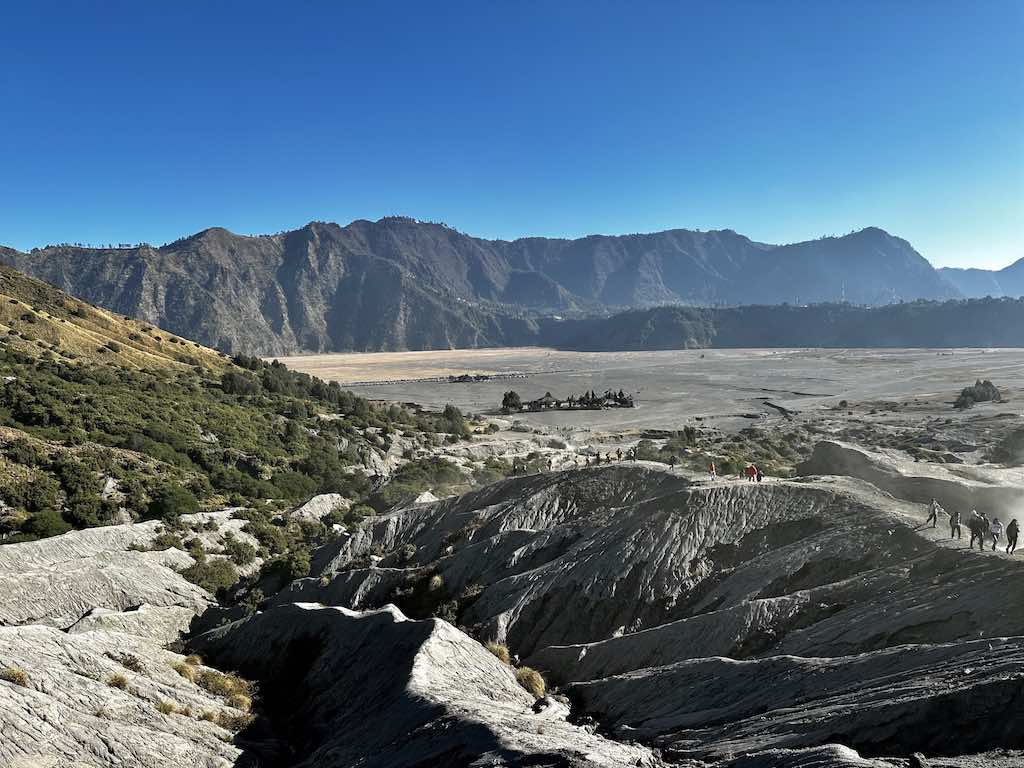
Lautan Pasir — the sea of sand
A flat plain of grey volcanic sand covering the caldera floor, ringed by a wall several hundred metres high. Nothing grows on it. Jeeps cross it in convoy at dawn and the dust hangs in the air behind them. Standing in the middle of it, with Batok’s fluted cone on one side and the caldera wall on the other, is the moment when the scale of the place finally registers — the photographs from the rim flatten it completely.
Pasir Berbisik — the Whispering Sands
The northeastern corner of the plain, named for the sound the wind makes dragging sand across it, and known in Indonesia as the location of a 2001 film of the same name. It is a standard stop on the four-point jeep circuit. Come here rather than the rim if the sky is flat: the interest is textural, not scenic, and it does not need good light.
Bukit Teletubbies and the savannah
South of the sand, the caldera floor turns green: rolling grass hills that Indonesians nicknamed Bukit Teletubbies for the obvious reason. In the rainy season they are genuinely lush, which is the one compensation for coming in January. They also burn — this is where the 2023 fire started, and the 2026 fire reached the savannah too.
If you approach from Malang and Tumpang rather than from Cemoro Lawang, you arrive through this southern side first, and the whole visit runs in reverse: savannah, then Whispering Sands, then the sand, then the crater, with the caldera panorama last instead of first. It is a longer and rougher drive, and it is much quieter.
Jeep Tours: How They Work and What They Cost
You cannot drive your own 4×4 onto the sea of sand. Access is reserved to the local drivers’ associations, the paguyuban, which is why every visitor ends up in the same fleet of old Toyota Hardtops.
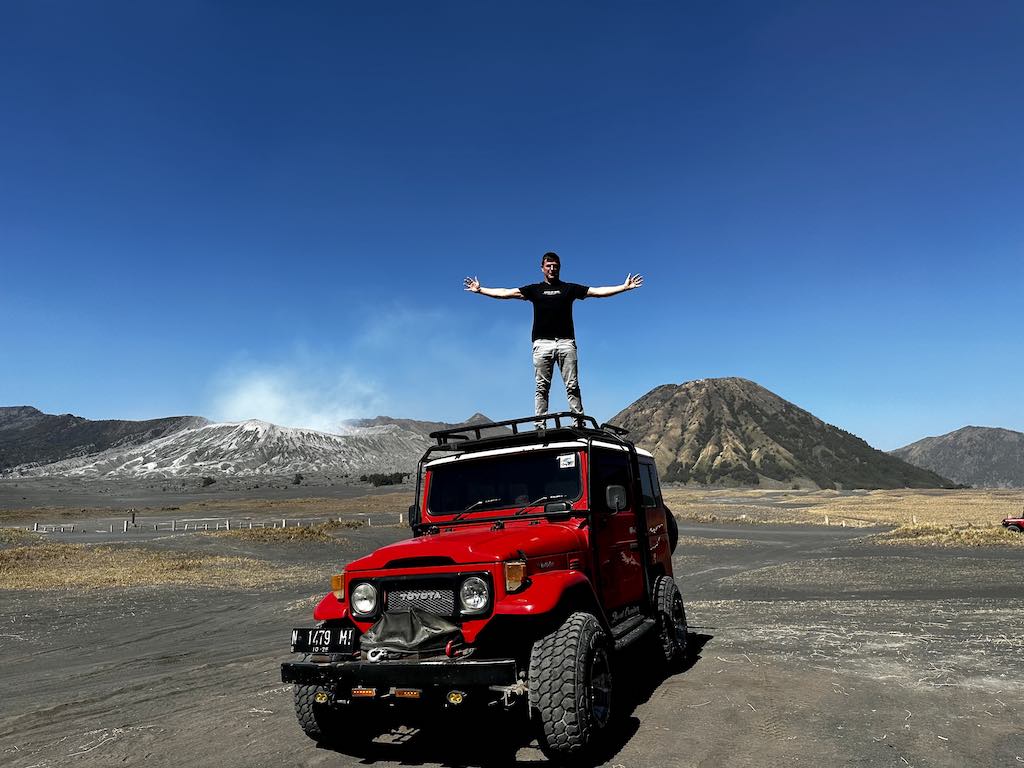
Prices in 2026
Prices are per jeep, not per person, and a jeep takes five to six adults. Split between four or five people it is very reasonable; alone it is not.
- From Cemoro Lawang: around Rp 600,000 for two stops (viewpoint + crater), Rp 700,000 for four stops adding the savannah and the Whispering Sands
- From Sukapura or Wonokitri: around Rp 650,000 and Rp 750,000 for the same
- From Tumpang: around Rp 1,100,000 · from Malang: around Rp 1,300,000 · from Batu: around Rp 1,450,000
These are private operators’ rates, not a regulated tariff, and they rise in July and August. The park entrance fee is not included unless you have bought an all-in package.
Booking one, and what time you actually leave
The simplest way, and the one I used both times, is to ask your guesthouse the evening before. Every hotel in Cemoro Lawang, Ngadisari and Sukapura has an arrangement with a driver. You can also book directly with the association at the gate, or through an agency by WhatsApp in advance — which costs more and gains you very little.
Departure from Cemoro Lawang or Wonokitri is around 03:00, back at the hotel by nine or ten. From Malang or Batu the pick-up is around midnight, because you have two to two and a half hours of mountain road before you even reach the park. If your driver tells you 02:30 rather than 03:00 in July or August, take the earlier time — the parking at Penanjakan fills before four.
One safety note worth taking seriously: the access roads are the genuinely dangerous part of a Bromo trip. The “Letter S” descent near Tosari is a known accident spot, with a fatal jeep crash in May 2026. Do not encourage a driver to make up time on the way down.
The Tenggerese and the Kasada Ceremony
The caldera is not an empty landscape. The Tenggerese have farmed these slopes for centuries and they are one of the few communities in Java to have remained Hindu after the island converted to Islam, practising a form of Hinduism blended with older ancestral belief. The villages of Cemoro Lawang, Ngadisari and Wonokitri are theirs, the horses on the sand are theirs, and the small temple standing alone on the plain — Pura Luhur Poten — is their principal sanctuary.
Their founding story explains the rest. Roro Anteng and Joko Seger, unable to have children, are said to have promised the mountain gods that they would sacrifice their youngest child in exchange for descendants. Twenty-five children later, they had not kept the promise, and the volcano took the last of them, Kesuma, who asked from inside the crater that his people bring offerings every year in his place.
Yadnya Kasada
That is what happens at the Kasada festival, on the fourteenth and fifteenth days of the Tenggerese lunar month of the same name. Villagers walk up to the temple by night, are blessed by their priests, then climb to the crater rim and throw offerings in — vegetables, rice, money, live chickens and goats. It is one of the most striking religious events in Indonesia, and the dates move every year: 21–24 June in 2024, 10–13 June in 2025, 30 May to 2 June in 2026.
Here is the part that matters if you are planning around it, and that a lot of tour operators still get wrong. Since 2024 the park closes completely to tourists for the ceremony — the whole area, all four days, access reserved to accredited participants and residents. Agencies continue to sell “Kasada packages”. If you are offered one, ask them to show you the park’s notice for that year’s dates before you pay.
Where to Stay Around Mount Bromo
Where you sleep decides what time you get up, and the difference is real: two hours of extra sleep between Cemoro Lawang and Malang. There are four sensible options, in decreasing order of proximity.
Cemoro Lawang — on the rim
The village sits directly on the caldera edge, which means you can walk to Bukit Mentigen for the sunrise without a jeep at all, and you leave at three rather than midnight. Rooms are simple, heating is rare, and hot water is not guaranteed — bring a layer for the night as well as the morning.
- Cemara Indah Hotel — the one with the caldera view straight from the terrace, and the reason to book it
- Cafe Lava Hostel — the long-standing backpacker address at the village crossroads, dorms and private rooms
- Bromo Permai 1 — plain, well placed, the middle option
- Good Karma Bromo Guesthouse and BROMO B&B — small family guesthouses, the best value in the village
Sukapura and Ngadisari — on the slope
Twenty to forty minutes below the rim, warmer at night, and where the more comfortable places are. This is where I stayed in 2021.
- Jiwa Jawa Resort Bromo — the best address on the mountain, set in gardens at Wonotoro in Sukapura, and the one I booked
- ARTOTEL Cabin Bromo — newer, design-led, mid-to-upper range
- Yoschi’s Hotel Bromo — a Ngadisari institution, good restaurant, reliable jeep arrangements
- Sky View Bromo Guest House and Bromo Holiday Guest House — simple and cheaper
Probolinggo and Malang — the towns
Probolinggo is the coastal town where the train arrives. Staying there means a very early start, but it makes sense if you arrive late and want to go up the next morning: Bromo Park Hotel is the practical choice near the station, with SM Bromo Hotel as an alternative.
Malang is a proper city with cafés and colonial streets, worth a night in its own right, and the base for the southern approach through Tumpang — at the cost of a midnight pick-up. Hotel Tugu Malang is one of the most characterful hotels in Java, and Ibis Styles Malang is the dependable mid-range option.
On the Pasuruan side, near the Wonokitri gate, the choice is thin — Bromo Backpacker Tosari is about the only thing bookable.
Compare current prices and availability around Mount Bromo on Booking.com →
One warning that applies to the whole area: several well-known Bromo hotels have closed their online listings in recent years, including the Lava View Lodge, which is still recommended in guidebooks and can no longer be booked. If a link takes you to a search page rather than a property page, that is why.
How to Get to Mount Bromo
Bromo sits between two arrival points: Surabaya, the big city and airport to the northwest, and Probolinggo, the small coastal town closest to the mountain. Everything else is a variation on getting to one of those two and then up the slope.
From Yogyakarta by train — the route I took
If you are crossing Java from west to east, this is the natural approach and it works well. Four direct trains run the 405 km from Yogyakarta to Probolinggo:
- Sri Tanjung — from Lempuyangan station around 07:00, arriving about 15:35. Eight and a half hours, economy class only, around Rp 86,000–94,000. Slow, cheap, and it lands you in Probolinggo in time to go straight up
- Logawa — Lempuyangan 09:36, arriving 16:50, about seven and a quarter hours
- Ranggajati — Yogyakarta Tugu around 11:08, arriving 18:24, business and executive class
- Wijayakusuma — an evening departure around 18:40 arriving at 01:45, for those who would rather lose a night than a day
Book through Access by KAI, the national railway’s own app, or through tiket.com or Traveloka. Fares on the faster trains vary a great deal by sub-class and date, so check rather than budget from a blog. Timetables also shift slightly each year — confirm in the app before you commit to a plan.
From Surabaya
Surabaya is the nearest international gateway and it is only about 107 km away. The Probowangi leaves Gubeng station around 05:35 and reaches Probolinggo at 07:49 for about Rp 27,000, which is the best value on the whole itinerary. Half a dozen other trains run through the day, and buses leave the Bungurasih (Purabaya) terminal constantly, with an official economy fare of around Rp 33,000. From the airport, the Damri shuttle to Bungurasih costs about Rp 35,000; a private transfer straight to Cemoro Lawang runs Rp 400,000–600,000 and takes three to four hours.
Probolinggo to Cemoro Lawang — the part that catches people out
The train station is in the centre of town; the minibuses leave from the Bayuangga terminal, five or six kilometres away. An angkot covers that for Rp 4,000–5,000 and an ojek for about Rp 10,000. Touts at the station will offer the same trip for Rp 100,000 and will steer you to a travel agency rather than the terminal. Go to the terminal.
From there, green minibuses known as bison run up to Cemoro Lawang — roughly 38 km, an hour and a half to two hours. Two things govern the experience:
- They only leave when full, which means fourteen or fifteen passengers. In low season that can mean a wait of several hours, and travellers regularly report negotiating a departure with four or five people by making up the difference
- The last one goes at about 16:00. Miss it and you are chartering a car
On the fare, be aware that the figure is disputed. Guides up to early 2026 give Rp 35,000 per person; every source from spring 2026 onwards gives Rp 50,000. There appears to have been a rise, but no official tariff has been published to confirm it. Foreigners are commonly quoted Rp 45,000–75,000 depending on how full the vehicle is. Chartering the whole minibus costs somewhere between Rp 500,000 and Rp 700,000. There is also a small local levy of Rp 10,000–15,000 collected on the road into the village, separate from the park ticket.
Aim to reach Bayuangga between 10:00 and 11:00, when connections from the rest of Java converge and the minibuses fill fastest. Going back down, they leave from the crossroads in Cemoro Lawang, best around 09:00–10:00.
From Malang
There is no public transport between Malang and Bromo. You either charter a jeep from Tumpang — two to two and a half hours through Gubugklakah, Ngadas and the Jemplang pass — or you go to Probolinggo first and pick up a bison there. The Jemplang road is rough, steep and needs proper ground clearance beyond the pass, and it is genuinely treacherous in the wet. What you get in exchange is the southern entrance, the savannah before the sand, and far fewer vehicles.
Onwards to Bali — learn from my mistake
I left Bromo for Bali on a shared minivan from Probolinggo, and it was the worst journey of that trip. The van turned up about two hours late, we were packed in, and it stopped everywhere. A friend travelling the same day took a full-size 32-seat coach from Surabaya and arrived faster and considerably more comfortably.
That was not bad luck, and the numbers explain why. Minivan operators advertise Probolinggo to Denpasar in 6 h 50 to 9 h 30. Booking platforms measuring the same services record an average of 9 h 58 to 11 h 38. The gap is structural: these vans are sold door-to-door, so they tour the pick-up addresses in Probolinggo and then the drop-off addresses across southern Bali. The stops are the product.
What I did not know at the time is that direct coaches run from Probolinggo to Denpasar too — around forty-nine services a day, from about Rp 190,000, leaving mostly between 18:00 and 22:00, averaging just under ten hours. Probolinggo sits on the Surabaya–Bali highway, so you are simply joining a long-distance coach in passing. From Surabaya itself there are over a hundred daily services with twenty-two companies, including proper sleeper buses at Rp 420,000–440,000, for an average of twelve and a half hours.
Whatever you take crosses the Bali Strait on the Ketapang–Gilimanuk ferry: thirty to sixty minutes at sea, but allow an hour and a half to two hours door to door with the loading queues. It runs around the clock, and on a bus you stay aboard while the vehicle is loaded. Then it is another three and a half to four hours from Gilimanuk down to Denpasar, which is the part that lengthens everything.
If your time is worth more than the fare, fly: Surabaya to Denpasar takes just over an hour, there are around 126 flights a week, and tickets start well under fifty dollars.
Compare trains, buses and ferries across Java and Bali on 12Go →
For the wider picture — domestic flights, ferries between islands and what a Java–Bali overland route really costs — see my guide to getting around Indonesia.
Best Time to Visit and Practical Tips
When to go
The dry season runs from about April or May to October and that is when the sunrise is reliable. Within it, May–June and September–October are the sweet spot: clear skies without the July–August crush. July and August give the best visibility, the biggest crowds, the coldest nights and, as 2023 and 2026 both showed, the highest fire risk.
November to March is the rainy season, with January and February at its worst. Expect low cloud, expect no sunrise most mornings, and check the closure calendar — the end of the Tenggerese fasting month falls in mid-January and shuts the park for two days. What you gain is an empty mountain, a green savannah and rooms available on the day.
The cold, seriously
Bromo is the coldest place most visitors to Indonesia will experience. Pre-dawn temperatures at the viewpoints sit around 3–5 °C in the dry season, the record is 1.6 °C, and frost — embun upas — forms on the sand and the grass on clear nights in June, July and August. You will be standing still, in the dark, in the wind.
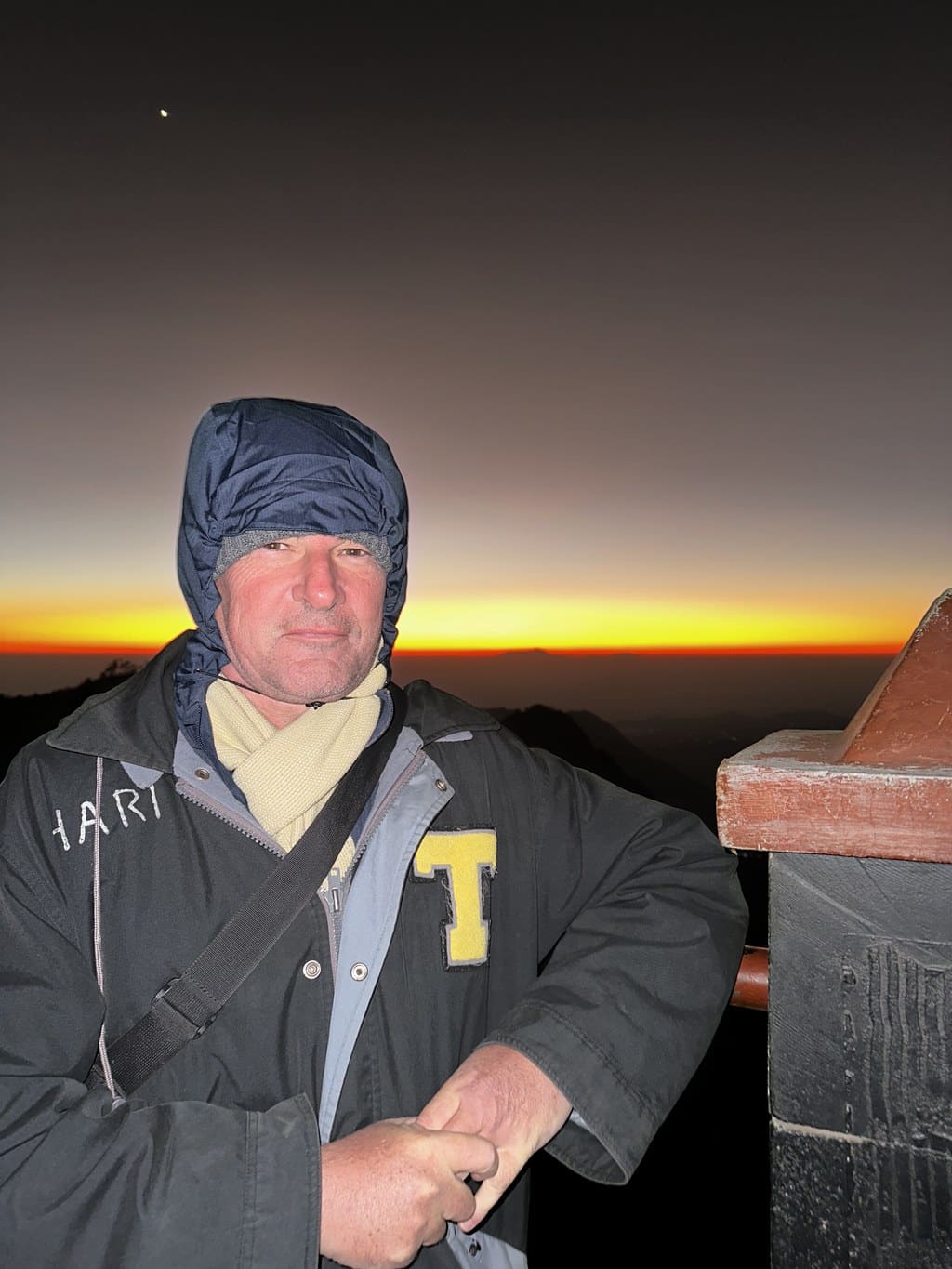
If you have not brought a coat, it does not matter: stalls at every stop rent thick parkas for Rp 30,000–50,000, hats for Rp 15,000–25,000 and gloves for Rp 10,000–20,000. Take one. I did, twice, and I have never regretted it.
Everything else worth knowing
- Buy your park ticket online before you arrive — there is no counter at the gate, payment must be completed within two hours, and there is a daily quota
- Bring cash. Jeeps, horses, parkas, warungs and the village levy are all cash, and ATMs on the mountain are unreliable
- A mask and closed shoes for the sand and the sulphur; sandals will fill with grit in the first hundred metres
- Altitude is mild but real — the viewpoints are at 2,400–2,770 m, and the stairs feel steeper than they are
- Charge everything the night before. Cold flattens phone batteries fast, and you will be shooting in the dark for an hour
- Two nights, not one, if the sunrise is the reason you came
Bromo is one stop on a much larger island. For temples, cities and the rest of the volcanoes, see my guides to Java and to Yogyakarta, Borobudur and Prambanan, or the overview of travelling in Indonesia.
Read More: Indonesia
Yogyakarta
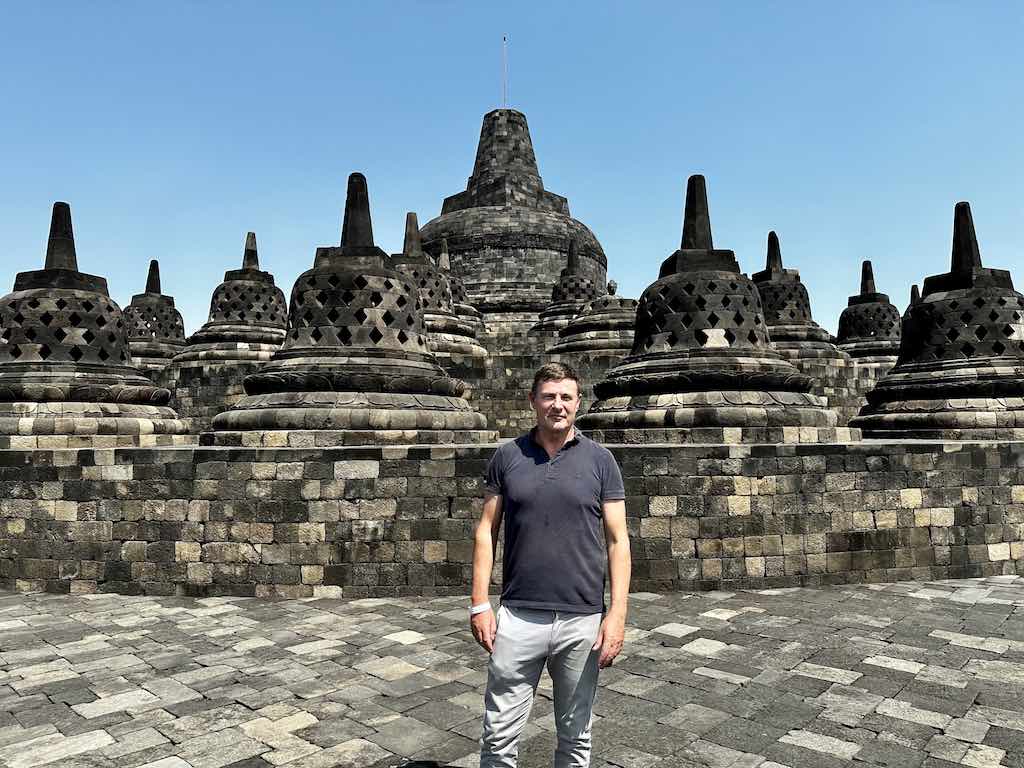
The cultural capital of Java, and the base for Borobudur and Prambanan. The natural first half of any west-to-east crossing that ends at Bromo.
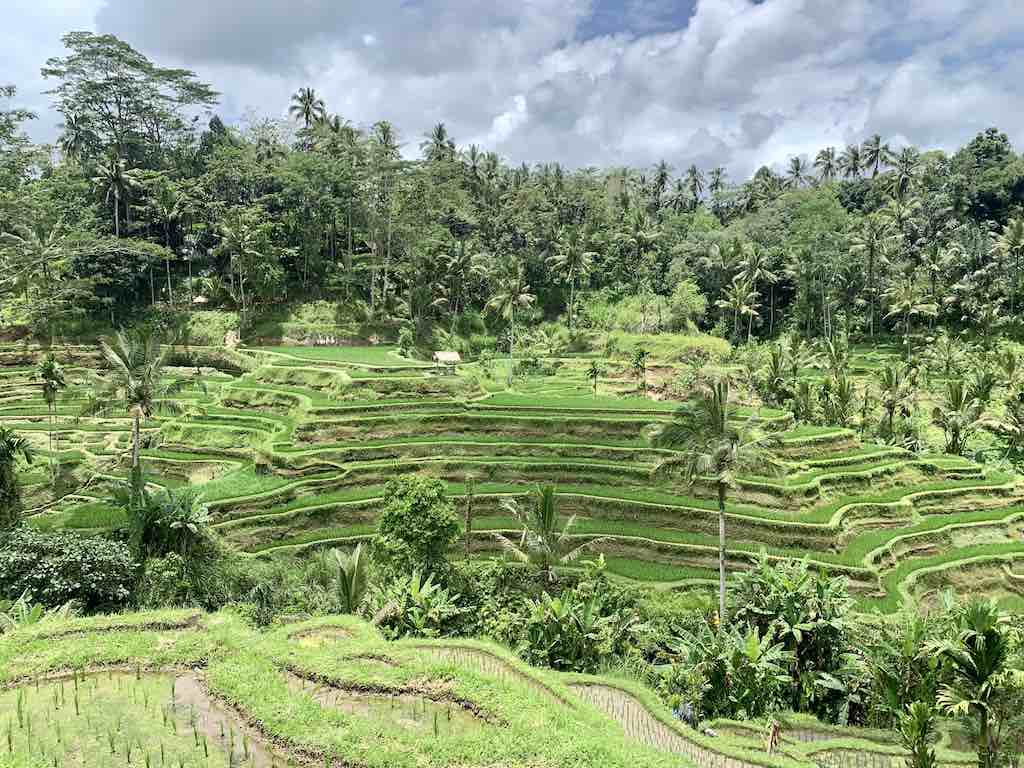
Bali
Where most travellers go next after Bromo, by ferry or by air. Temples, rice terraces, diving and the volcanoes of the north.
Flores
Further east: the three-coloured lakes of Kelimutu, the Komodo dragons, and one of the best road trips in Indonesia.
Frequently Asked Questions About Mount Bromo
Is Mount Bromo active?
Yes. Mount Bromo is an active volcano and has been at alert level II (Waspada) since 13 December 2023, the second of Indonesia’s four levels. It vents gas continuously from its crater and has produced phreatic eruptions with no warning in the past. The official recommendation at this level is to stay one kilometre from the active vent, even though the staircase to the rim has remained open in practice.
Is Mount Bromo open right now?
Not at the time of writing. All five gates closed on 8 August 2026 after a wildfire burned around 520 hectares of the caldera and savannah, and no reopening date has been announced. Bromo also closes on fixed dates each year for Tenggerese ceremonies and ecosystem recovery, so always check the park’s official site, bromotenggersemeru.org, before booking.
How much does it cost to visit Mount Bromo?
The park entrance fee is Rp 255,000 for foreign visitors, flat rate on weekdays and weekends, plus Rp 10,000 per vehicle. A jeep costs Rp 600,000–700,000 from Cemoro Lawang or Rp 1,300,000 from Malang, per vehicle for five or six people. Add roughly Rp 50,000 for a rented parka and Rp 150,000–250,000 if you take a horse across the sand.
Do I need to book my Mount Bromo ticket in advance?
Yes, and this catches people out. Since October 2024 tickets are sold online only — there is no ticket window at the gate. Registration is on the park’s official site, payment is by virtual account and must be completed within two hours, and there is a daily visitor quota.
Which sunrise viewpoint is best at Mount Bromo?
Penanjakan 1 at 2,770 m gives the classic view of Bromo, Batok and Semeru aligned, and about 80 % of visitors go there. For the same view with far fewer people, ask for Bukit King Kong slightly lower on the same road. Seruni Point serves the Probolinggo side but requires a 256-step climb from the car park, and Bukit Mentigen is the only viewpoint you can walk to from Cemoro Lawang without a jeep.
How hard is the climb to the Bromo crater?
It is easy but dusty. From the jeep park it is 1.5 to 2 km across the sea of sand, thirty to forty-five minutes on foot, then around 250 concrete steps taking fifteen to thirty minutes. Allow an hour and a half to two and a half hours for the round trip. No equipment is needed beyond closed shoes, water and something over your mouth for the dust and sulphur.
How cold is Mount Bromo at sunrise?
Between 3 and 5 °C at the viewpoints before dawn in the dry season, and the weather station recorded an all-time low of 1.6 °C in July 2026. Frost forms on the sand and grass on clear nights between June and August. Thick parkas rent for Rp 30,000–50,000 at every stop, and taking one is the standard, sensible thing to do.
What happens if the sunrise is clouded out?
Go down rather than back. Cloud sitting at 2,700 m often does not reach the caldera floor, and the sea of sand, the Whispering Sands and the savannah are all worth seeing under flat light. Lower viewpoints such as Seruni Point and Mentigen sometimes sit below the cloud base. If the sunrise is the reason you came, plan two mornings rather than one — it is the only real insurance.
How do I get from Probolinggo to Cemoro Lawang?
By green minibus, locally called a bison, from the Bayuangga terminal — five or six kilometres from the train station, reached by angkot for Rp 4,000–5,000. The ride takes an hour and a half to two hours. Fares are quoted at Rp 35,000 in older guides and Rp 50,000 in 2026 sources, with foreigners commonly asked Rp 45,000–75,000. The minibuses only leave when full, and the last one goes at around 16:00.
Where should I stay to visit Mount Bromo?
Cemoro Lawang if you want the shortest possible start and the option of walking to a viewpoint. Sukapura or Ngadisari, twenty to forty minutes below, for more comfortable hotels and a warmer night — the Jiwa Jawa Resort Bromo is the best of them. Probolinggo works if you arrive late by train, and Malang if you want a city and the quieter southern approach, at the cost of a midnight departure.
When is the Kasada ceremony, and can tourists attend?
Yadnya Kasada follows the Tenggerese lunar calendar and moves each year: 21–24 June 2024, 10–13 June 2025, and 30 May to 2 June 2026. Since 2024 the park has closed completely to tourists for the duration, with access limited to accredited participants and residents. Tour operators still selling “Kasada packages” are selling access the park does not currently grant.