Yogyakarta, Borobudur and Prambanan: The Complete Travel Guide
By Blaise Jaeger · Updated August 11, 2026
Why Visit Yogyakarta?
Yogyakarta is the only city in Indonesia still ruled by a sultan, and the only province where the head of state becomes governor without an election. That single fact explains most of what makes the city different: a working palace in the middle of the street grid, gamelan played at nine in the morning because the court says so, batik workshops that supply the palace rather than the airport, and a population that will tell you, politely but clearly, that Jakarta is the capital but Yogyakarta is the culture.
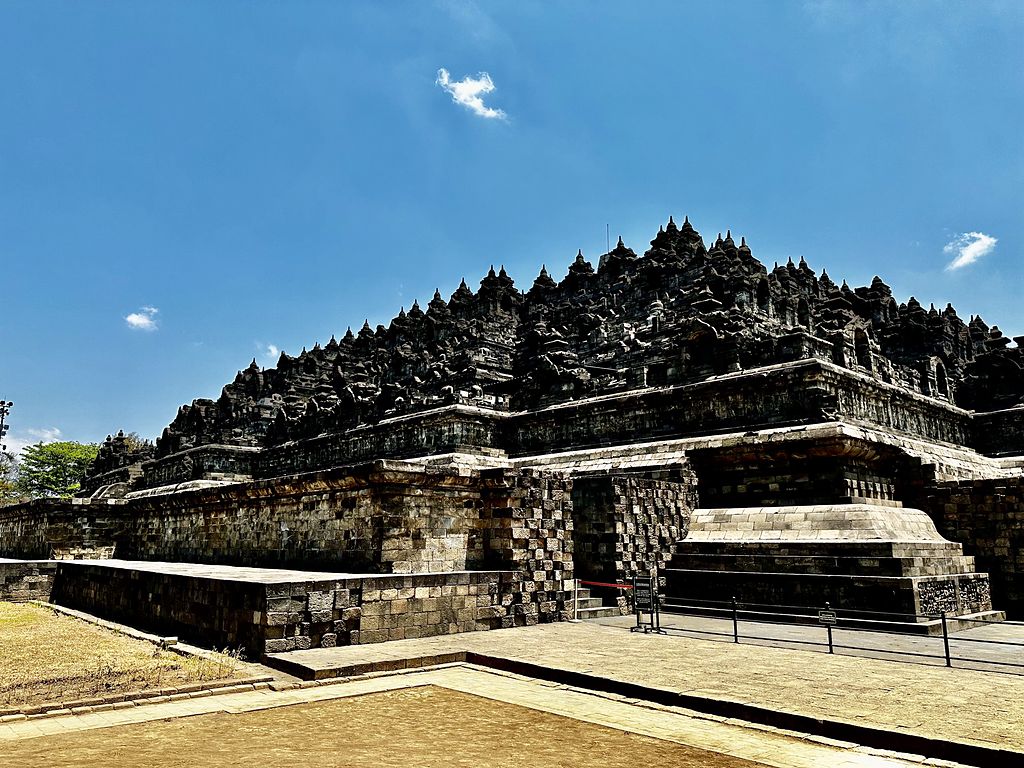
It is also the base for the two greatest monuments in Southeast Asia. Borobudur, the largest Buddhist monument in the world, is forty kilometres to the northwest. Prambanan, the tallest Hindu temple complex in Indonesia, is seventeen kilometres to the east. Both are ninth century, both are UNESCO World Heritage sites, and both can be reached from the same hotel room — which is why almost nobody sleeps at the temples and almost everybody sleeps in Yogyakarta.
What the brochures leave out is everything around them. An active volcano twenty-eight kilometres north that has been on alert level III since 2020. A limestone coast to the south with cave descents and a wooden cable car strung over the surf. A second royal city an hour away by commuter train. Street food that costs less than a euro and has queues at eleven at night. And a scam on the main tourist street so well organised that it has its own script.
I have been to Yogyakarta three times — in January 2021, September 2023 and May 2024 — and those three visits could not have been more different. The first was during Covid, when the streets were empty and the top of Borobudur was closed. The second was a single sunlit day when I finally climbed it. The third was a private party at the foot of the temple at night. This guide is built on all three, plus the practical details I had to look up each time because no one had written them down properly.
Yogyakarta at a Glance
- Where it is: south-central Java, Indonesia, about 25 km from the Indian Ocean and 28 km south of Mount Merapi. Roughly 430 km east of Jakarta and 330 km west of Surabaya
- What it is: capital of the Special Region of Yogyakarta (DIY), the only Indonesian province ruled by a hereditary monarch — Sultan Hamengkubuwono X, who is governor by right rather than by election
- Population: around 400,000 in the city, some 4 million in the wider region, with more than 100 universities — this is the student capital of Indonesia
- The two big temples: Borobudur 40 km northwest, Prambanan 17 km east. Both ninth century, both UNESCO
- Airport: Yogyakarta International Airport (YIA), 45 km west of the centre. The old airport, Adisutjipto, still operates and still holds the code JOG — check which one your ticket says
- Entrance fees, foreign visitors, 2026: Borobudur grounds around Rp 411,000, climbing to the top Rp 455,000; Prambanan Rp 400,000; the Kraton Rp 25,000; Taman Sari Rp 25,000
- If you hold a KITAS, you pay the Indonesian price at Borobudur, Prambanan and Ratu Boko — Rp 50,000 instead of Rp 400,000. See the section below, this is official and almost nobody mentions it
- Best time to go: the dry season runs roughly April to October, peaking in August. Avoid the Lebaran holiday week and Indonesian school holidays in late June and July
- Time needed: two days for the city and the two temples, three or four to add Merapi, the south coast or Solo
Yogyakarta, Jogja, Yogya or Djokjakarta?
All four are the same place, and the confusion is not your fault. Yogyakarta is the official spelling. Jogja — sometimes written Jogia or Jogya — is what everyone actually says, including the city’s own tourism board. Yogya is the shorter version of the same nickname. Djokjakarta is the old Dutch colonial spelling, still seen on antique maps and in a few hotel names.
The pronunciation is the part that trips people up: the J is soft, closer to an English j than to a French one, and the whole thing runs together as JOG-ja-KAR-ta. Say “Jogja” to a taxi driver and you will be understood immediately. Say “Yogyakarta” carefully and you will be understood too, just more slowly.
The name itself comes from Ayodhya, the city of Rama in the Ramayana, combined with karta, prosperity. Which is a neat piece of circularity, because the Ramayana is still performed every week in front of Prambanan, seventeen kilometres away.
My Three Visits to Yogyakarta: 2021, 2023 and 2024
January 2021: the first foreigner of the year
I flew in from Sulawesi on 31 December 2020 and slept that night at the Swiss-Belboutique, a few minutes’ walk from Malioboro. The country was closed, the city was empty, and walking out the next morning I found an eight-lane approach to the presidential palace with no cars on it at all. I have never seen Yogyakarta like that since, and I do not expect to again.
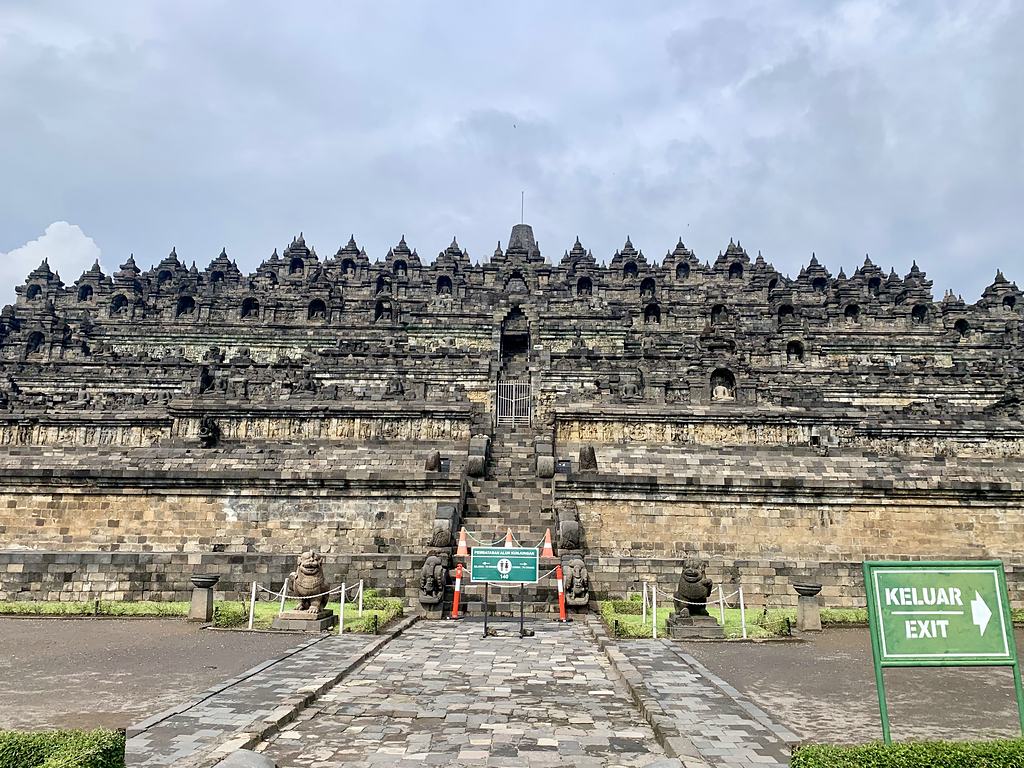
I went to Borobudur that same day, 1 January 2021. It turned out that I was the first bule — the Indonesian word for a Western foreigner — to visit the temple that year, and a local newspaper ran a short piece about it. That is the sort of thing that only happens in a pandemic, and it is the only time in my life a newspaper has been interested in me buying a ticket.
The site was not deserted — there were Indonesian visitors, masked, spread out across the terraces — but the climb to the upper platforms was closed. You could walk the grounds and look up at the stupas from below, and that was all. I did not get to the top of Borobudur on that trip.
Prambanan, on the other hand, was open. I went two days later and walked the whole complex behind a mask, past a large concrete #COVIDSAFE sign that someone had installed at the entrance and that now reads like a time capsule. From there I carried on to Ratu Boko and to Candi Sewu, both of which I had almost entirely to myself.
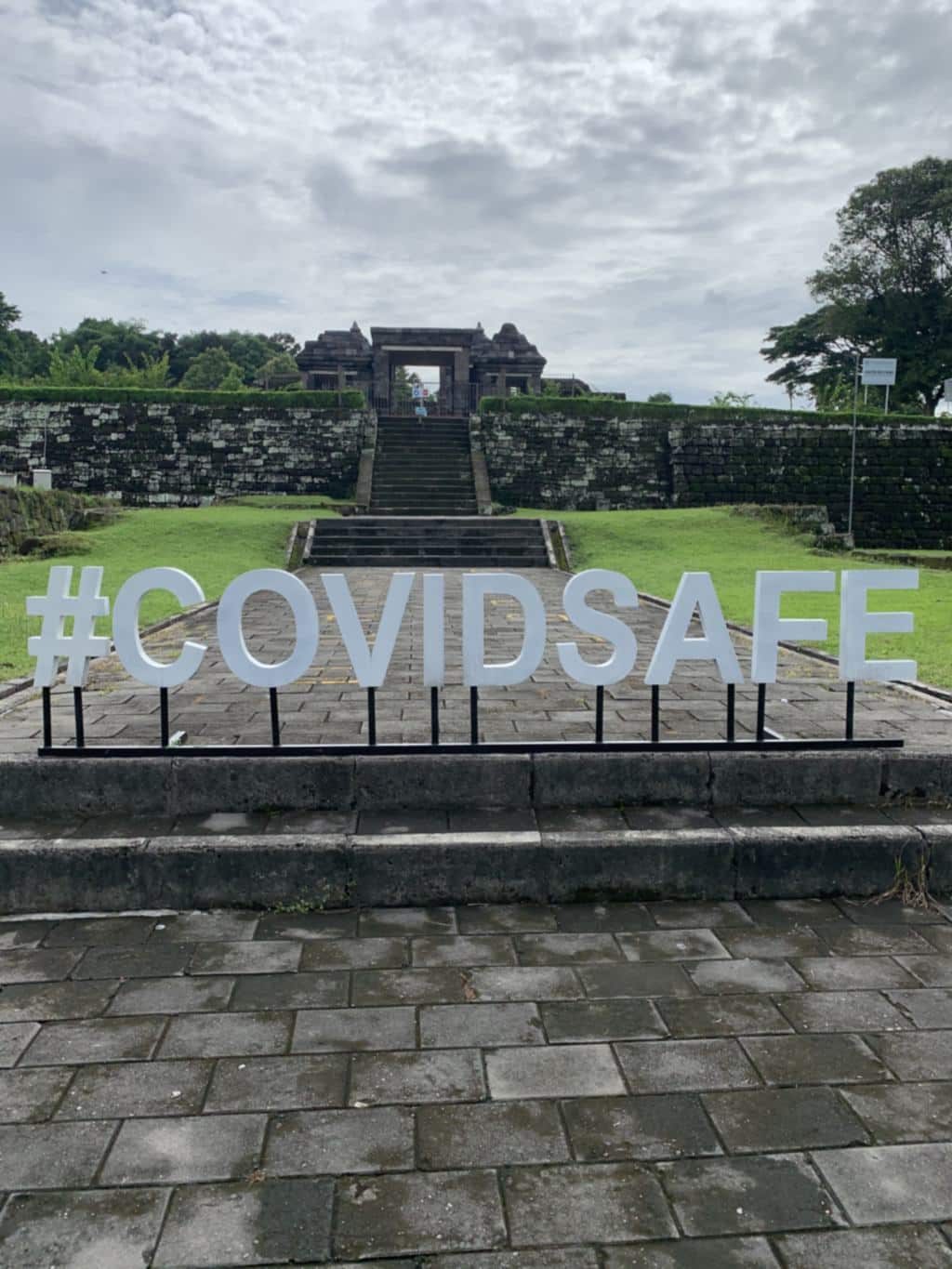
I left Yogyakarta by train, from Lempuyangan towards Probolinggo and Mount Bromo. More than eight hours in economy class, and one of the better train journeys I have taken in Asia.
September 2023: one day, and the climb
The second visit was short and deliberate. I arrived by car from Jakarta on 26 September 2023, went straight to Borobudur, and left the same day for Probolinggo. No Prambanan, no city, no Kraton. One temple, one afternoon.
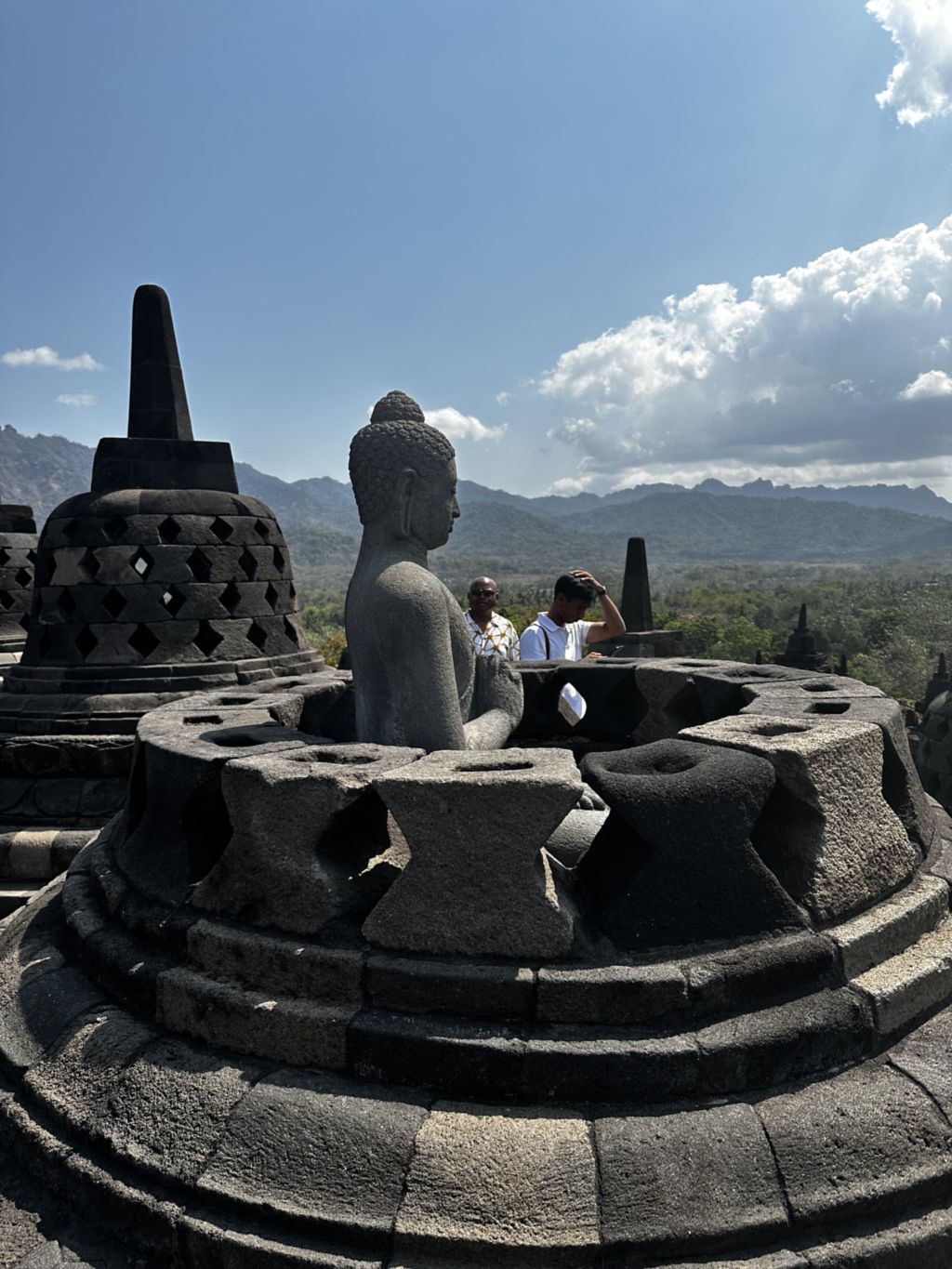
This time I bought the ticket that lets you climb, and I went up. It is the only time I have done it. You are given a pair of upanat sandals at the gate — woven soles designed to spare the ninth-century stone — a guide walks the group up, and then you are on the upper terraces among seventy-two bell-shaped stupas with the Menoreh hills on one side and, on a clear day, Merapi on the other.
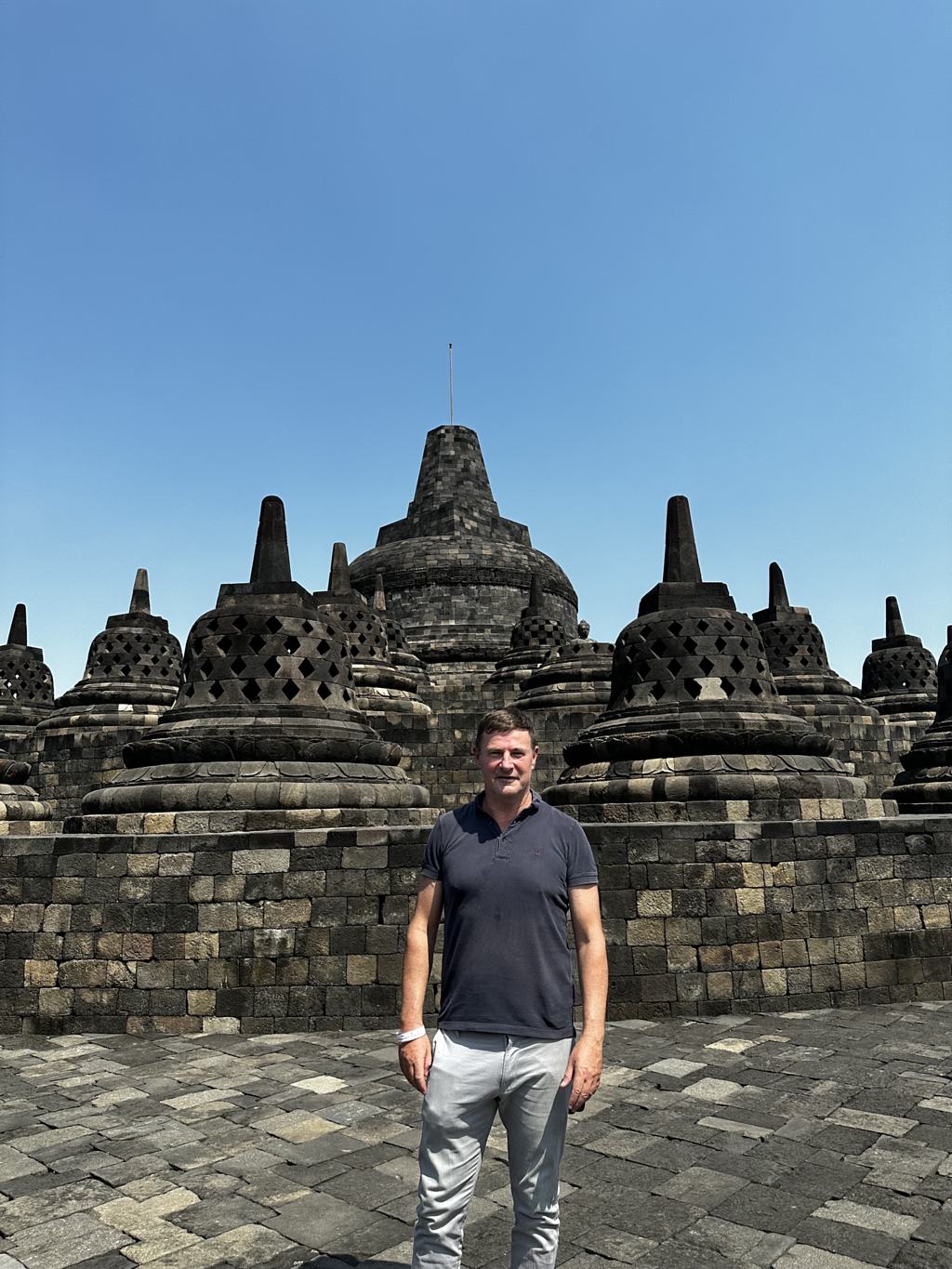
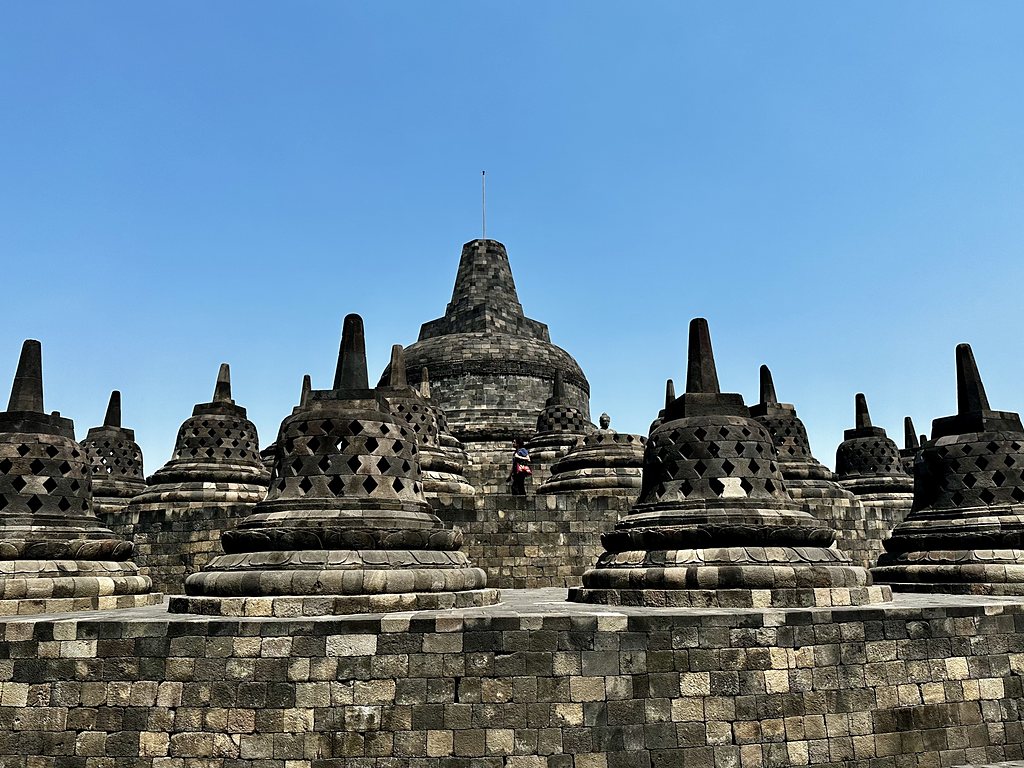
Put those two photographs side by side and you have the honest version of Borobudur: a monument that is not always fully accessible, and a ticket that is worth buying the day it is available. The climb was reopened in stages after Covid and the daily quota has been raised twice since, but it still closes on Mondays and it still sells out.
May 2024: Borobudur after dark
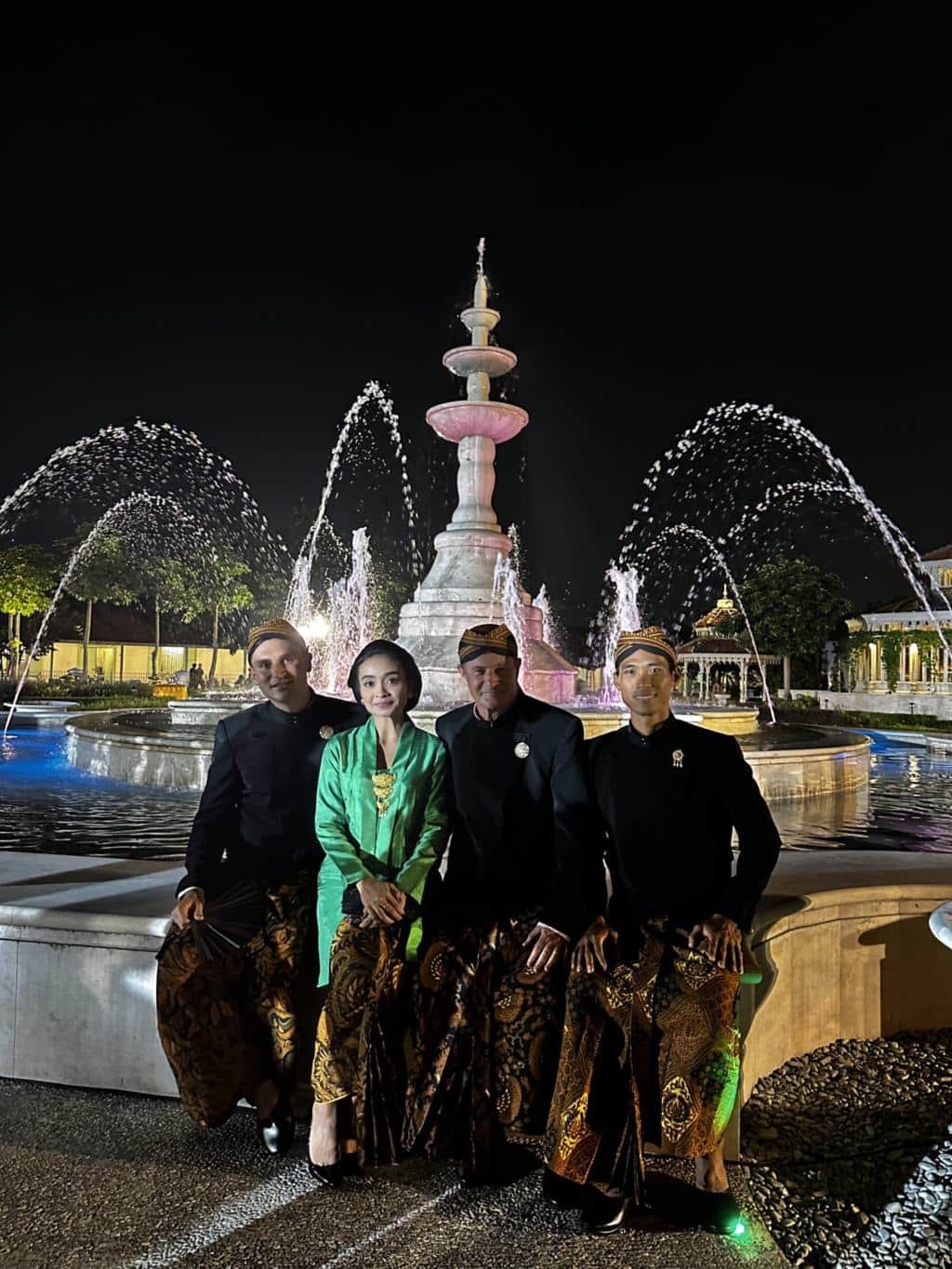
The third visit was for the eightieth birthday of an Indonesian friend’s father, held at the foot of Borobudur on 11 May 2024. Black tie, a stage on the lawn, Javanese dancers, a horse-drawn carriage, a buffet of sate and sayur lodeh served in clay pots, and fireworks over the temple while spotlights raked the terraces.
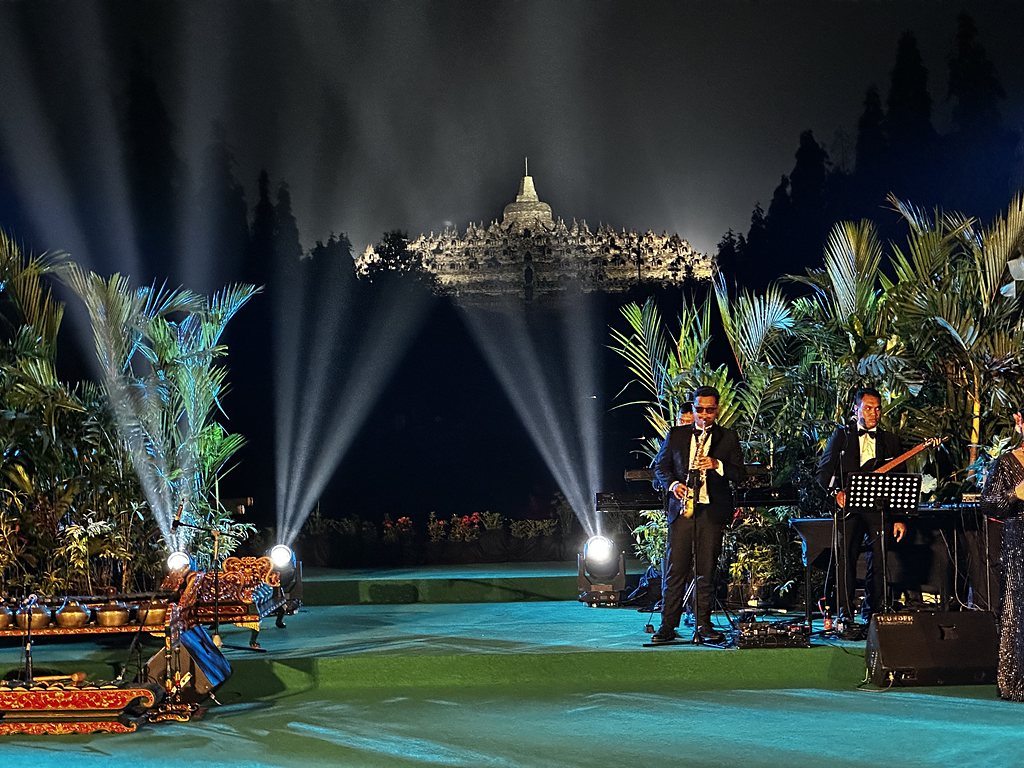
I am including this for one reason and flagging it for another. The reason: it is the only time I have seen the monument lit at night, and it is extraordinary. The flag: this was a private event and there is no equivalent open to visitors. If a website offers you a “Borobudur night show”, check very carefully what you are actually buying. The temple closes in the late afternoon.
On the same trip I went on to Solo by train, which is how I ended up photographing the Surakarta palace lit up after dark — a building that, as of July 2026, is closed to visitors. More on that below.
Borobudur: Tickets, the Climb and the Sunrise
Borobudur was built around 800 AD, abandoned within a century and a half, buried under volcanic ash and jungle, and rediscovered in 1814. It has been a UNESCO World Heritage site since 1991. It is a single stepped pyramid of two million stone blocks, nine platforms, 504 Buddha statues and 2,672 relief panels, which together tell the path from desire to enlightenment as you spiral clockwise up the terraces. It is not a temple you enter. It is a book you walk on.
Ticket prices in 2026
There are two tickets, and the difference matters. The grounds ticket lets you into the park and up to the base of the monument. The temple structure ticket — often sold as “Nirvana” or “upper area” — lets you climb the terraces, and it includes the grounds. You do not pay twice.
- Foreign visitor, grounds only: around Rp 411,000 for adults, Rp 305,000 for children aged 3–10. This one is pegged to roughly USD 25, so the rupiah figure drifts — it was Rp 400,000 in January 2026 and around Rp 430,000 in June
- Foreign visitor, climbing to the top: Rp 455,000 adults, Rp 305,000 children. This is a fixed rupiah price and has not moved since 2024
- Indonesian visitor: Rp 50,000 grounds, Rp 150,000 to climb (Rp 25,000 and Rp 100,000 for children)
- Opening hours: grounds 06:30–16:30, the climb 08:30–17:00, closed for climbing on Mondays for maintenance
Tickets are sold online through the operator, InJourney Destination’s official site, formerly ticket.borobudurpark.com. Book several days ahead in high season; the climbing slots fill first.
If you hold a KITAS, you pay the Indonesian price
This is worth its own heading because almost no guide mentions it and the saving is enormous. On the official booking flow, the “Choose tourist type” screen defines the foreign category as “For tourists visiting from outside of Indonesia (without KITAS)” and the domestic category as “for guests coming from Indonesia. They must have an Indonesian ID card (KTP) or a Limited Stay Permit Card (KITAS).”
In other words: a foreigner holding a KITAS pays Rp 50,000 instead of about Rp 411,000 for the grounds, and Rp 150,000 instead of Rp 455,000 to climb. The same rule appears on the Prambanan and Ratu Boko booking pages, which are run by the same operator. I hold a KITAS and I have paid the local rate.
One honest caveat: this is the rule on the ticketing system, and long-term residents report that enforcement at the counter has historically depended on who was selling. Book online, select the domestic category, and carry the card.
Climbing to the top: quota, sandals and guides
Access to the upper terraces has been rationed since the monument reopened. The quota was 1,200 people a day until July 2025, then raised to 3,000 as a trial, then to 4,000 a day from November 2025. It is still a quota, and it is still worth booking early rather than turning up.
Three things are non-negotiable once you are in. You climb with a guide, in a group, on a timed slot — there is no independent wandering. You wear upanat sandals, woven from pandan fibre and included in the ticket; your own shoes stay off the stone. And you keep to the marked route, because the point of all of this is that several million feet a year were wearing the ninth century away.
The sandals are yours to keep, which is a small and rather good souvenir.
Is the Borobudur sunrise still possible?
Yes, but not in the way the old blog posts describe it, and not cheaply. The sunrise access still runs through the Manohara gate, with arrival around 04:40, at roughly Rp 1,000,000 per person in 2026. What has changed is Manohara itself: it no longer operates as a full-service hotel, and its Booking.com listing now reads “Manohara Borobudur Cultural Center”. Travellers still book it expecting to sleep there. Do not.
If a million rupiah for a sunrise is not your idea of value, there are two hills outside the park that look straight at the temple through the morning mist:
- Punthuk Setumbu — the classic Borobudur-through-the-mist viewpoint. Around Rp 20,000 for Indonesians and Rp 50,000 for foreigners, open from 04:00
- Bukit Rhema, the abandoned prayer house known as the “Chicken Church” — Rp 25,000 flat for everyone, open 06:00–17:00, with a jeep shuttle up the hill for Rp 10,000
Mendut and Pawon, the two temples nobody stops at
Borobudur, Pawon and Mendut stand on a straight line running east from the main temple, and they were almost certainly built as one processional route. Pawon is tiny and sits about 1.75 km from Borobudur; Mendut is three kilometres further and holds a three-metre seated Buddha carved from a single block, flanked by two bodhisattvas — the finest statuary of the three sites, and usually empty.
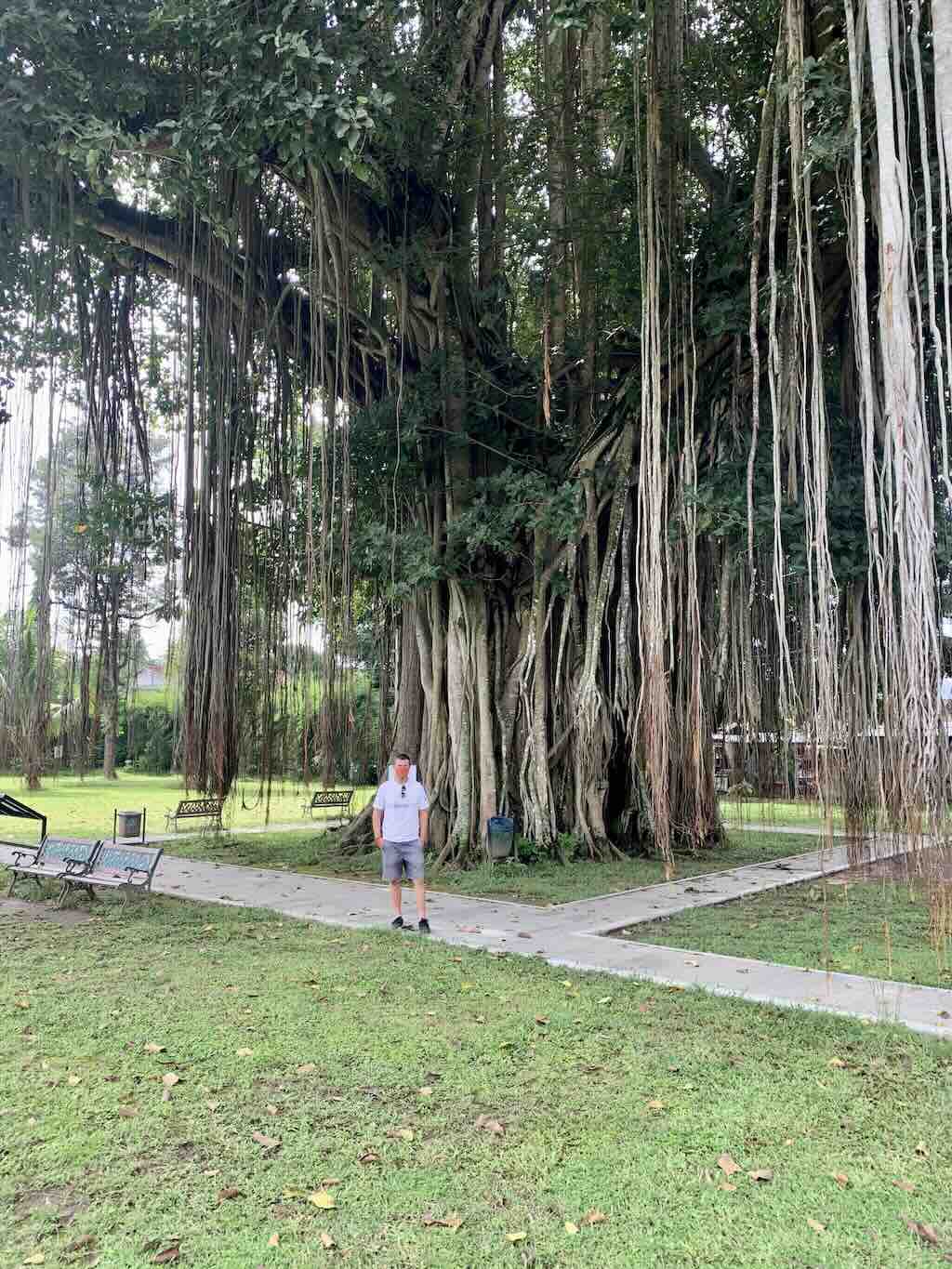
What I remember from Mendut is not the Buddha, though. It is the banyan tree in the courtyard: enormous, aerial roots to the ground, the kind of tree that makes a small temple look older than it is. Entry is around Rp 20,500 for foreign visitors, open Tuesday to Sunday, closed Mondays. Restoration work was reported at Mendut in early 2026 with a reduced entry fee, so check before making a special trip.
Getting to Borobudur from Yogyakarta
It is 40–45 km and takes an hour to ninety minutes depending on traffic. Four ways to do it:
- Public bus — Trans Jogja to Jombor terminal (Rp 2,700 by card), then a Borobudur bus for around Rp 30,000. Slow, hot, roughly two hours door to door, and you still have a walk from the Borobudur terminal to the gate
- DAMRI from the airport — if you are arriving at YIA and going straight to the temple, the direct bus takes about 2h30 and starts around Rp 50,000
- Grab or Gojek — simple, one-way, and you will need to arrange the return
- Car with driver for the day — Rp 600,000–750,000, which for two or three people is the sane option and lets you add Mendut, Pawon and a sunset hill
Prambanan, Ratu Boko and the Temples Around Them
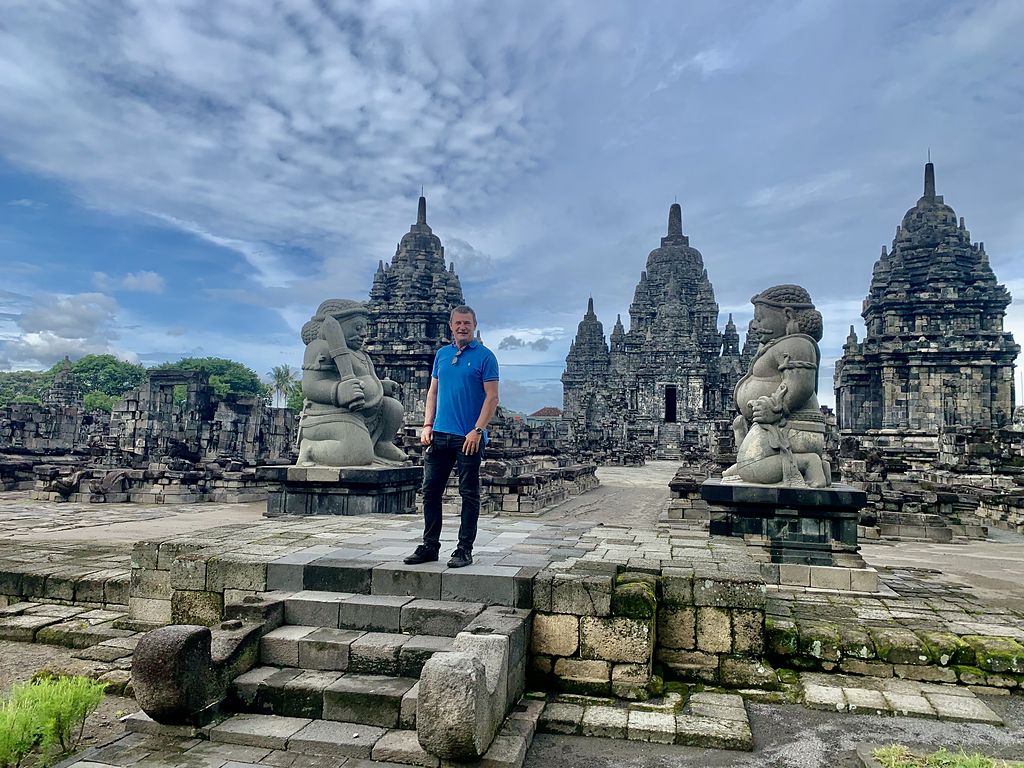
Prambanan was built about fifty years after Borobudur, seventeen kilometres east of Yogyakarta, and the contrast is the point. Borobudur is Buddhist, horizontal, a pyramid you walk around. Prambanan is Hindu, vertical, a forest of sharp towers rising to 47 metres — the tallest of them dedicated to Shiva, flanked by Vishnu and Brahma, with the Ramayana carved in relief around the inner balustrade. It has been on the UNESCO World Heritage list since 1991.
That the two stand within forty kilometres of each other, built within a century of each other, by rival dynasties who apparently coexisted, is the single most interesting fact about central Java. Nowhere else in Asia did Buddhism and Hinduism build at this scale, at the same time, in the same valley.
Prambanan tickets, hours and the combined ticket
- Foreign visitors: Rp 400,000 for adults, Rp 250,000 for children under 10
- Indonesian visitors (and KITAS holders): Rp 50,000 on weekdays, Rp 65,000 at weekends and on public holidays; Rp 25,000 / Rp 35,000 for children
- Hours: ticket office 06:30–17:00, temple zone 07:00–17:30
- Mondays: the three main towers close for maintenance, but the rest of the park — including Candi Sewu, Lumbung and Bubrah — stays open
- You cannot climb the temples. Access to the structures has been closed since mid-2020; you walk the courtyards and the inner chambers only
Now the correction. A great many guides — including, until today, this one — state that there is no combined Borobudur and Prambanan ticket. That is no longer true. A two-day combined ticket exists and costs around Rp 750,000 for foreign visitors. The one thing it does not include is the climb at Borobudur, so if you want the upper terraces you still need the Rp 455,000 ticket for that site.
There is also a Prambanan + Ratu Boko ticket at around Rp 675,000 for foreigners, which includes the shuttle bus between the two sites. If you are going to Ratu Boko for sunset — and you should — this is the one to buy.
The Ramayana Ballet is not a full-moon show
Another correction, and a common one. The Ramayana Ballet at Prambanan is often described as a full-moon performance. It is not. It runs every Tuesday, Thursday and Saturday, all year round: on the open-air stage beside the Shiva temple from May to October, and in the covered, air-conditioned Trimurti theatre from November to April.
Performances start at 19:30 and run about two hours, with doors from 18:30. Prices in 2026: Class 2 Rp 165,000, Class 1 Rp 220,000 (Rp 275,000 at weekends), Special Rp 385,000 (Rp 440,000), and on the open-air stage a VIP tier at Rp 495,000 (Rp 550,000). Book three to seven days ahead.
The confusion comes from a real thing: there is a separate special performance called Padhang Bulan on full-moon nights, ticketed on its own. That is the full-moon show. The weekly ballet is not.
Ratu Boko, the sunset site
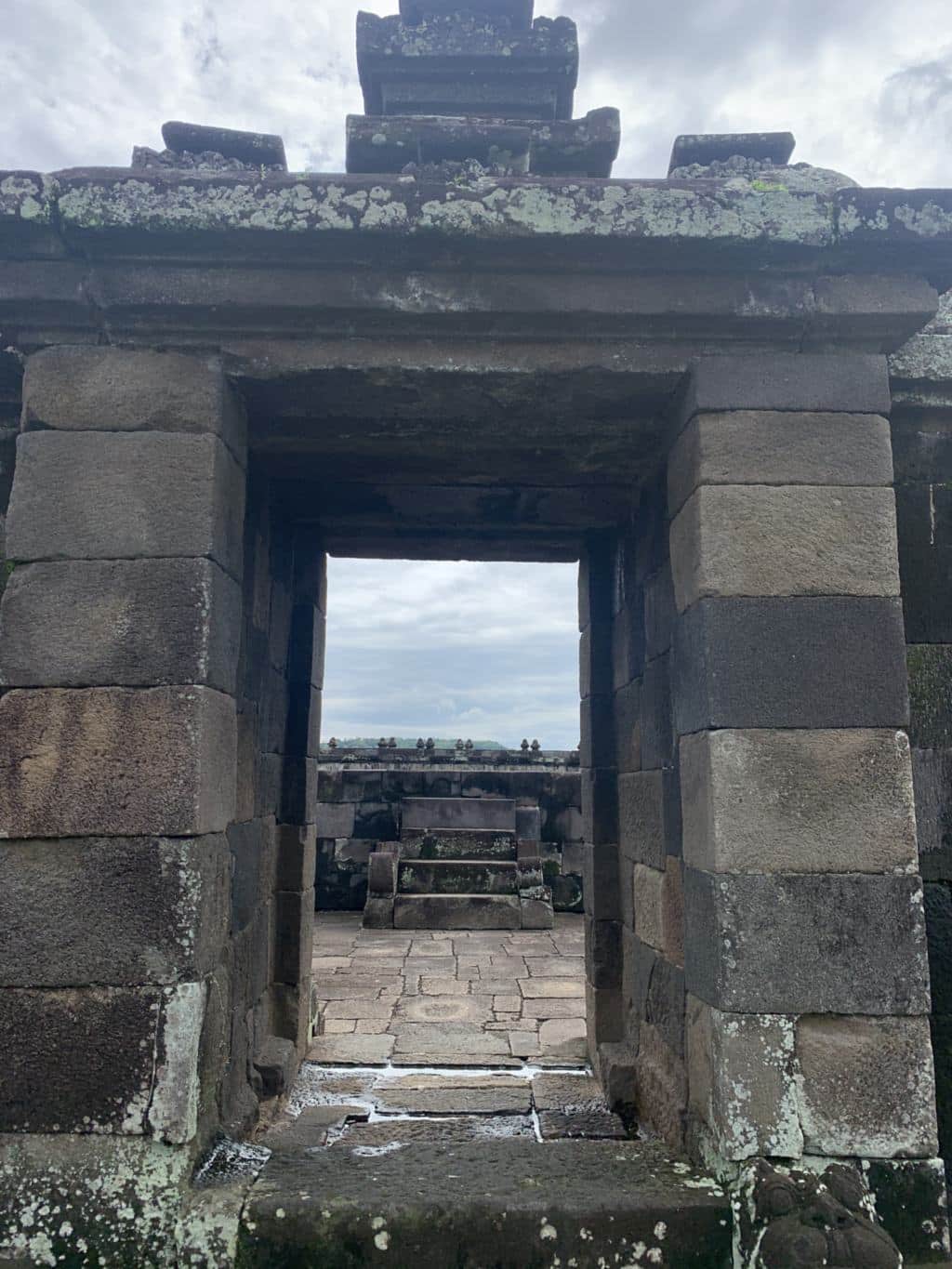
Three kilometres south of Prambanan and sixteen from Yogyakarta, Ratu Boko is not a temple but the remains of a fortified palace complex on a plateau — a monumental split gateway, terraces, bathing pools, and a great deal of open grass. It faces west, which is the entire point: the gates in silhouette against a red sky is the best sunset in the Yogyakarta area, and the crowds are a fraction of Prambanan’s.
Open 07:00–17:00. Buy it as part of the Prambanan combination rather than separately, and go late in the day.
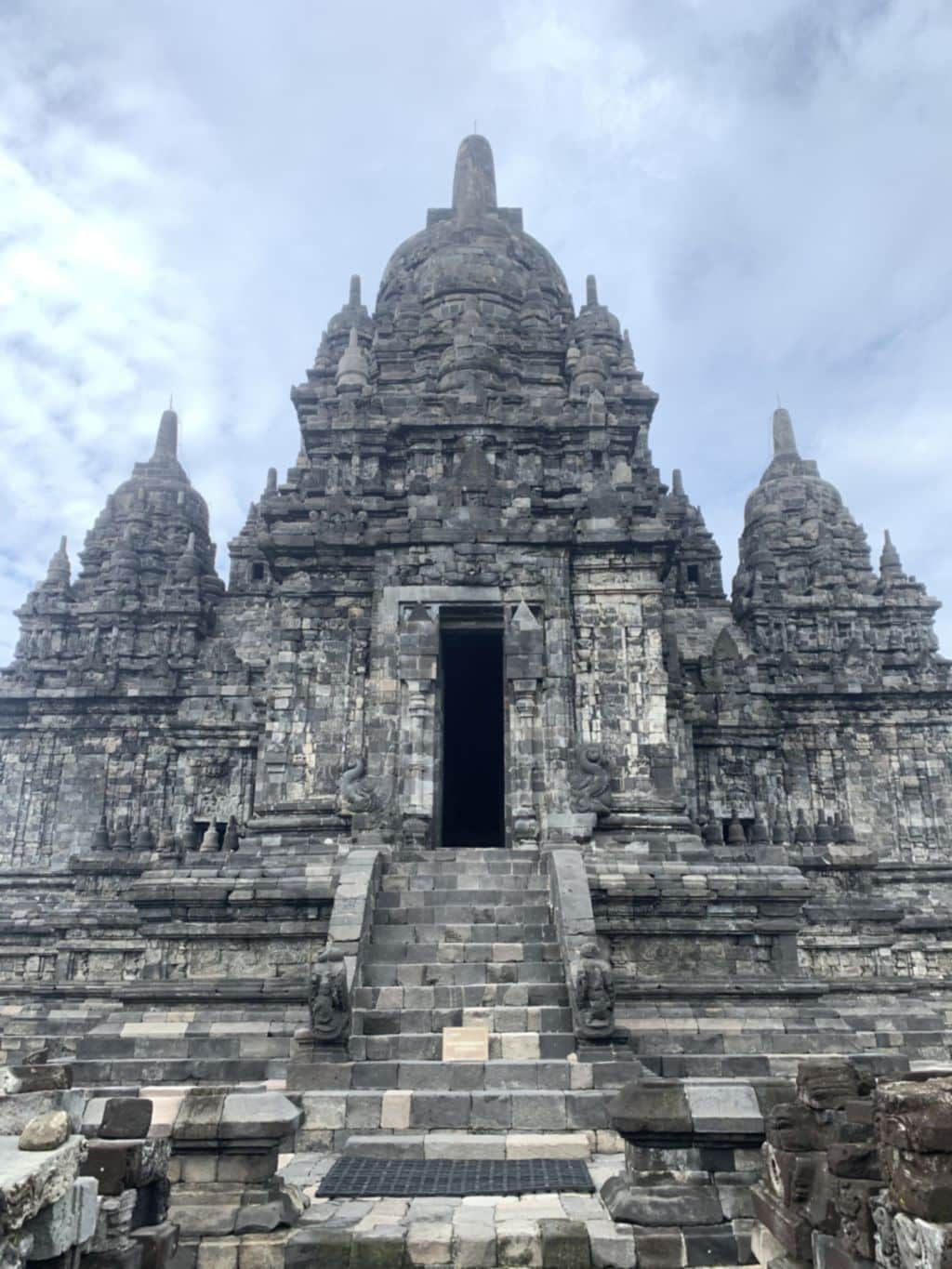
The other temples: Sewu, Plaosan, Ijo, Sambisari
There are more than a dozen temples in the plain east of Yogyakarta, and four of them are worth your time:
- Candi Sewu — the second largest Buddhist complex in Indonesia after Borobudur, 249 structures, 800 m from Prambanan and included in the same ticket. Most visitors never walk that far, which is why you can have it almost to yourself
- Candi Plaosan — twin Buddhist temples surrounded by 116 stupas, built by a Buddhist queen for her Hindu husband. Around Rp 5,000
- Candi Ijo — the highest temple in the region at 395 m, with a panorama over the whole plain. The alternative sunset spot to Ratu Boko
- Candi Sambisari — a ninth-century Hindu temple found by a farmer in 1966 under 6.5 m of volcanic soil, and still sitting in the pit it was excavated from. You look down at it
Getting to Prambanan: take the commuter train
The smartest way to reach Prambanan is the electric commuter train, the KRL Yogyakarta–Solo. It leaves from both Tugu and Lempuyangan stations, stops at Brambanan (spelt with a B), takes about twenty minutes, runs 27 times a day, and costs a flat Rp 8,000 however far you go. From the station it is about a kilometre to the temple gate — twenty minutes on foot, or an online ojek for around Rp 50,000.
The alternative is Trans Jogja line 1A, which runs Prambanan–Malioboro for Rp 2,700 by card, and takes about an hour. Grab and Gojek cover the 16–17 km in thirty to forty minutes.
The Kraton, Taman Sari and the Sultan’s City
The Kraton Ngayogyakarta Hadiningrat is not a museum with a royal past. It is a working palace with a sultan in it, several hundred abdi dalem — court servants, many of them volunteers who have served for decades — and a daily programme of gamelan, dance and shadow puppetry that exists because the court has always done it, not because tourists asked.
- Kedhaton (the palace): Rp 25,000 for foreign adults, Rp 15,000 for Indonesians. Open Tuesday to Sunday, roughly 08:00–14:00, closed Mondays
- Wahanarata, the royal carriage museum, is a separate ticket at Rp 30,000 for foreigners
- The performances are included. There is a court art performance most mornings from about 09:00 to 11:00, a different discipline each day — gamelan, classical dance, macapat sung poetry, wayang kulit
- Uyon-Uyon Hadiluhung, a full gamelan and dance evening, is held on Senin Pon — a Monday in the 35-day Javanese cycle — at 19:00, free, but you must reserve and the places go in under an hour. It is also streamed on the palace’s YouTube channel
One rule that catches visitors out: the palace’s own visitor guidelines require modest dress and explicitly forbid ordinary visitors from wearing Javanese court dress — kebaya or beskap — inside the grounds. Batik is fine; a costume is not.
The succession question nobody writes about
Sultan Hamengkubuwono X has five daughters and no son. In May 2015 he gave his eldest, GKR Mangkubumi, the title of crown princess — the first time in the history of the court that an heir apparent has been a woman. In October 2025 he said publicly that the Republic does not distinguish between men and women, so why should he.
Nothing has been formally settled. Tradition holds that the throne passes to a man, part of the family disputes the designation, and there has been no binding announcement. And because the Sultan of Yogyakarta automatically becomes governor of the province, this is not only a palace matter — it is the succession to an elected office that is not elected. Ask a local about it and you will get a longer and more interesting answer than anything in a guidebook.
Taman Sari, the water castle
Ten minutes’ walk from the Kraton, Taman Sari was built in the mid-eighteenth century as a pleasure garden, retreat, workshop and fortress in one. What survives is the bathing complex — three pools, changing towers, and a gate carved with the face of Kala — plus a network of tunnels and, at the end of them, Sumur Gumuling: a circular underground mosque with five staircases meeting on a central platform, built so that a voice at the centre carries to the whole structure.
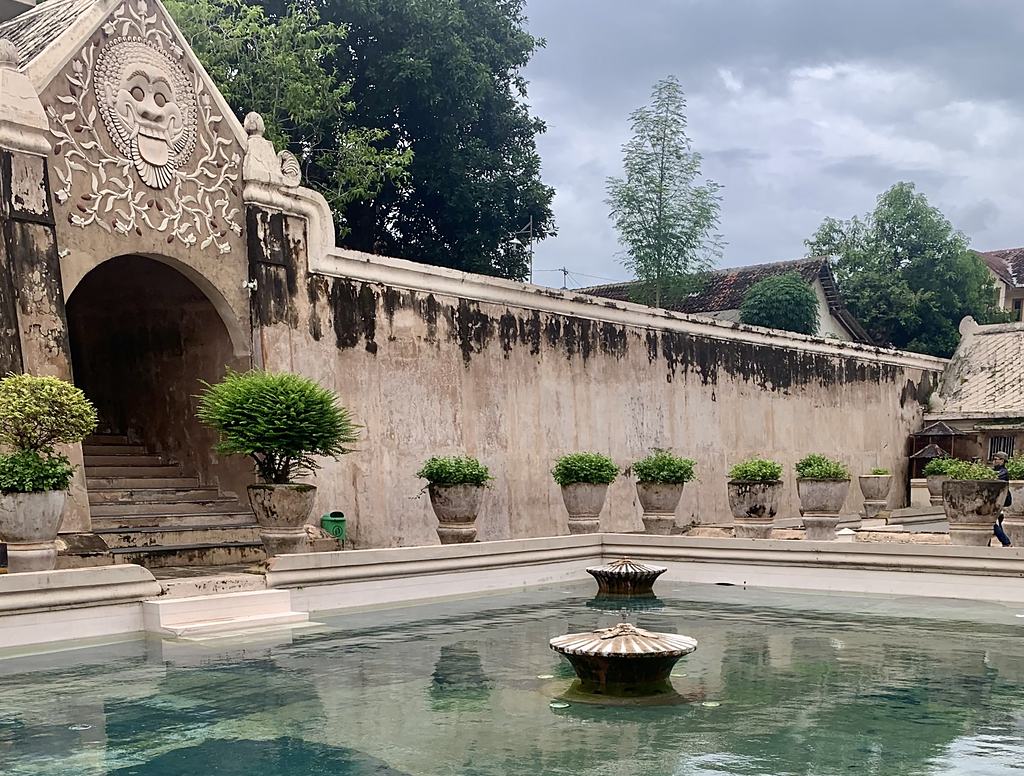
Rp 25,000 for foreign visitors, open daily 09:00–15:00. Guides wait at the entrance and charge around Rp 30,000–50,000 per group; they are not compulsory, but the tunnels are genuinely confusing and the history is not signposted. Around the ruins lies the Kampung Cyber, an ordinary kampung that wired itself for community wifi in the 2010s and became mildly famous for it.
Kotagede, the museums and Alun-Alun Kidul
Kotagede, five kilometres southeast, was the capital of the Mataram sultanate before Yogyakarta existed. It has the royal cemetery, a narrow-laned old quarter, and the silverwork trade the district is known for. Museum Sonobudoyo holds the best collection of Javanese artefacts outside the palaces and stages a wayang kulit performance on Tuesday evenings, 20:00–21:30, tickets sold at the door. Museum Ullen Sentalu, up at Kaliurang on the Merapi road, is the one to make time for: guided visits only, no photography inside, closed Mondays, from Rp 50,000 with an English-language tour at Rp 100,000.
And in the evening, Alun-Alun Kidul, the southern square: two ancient banyan trees, neon-lit pedal carriages doing laps, and the masangin ritual — you walk blindfolded from one side of the square to the space between the two trees. Almost nobody makes it. Blindfolds rent for Rp 5,000. It is free, silly and completely local.
Malioboro and the Batik Scam You Should Know About
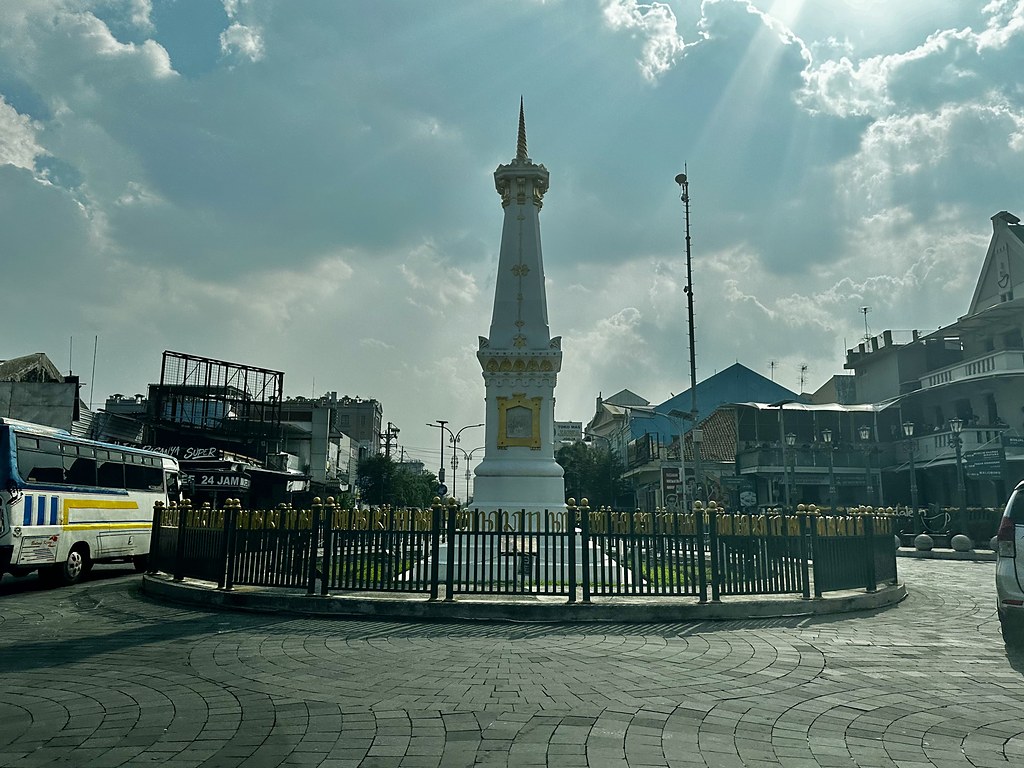
Malioboro is the axis of the city: a semi-pedestrian street running from the Tugu monument down to the northern square of the palace, part of the “philosophical axis” that UNESCO listed in 2023. It is where the batik shops are, where Pasar Beringharjo spills out onto the pavement, and where every visitor to Yogyakarta ends up on their first evening.
Two practical updates that most guides have not caught up with. First, Teras Malioboro 2 no longer exists where the guidebooks put it: in January 2025 the 1,041 relocated street traders moved again, to permanent sites at Ketandan — in the old Chinese quarter, 605 traders, open 07:00–22:00 — and at Beskalan. Second, the city is tightening its smoke-free rules along the entire Malioboro corridor, with on-the-spot fines rather than a court process. The revision was still going through in mid-2026, so treat the whole street as non-smoking and you will not have a problem.
One more thing: Selasa Wage. On the Tuesday that falls on Wage in the 35-day Javanese calendar, all the street traders close for 24 hours and the street is cleaned. If you arrive to find Malioboro strangely empty, that is why, and it is worth seeing.
How the batik gallery scam works
I have never been targeted by this, in three visits. But it is the most consistently documented tourist scam in Indonesia, it has been running on Malioboro for at least fifteen years, and it works because the approach is nothing like what you expect a scam to look like. The script goes like this:
- A friendly, well-spoken man starts a conversation that has nothing to do with batik — where you are from, his son who studies in your country, how long you are staying. Sometimes he warns you about other scams, which is what makes him credible
- He mentions an exhibition that closes today, or a government-supported workshop, or a student show that is about to move on. Today is always the last day
- You are walked to a gallery with no sign on the door. A second man takes over, demonstrates the wax technique, offers tea, and compliments your eye
- The prices are fixed “by the government” and therefore not negotiable. They are six to fifteen times the real value. Some victims are walked to an ATM; some are asked to sign a note confirming no pressure was applied
There is a becak variant too: a ride offered at an implausible Rp 5,000–10,000, followed by “Malioboro has moved, there is no Malioboro any more”, followed by a detour to a shop where bakpia sells at three times the normal price. Or the fare quoted at Rp 20,000 that becomes Rp 80,000 on arrival — a case the Indonesian press has covered more than once.
The defence is simple. Decline any invitation to an exhibition, workshop or gallery from someone who approaches you in the street, however pleasant. Agree the becak fare before you get in, or use Grab. Buy batik at Pasar Beringharjo or in a shop with a name on the front. As a price anchor, decent hand-drawn batik runs about 25–35 USD per square metre — if you are being quoted five times that in a room with no sign, walk out.
Mount Merapi: Lava Tours and the 2010 Eruption
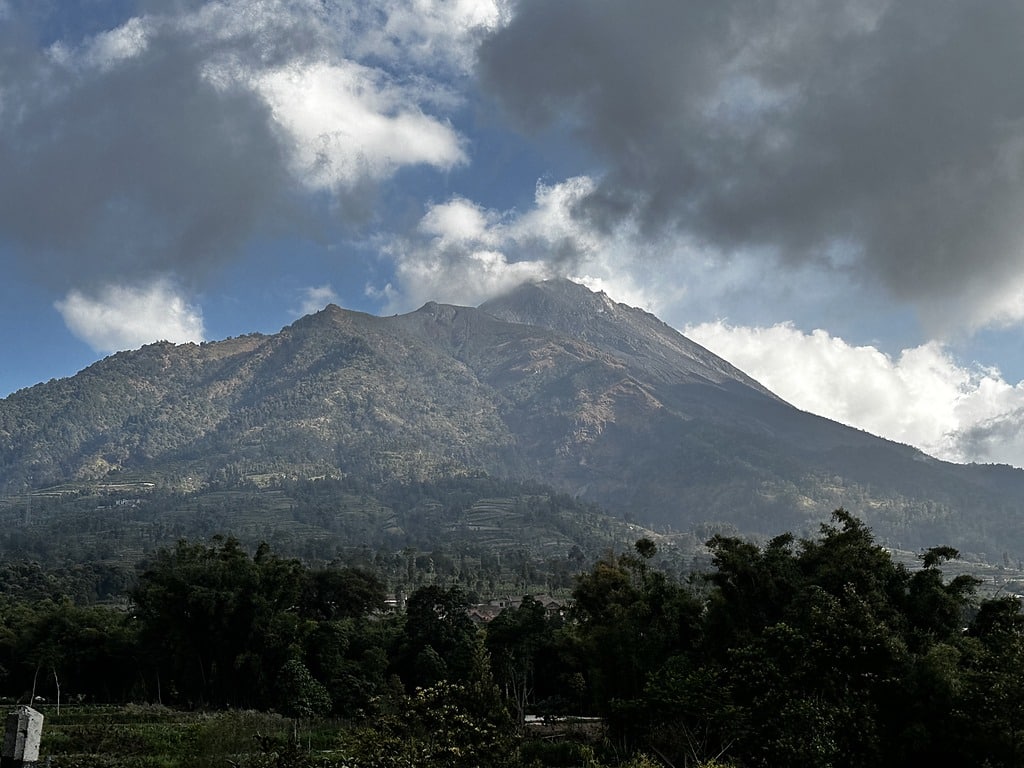
Merapi — “the one who makes fire” — stands 2,930 m about 28 km north of the city, and it is one of the most active volcanoes on earth. On 26 October 2010 it produced the worst eruption in a century: 353 people died and around 350,000 were evacuated. Among the dead was Mbah Maridjan, the volcano’s spiritual gatekeeper, appointed by the sultan, who refused to leave his post at Kinahrejo. He was found in his house, in the posture of prayer.
Is Merapi safe to visit in 2026?
The volcano has been at alert level III, Siaga, continuously since 5 November 2020 — the second-highest level on the Indonesian scale. It is in a slow effusive eruption: a lava dome that grows and collapses, sending avalanches and small pyroclastic flows down the flanks. There were pyroclastic flows of about 2 km on 17 May and again on 23 June 2026, and the bulletin for 9 August 2026 recorded five lava avalanches out to 1,900 m.
The exclusion zones have been stable all year: 5 km down the Boyong river, 7 km down the Bedog, Krasak and Bebeng, 3 km down the Woro, 5 km down the Gendol, and a 3 km radius from the summit for ejected material. Yogyakarta itself, at 28 km, is far outside all of it. Check the current bulletin on MAGMA Indonesia before you go up the mountain.
Climbing Merapi is not possible. The trail has been closed since a phreatic eruption on 22 May 2018 and was confirmed still closed in June 2026, by which point 67 illegal climbers had been intercepted that year. Anyone offering you a summit trek is selling you a fine and a real risk. The park recommends the gentle walk at OWA Kalitalang instead; for an actual summit, the neighbouring Merbabu is open, and Gunung Api Purba Nglanggeran — an extinct volcano 60 million years old, in Gunung Kidul — costs Rp 30,000 and takes an hour.
The jeep lava tours
What you can do is the lava tour: an hour to three hours in an old Land Cruiser, run by dozens of independent driver cooperatives out of Kaliurang and Kaliadem, along tracks and riverbeds on the southern flank. You visit Batu Alien, a rock the eruption threw out that looks like a face; the Kaliadem bunker, a shelter that failed to protect the two men inside it in 2006; and the Museum Sisa Hartaku at Kinahrejo — “the remains of my belongings” — a house full of objects deformed by the 2010 heat, including a clock stopped at the hour.
- Short trip, 1–1.5 hours: roughly Rp 350,000–450,000
- Medium, 2 hours: roughly Rp 450,000–550,000
- Long, 2.5–3 hours: roughly Rp 600,000–750,000
- Sunrise tour, departing around 04:30, more again
Those prices are per jeep, not per person, and a jeep takes four. They vary by operator and by day, they are negotiable, and they go up at weekends. The routes are designed to stay outside the official exclusion zones, and operators suspend them when conditions change — which, given the June 2026 pyroclastic flow, is a real possibility. Confirm on the day rather than assuming.
Kaliurang itself, 23–25 km from the city and about forty-five minutes away, is a hill station at 900 m: cool air, 17–21 °C, a small lake at Tlogo Putri, a wartime Japanese tunnel, wild macaques and a local snack called jadah tempe. It is also where Ullen Sentalu is.
The South Coast: Caves, Cliffs and Gunung Kidul
South of Yogyakarta the land turns to limestone karst and drops into the Indian Ocean. This is Gunung Kidul, and it is where people go on the third or fourth day, when the temples are done. Two and a half to three hours from the city, on roads that narrow and steepen towards the end — a driver or a scooter, not a bus.
Goa Jomblang and the shaft of light
Jomblang is a collapsed doline: you are lowered 60 m on a rope into a sinkhole full of prehistoric forest, then walk through to a second shaft, Luweng Grubug, another 30 m deeper, where a beam of sunlight comes down through the hole and hits the cave floor. It is the single most photographed thing in the region after Borobudur.
It costs Rp 500,000 per person — high by Indonesian standards, and it includes the caving gear, the guide, insurance and lunch. Booking is compulsory, the daily quota is 80 people in groups of 20, and the age range is 7 to 70. The light only appears when the sun is high enough, so the visit is scheduled around late morning; go in the dry season, because the descent in the rain is genuinely unpleasant and sometimes suspended.
Goa Pindul and the beaches
Goa Pindul is the gentler option: an hour of cave tubing on an underground river, through a bright section, a dim one and a completely dark one, for around Rp 40,000. Children from about five can do it.
The beaches are ticketed by zone, not individually, so one payment at the gate covers several in a row. Roughly: Rp 15,000 for the Baron–Kukup–Krakal–Sundak–Indrayanti stretch, Rp 8,000 for the Wediombo and Timang zone, Rp 5,000 for Siung and Nglambor. Treat these as indicative — the schedule dates from 2024.
- Timang — the one with the wooden gondola on a cable, hand-hauled across the channel to an offshore rock, and a suspension bridge alongside it. Around Rp 150,000–250,000 for the gondola, Rp 100,000–150,000 for the bridge. Suspended in heavy swell
- Nglambor — the only beach here where you can comfortably snorkel, protected by a natural reef barrier. Rp 10,000 entry plus about Rp 50,000 for the full snorkelling package
- Indrayanti — the developed one, white sand, cafés on the beach itself
- Wediombo for surf, Siung for rock climbing, Pok Tunggal if you want to walk in and be alone
Parangtritis and the queen of the southern sea
Parangtritis is the closest beach to the city, Rp 10,000 to enter, and the entry covers the Gumuk Pasir — sand dunes formed from volcanic sediment washed down from Merapi, the only formation of their kind in Southeast Asia, where people sandboard.
Do not swim. The currents are severe and the channels move; the authorities discourage it outright and people drown here every year. And do not wear green. Nyai Roro Kidul, the queen of the southern sea, is said to favour the colour and to take those who wear it — a belief taken seriously enough that hotels along this coast keep a room reserved for her. The rational version of the same rule is just as good: green is the hardest colour to spot against the water if you get into trouble.
Closer in, three viewpoints are worth the detour if you have a scooter: Tebing Breksi, a quarry carved into sculpture, Rp 20,000; Hutan Pinus Mangunan, a pine forest at Rp 5,000; and Bukit Panguk Kediwung at Rp 11,000, where the sunrise comes up over the mist in the Oyo river valley.
Solo: the Other Royal City
Surakarta — everyone calls it Solo — is Yogyakarta’s older rival, sixty kilometres east and an hour away by commuter train. The two cities were a single sultanate until 1755, when a treaty split it in two, and the courts have been quietly competing ever since. Solo is less polished, less visited and, to my mind, more Javanese for it.
And here is the thing no other guide will tell you right now. The Kraton Kasunanan Surakarta has been closed to visitors since 23 July 2026. A state-funded restoration covering thirteen buildings — the museum, the Sitinggil, the Sasana Handrawina, the Panggung Sangga Buwana and others — shut the whole site down, with only construction staff admitted. It is scheduled to run to the end of 2026 and no reopening date has been announced. It is not fire damage; it is a long-planned rebuild.
So go for the rest. Pura Mangkunegaran, the second court, is open — a guided visit is included in the ticket, roughly Rp 40,000–50,000 for foreign visitors, mornings only. Pasar Klewer is the largest batik market in Java and the reason serious buyers come to Solo rather than Yogyakarta. Pasar Triwindu sells antiques and convincing fakes. And the two batik villages, Laweyan and Kauman, still have working workshops you can walk into.
Further out, on the slopes of Mount Lawu, are two of the strangest temples in Java: Candi Cetho, fifteenth century, built in terraces up a mountainside at 1,496 m, Rp 30,000; and Candi Sukuh, pyramidal, with fertility carvings explicit enough that guidebooks tend to describe them vaguely, Rp 25,000. Both are about an hour from Solo and neither sees many foreign visitors.
Getting there is easy: the KRL commuter train runs 27 times a day between Yogyakarta and Solo, takes 68 to 80 minutes end to end, and costs Rp 8,000.
What to Eat in Yogyakarta
Yogyakarta is a student city, which means the food is cheap, plentiful and served late. A street meal costs Rp 15,000–25,000, a warung meal Rp 15,000–35,000, and a proper restaurant Rp 50,000–150,000 a head. There is no reason to eat badly here, and very little reason to eat expensively.
Gudeg, the dish the city is known for
Gudeg is young jackfruit simmered for hours in coconut milk, palm sugar and teak leaves until it turns brown and sweet, served with rice, chicken, egg and krecek — spicy beef skin. It comes in two styles: kering, dry, with the sauce reduced almost to a glaze, and basah, wet, looser and milder. Yogyakarta is the only place in Indonesia where it is a civic identity.
- Gudeg Yu Djum, Jl. Wijilan 167, in the gudeg street just east of the palace — the most famous name, open around the clock
- Gudeg Mbah Lindu, Jl. Sosrowijayan, two hundred metres west of Malioboro Mall — going since the 1940s, open 05:00–10:00, a breakfast institution
- Gudeg Pawon, Jl. Janturan — opens at about 21:30 straight out of the kitchen, with a queue forming from 21:00. The name means “kitchen”, and you eat standing up
Angkringan, kopi joss and sate klathak
An angkringan is a cart with a tarpaulin, a few low benches and a charcoal brazier, and it is where Yogyakarta actually eats at night. You take a nasi kucing — “cat rice”, a small parcel of rice with a spoonful of something on top — and a few skewers, and you grill them yourself. The bill is rarely more than Rp 20,000.
The one to go to is Angkringan Lik Man on Jl. Wongsodirjan, next to Tugu station, open from about 17:00 until the food runs out. It is the home of kopi joss: black coffee into which a glowing lump of charcoal is dropped at the table. It hisses, it smells of woodsmoke, and it is a genuinely good cup of coffee.
Sate klathak is the other local speciality: goat meat skewered on bicycle spokes rather than bamboo, so the metal conducts heat through the middle of the meat, seasoned with nothing but salt, pepper and coriander. Sate Klathak Pak Pong (Jl. Imogiri Timur km 10, 10:00–00:00) and Pak Bari in Wonokromo market (19:00–02:00) are the two names, both in Bantul south of the city, both worth the taxi. Around Rp 20,000–25,000 a portion.
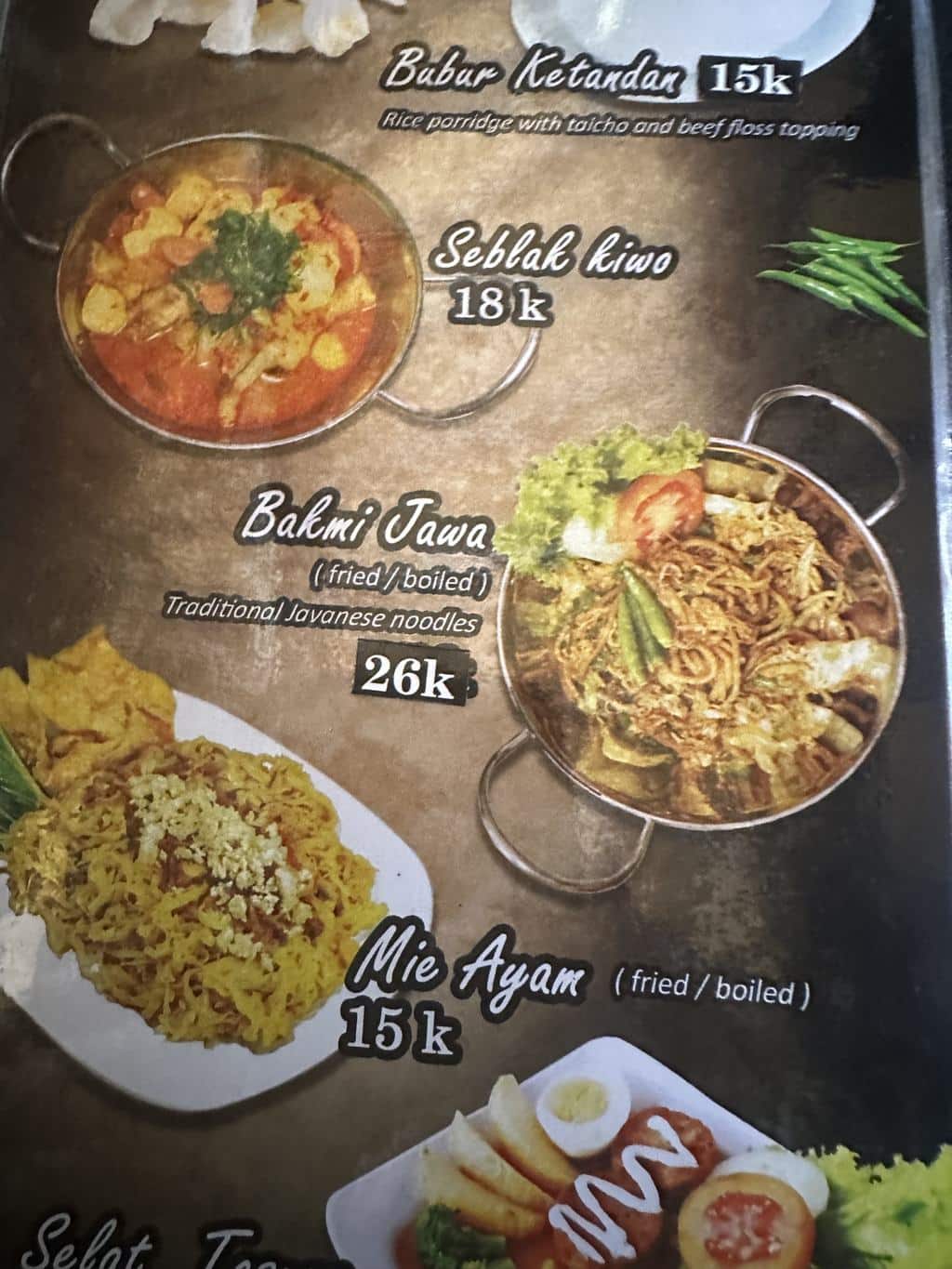
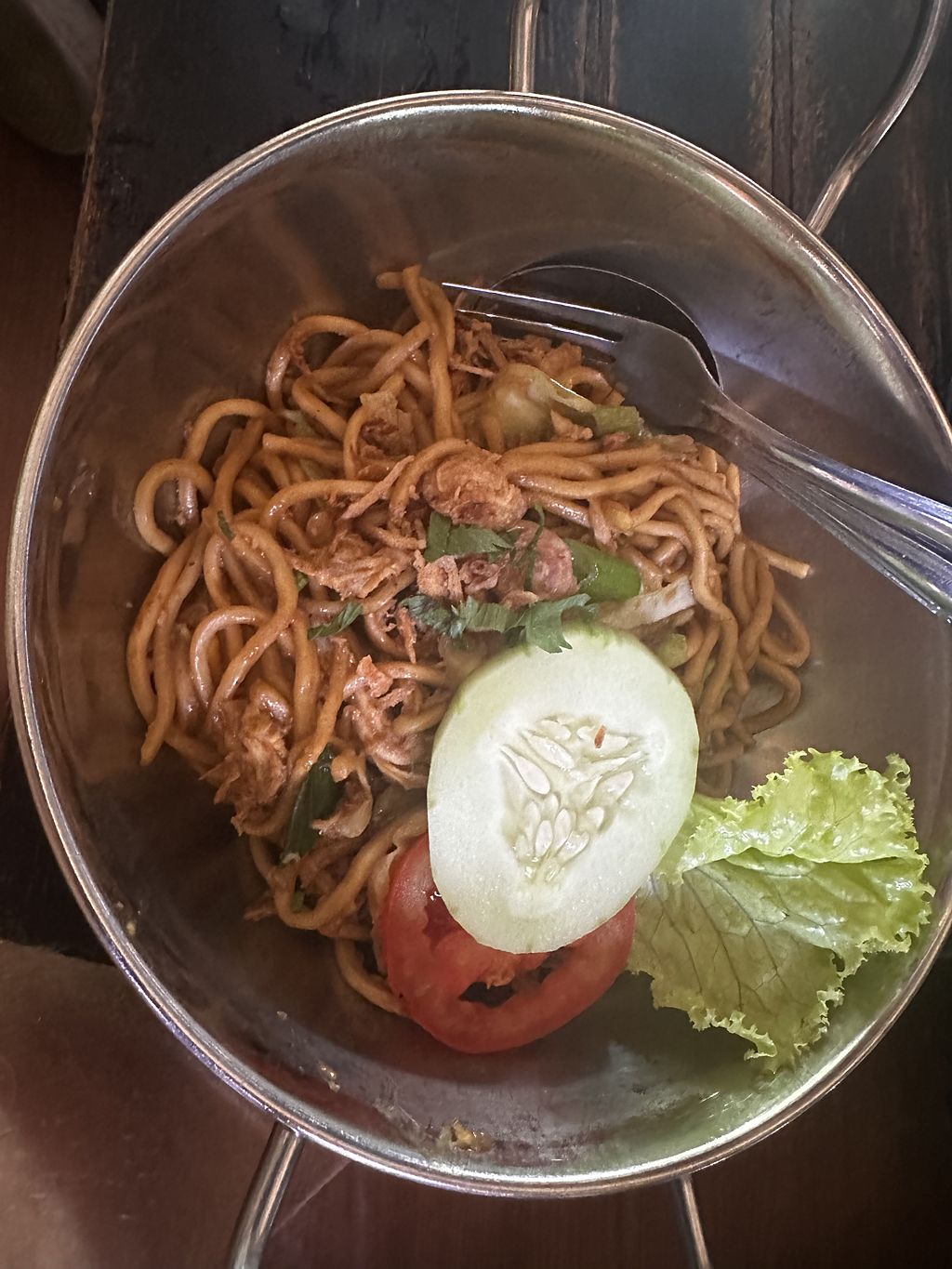
Three more worth hunting down: oseng-oseng mercon, “firecracker stir-fry”, at Bu Narti near the Kilometre Zero point, open 17:00–23:00 and running on an absurd quantity of chilli; mie lethek, the pale cassava-and-tapioca noodle of Bantul, at Mbah Mendes; and bakpia, the small bean-filled pastry that everyone takes home, from the Pathok district — Pathok 25 and Pathok 75 are the two established names.
Where to Stay in Yogyakarta
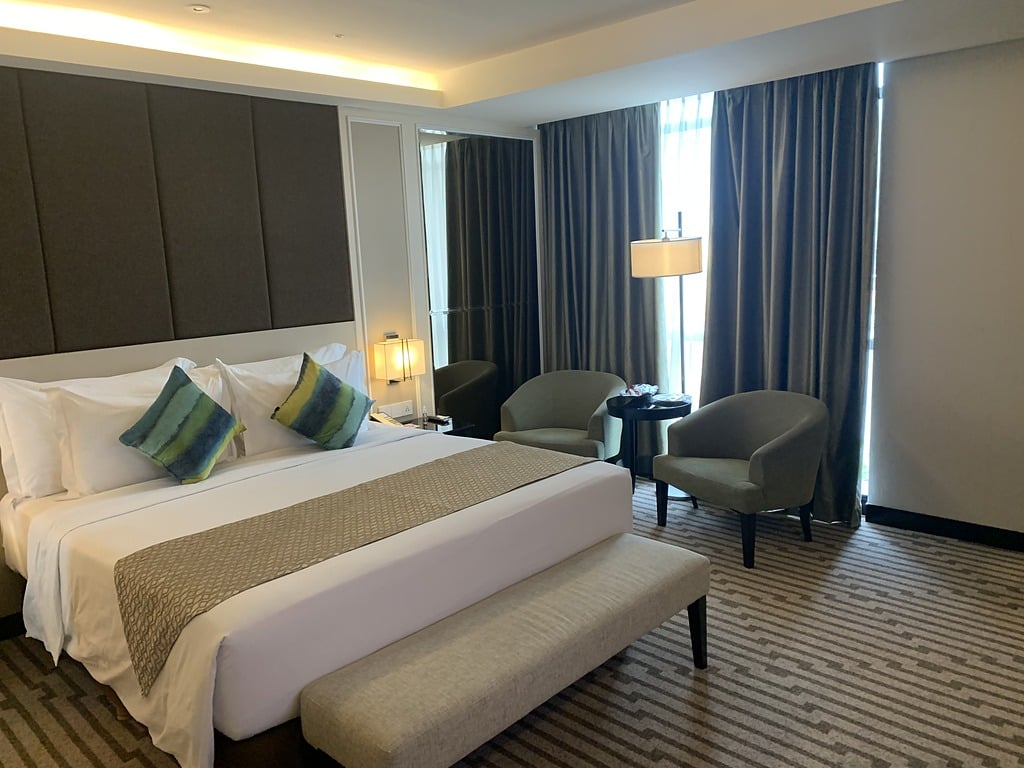
Yogyakarta is roughly 20–30% cheaper than Bali for the same standard. A hostel dorm runs Rp 50,000–100,000, a decent budget room with air conditioning Rp 100,000–300,000, mid-range Rp 300,000–900,000, and the top end Rp 1,000,000–2,800,000. Where you sleep matters more than what you pay, because the city spreads and the traffic is real.
Malioboro and Sosrowijayan: walk everywhere
The centre, within walking distance of Tugu station, the market and the palace. Noisy on the main street, and the chain hotels are interchangeable, but nothing else puts you this close to everything. Sosrowijayan, the lane behind Malioboro known as Gang 1 and Gang 2, is the old backpacker quarter and still has the cheapest beds in the city.
- Swiss-Belboutique Yogyakarta — where I stayed on 31 December 2020. Rooftop pool, reliable chain standards, a few minutes’ walk from Malioboro
- The Phoenix Hotel Yogyakarta — the 1918 colonial building on Jl. Jenderal Sudirman, now in Accor’s Handwritten Collection. The one with actual character
- Grand Hotel De Djokja — the 1911 landmark on Malioboro itself, renamed in November 2025; you may know it as the Grand Inna Malioboro or the Hotel Garuda
- ibis Styles Yogyakarta — five minutes from Malioboro on Jl. Dagen, dependable and well priced
- Harper Malioboro Yogyakarta by ASTON — a step up on equipment, still walkable to the station
- Hotel Neo Malioboro by ASTON — compact, modern, good value in the middle of it all
- Losmen Setia Kawan — the classic Sosrowijayan losmen, basic rooms and a sociable courtyard
Prawirotaman and the Kraton: quieter, more character
Prawirotaman and the neighbouring Jl. Tirtodipuran have been the European and Australian traveller quarter since the 1980s, and have since filled up with espresso bars, galleries and small design hotels. Twenty to thirty minutes’ walk from the centre, much calmer, and better for a stay of several days. Around the Kraton and Taman Sari the accommodation is mostly guesthouses in Javanese houses — less equipment, more immersion.
- Greenhost Boutique Hotel Prawirotaman — vertical garden, rooftop vegetable plot, the best breakfast in the quarter
- Adhisthana Hotel Yogyakarta — a small “slow living” hotel with a library and a garden, consistently well reviewed
- Duta Guest House — a Prawirotaman institution, garden and pool, simple rooms
- Wonderloft Hostel Jogja — the best-rated hostel in the city, capsule dorms, near the Kraton
- The Patio Yogya — small, very highly rated, minutes from Taman Sari, and often recommended for solo women travellers
North of the centre, Borobudur and Merapi
The northern suburbs around Jl. Kaliurang and the university have the space for gardens and pools, at the cost of twenty to forty minutes into town. Sleeping at Borobudur itself makes sense for one reason only: being at the gate when it opens. And Kaliurang is where you stay if the volcano is the point of the trip.
- Hyatt Regency Yogyakarta — a large wooded property with a nine-hole golf course, the family option
- Royal Ambarrukmo Yogyakarta — built around a former royal pavilion, attached to the Ambarrukmo shopping mall
- The Alana Yogyakarta — large, comfortable, geared to families and conferences
- Plataran Borobudur — villas with private pools facing Merbabu and Merapi, twenty minutes from the temple
- Villa Borobudur Resort — smaller and superbly rated, with temple views from some of the villas
- Amata Borobudur Resort — the sensible mid-range base for being first through the gate
- Pesona Merapi Syariah Guesthouse Kaliurang — simple and cheap, at the foot of the volcano
Two names to know about before you search. Amanjiwo, the famous resort facing Borobudur, is not on Booking.com at all and is sold direct. And Hotel Tentrem, the best hotel in the city — I stayed there in May 2024 — has been delisted from Booking.com: the old listing now redirects to a search page, although the hotel is very much open and bookable through its own site and other platforms. If a link promises you Tentrem, check where it actually lands.
Compare current prices and availability in Yogyakarta on Booking.com →
Getting to Yogyakarta and Around It
By air: YIA, and the airport that is not closed
Yogyakarta International Airport (YIA) opened in 2020 at Kulon Progo, 45 km west of the city, and took over the commercial traffic. Direct flights include Jakarta (about 1h15), Denpasar in Bali (about 1h50, roughly four a day), Surabaya, Makassar, Balikpapan and Lombok, plus Kuala Lumpur and Singapore internationally. Since June 2026 it has also run direct Umrah charters to Jeddah and Medina.
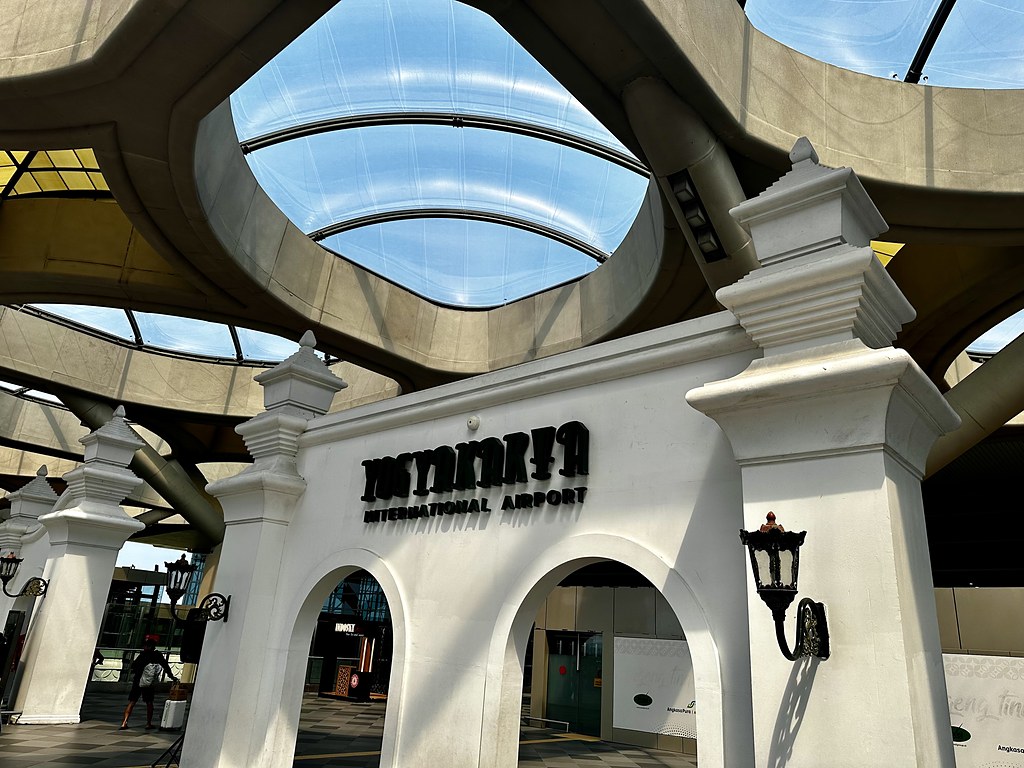
Here is the trap. The old airport, Adisutjipto, on the eastern edge of the city, is not closed — and it kept the code JOG. It handled 139,699 passengers in 2025 and added a daily Citilink route to Banjarmasin in July 2026. Every year people fly into the wrong one during the holidays. Check the three letters on your booking.
From YIA into town, the airport train is the obvious answer: it runs from beneath the terminal to Tugu station in 35–40 minutes, twelve times a day, from around Rp 10,000 on the regular service and Rp 40,000 on the Xpress. Fares came down in early 2026, so ignore the older figures still circulating. DAMRI buses cost Rp 80,000 and take 90–110 minutes on five routes; a taxi runs around Rp 350,000 and Grab around Rp 280,000, in 75–90 minutes. Note that Trans Jogja does not serve YIA — its “airport” stop is the old Adisutjipto.
By train, which is the best way
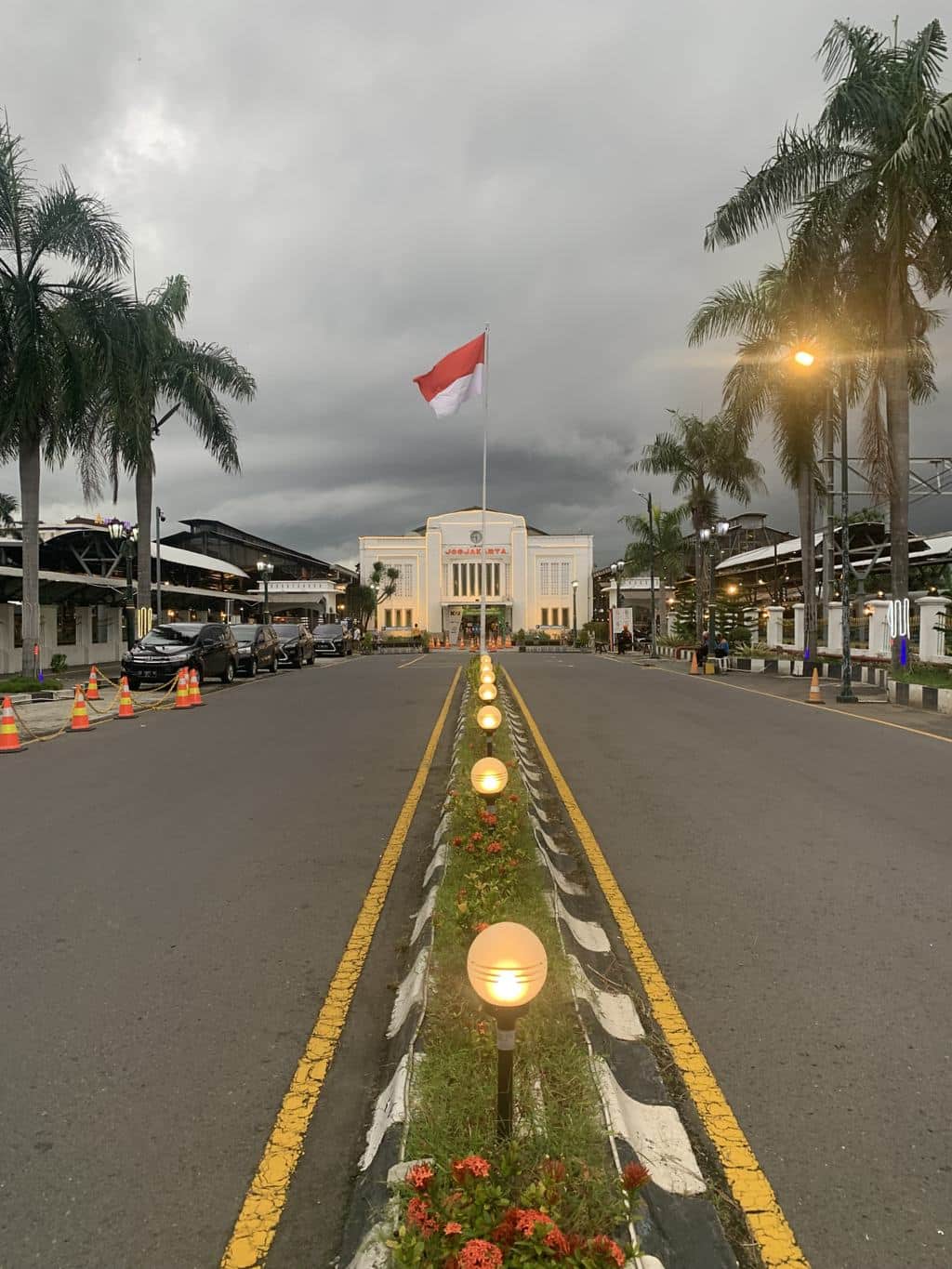
Yogyakarta sits on the main line across Java, and the train is genuinely the pleasant way to arrive. There are two stations: Tugu, in the centre, for executive and long-distance services, and Lempuyangan, a kilometre east, for economy trains.
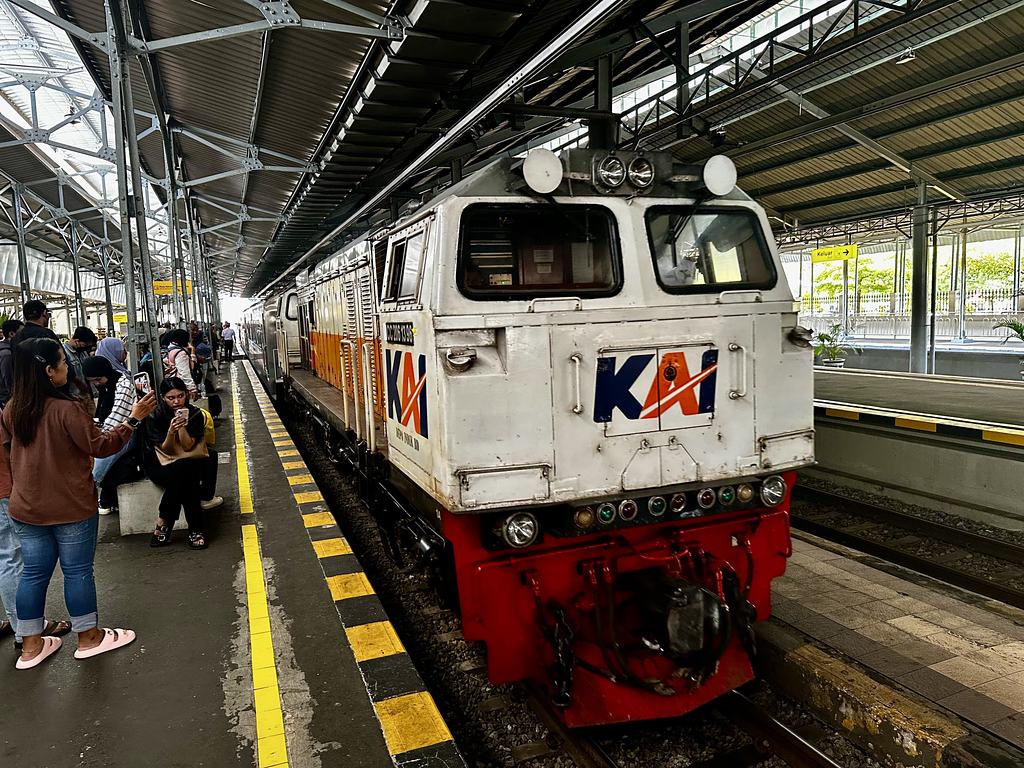
- From Jakarta Gambir: about 6h55 on the Argo Lawu, Argo Dwipangga, Taksaka or Bima. Executive class runs roughly Rp 520,000–650,000, Luxury from about Rp 1,375,000
- Panoramic cars were added in 2026 to the Argo Lawu, Manahan and Argo Dwipangga — full-height windows, swivel seats, meals included, Rp 750,000–1,100,000. If you are doing Jakarta to Yogyakarta once, do it in one of these
- To Solo: the KRL commuter, Rp 8,000, 68–80 minutes, 27 services a day
- Towards Bromo and the east: the economy KA Sri Tanjung leaves Lempuyangan at 07:00 for Banyuwangi, about Rp 94,000, 13–15 hours. Check the stop at Probolinggo when you book
- Booking opens 45 days ahead through Access by KAI. The 90-day window announced by the operator was never actually implemented — plan for H-45
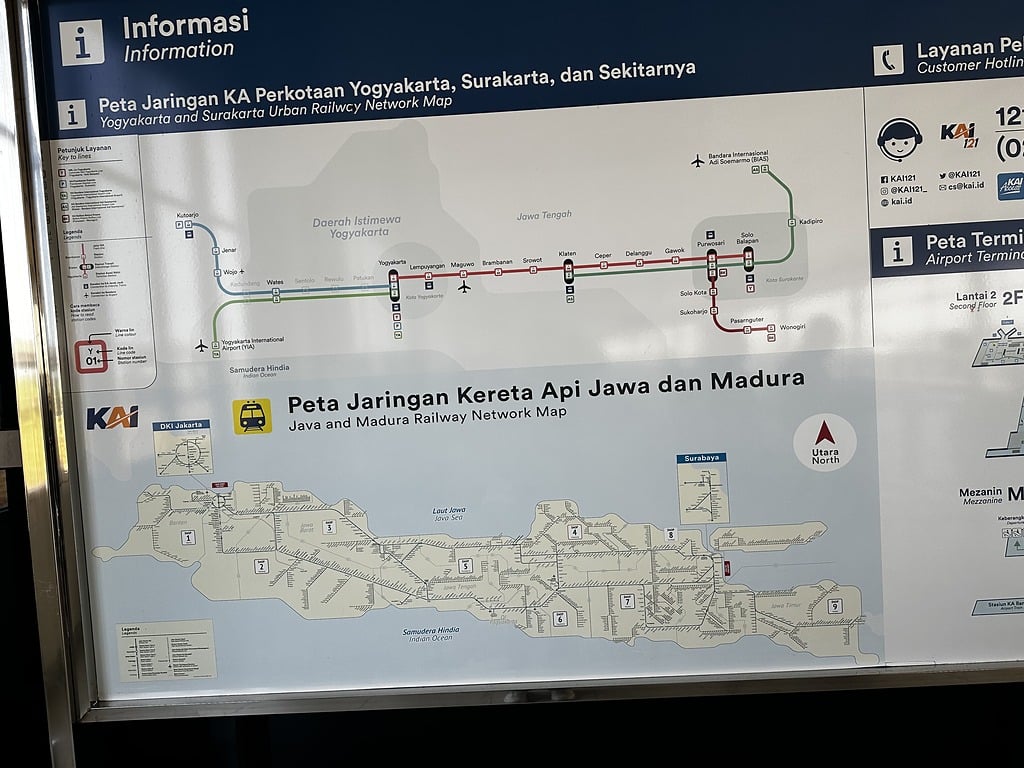
For ferries, buses and trains across the rest of the country, 12Go is the simplest way to compare schedules and book from abroad. For the wider picture, see my guide to getting around Indonesia and the overview of travelling in Indonesia.
Getting around the city
- Trans Jogja — Rp 2,700, cashless only since 2026 (e-money card, QRIS or GoPay), running 05:30–20:30, with electric buses on the Jombor–Malioboro line from 08:00 to 17:00. Line 1A is the one for Prambanan
- Grab and Gojek — everywhere, cheap, Rp 8,000–15,000 for a short hop. Note that motorised three-wheelers were banned from parts of the centre in 2025 to protect the traditional becak and andong trades
- Scooter — from about Rp 40,000 a day. An international driving permit is legally required, and the helmet is not optional
- Becak and andong — the pedal rickshaw and the horse carriage, both part of the street furniture around the palace. Agree the fare before you sit down; overcharging is documented often enough in the local press to be a pattern
Best Time to Visit and Practical Tips
The dry season runs from about April to October and peaks in August; the wet season is November to March, when the afternoons flood and the volcano is usually in cloud. BMKG forecast the 2026 dry season in Yogyakarta to be drier than average, with the peak in August.
Neither season is unusable. My January 2021 visit was in the middle of the rains and I got grey skies over green grass at Borobudur — which, honestly, photographs better than the hard midday light of September. What the wet season does spoil is Jomblang, where the descent gets slippery, and the Merapi jeep tracks.
- Dates to avoid: Lebaran, when the whole country travels — 20–24 March in 2026, around 9 March in 2027 — and Indonesian school holidays in late June and July
- Dates to aim for: Waisak at Borobudur, when a lantern release follows a procession from Mendut. It fell on 31 May in 2026 and falls on 20 May in 2027. Tickets are separate, sold through the Buddhist association, and they go early
- Visa: visa on arrival for most nationalities at Rp 500,000, valid 30 days, extendable once by another 30. The e-VOA can be bought before you fly
- Time zone: WIB, UTC+7. Money: rupiah, cash for warungs, becaks, jeeps and temple parking
- Dress: shoulders and knees covered at the Kraton, at Taman Sari and inside the temples. Sarongs are handed out where needed
- Earthquakes: on 27 May 2006 a magnitude 5.9–6.3 quake on the Opak fault, 25 km south of the city, killed between 5,778 and 6,234 people and left more than 800,000 homeless. Much of what you see restored around the Kraton and at Prambanan dates from after that morning
If you have four days, the shape that works is: temples first while you are fresh — Borobudur one morning, Prambanan and Ratu Boko the next, ending at sunset — then the city on foot, Kraton to Taman Sari to Malioboro, then a choice between Merapi to the north and Gunung Kidul to the south. Solo is the extra day, and the train makes it painless.
Yogyakarta is also the natural first half of a west-to-east crossing of Java that ends at Mount Bromo and then Bali — which is exactly the route I took in 2021, by train, and would take again.
Read More: Indonesia
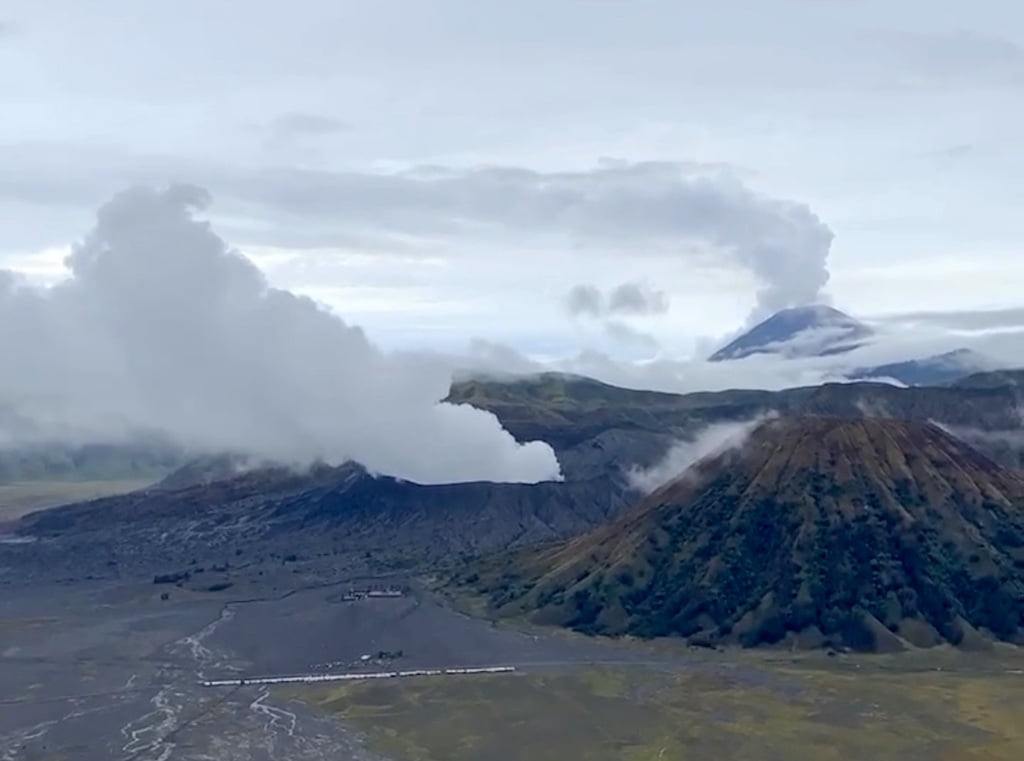
Mount Bromo
The other half of Java: three volcanoes in a sea of sand, and the sunrise everybody photographs. Eight hours east of Yogyakarta by train.
Bali
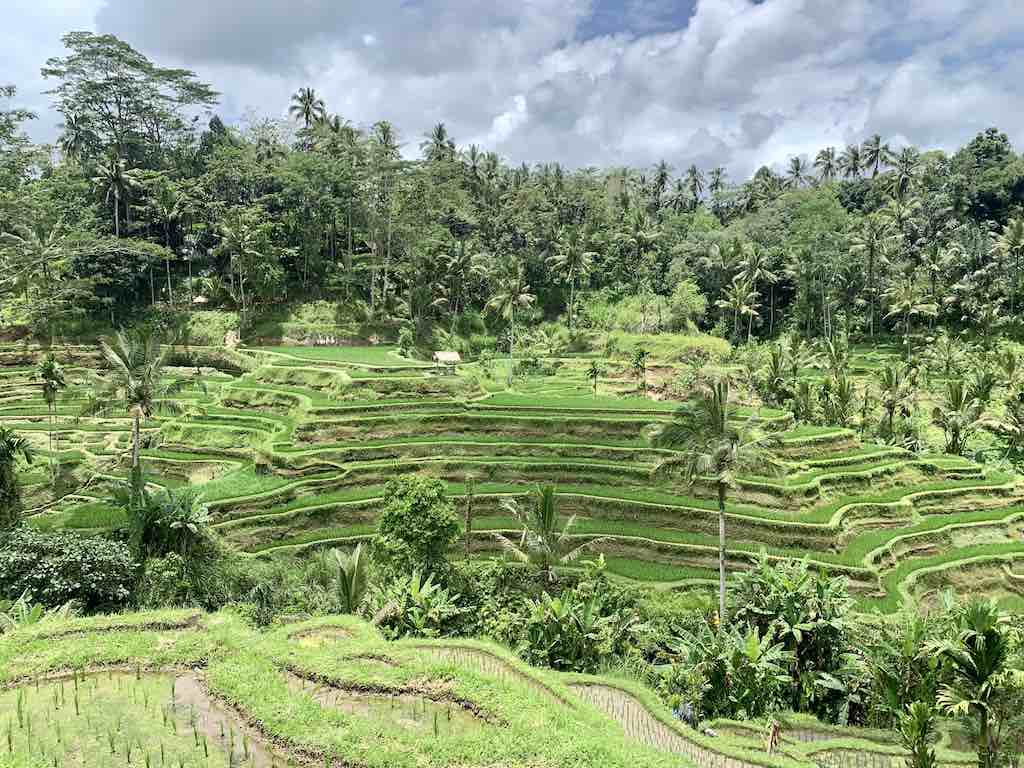
Where most travellers go next: temples, rice terraces, diving and volcanoes, under two hours away by air.
Flores
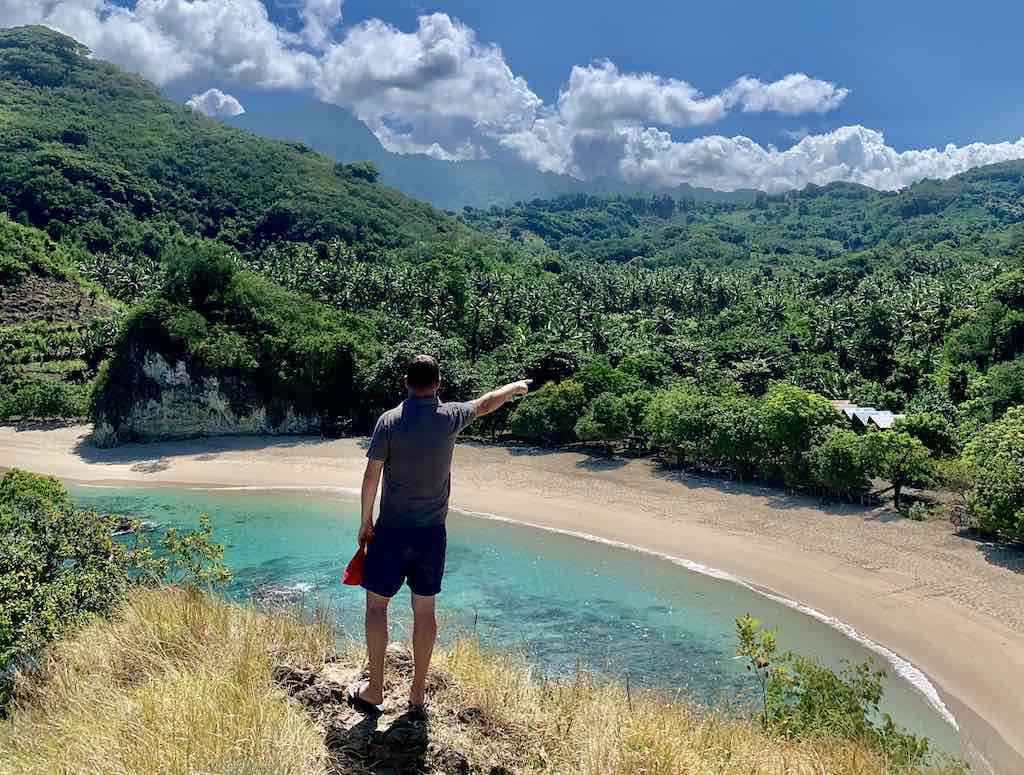
Further east again: the three-coloured lakes of Kelimutu, the Komodo dragons, and one of the best road trips in the country.
Frequently Asked Questions About Yogyakarta
Where is Yogyakarta?
Yogyakarta is in south-central Java, Indonesia, about 25 km inland from the Indian Ocean and 28 km south of Mount Merapi. It is roughly 430 km east of Jakarta and 330 km west of Surabaya, and it is the capital of its own Special Region, the only Indonesian province ruled by a sultan.
How many days do you need in Yogyakarta?
Two days covers the city and the two great temples. Three or four lets you add Mount Merapi, the caves and beaches of Gunung Kidul, or a day trip to Solo. Anything less than two days and you will be choosing between Borobudur and Prambanan.
How much does it cost to enter Borobudur in 2026?
For foreign visitors, around Rp 411,000 for the grounds and Rp 455,000 to climb the monument, the second including the first. Indonesians pay Rp 50,000 and Rp 150,000. The grounds price is pegged to about USD 25 and moves with the exchange rate; the climbing price has been fixed since 2024.
Do KITAS holders pay the local price at Borobudur?
Yes. The official ticketing system defines the foreign category as visitors “without KITAS” and the domestic category as those holding an Indonesian ID card (KTP) or a Limited Stay Permit Card (KITAS). The same applies at Prambanan and Ratu Boko. Select the domestic category when booking online and carry the card.
Is there a combined Borobudur and Prambanan ticket?
Yes, and a lot of guides still say otherwise. A two-day combined ticket exists at around Rp 750,000 for foreign visitors. It does not include climbing Borobudur, which is sold separately. There is also a Prambanan and Ratu Boko combination at about Rp 675,000 that includes the shuttle between the two.
Can you still climb to the top of Borobudur?
Yes, with a timed ticket, a guide and the supplied upanat sandals. The daily quota was raised to 4,000 people in November 2025. Climbing is closed on Mondays, when only the grounds and the museum are open.
When is the Ramayana Ballet at Prambanan?
Every Tuesday, Thursday and Saturday, all year, at 19:30 — outdoors beside the temples from May to October, in the covered Trimurti theatre from November to April. It is not a full-moon show; the full-moon performance, Padhang Bulan, is a separate ticketed event.
Is Mount Merapi safe to visit?
The lava tours run outside the official exclusion zones and operate normally most of the time, but Merapi has been at alert level III since November 2020 and produced pyroclastic flows in May and June 2026. Climbing the volcano has been forbidden since 2018. Check the current bulletin and confirm with your operator on the day.
Is the Kraton of Solo open to visitors?
No. The Kraton Kasunanan Surakarta has been closed since 23 July 2026 for a state-funded restoration covering thirteen buildings, scheduled to run to the end of 2026 with no reopening date confirmed. Pura Mangkunegaran, the city’s second court, remains open.
What is the batik scam in Yogyakarta?
A friendly stranger on or near Malioboro strikes up a conversation, then mentions a batik exhibition or government workshop closing that same day. The gallery has no sign, the prices are described as fixed and non-negotiable, and the paintings sell for six to fifteen times their value. Decline any street invitation to a gallery, and buy at Pasar Beringharjo or in a named shop.
What is the best time of year to visit Yogyakarta?
April to October, and ideally May, June, September or early October — dry skies without the August peak or the Indonesian school holidays. Avoid the Lebaran week entirely, when the whole country is on the move and prices double.