How to Get to Koh Phi Phi, and Which Boat to Actually Take
By Blaise Jaeger · Updated August 20, 2026
The Short Answer: Six Ways In, One Pier Out
Koh Phi Phi has no airport, no bridge and no car. Every single person who arrives does so by boat, and almost all of them step off at the same place: Ton Sai pier, on the narrow neck of sand that joins the two halves of Phi Phi Don. That single fact decides everything else about the journey — your departure pier, your crossing time, your luggage, and how early you have to get up.
Six departure points matter. Phuket has by far the most sailings and the widest choice of boat. Krabi Town, Ao Nang and Railay are the mainland side of the same bay and share many of the same hulls. Koh Lanta is the quiet one, and the one that thins out dramatically outside the high season. Bangkok is not really a departure point at all — it is a decision between a five-hour day and an eighteen-hour night.
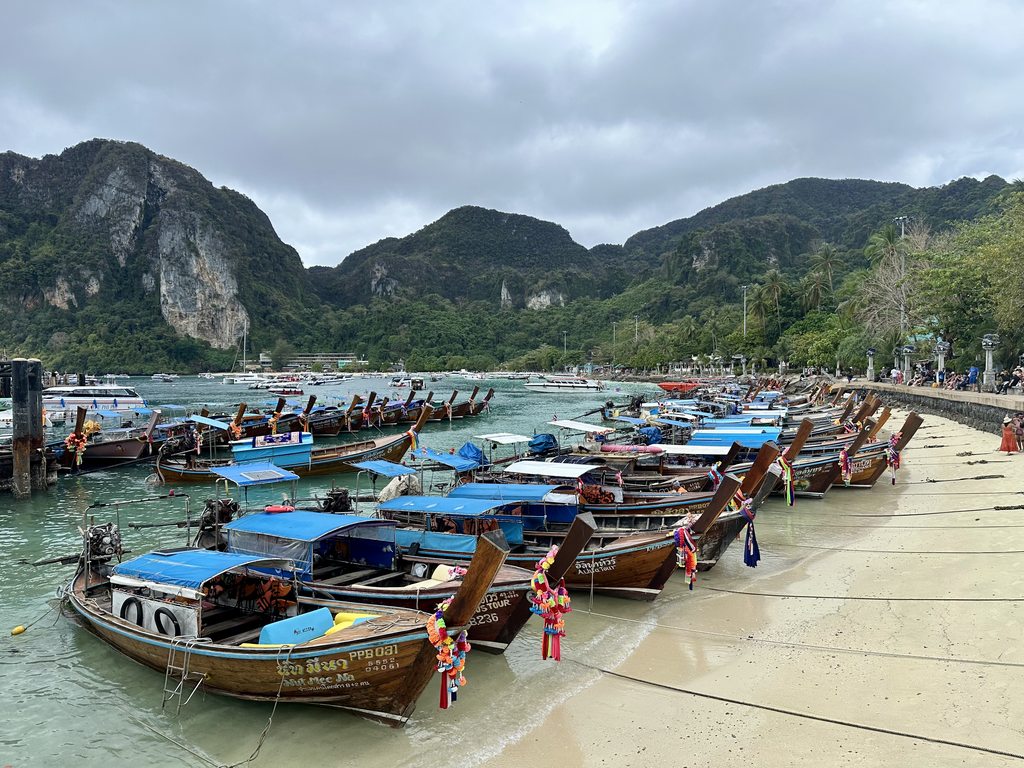
If you only read one paragraph: from Phuket or the Krabi mainland, a standard ferry costs around 450–500 THB and takes about two hours; a speedboat costs roughly double and takes 30 to 50 minutes. From Koh Lanta the crossing is short but the timetable is thin. And whichever boat you take, the 400 THB national park fee is not included unless someone tells you in writing that it is.
Koh Phi Phi Ferries at a Glance
The table below is the whole page in twelve lines. Prices are the real published floors on the booking platforms in August 2026, not rounded estimates, and they are one-way per adult. High-season fares run 10–20 % above these.
| From | Departure pier | Ferry | Speedboat | From (THB) | Sailings/day |
|---|---|---|---|---|---|
| Phuket | Rassada Pier | 2 h | 50 min | 450 | Many, all year |
| Krabi Town | Klong Jilad, Ao Nam Mao | 2 h | 45 min | 462 | Several |
| Ao Nang | Nopparat Thara | 2 h | 30 min | 459 | Several |
| Railay | Floating Pier East Railay | 1 h 45 | — | 461 | 1–2 |
| Koh Lanta | Saladan Pier | 1 h | 30 min | 675 | Few, seasonal |
| Bangkok | Airport or Khao San | 5 h flying, ~18 h by bus and boat | 1 260 | Daily | |
Three numbers are worth holding on to, because they explain most of the surprises people report:
- 400 THB — the Hat Noppharat Thara – Mu Ko Phi Phi National Park fee for foreign adults, 200 THB for children. Cash only, collected by rangers, and almost never included in a transfer ticket.
- 1 August to 30 September — Maya Bay closes every year. If Maya Bay is the reason you are going, this is the single date range that matters.
- November to April — the dry season, calm seas, full timetables. May to October the sea is rougher, some routes shrink to one sailing a day, and cancellations become normal rather than rare.
Four Crossings in Five Days: What I Actually Took
I crossed this stretch of the Andaman four times in February 2025, on four different kinds of boat: a big ferry, two speedboats and a car ferry. What follows is what each one is actually like, because the things that catch people out on this route are never the boats themselves — they are the piers, the timings and the luggage.
23 February: Phuket to Koh Phi Phi on the morning ferry
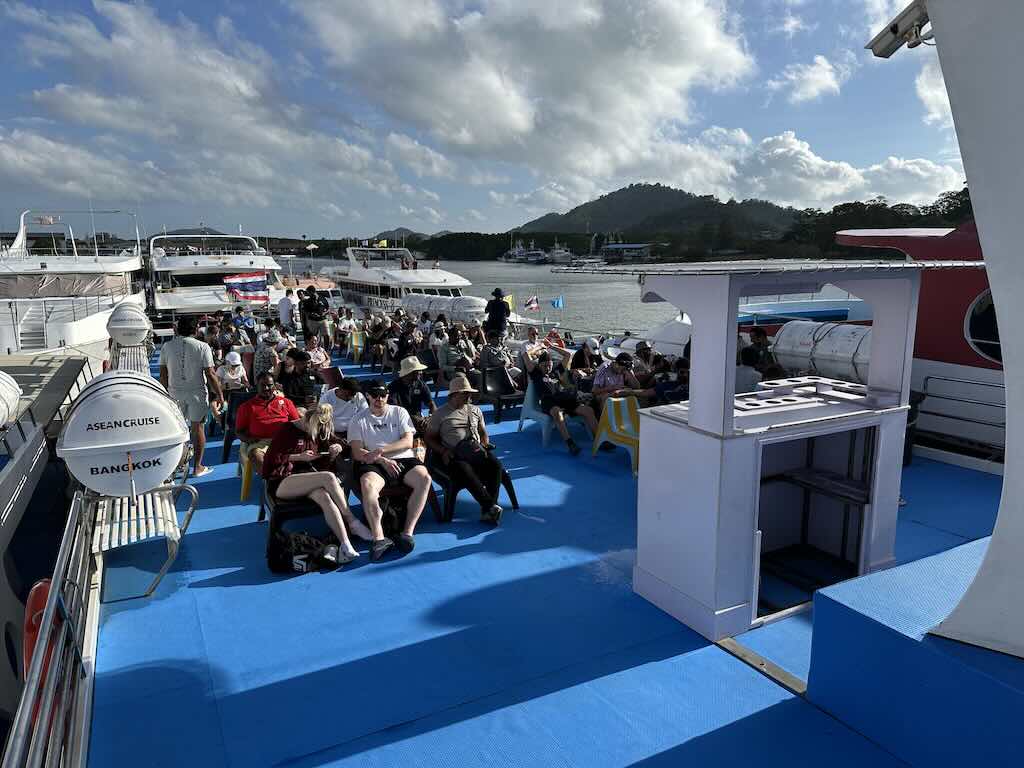
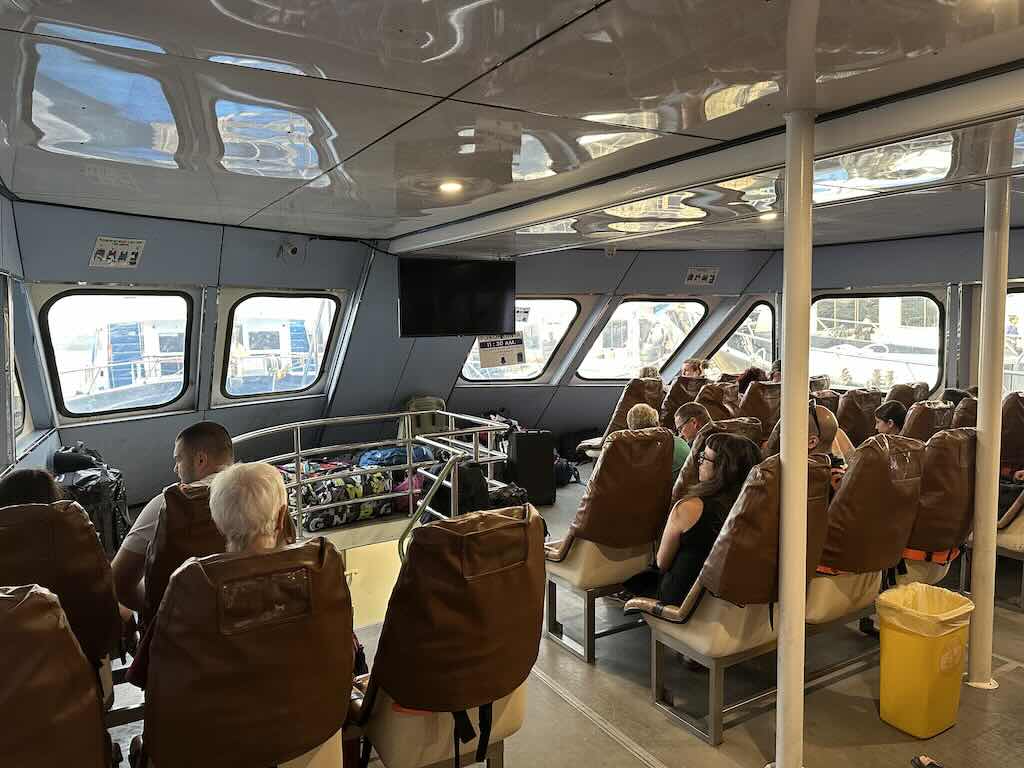
I took the morning ferry out of Phuket on 23 February. This is the crossing most people make, and it is a genuinely pleasant two hours if you treat it as part of the holiday rather than as transit. The boat has two decks. The lower one is enclosed, air-conditioned, and has rows of seats like a coach. The upper one is open to the sky with plastic chairs and a bar, and it is where you want to be — the approach to Phi Phi Don through the limestone is the best part of the journey and you cannot see it from inside.
24 February: Koh Phi Phi to Koh Lanta by speedboat
After a morning boat tour around Phi Phi Leh I took the afternoon speedboat to Koh Lanta and arrived in the late afternoon. It is a completely different experience from the Phuket ferry — a covered cabin, no deck to walk on, engines you hear over everything — and it is over almost before it starts. Half an hour, and you are at Saladan. On a crossing this short the speedboat is the right choice; the calculation only changes on the two-hour routes.
25 February: off Koh Lanta by car ferry
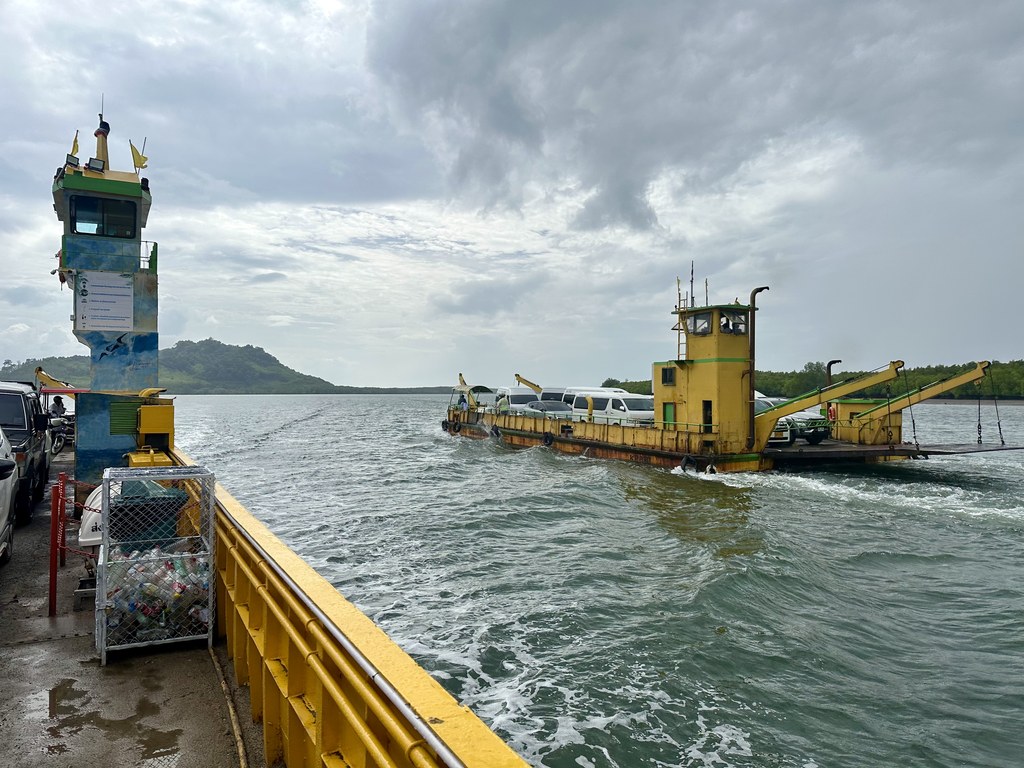
Koh Lanta is the one island in this group you can reach with a car, and in 2026 that still means a flat-bottomed car ferry between Koh Lanta Noi and the mainland. I left on the three o’clock crossing and watched Lanta go backwards. Worth knowing if you are planning a loop rather than a there-and-back: Lanta connects to the road network, Phi Phi never will.
27 February: Nopparat Thara to Phuket, off the sand
The last crossing was the one that taught me the most, and it started at 11:22 in the morning at Nopparat Thara, the estuary pier just west of Ao Nang. There was no pier in the way most people picture one. The speedboat was run up onto the sand, a crew member held the gangway steady, and everybody walked aboard across the beach.
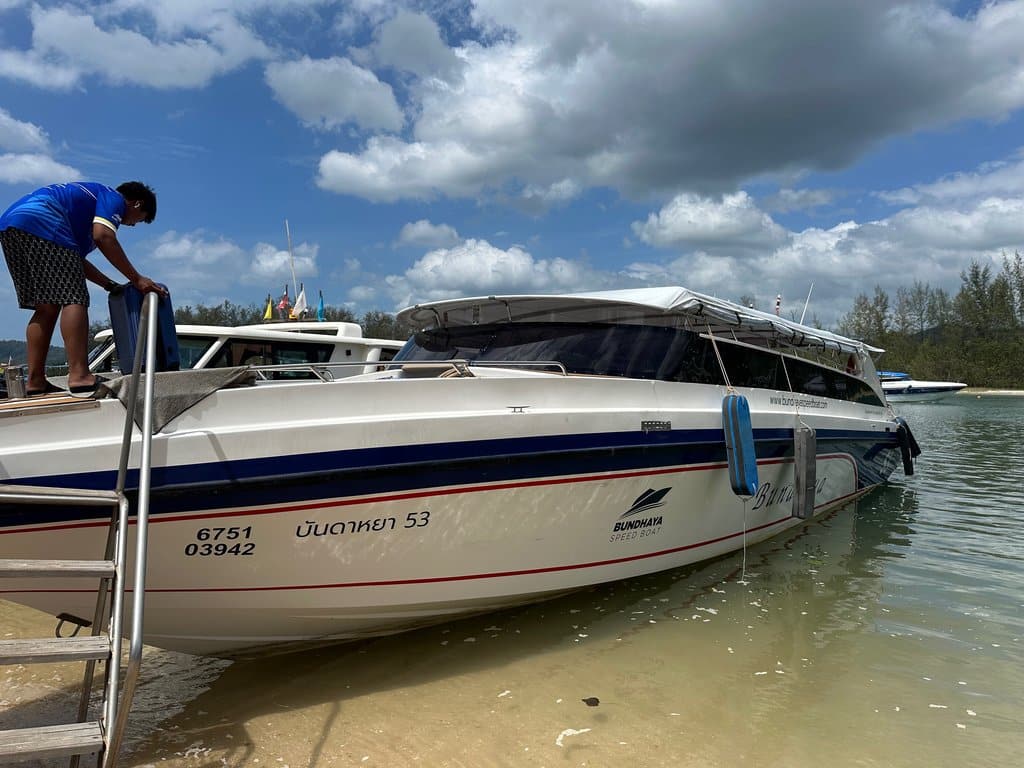
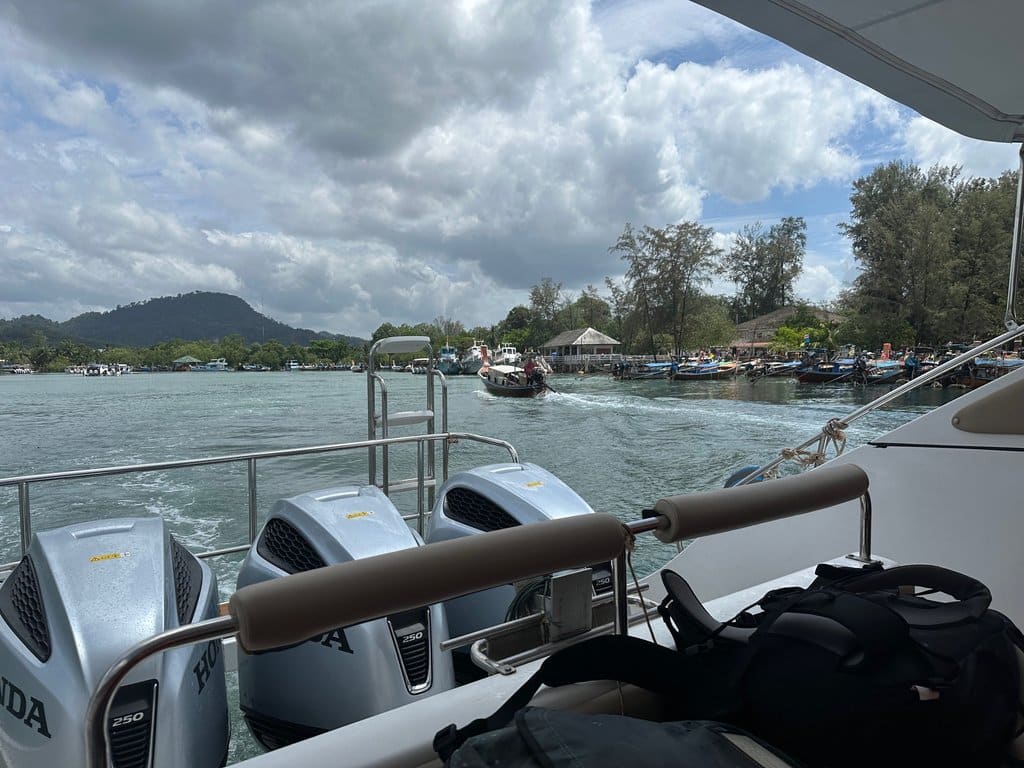
Inside, an orange life jacket hangs on every single seat, and the cabin fills completely. Seven minutes later we were out in the channel, and the two details I would want to have known are both visible from the stern: three 250-horsepower outboards, which is why these boats do the crossing in half an hour, and the luggage stacked in the open on the back bench, unprotected. Anything that must not get wet or salty travels on your knees, not in your bag.

From Phuket: Rassada Pier
Phuket is the busiest gateway by a wide margin — well over a hundred departures a day are bookable in high season, against a dozen or so from Koh Lanta. If your dates are tight or you are travelling at Christmas or Chinese New Year, this is the route with the most room to absorb you.
Almost everything leaves from Rassada Pier, on the east side of the island near Phuket Town, about 45 minutes from Patong and an hour from Karon or Kata. A handful of speedboats use Sea Angel Pier instead. Read your ticket: the two are not close together, and a taxi driver told to go to “the Phi Phi pier” will take you to Rassada.
The big ferry: two hours, and the better ride
The standard ferries — Andaman Wave Master, Phi Phi Cruiser, Chaokoh and Tigerline are the names you will see — leave through the morning and early afternoon and take about two hours to Ton Sai. Fares start around 450 THB. They are large, stable, have toilets and a snack counter, and they handle a choppy sea far better than a speedboat does.
Booking ahead matters less for the crossing than for the transfer: most tickets can be bought with a hotel pickup included, and that is what actually saves you money and argument. You can compare every Phuket to Koh Phi Phi departure and price on 12Go, which lists the operators side by side with the pier each one uses.
The speedboat: 50 minutes, roughly double the fare
Speedboats do Phuket to Ton Sai in about 50 minutes for something close to twice the ferry price. They are worth it in one specific case — you are arriving on a late flight, or leaving on an early one, and an hour of your day is genuinely valuable. They are worth avoiding if the sea is up, if you get motion sick, or if you are travelling with small children: a speedboat in a swell is a physical experience.
Day trip or one-way?
A large share of Phuket’s Phi Phi traffic is not transport at all — it is day tours that go to Maya Bay, Pileh Lagoon and Bamboo Island and come back the same evening. If you want the islands rather than the town, that is a legitimate way to see them, and it includes the boat, the guide and usually lunch. The Maya, Phi Phi and Bamboo Island day trip with buffet lunch is the standard version of it, and Klook lists the same run if you prefer to compare.
One warning that applies to every day trip from anywhere: check whether the 400 THB park fee is in the price. On the bigger operators it usually is. On a boat booked at a beach desk it usually is not, and you will be asked for cash in the middle of the sea.
From Krabi Town: Klong Jilad and Ao Nam Mao
Krabi Town is the transport hub of the province — it has the airport, the bus station and the cheapest beds — but it is not on the sea in any useful sense. Boats to Phi Phi leave from Klong Jilad Pier, a few minutes south of the town centre, and some services use Ao Nam Mao, further out towards the Railay headland.
Crossings run about two hours by ferry from roughly 460 THB, or 45 minutes by speedboat. If you are flying into Krabi International and going straight to Phi Phi, buy the combined airport transfer and boat ticket rather than assembling it yourself — the pier is 20 minutes from the terminal and the sailings are timed against the flights, not against your taxi.
You can see the Krabi to Koh Phi Phi timetable and fares here. For the tour version rather than the transfer, the Krabi to Phi Phi and Bamboo Island speedboat day tour covers the same water with stops.
From Ao Nang and Nopparat Thara
Ao Nang is where most people staying on the Krabi mainland actually sleep, and it has the fastest crossing of the lot: 30 minutes by speedboat, from around 459 THB, with ferries taking about two hours. Departures use Nopparat Thara Pier, in the estuary about ten minutes west of the main beach, and some use Ao Nam Mao on the other side.
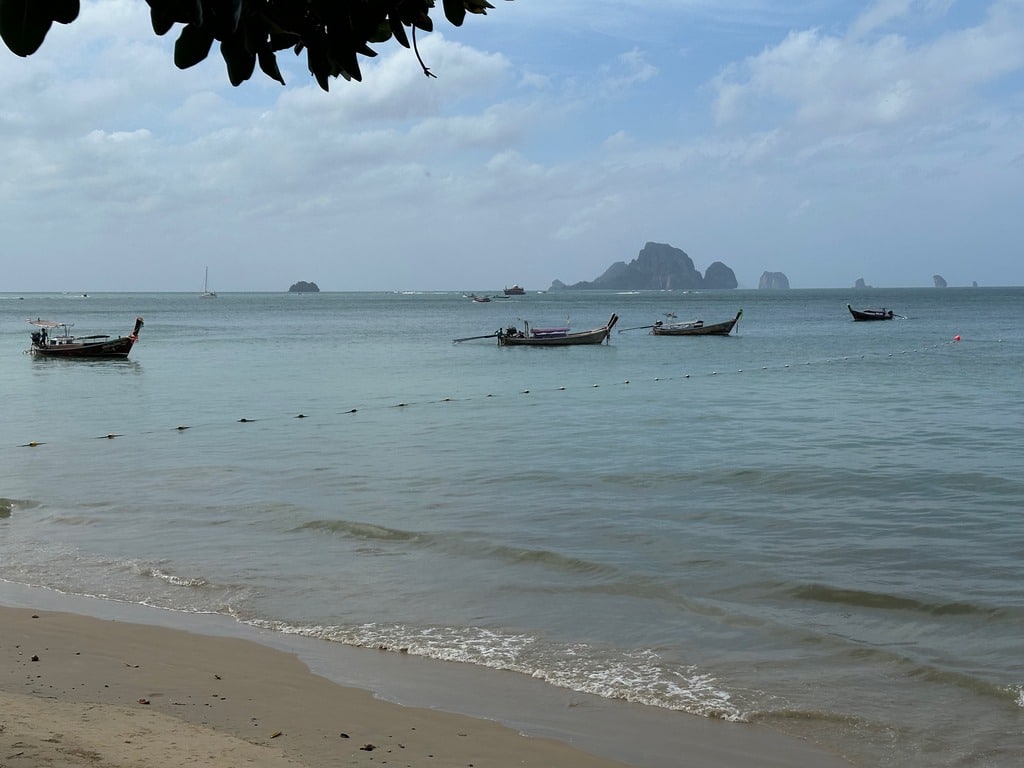
Two things about Nopparat Thara are worth knowing before you arrive with a suitcase. First, boarding can be off the sand rather than off a jetty, as it was for me — flip-flops, not laced shoes. Second, the pier is not walkable from most Ao Nang hotels, so a ticket that includes the transfer is worth more here than the fare difference between operators.
The full list of Ao Nang to Koh Phi Phi departures is here. If you are basing yourself in town rather than passing through, the Ao Nang guide covers where to stay and what the town is actually good for.
From Railay: the Floating Pier
Railay has no road, so getting to Phi Phi from there means one of two things. Either you take a longtail back across to Ao Nang and pick up a boat at Nopparat Thara, or you use the Floating Pier East Railay — a pontoon off Railay East where the Ao Nang–Phi Phi ferries stop on their way past.
The direct option is the good one when it runs: about 1 h 45 to Ton Sai, from roughly 461 THB, with one or two sailings a day. Because there are so few, this is the route where booking the day before genuinely matters — miss it and your alternative is a longtail, a beach, and a lost morning. Check the Railay to Koh Phi Phi sailings here, and see the Railay Beach guide for how the peninsula works.
From Koh Lanta: Saladan Pier, and the Season Problem
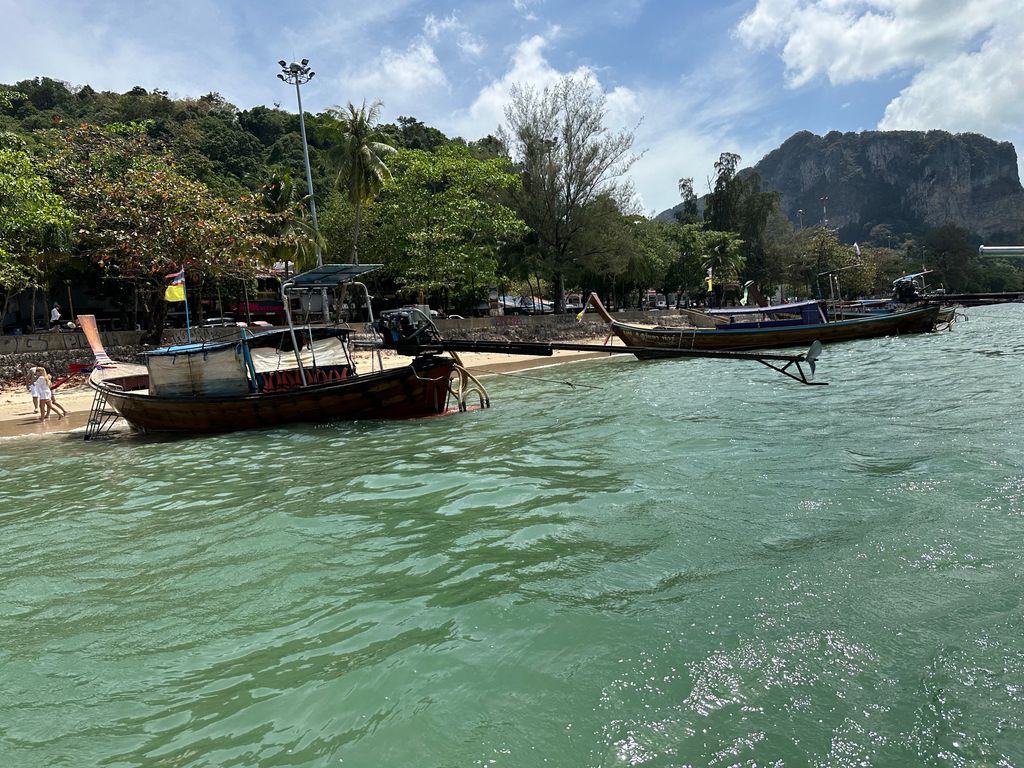
This is the shortest crossing and the most fragile timetable. Boats leave from Saladan Pier at the northern tip of Koh Lanta Yai and reach Ton Sai in 30 minutes by speedboat or about an hour by ferry, from around 675 THB — noticeably more than the mainland routes, for a fraction of the distance.
The reason is volume. Checking the same booking platform on the same day in August 2026, Phuket to Phi Phi offered 109 departures and Koh Lanta to Phi Phi offered eleven. That is the low season in one comparison. From November to April the Lanta service is comfortable and frequent; outside it, you are choosing between a small number of sailings, and a cancelled boat can cost you a day.
Practical consequence: on this route, book before you arrive on Lanta, not the night before you leave. The Koh Lanta to Koh Phi Phi sailings are listed here. There is also a day-trip version — the Koh Lanta to Phi Phi day trip by speedboat — and a snorkelling tour that leaves from Lanta.
From Bangkok: Five Hours or Eighteen
There is no boat from Bangkok, and the choice is stark. Flying to Krabi or Phuket and continuing by ferry gets you from the capital to Ton Sai in about five hours door to door. The overland combination — a night bus from Khao San or the Southern Bus Terminal, then a morning boat — takes around eighteen hours and starts at about 1 260 THB.
The bus is not the bargain it looks like. Once you add the night you did not sleep and the day you spend recovering, a cheap domestic flight into Krabi usually wins on both money and time. The overland route earns its place in exactly one situation: you want to break the journey somewhere else on the way south, and Phi Phi is a stop rather than a destination.
Compare the Bangkok to Koh Phi Phi options here — flights, buses and combined bus-and-boat tickets appear on the same page, which is the fastest way to see that the price gap is smaller than the time gap.
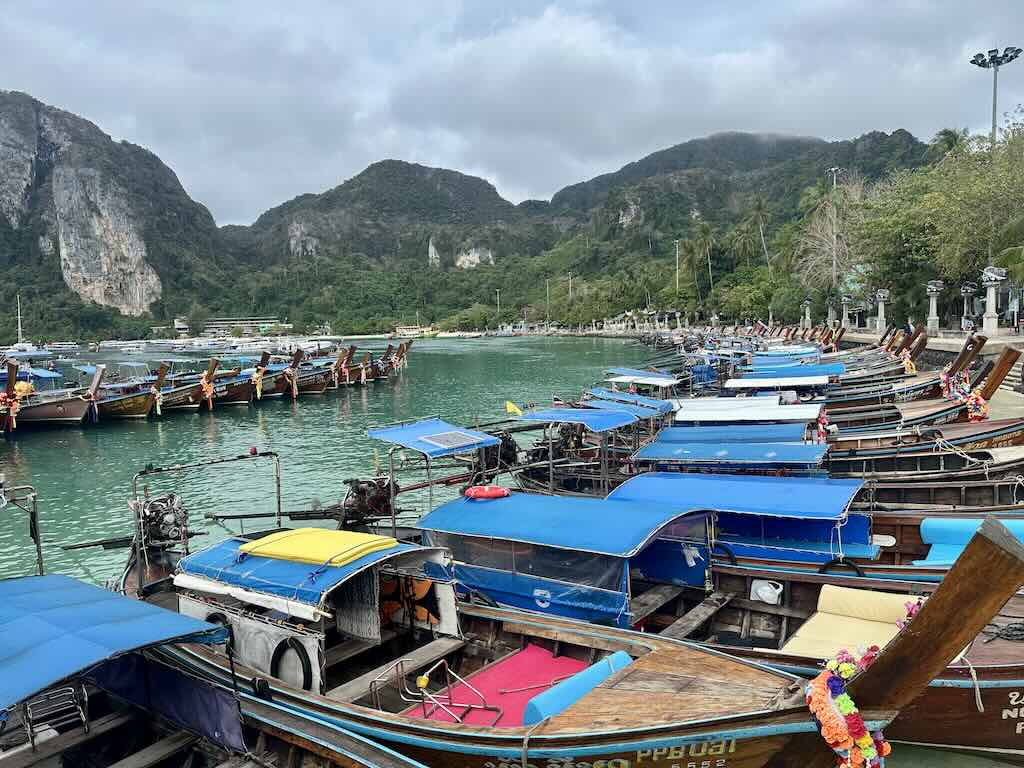
Arriving at Ton Sai: the First Fifteen Minutes
Ton Sai is small, crowded and slightly chaotic, and knowing the sequence removes most of the friction.
- There are no cars. None. No taxis, no tuk-tuks, no motorbikes. You walk, or you take a longtail.
- Your luggage walks with you. Porters with handcarts wait at the pier and will take bags to a hotel in the village for a small fee. Wheeled suitcases and sand alleys are a poor combination.
- If your hotel is on a remote bay — Phak Nam, Loh Bagao, Laem Tong — its longtail meets the boat. Confirm the pickup before you sail, not after you land.
- Cash. There are ATMs and exchange counters in the village, but beach-booked boats, small restaurants and the national park fee are all cash only.
Buying the Ticket: When, Where and What It Should Cost
How far ahead to book
It depends entirely on the route, and this is where most advice is uselessly generic. From Phuket, with a hundred-odd daily departures, booking the day before is fine outside the Christmas and Chinese New Year peaks. From Railay or Koh Lanta, where the whole day may hold one or two sailings, book several days ahead — the scarcity is structural, not seasonal noise.
Pier ticket, hotel desk or online
Buying at the pier is occasionally cheaper and always riskier: you are betting there is a seat. A hotel desk is convenient and takes a commission. Booking online is the only method that shows you every operator on one screen with the departure pier named, which matters more than the fare — Rassada and Sea Angel are not the same place, and Klong Jilad and Ao Nam Mao are half an hour apart.
What is not in the price
The 400 THB national park fee for foreign adults, 200 THB for children, is collected by rangers in cash and is almost never bundled into a transfer ticket. Hotel transfers at either end may or may not be included — the booking page says so explicitly, the hotel desk often does not. And if you are joining a snorkelling stop, fins and mask are sometimes extra.
Seasons, Rough Seas and Cancellations
November to April is the dry season: calm water, full timetables, every route running. May to October brings the southwest monsoon — not constant rain, but a real swell, thinner schedules, and cancellations that are a normal part of the system rather than an exception.
Three rules for the wet season. Take the big ferry rather than the speedboat when there is any sea running; the difference in comfort is enormous and the difference in time is an hour. Do not plan a Phi Phi crossing on the day of an international flight — leave a night’s margin on the mainland. And remember that Maya Bay is closed from 1 August to 30 September every year, which changes what a day trip is even selling you.

Transfer or Day Tour? They Are Not the Same Ticket
People routinely book the wrong one. A transfer takes you and your luggage from A to Ton Sai and stops there. A day tour takes you around Phi Phi Leh, Maya Bay, Pileh Lagoon, Monkey Beach and Bamboo Island, feeds you, and brings you back to where you started — it will not drop you on the island with your suitcase, and it usually cannot.
If you are staying on Phi Phi, book a transfer and take a tour once you are there. If you are not staying, a day tour is a perfectly honest way to see the best of the archipelago: the small-group Phi Phi and 4 Islands sunset tour from Krabi is the version that avoids the midday crowd, and there is a full list of Phi Phi Islands tours if you want to compare formats.
Leaving Koh Phi Phi
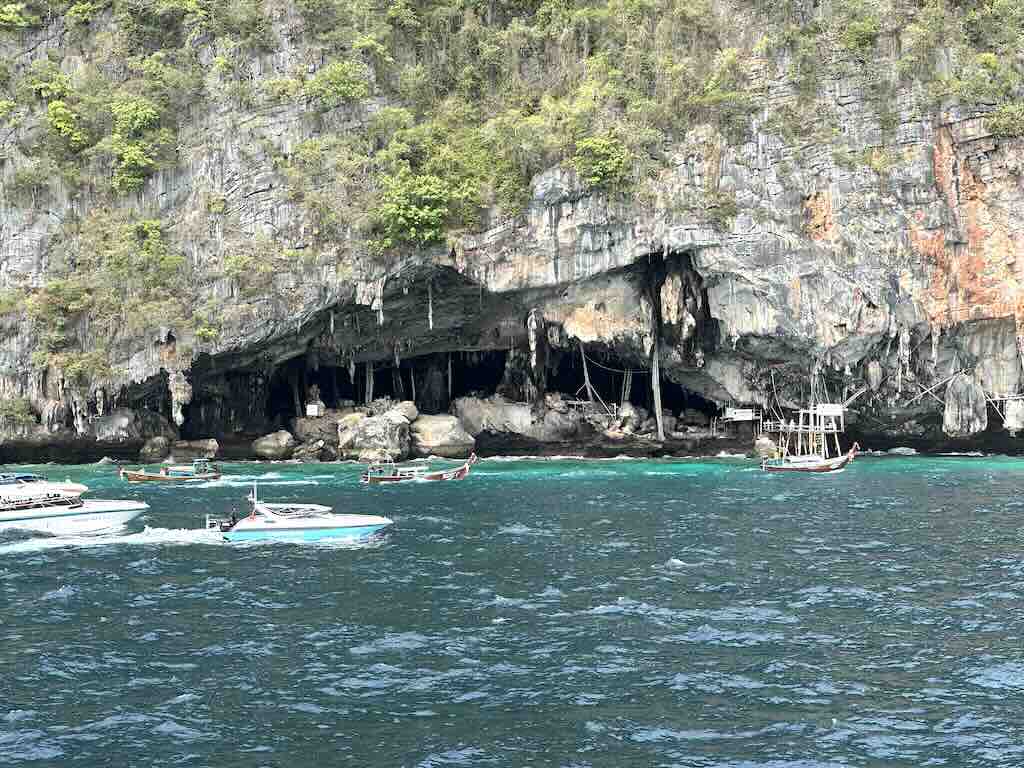
The return works the same way in reverse, with one asymmetry worth planning around: departures cluster in the morning and early afternoon. There is no useful evening boat off the island. If you have a flight out of Phuket or Krabi, that means either an early boat and a long airport wait, or a night on the mainland.
Onward by sea is also possible without going back to where you came from: Phi Phi connects directly to Koh Lanta in half an hour, which makes a Phuket–Phi Phi–Lanta line far more sensible than a series of returns. That is exactly the shape my own February route took, and it is the one I would repeat.
Which Boat Should You Actually Take?
- First time, no fixed plan, high season — the standard ferry from Phuket. Most departures, cheapest fare, best ride, and the upper deck is worth the two hours.
- Flying into Krabi — the combined airport-and-boat ticket from Klong Jilad. Do not build it yourself.
- Staying in Ao Nang — the speedboat from Nopparat Thara. Thirty minutes, and you keep the day.
- Coming from Railay — the direct sailing from the Floating Pier if there is one; otherwise longtail to Ao Nang and go from there.
- Coming from Koh Lanta — book early, and check the season before you build an itinerary around it.
- Starting in Bangkok — fly. The bus saves less than it costs you.
Still deciding between the islands rather than between the boats? The Krabi, Koh Phi Phi and Koh Lanta comparison guide sets them against each other, with a map of how the whole archipelago connects.
Discover More of the Krabi Islands
Koh Phi Phi Travel Guide
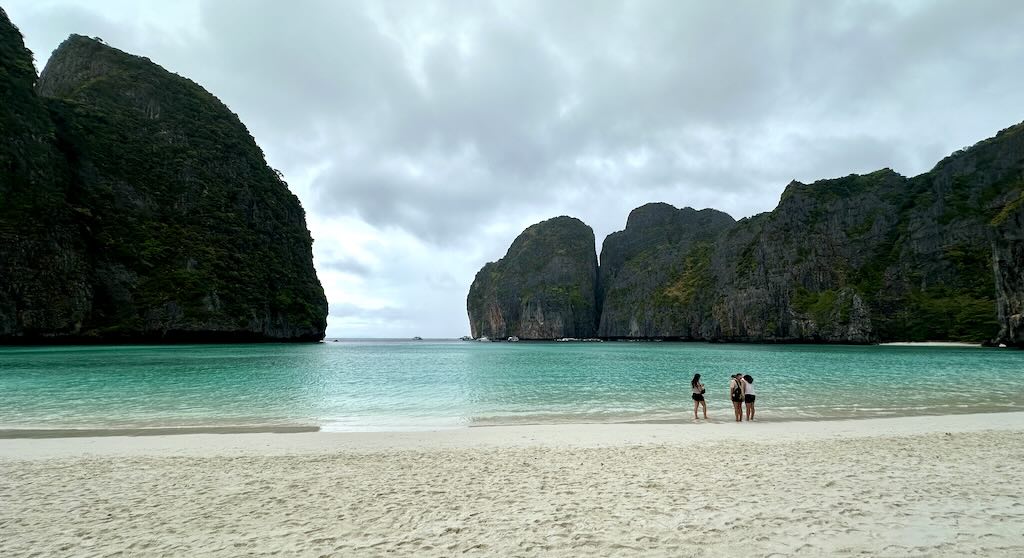
Where to stay, which beaches are worth the longtail, the viewpoint climb, Maya Bay’s rules, and the two-day itinerary that actually works once you have landed.
Railay Beach Guide
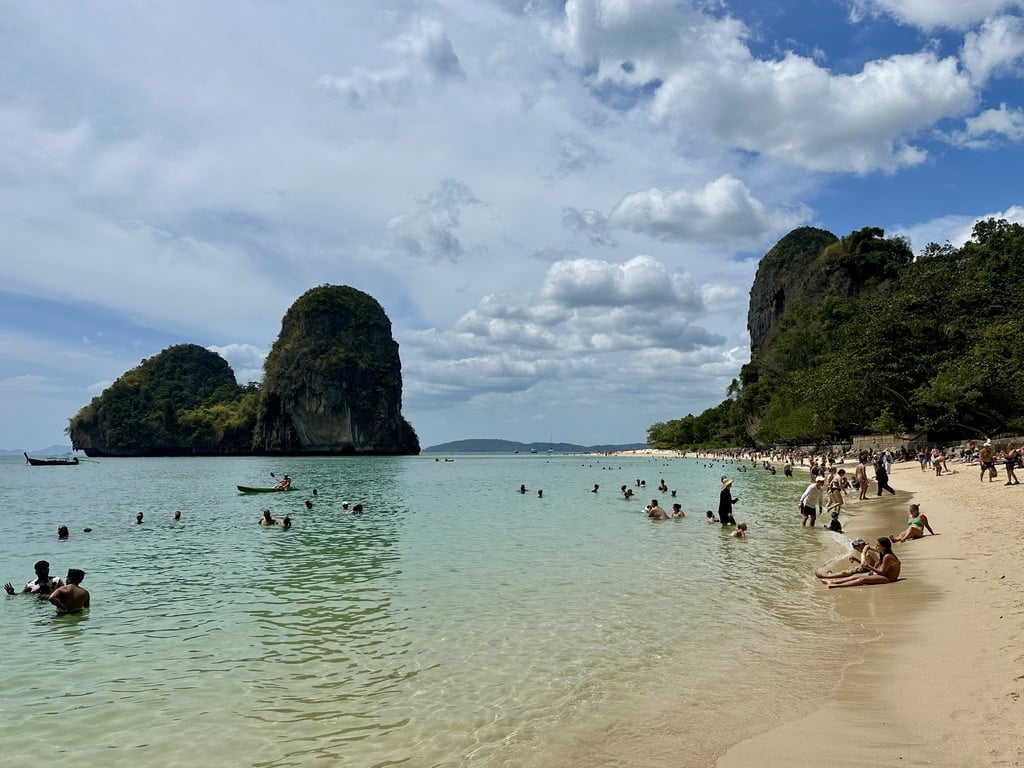
The peninsula with no road: Phra Nang, the viewpoint scramble, the tide timetable that governs Railay East, and how the longtail shuttle from Ao Nang really works.
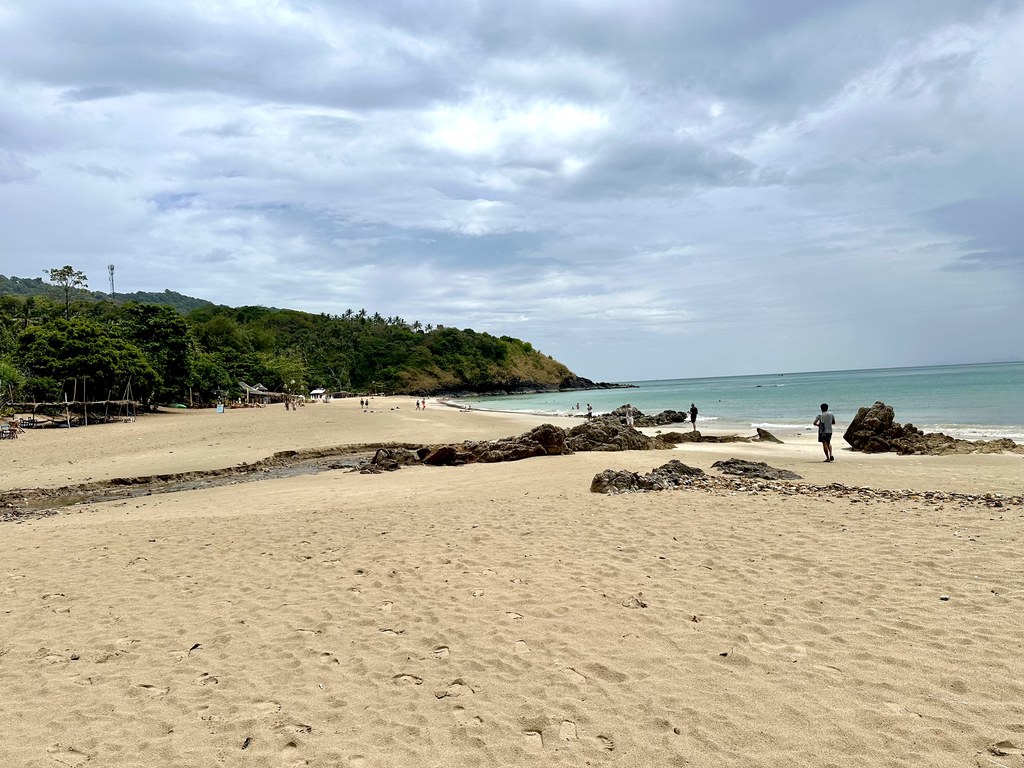
Koh Lanta Travel Guide
The long quiet island south of Phi Phi: the beaches north to south, Mu Ko Lanta National Park, the Old Town, and why one night there is a mistake.
Frequently Asked Questions About Getting to Koh Phi Phi
Is there an airport on Koh Phi Phi?
No. Koh Phi Phi has no airport and no bridge, and every arrival is by boat. The two nearest airports are Krabi International, about two hours away by road and ferry, and Phuket International, roughly the same. There are no helicopter services for ordinary visitors.
How long is the ferry from Phuket to Koh Phi Phi?
About two hours on a standard ferry from Rassada Pier to Ton Sai, or roughly 50 minutes by speedboat. Ferry fares start around 450 THB one way; speedboats cost close to double. Sailings run through the morning and early afternoon, all year.
Which pier do boats to Koh Phi Phi leave from?
Rassada Pier in Phuket, Klong Jilad or Ao Nam Mao in Krabi, Nopparat Thara in Ao Nang, the Floating Pier on Railay East, and Saladan on Koh Lanta. Arrival is Ton Sai on Phi Phi Don, apart from a few Phuket sailings that call at Laem Tong. Check the pier name on your ticket — several are half an hour apart by road.
How much does it cost to get to Koh Phi Phi?
In August 2026, one-way fares started at 450 THB from Phuket, 462 THB from Krabi, 459 THB from Ao Nang, 461 THB from Railay, 675 THB from Koh Lanta and 1,260 THB from Bangkok. Speedboats sit well above those floors, and high-season prices run 10–20 % higher.
Do I have to pay a national park fee?
Yes, if you enter the Hat Noppharat Thara – Mu Ko Phi Phi National Park, which includes Maya Bay and Pileh Lagoon. The fee is 400 THB for foreign adults and 200 THB for children, cash only, collected by rangers. It is rarely included in a transfer ticket and is not always included in a tour — check before you board.
Can I get to Koh Phi Phi from Bangkok in one day?
Yes, by flying. A morning flight to Krabi or Phuket plus the onward ferry puts you on the island in about five hours door to door. The overland alternative — night bus, then a morning boat — takes around eighteen hours and saves less money than most people expect.
Should I take the ferry or the speedboat?
Take the ferry unless the extra hour genuinely matters. It is cheaper, far more comfortable, has toilets and a deck you can walk on, and it copes with a swell that makes a speedboat unpleasant. Take the speedboat when you are connecting to a flight, or on the short Koh Lanta crossing where half an hour in a hard seat is no hardship.
How far in advance should I book?
It depends on the route, not the season alone. From Phuket, with more than a hundred daily departures, the day before is usually fine outside the Christmas and Chinese New Year peaks. From Railay or Koh Lanta, where a whole day may hold one or two sailings, book several days ahead.
Can I take a day trip to Koh Phi Phi instead of staying?
Yes, and it is a reasonable choice if the islands rather than the village are what you want. Day tours run from Phuket, Krabi, Ao Nang and Koh Lanta and cover Maya Bay, Pileh Lagoon, Monkey Beach and Bamboo Island. They return to your starting point, so they cannot be used as a transfer with luggage.
Are there boats to Koh Phi Phi in the rainy season?
Yes, all year from Phuket and the Krabi mainland, but timetables thin out from May to October and cancellations become routine. Koh Lanta is the route most affected: on the same August day that Phuket offered 109 departures, Koh Lanta offered eleven. Leave a margin before any onward flight.
Is there transport on Koh Phi Phi once I arrive?
No cars, no motorbikes and no taxis. You walk, or you take a longtail boat. Porters with handcarts meet the ferries at Ton Sai and will carry luggage to a village hotel for a small fee. If your hotel is on a remote bay, its own longtail collects you — arrange it before you sail.
Can I go straight from Koh Phi Phi to Koh Lanta?
Yes, and it is one of the best moves in this archipelago. The crossing to Saladan takes about 30 minutes by speedboat or an hour by ferry, which makes a Phuket–Phi Phi–Lanta line far more efficient than a series of return trips. Book ahead outside the November to April season.