Railay Beach: Krabi’s Most Spectacular Beach
By Blaise Jaeger · Updated August 18, 2026
Why Visit Railay Beach?
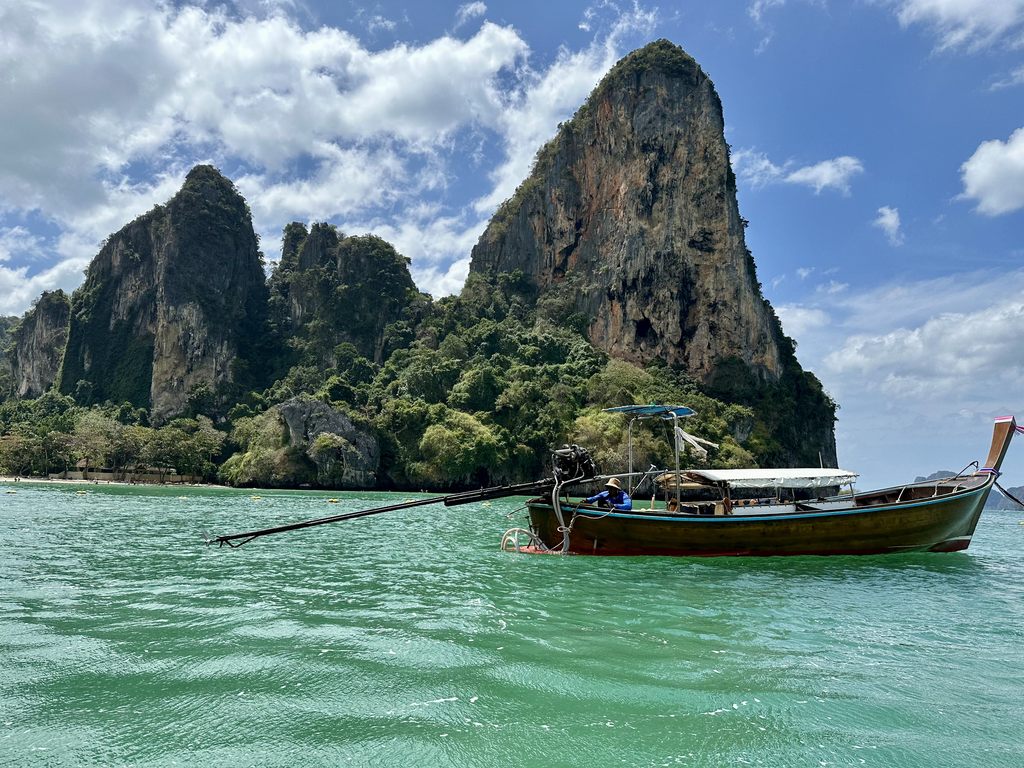
Railay is a peninsula that behaves like an island. It is physically attached to mainland Thailand, in Krabi Province on the Andaman coast, but a wall of limestone karst cuts it off so completely from the rest of the country that no road has ever been built to it. The only way in is by boat — a fifteen-minute longtail crossing from Ao Nang, or a slightly longer one from Krabi town. That single geographic fact shapes everything about the place: no cars, no scooters, no traffic noise, and a peninsula small enough to walk end to end in half an hour.
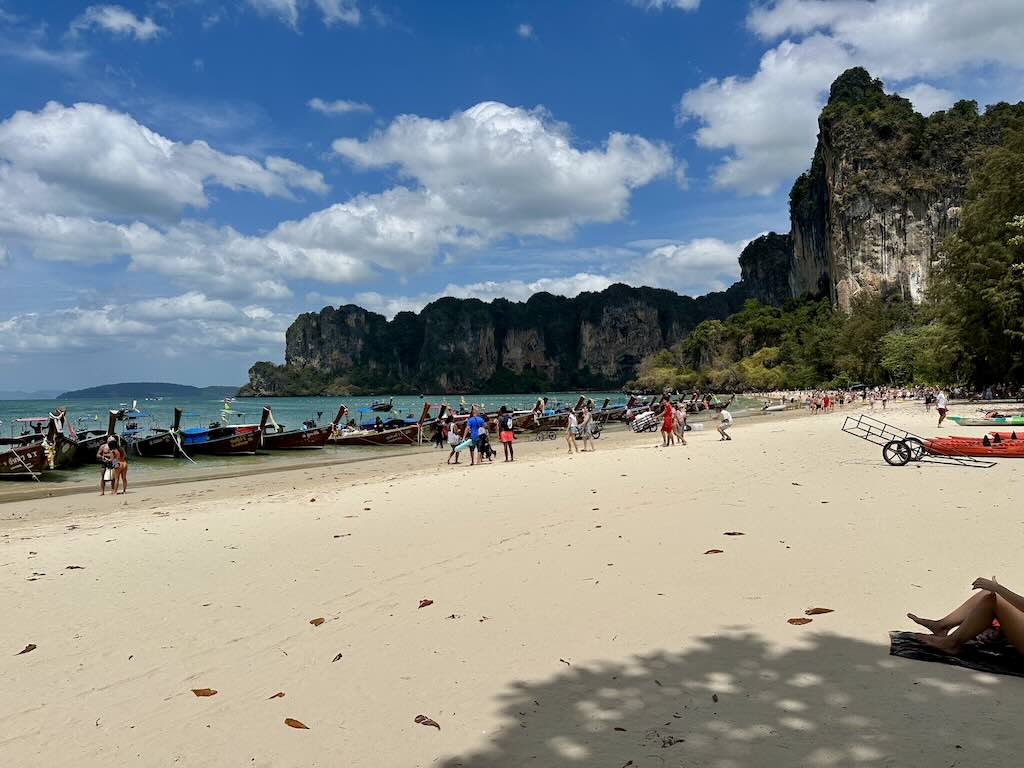
What you come for is the rock. Railay sits inside an amphitheatre of vertical limestone up to 300 metres high, streaked orange and grey, hung with stalactites and draped in vegetation that somehow finds a hold on the overhangs. Those walls made Railay one of the most famous sport-climbing destinations on the planet, and they also gave it four very different beaches within a twenty-minute walk of each other — including Phra Nang Beach, which turns up on more “best beaches in Thailand” lists than almost anywhere else in the country.
Railay is also the easiest of the three Krabi Islands destinations to fit into a trip. You can see the best of it in a single day from Ao Nang, or stay a couple of nights and watch it empty out completely once the day boats leave. This guide covers both.
Railay Beach at a Glance
- Where: a peninsula in Krabi Province, southern Thailand, on the Andaman Sea
- Access: by boat only — no road connects Railay to the mainland
- From Ao Nang: 10–15 minutes by longtail boat, around 150 THB per person each way
- Size: walkable end to end in roughly 30 minutes
- Four beaches: Railay West, Railay East, Phra Nang and Tonsai
- Famous for: limestone cliffs, Phra Nang Beach, the Princess Cave shrine, the viewpoint and lagoon hike, Diamond Cave, and world-class rock climbing
- Best time to visit: November to April (dry season); December to February is the sweet spot
- Busiest: 11:00 AM to 3:00 PM, when the day boats are in
- Quietest: before 9:00 AM and after 5:00 PM
- Vehicles: none, apart from a few beach tractors used to move luggage and supplies
- Protected status: the peninsula lies within Hat Noppharat Thara – Mu Ko Phi Phi National Park
- Typical meal: 100–250 THB at a local restaurant, 800 THB and up at a resort
- Cash: bring it — ATMs exist but are few, and charge high fees
My Day at Railay: What a Trip from Ao Nang Actually Looks Like
I went to Railay on 26 February 2025, as a day trip from Ao Nang, where I was staying. I want to describe that day honestly, because a lot of what is written about Railay assumes you have a week there and a rope in your bag. I had neither, and it was still one of the best days of that trip.
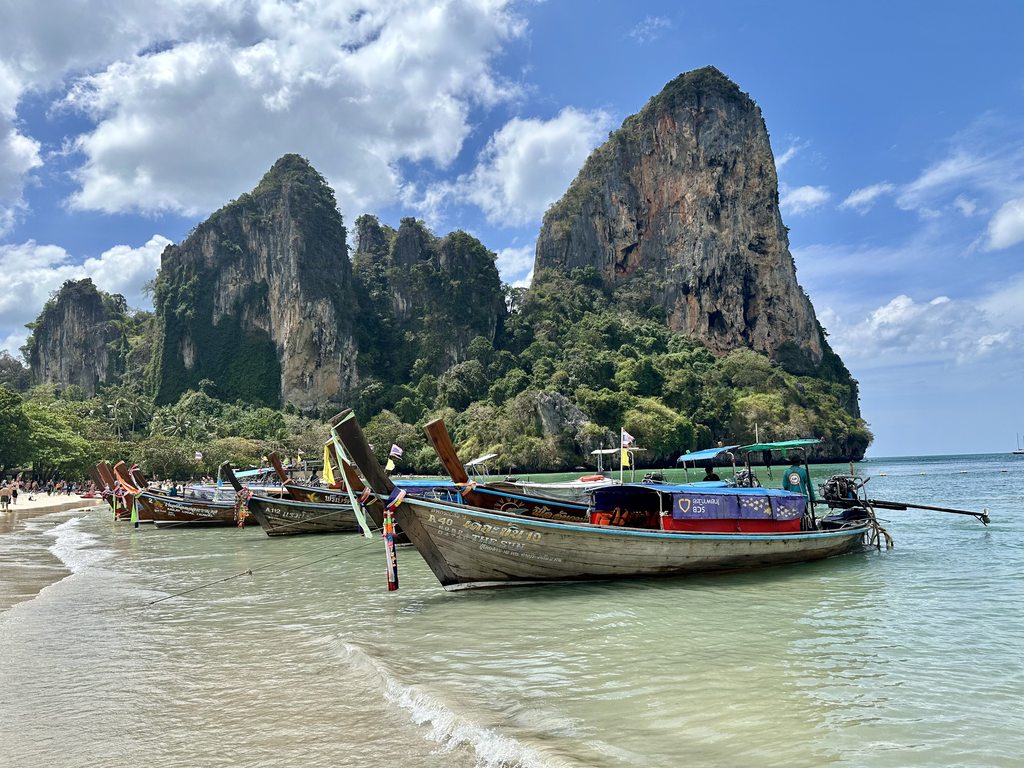
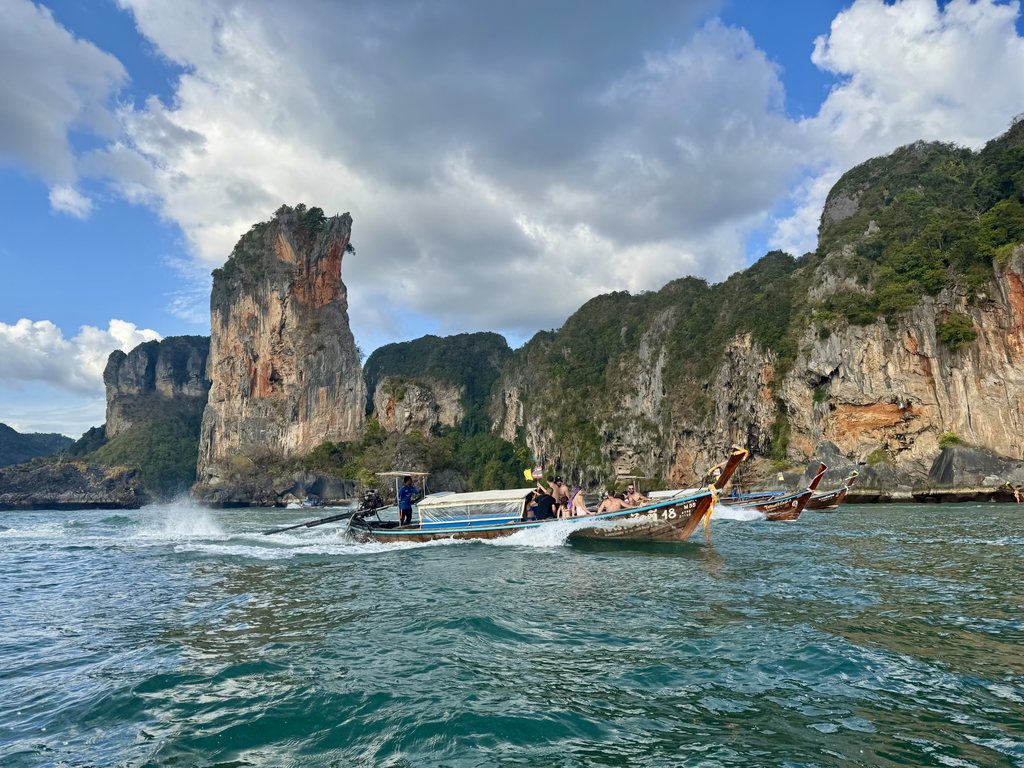
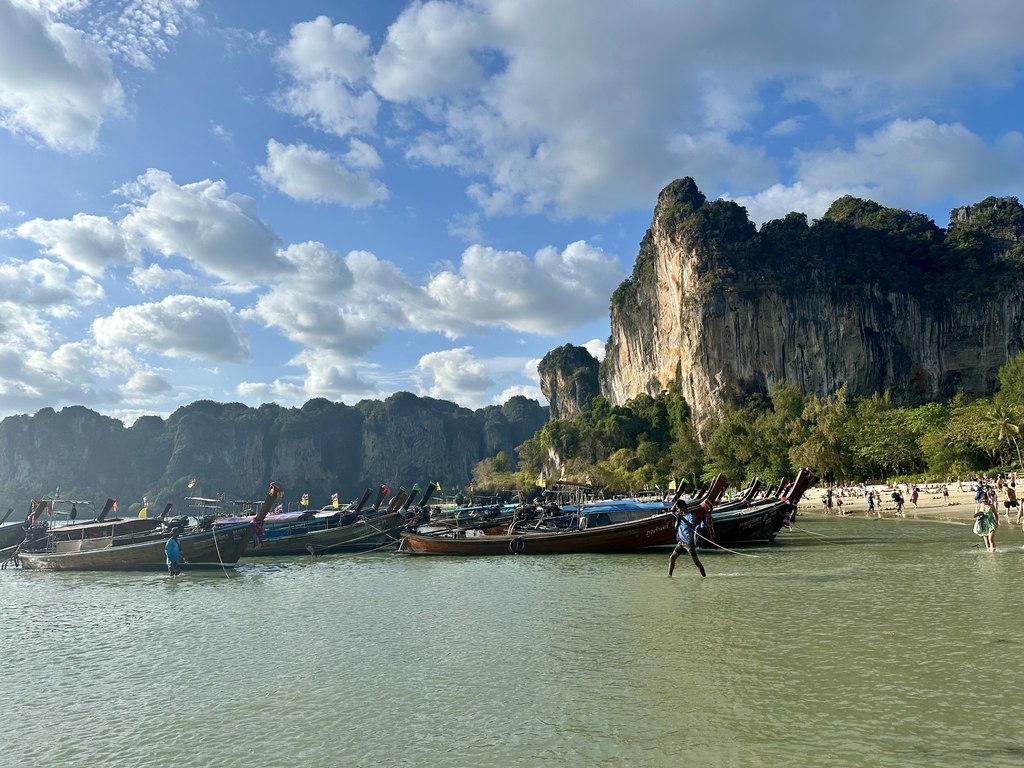
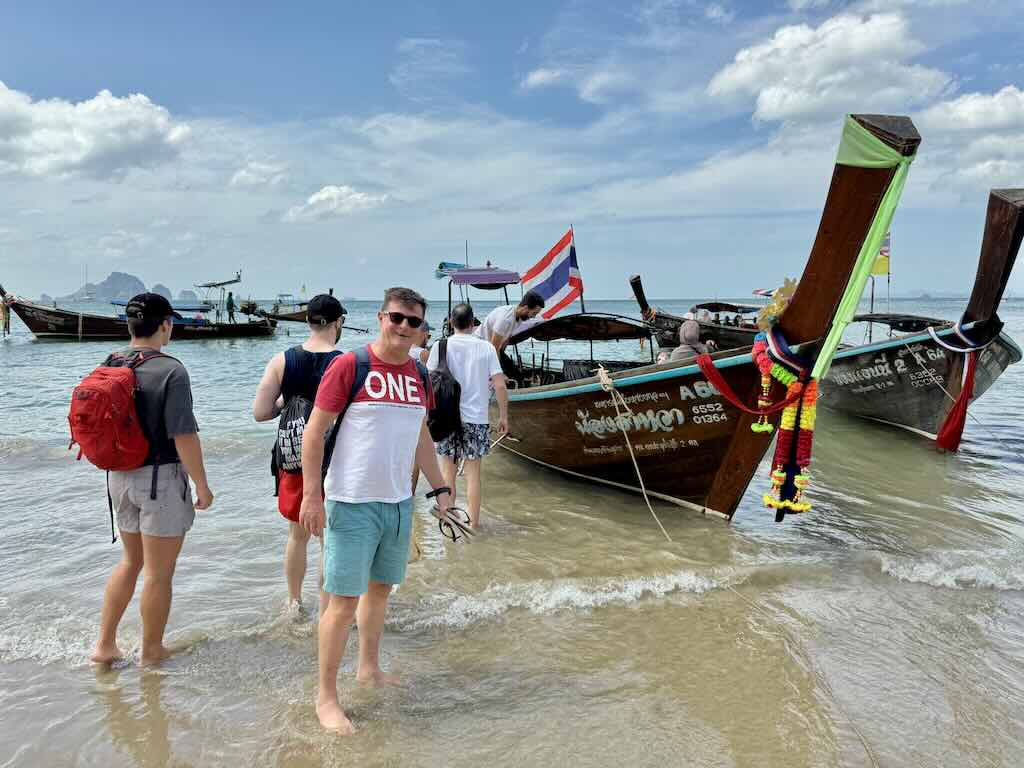
The boat leaves from Ao Nang beach itself — there is no pier. You walk into the sea up to your knees, hand your bag up, and climb over the side of a wooden longtail while it rocks. Boats leave when they fill up rather than on a timetable, and that morning it was quick; we were moving within a few minutes. The crossing takes about a quarter of an hour, spray coming over the bow, and then the karst towers of Railay West come out from behind the headland and everyone on board stops talking and reaches for their phone.
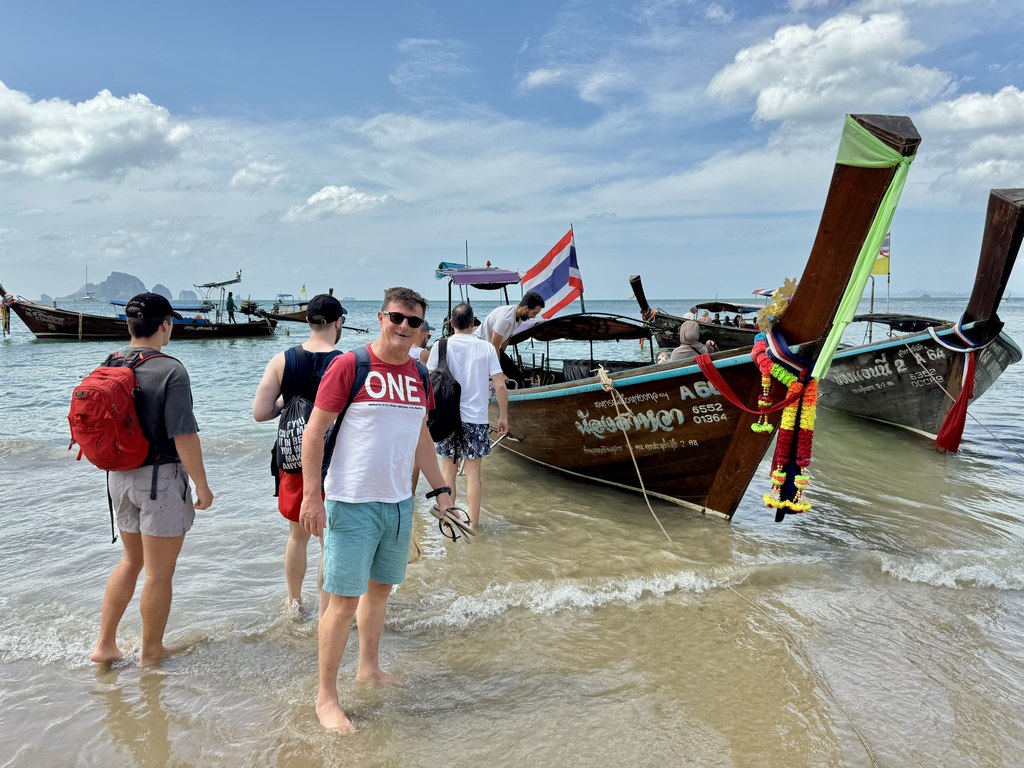
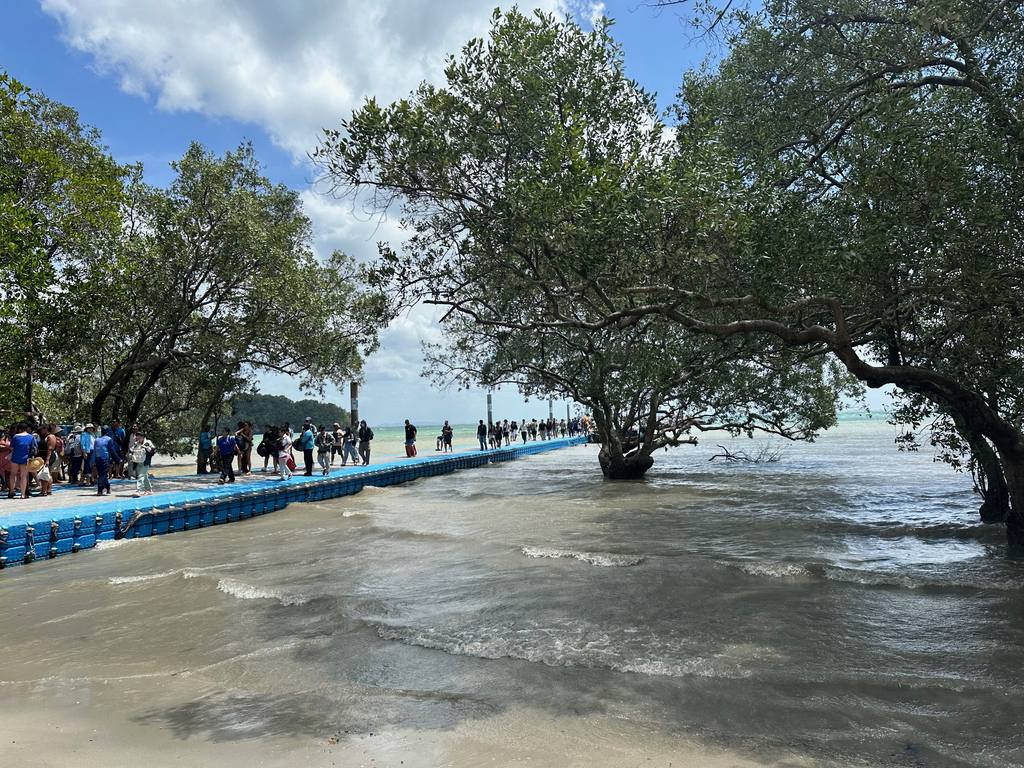
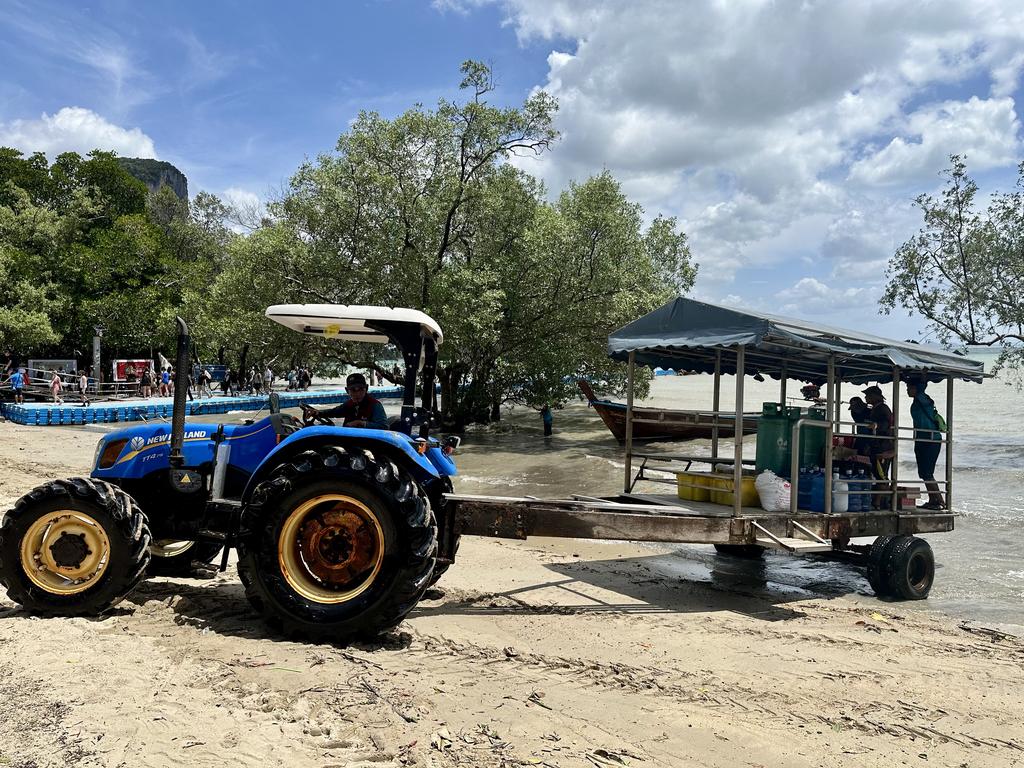
I walked the peninsula rather than picking one beach and staying on it, and I would do the same again. From Railay West I crossed to Railay East, where the mangroves sit on a huge tidal flat that empties completely at low tide — the boats end up sitting on wet sand, and a blue floating walkway takes you out over the mud. There is a tractor parked on the beach there, which tells you everything about how supplies move on a peninsula with no roads. I saw a water monitor lizard on the path, unbothered, the length of my arm.
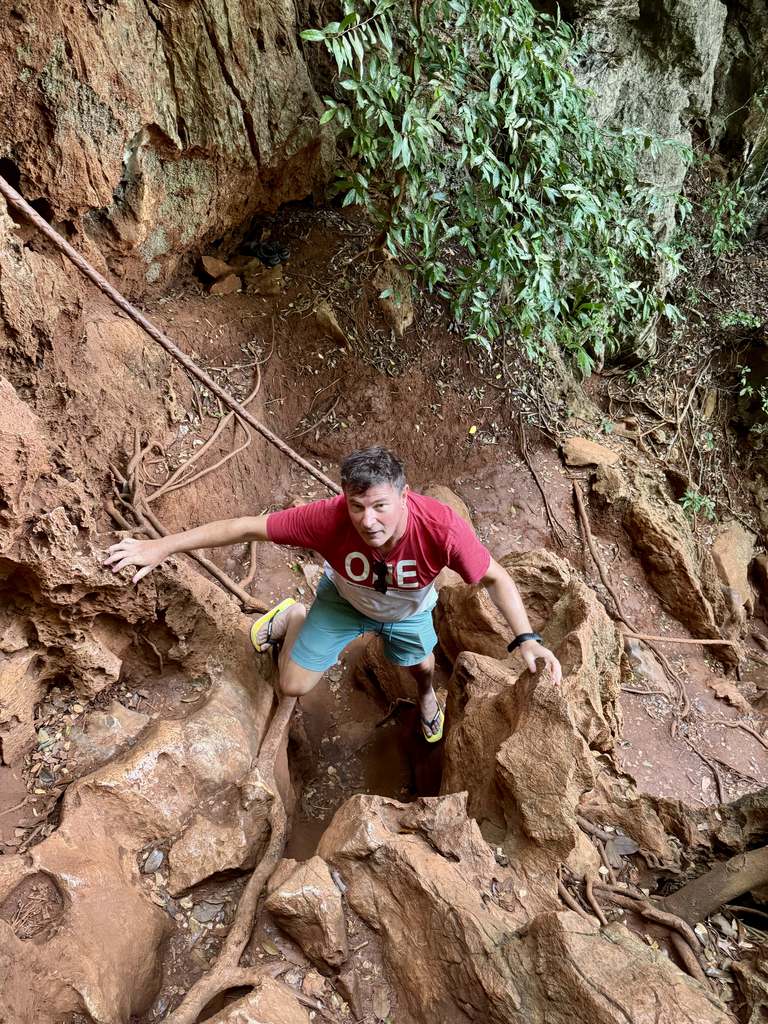
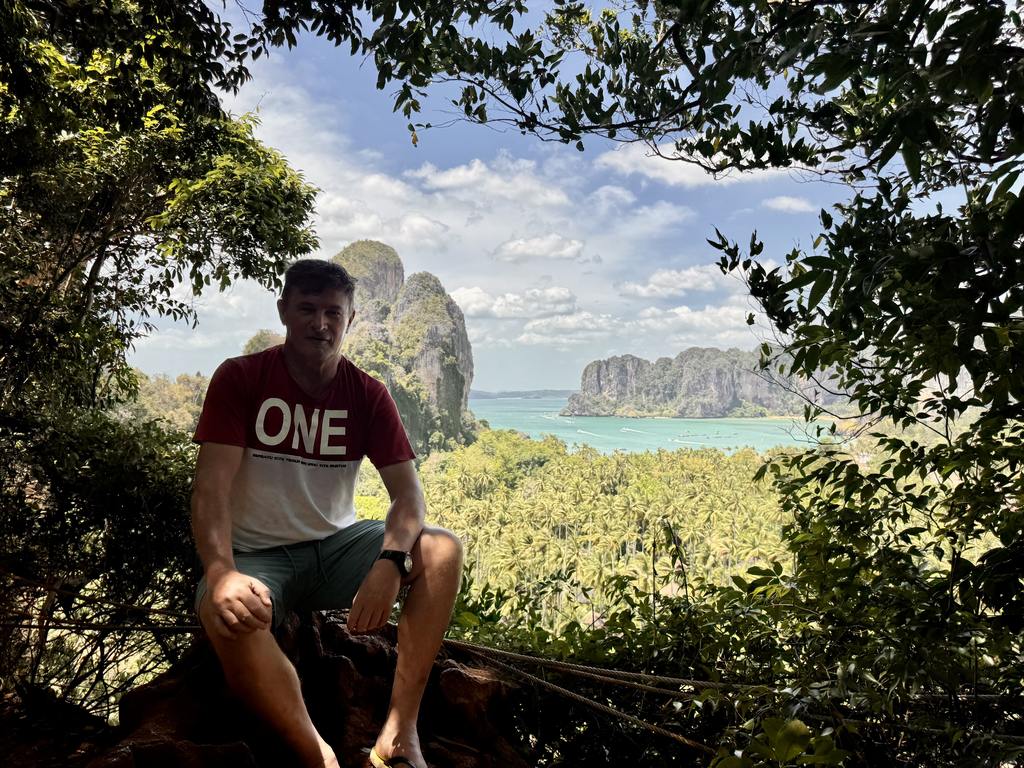
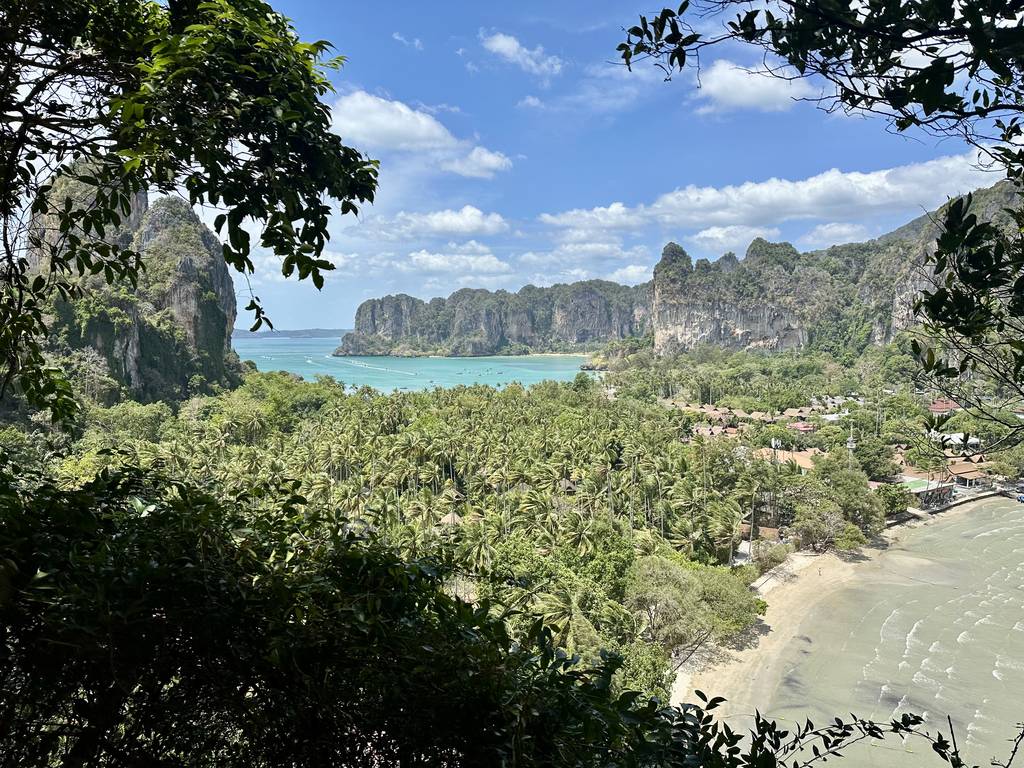
Then the viewpoint. This is the part everyone warns you about and they are right to. The trail starts as a normal path and turns almost immediately into a near-vertical climb up bare orange clay, with knotted ropes fixed to the rock where there is nothing to hold onto. I was in flip-flops. I made it to the top — the panorama over the Railay East mangroves and both bays is worth every minute of it — but I did not attempt the descent to the hidden lagoon, which requires down-climbing two rock walls beyond the viewpoint. In flip-flops that would have been stupid rather than adventurous. Wear proper shoes and you can do both.
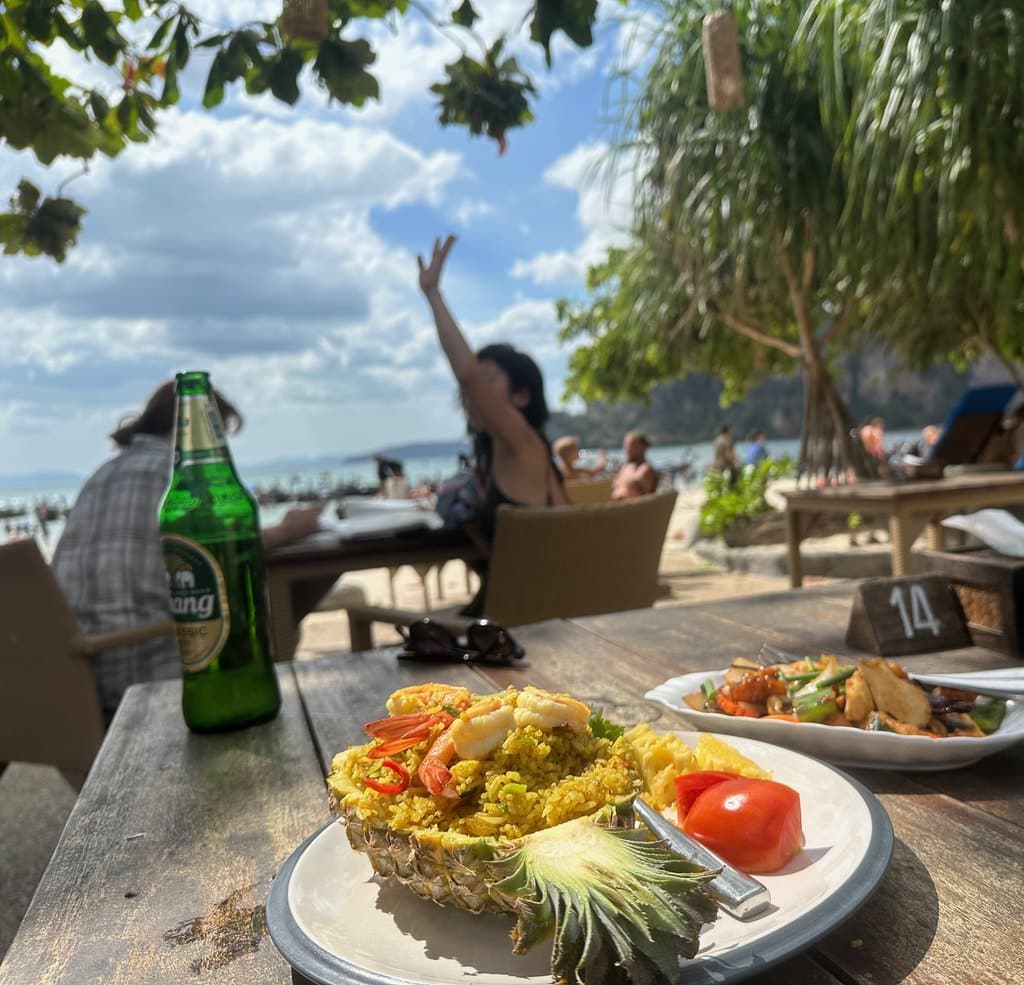
Down at Phra Nang I swam, which after that climb was the entire point. And I ate on Railay — at ten to three in the afternoon, at a wooden table under the trees at Railay Beach Cafe on Railay West: pineapple fried rice served in a hollowed-out pineapple, a plate of stir-fried vegetables, a cold Chang. Dessert was mango with pandan sticky rice and a glass of coconut cream. It cost a fraction of what the resort restaurants charge and it was better.
I took the last light on Railay West and a longtail back to Ao Nang at dusk. If I went again I would sleep there. The day trip gives you the peninsula between eleven and four, which is precisely when it is at its most crowded.
The Four Beaches of Railay
People talk about “Railay Beach” as if it were one place. It is four, and they are genuinely different from each other. Knowing which is which is the single most useful thing you can learn before you arrive, because it decides where you swim, where you sleep and where you eat.
Railay West — the postcard beach
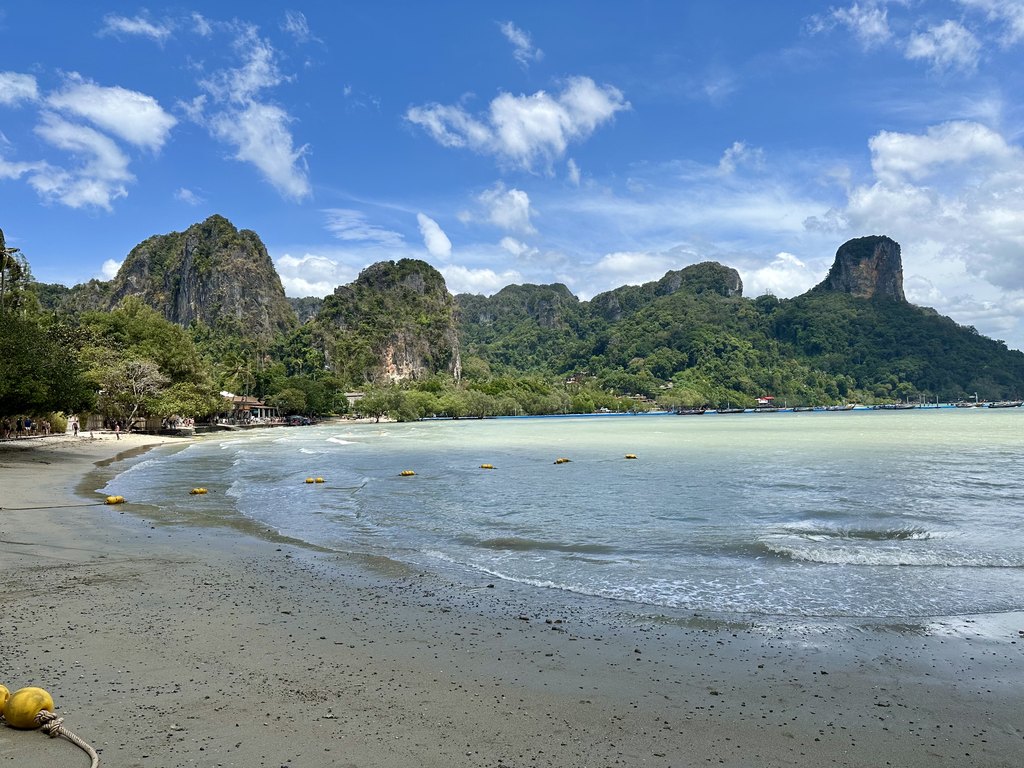
This is the beach in the photographs: a broad curve of pale sand between two headlands, deep enough to swim at any tide, and facing west for the sunset. It is where the longtails from Ao Nang land, and where the mid-range and upper-end resorts sit. It is also the busiest strip on the peninsula between late morning and mid-afternoon. Come back at 6:00 PM and it is a different beach entirely.
Railay East — mangroves, not swimming
Railay East is not a swimming beach and nobody should tell you otherwise. It is a shallow mangrove bay that drains almost entirely at low tide, leaving a vast flat of wet sand and stranded longtails. What it does have is the Walking Street — the concentration of cheap restaurants, bars, dive shops, climbing schools and budget rooms — and prices roughly a third lower than the west side. Most people who stay several nights on Railay sleep on the east and walk five minutes over to the west to swim.
Phra Nang — the best beach in Krabi
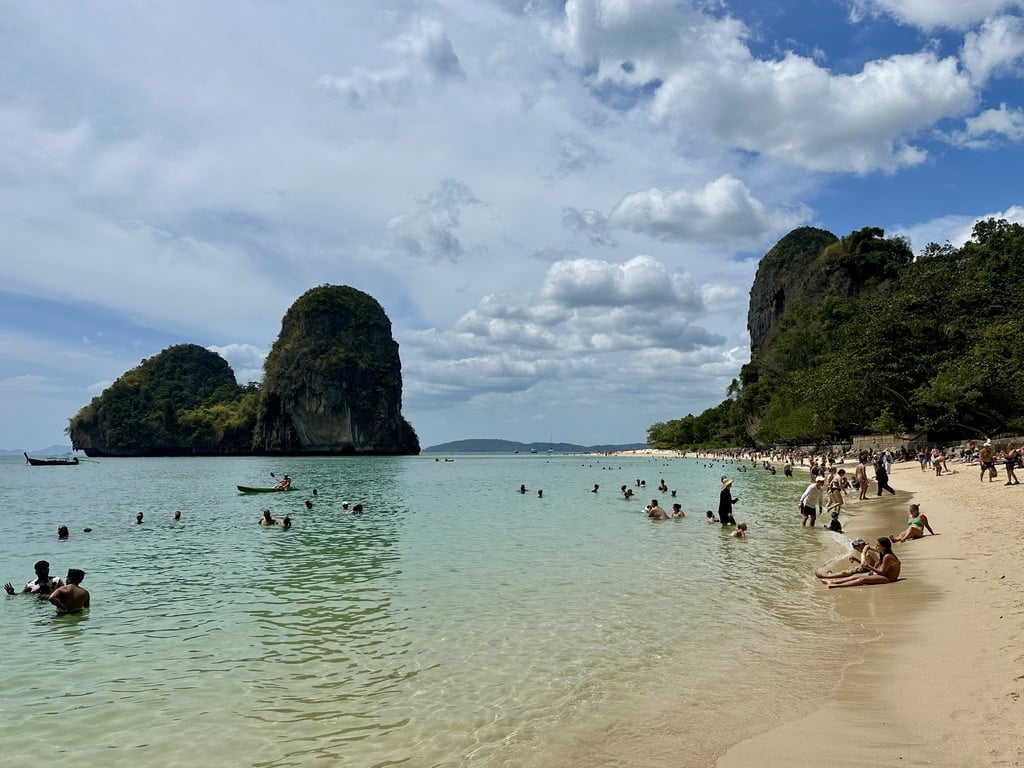
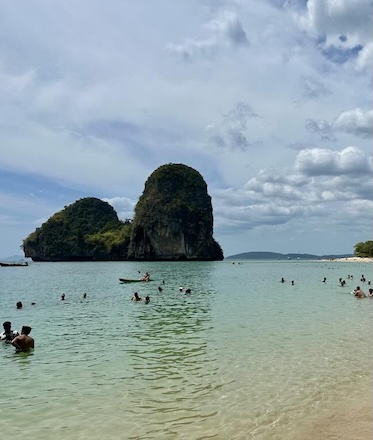
A ten-minute walk south from Railay East, past the entrance to Diamond Cave, brings you to Phra Nang: white sand, water that shades from clear to jade, a limestone islet offshore, and an enormous overhanging cliff at the southern end hung with stalactites that come down almost to the sand. It is the most photographed beach in the province and it deserves it. It has its own section below, because there is more to it than the sand.
Tonsai — the climbers’ beach
Tonsai sits just north of Railay West, reachable on foot over the rocks at low tide or by a short boat hop at high tide. It is rougher, cheaper and much more of a climbers’ scene: bamboo bungalows, reggae bars, some places still running on generators with power only in the evening. If you are climbing for a week, Tonsai is where you stay. If you want a pool and reliable air conditioning, it is not.
Phra Nang Beach and the Princess Cave Shrine
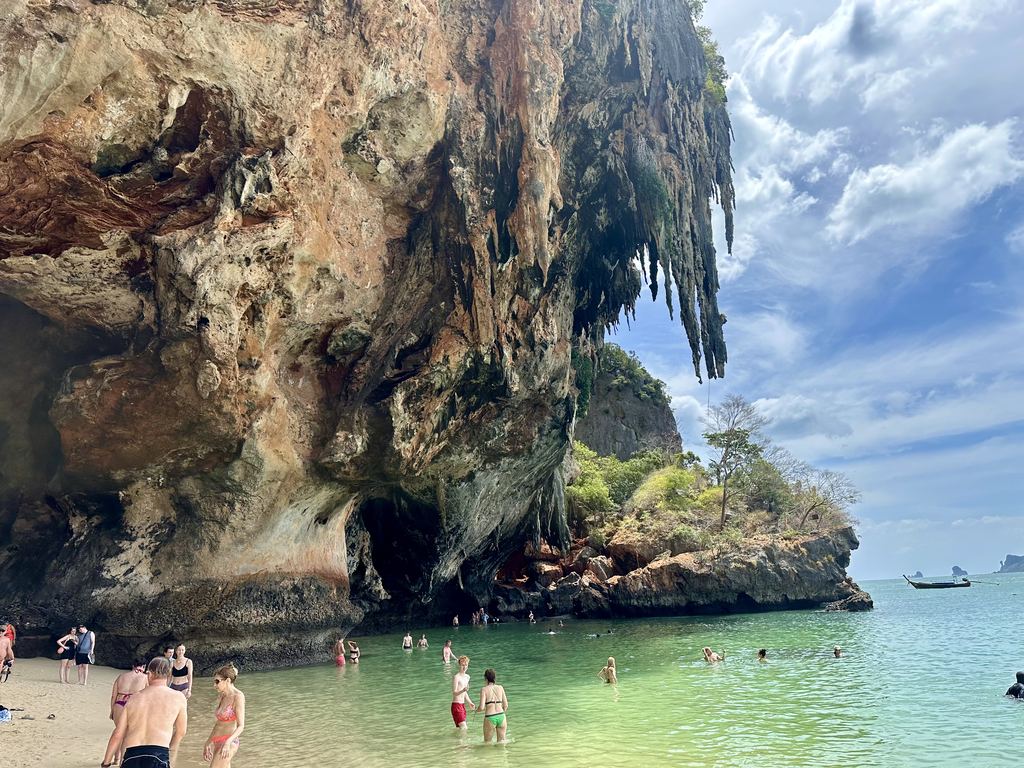
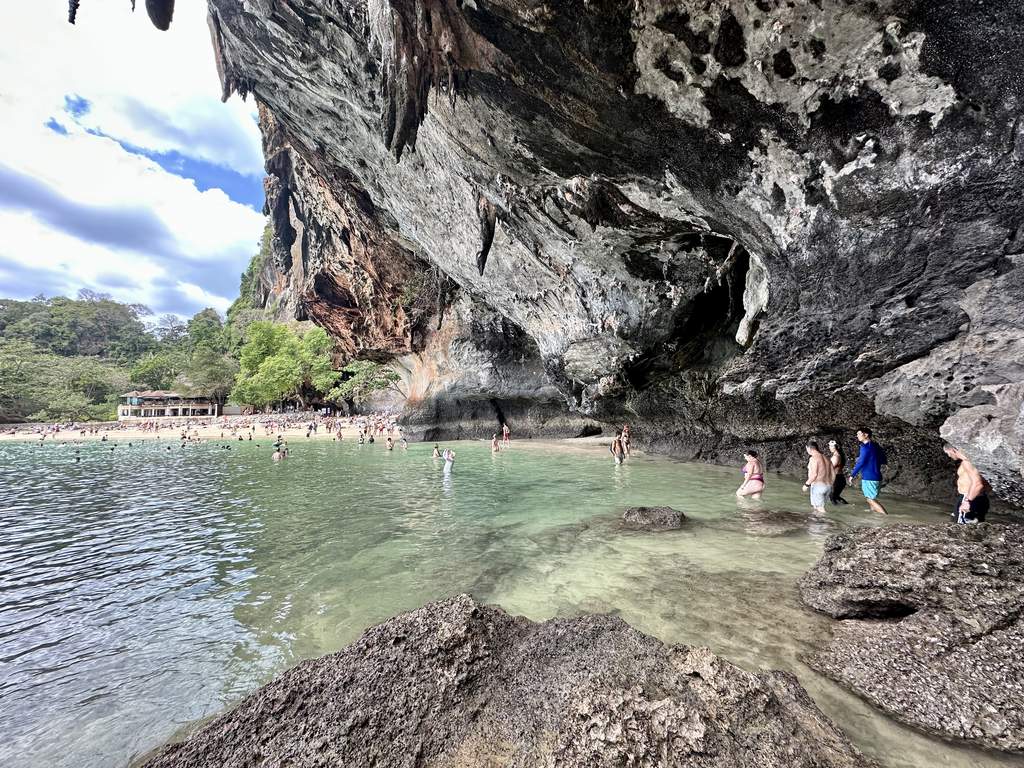
Phra Nang is a short, sheltered beach at the southern tip of the peninsula, and it is the reason a lot of people come to Railay in the first place. The sand is fine and pale, the water is shallow and calm enough for children, and the limestone rises straight out of it on three sides. Longtail boats moor offshore and sell food and drinks from the water — grilled skewers, cold coconuts, beer — which is one of the more pleasant ways to have lunch anywhere in Thailand.
The Princess Cave (Tham Phra Nang Nok)
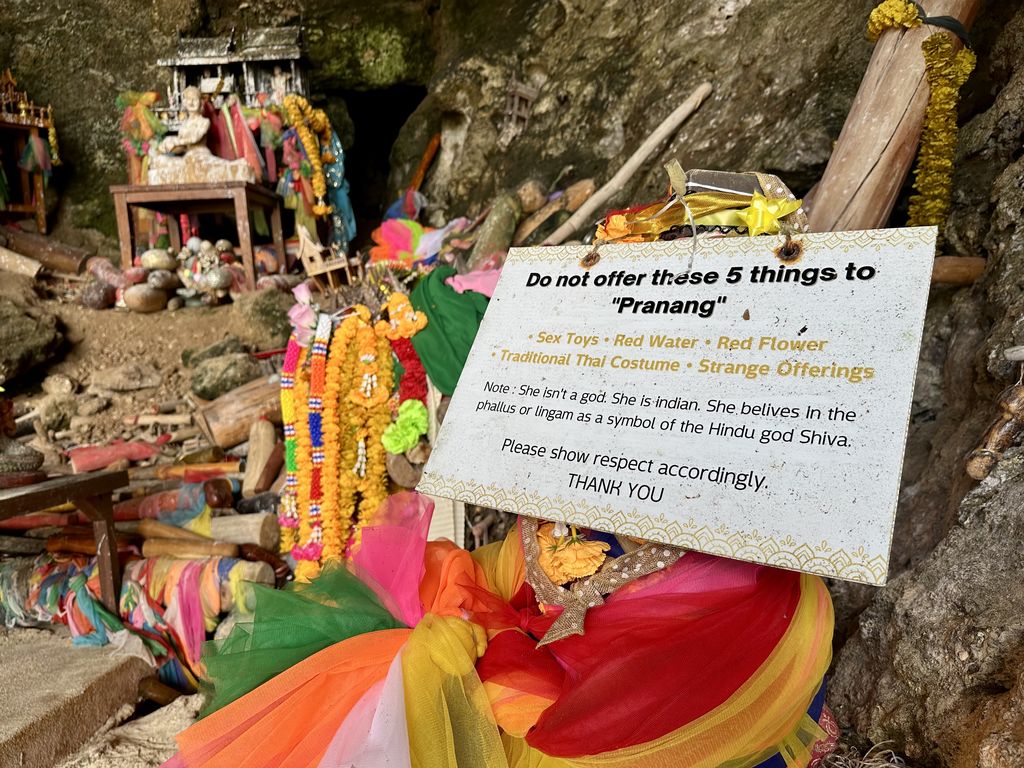
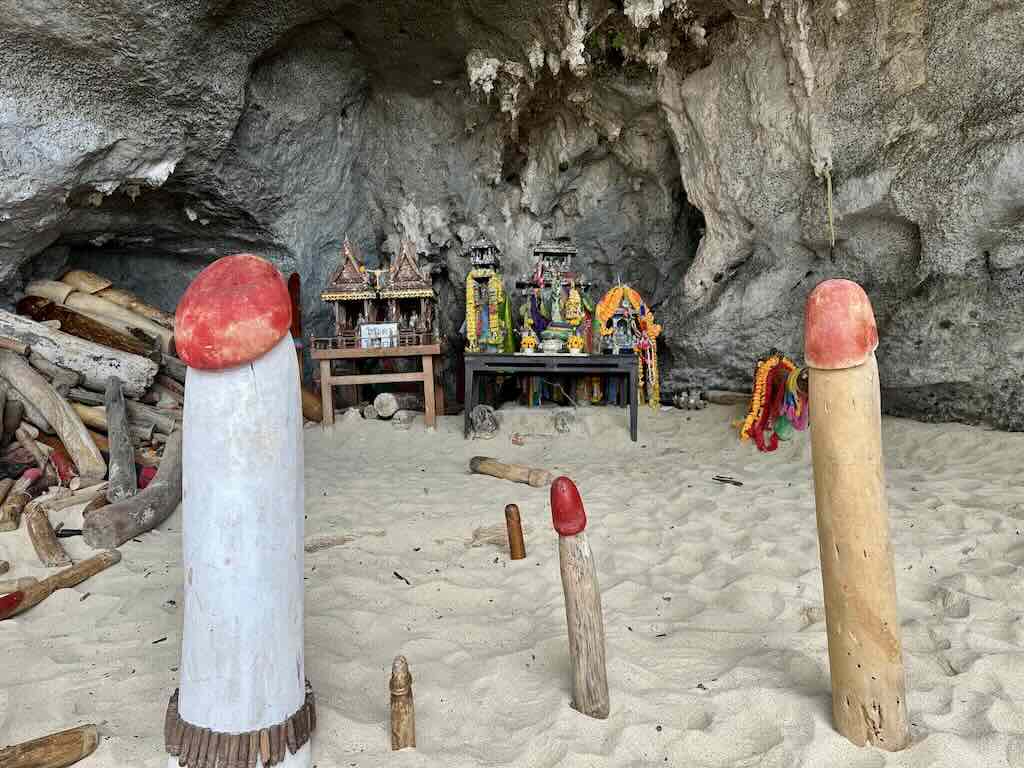
At the eastern end of the beach, in a cleft in the rock, sits the shrine that gives the beach its name. Local tradition holds that a princess — Phra Nang — is the guardian spirit of these waters, and fishermen have left offerings here for generations asking for safe passage and good catches. The offerings are carved wooden phalluses, painted in bright reds and golds, stacked by the hundred against the rock and dressed with ribbons and flowers.
It surprises a lot of visitors, and it is worth understanding rather than photographing and moving on. This is a working shrine, tended and renewed, not a curiosity: symbols of fertility offered to a female sea spirit for protection and abundance are a coherent and very old idea, and one you find in coastal cultures well beyond Thailand. There is a notice at the site listing what should not be offered. Read it, keep your voice down, and do not move or pose with the offerings.
The rocks and the inner pool
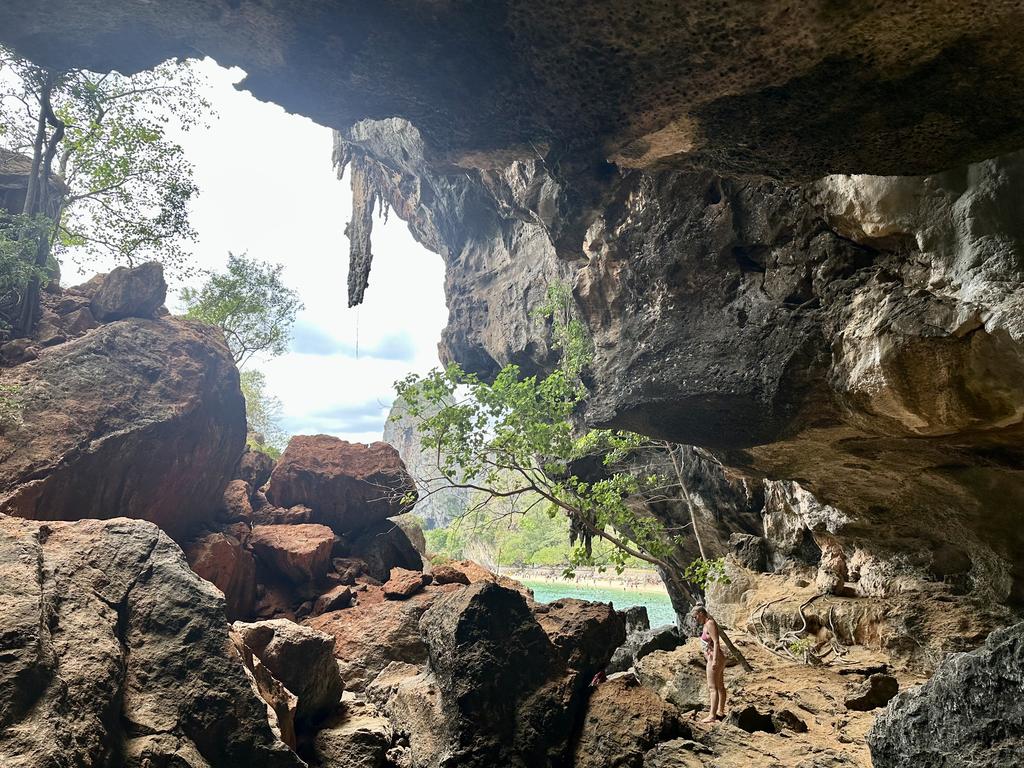
At the far southern end of Phra Nang, past the swimmers, a jumble of boulders leads up under the overhang. Scramble through and you come out in a gap in the cliff with a shallow pool inside and the sea framed between two walls of rock. It takes ten minutes, needs hands as well as feet, and it is where most of the good photographs of Phra Nang are actually taken. Go barefoot or in shoes with grip — the rock is smooth and often wet.
The Railay Viewpoint and the Hidden Lagoon
This is the best thing you can do on Railay that costs nothing, and the one most likely to go wrong if you turn up unprepared. There is no entrance fee and no ticket office — just an orange sign on the path between Railay East and Phra Nang, and a trail that goes almost straight up.
The climb to the viewpoint
Allow 20 to 30 minutes up if you are reasonably fit. The trail gains around 100 metres and there is very little of it that is walking — most is hauling yourself up bare orange clay on fixed ropes and tree roots. The clay is the problem: dry, it is grippy enough; damp, it behaves like wet soap. Ropes are knotted and generally sound, but they are exposed to sun and rain year-round, so check what you are pulling on before you commit your weight to it.
The reward at the top is a clearing that opens onto both sides of the peninsula at once — the mangrove flats of Railay East on one side, the curve of Railay West and the karst towers on the other. It is genuinely one of the great views in southern Thailand and it takes half an hour to earn.
Continuing down to the lagoon
From the viewpoint a second trail drops into a sinkhole to reach the hidden lagoon — an enclosed tidal pool at the bottom of a shaft in the limestone, with cliff walls rising on every side. This is a different proposition from the viewpoint. It involves down-climbing two rock faces, squeezing through gaps, and getting your hands filthy in the clay both ways. The way back up is harder than the way down and needs some upper-body strength.
Do it if you have proper footwear, gloves or at least a willingness to ruin your hands, and a dry day behind you. Do not do it alone, do not do it late in the afternoon, and do not do it after rain. The lagoon fills and empties with the tide, so it is worth checking the tide times before you set off — at low water there is not much lagoon left to see.
What to bring
- Closed shoes with real grip. Flip-flops will get you to the viewpoint if you are careful — I know, because I did it — but they are the wrong tool and they will not get you to the lagoon.
- More water than you think. There is no shade on the climb and no one selling anything at the top.
- Clothes you do not mind staining. The clay is orange and it does not wash out easily.
- A small bag you can climb with. You need both hands.
Diamond Cave (Tham Phra Nang Nai)
Diamond Cave is a five-minute walk from Railay East, signposted off the path towards Phra Nang. Inside, a raised wooden boardwalk runs through a series of chambers lit with coloured lamps, past columns, flowstone and calcite formations that catch the light — which is where the name comes from. Bats live in the roof and you will hear them.
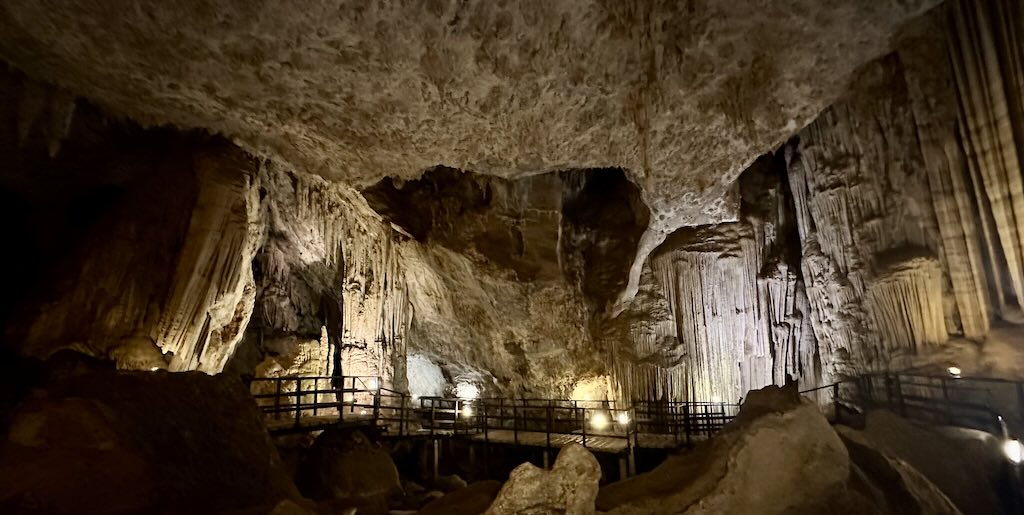
It is a short visit — fifteen to twenty minutes is normal — and it works best as something you fold into the walk between Railay East and Phra Nang rather than a destination in itself. The boardwalk means you can do it in sandals, and it is one of the few things on Railay that is just as good in the rain.
A word on the entrance fee, because reports vary and I would rather be straight with you than tidy. There is usually someone collecting money at the entrance, commonly around 200 THB for foreign visitors, and you may or may not be given a ticket. Whether this is an official park charge or a local arrangement is not clearly documented anywhere I can point you to. Carry small notes, expect to pay something, and treat any figure you read online — including this one — as approximate.
Rock Climbing in Railay
Railay and Tonsai are among the best-known limestone sport-climbing venues in the world, and climbing is the reason a large share of the people you see staying more than two nights are there at all. The route database lists several hundred documented bolted lines across the peninsula, with guidebooks and schools quoting totals from 700 upwards depending on what they count; grades run from beginner slabs to hard overhangs.
Where people climb
One-Two-Three Wall on Railay East is the classic beginner sector and the busiest crag in the area — its three easiest routes are literally named One, Two and Three. Muay Thai Wall, also on the east side, is the other standard first-timer venue, and it holds morning shade. Diamond Cave wall covers beginner to intermediate and is where most group lessons end up. Wee’s Present Wall on Railay West steps things up, and Thaiwand Wall is the big one: 40 metres of vertical limestone with multi-pitch routes running up to five pitches. Over at Tonsai the angle tips past vertical and the grades get serious.
Courses and prices
You do not need any experience. Half-day beginner courses run roughly 1,200–1,800 THB per person including all gear and instruction, full days around 2,500–2,800 THB, and private guiding from about 3,500 THB for a half day. Multi-pitch guiding on routes like Humanality starts around 6,000 THB. Gear rental on its own, if you are already competent, runs roughly 250–400 THB a day. Schools cluster along the Railay East Walking Street and on Tonsai; prices shift with season, so treat these as the shape of the market rather than a quote. If you would rather have a place booked before you arrive — worth it in January and February, when the good instructors fill up — you can compare Railay climbing courses on GetYourGuide.
Deep water soloing
Deep water soloing means climbing unroped above the sea and falling into it when you come off. Trips run by boat from Tonsai to the surrounding walls and towers, typically 1,500–2,000 THB for a half day including guide, boat and shoes. You need to be a confident swimmer and comfortable with heights, and you should be aware that the regulatory position around the national park waters is not always clear-cut. Go with an established operator.
Bolts, salt air and safety
This matters and it does not get said often enough. Sea air attacks stainless steel through stress corrosion cracking, a failure mode where a bolt degrades internally while still looking perfectly sound from the outside. Thai limestone areas including Railay have been progressively re-equipped with titanium glue-in anchors — dull, matte grey, single-piece — through a long-running rebolting effort. Shiny bolts with hex nuts, or anything showing rust streaks, belong to the older generation. If you are climbing independently rather than with a school, learn to tell the difference before you leave the ground.
Kayaking, Snorkelling and Island Hopping
Kayaking along the cliffs
Kayaks rent from the beach on Railay West for roughly 100–200 THB an hour, or 500–600 THB for a half day. Paddling is the only way to reach several small beaches and cave mouths along the coast, and it is a genuinely different view of the peninsula — the cliffs read as much bigger from sea level. The classic route runs north along the coast towards Ao Nang, about 40 minutes with the wind behind you and considerably longer coming back against it. Check the wind before you commit to a one-way plan.
The Four Islands tour
The standard Krabi day trip visits Chicken Island (Koh Kai), Poda Island, Tup Island and Phra Nang. Shared longtail tours run roughly 1,100–1,300 THB per person for five to six hours; a private longtail or speedboat charter for a small group runs into five figures in baht. The highlight is the sandbar linking Tup Island to its neighbours, which is walkable only at low tide and disappears completely at high water — so the tour’s value depends heavily on when the tides fall that day. You can compare departures and boat types on the speedboat version or the slower, quieter longtail version.
These islands sit inside Hat Noppharat Thara – Mu Ko Phi Phi National Park, and the park entrance fee is 400 THB for foreign adults and 200 THB for children, usually collected separately from the tour price. Some tour listings still advertise an older 200 THB figure — budget for 400.
The Hong Islands
The Hong Islands lie in the other direction, inside Than Bok Khorani National Park, and centre on an almost enclosed lagoon reached through a narrow gap in the rock, plus a viewpoint climb on the main island. It is quieter than the Four Islands circuit. Park entry is around 300 THB for foreign adults, though that figure comes from operators rather than a published schedule, so confirm when you book. Most people do it as a full-day speedboat trip from Krabi.
Snorkelling and diving
Railay is not really a dive base — the operators and boats are concentrated in Ao Nang, and most people who dive in Krabi book from there or head to Koh Phi Phi or Koh Lanta. Snorkelling from Railay happens mostly as part of an island-hopping day rather than as a thing you do off the beach; the water directly off Railay West is lovely to swim in but there is little to look at under it.
One thing worth knowing if you are planning a Phi Phi day trip: Maya Bay closes every year from 1 August to 30 September to let the reef recover. Tours still run in that window, but they will not go into the bay.
Where to Eat and Drink in Railay
Eating on Railay splits cleanly along the same line as everything else: resort restaurants on the west side and at Phra Nang, and everything affordable on the Railay East Walking Street. The gap is large — you can eat well for 150 THB on the east side and spend 1,000 THB for two without trying on the west.
Railay East Walking Street
This narrow strip behind the mangrove bay is where the peninsula actually eats. Mom’s Kitchen is the long-standing favourite for straightforward Thai — grilled prawns, curries, simple dishes under 100 THB. Phra Nang Cuisine does something similar with a deck over the water. Around them sit a rotating cast of small kitchens, roti carts and skewer stalls. Pineapple fried rice served in the pineapple is a Railay staple and it is as good as it sounds.
Railay West
The west side is mostly resort dining plus a handful of independents. Kohinoor has been serving Indian food here for years — vindaloo, tandoori, naan, with meat dishes around 350 THB and vegetarian around 200. There are also simple Thai kitchens along the path behind the beach charging closer to Walking Street prices than resort prices. Railay Beach Cafe is where I ate: rough wooden tables under the trees a few steps from the sand, pineapple fried rice served in the pineapple, and mango with pandan sticky rice for dessert. Nothing elaborate, and far better value than the resort dining rooms twenty metres away.
Phra Nang and the boat vendors
There are no restaurants on Phra Nang itself, which is part of why it stays beautiful. Instead, longtail boats moor a few metres off the sand with portable stoves aboard, selling grilled skewers, pad thai, fruit, cold coconuts and beer. You wade out and order. At the top end, The Grotto serves Mediterranean food from tables set under the cliff overhang at Rayavadee — spectacular setting, and priced accordingly at around 1,000 THB for two as a floor.
Bars and the evening
The Last Bar on Railay East is the main evening venue on the peninsula: fire shows, a Muay Thai ring used for exhibition bouts, pool tables and a dance floor. Tew Lay Bar and Bang Bang Bar are smaller and quieter, popular with climbers. Over on Tonsai, Chill Out Bar, Sabai Sabai and Sunset Pirate run a reggae-and-hammocks version of the same idea. None of this is Bangkok nightlife — it winds down early and it is all the better for it.
Where to Stay in Railay Beach
Staying on Railay changes the place completely. The day boats stop arriving around four in the afternoon and the peninsula empties; by six, Railay West is quiet enough to have long stretches of sand to yourself, and the light on the cliffs at that hour is the best of the day. Almost every complaint you read about Railay being overcrowded comes from someone who was there between eleven and three.
One practical note before you book: your bags come off a longtail boat onto a beach. There is no pier, no porter at the door and no taxi. Most resorts will send someone with a cart, but pack accordingly, and put anything that must stay dry in a waterproof bag.
Luxury — the one that is genuinely different
Rayavadee occupies the headland between Railay West, Railay East and Phra Nang — the only property that sits on all three, with its own access to Phra Nang beach. Two-storey circular pavilions in tropical gardens under the cliffs, and rates from roughly 20,000 THB a night upwards. It is one of the genuinely famous hotels in Thailand and the setting is the reason.
For a group or family wanting a whole house, Villa Macaque and Villa Languor are private pool villas on the Phra Nang side, booked as whole-villa buyouts.
Beachfront resorts on Railay West
This is the sweet spot for most people: on the sand, sunset side, roughly 3,000–6,000 THB a night.
- Sand Sea Resort Railay Beach — directly on Railay West with three pools and consistently the strongest guest scores on the beach. Note that it does not sell alcohol on site.
- Railay Bay Resort & Spa — large beachfront grounds of cottages, stretching across the neck of the peninsula towards the Phra Nang side.
- Railay Village Resort & Spa — cottage-style rooms set around two pools, a minute from the sand, and one of the better family options.
Value on Railay East and the hillside
Five minutes’ walk from the west beach, at roughly half the price. Around 1,700–3,500 THB a night.
- Bhu Nga Thani Resort & Villas Railay — the most polished option on the east side, with pool villas at the top of its range.
- Railay Phutawan Resort — up on the hillside with a pool looking straight at the karsts, and a shuttle down to the beaches.
- Railay Great View Resort — jungle-hillside bungalows with sea-view balconies.
- Avatar Railay-Adults Only — saltwater pool and a restaurant with live music, steps from the Walking Street. Adults only.
- Diamond Cave Resort — named for the cave it sits beside, and about ten minutes on foot from Phra Nang.
Tonsai and budget bungalows
Under 1,500 THB, and in some cases well under. Check the power situation before booking — several Tonsai places still run generators with electricity only in the evening.
- Tinidee Hideaway Tonsai Beach Krabi — the one properly comfortable, air-conditioned option on Tonsai, at upper-mid rather than budget prices.
- Tonsai Bay Resort — villas with balconies, direct beach access and a dive centre on site.
- Rapala Rock Wood Resort- SHA Plus — the best-reviewed cheap option on Railay East.
- Railay Garden View Resort — rustic hillside bungalows, breakfast included, no air conditioning.
- Chill Out Bar and Bungalows — the long-running climbers’ hangout on Tonsai, bar attached.
- Blanco Hideout Railay – Youth Hostel 18 to 35 Only — dorms by the Walking Street, with an age restriction that is enforced.
How to Get to Railay Beach
From Ao Nang — the usual way
Longtail boats leave from Ao Nang beach for Railay West all day, roughly 8:00 AM to 6:00 PM. The crossing takes 10 to 15 minutes and costs around 150 THB per person each way, a little more after dark. There is no ticket office worth the name and no schedule: you pay at a small booth on the sand, then wait for the boat to fill — usually eight passengers. On a busy morning that takes minutes.
You board by wading. The boats cannot come alongside anything, so you walk into the water up to your knees at both ends of the trip. Sandals you can carry, shorts you do not mind soaking, and a dry bag for a camera are the whole packing list.
From Krabi town and Ao Nam Mao
Boats also run from Krabi Town pier — around 45 minutes and roughly 150–200 THB — and from Ao Nam Mao pier, which is the shortest crossing to Railay East and the one most resorts use for transfers. Ao Nam Mao is the better option if you are arriving with luggage, because it lands you on the east side where most of the accommodation is.
From Krabi Airport, Phuket, Phi Phi and Koh Lanta
Combined transfers exist for all of these and are usually cheaper and less stressful than assembling the legs yourself. You can compare operators, times and prices for Krabi Airport to Railay, Railay to Koh Phi Phi, Railay to Koh Lanta and Railay to Phuket on 12Go. In high season the Phi Phi and Lanta ferries fill up, so book a day or two ahead rather than turning up at the beach.
Getting around once you are there
On foot. That is the whole answer. Railay West to Railay East is a five-minute walk on a paved path; Railay East to Phra Nang is about ten minutes; Railay West to Tonsai is fifteen minutes over the rocks at low tide, or a 100 THB boat hop when the tide is in. The only vehicles are the tractors that shift luggage and beer crates along the sand.
Going the other way, Railay has a direct link to the islands that most visitors never notice: ferries from Ao Nang call at the Floating Pier on Railay East and reach Ton Sai on Koh Phi Phi in about an hour and three quarters, from around 461 THB. There are only one or two sailings a day, so this is a route to book the day before rather than the morning of — the Koh Phi Phi ferry guide has the times and the operators.
Best Time to Visit Railay Beach
November to April — dry season
This is when you want to be there. Calm seas, reliable boat crossings, clear skies and low humidity. December to February is the peak of it — the climbing is at its best, the viewpoint trail is dry, and the sea is flat. It is also the most expensive and the most crowded, and rooms on the west beach need booking well ahead over Christmas and New Year. I went at the end of February and the conditions were perfect.
May to October — green season
Fewer people and noticeably cheaper rooms, at the cost of rain. It rarely rains all day — the pattern is short, hard downpours — but the sea gets rougher, boat crossings can be cancelled outright at the April/May and September/October transitions, and the viewpoint trail becomes genuinely dangerous rather than merely awkward. Climbers still come, because the overhangs stay dry and the rock dries fast.
The daily rhythm matters as much as the season
Whatever month you come, the peninsula has a tide of people as predictable as the tide of water. Day boats start landing around 10:00 AM, peak between 11:00 and 3:00, and are gone by late afternoon. If you are on a day trip, take the earliest boat you can and you will have Phra Nang almost to yourself for an hour. If you are staying, do your walking and climbing in the morning, retreat somewhere shaded at midday, and take the beaches back at five.
Practical Tips for Visiting Railay
Money
Bring cash. There are ATMs on Railay East but they are few, they run out, and Thai machines charge a fixed foreign-card fee of around 220 THB per withdrawal on top of your own bank’s charge. Small restaurants, boat operators and the cave collection point are cash-only. Resorts and the bigger climbing schools take cards.
Tides
Tides govern more here than anywhere else in Krabi. They decide whether you can walk to Tonsai or need a boat, whether the Tup Island sandbar exists on your island tour, whether Railay East is water or mud, and whether the hidden lagoon is a lagoon. Look up the day’s tide table before you plan anything — most resorts post it at reception.
Monkeys
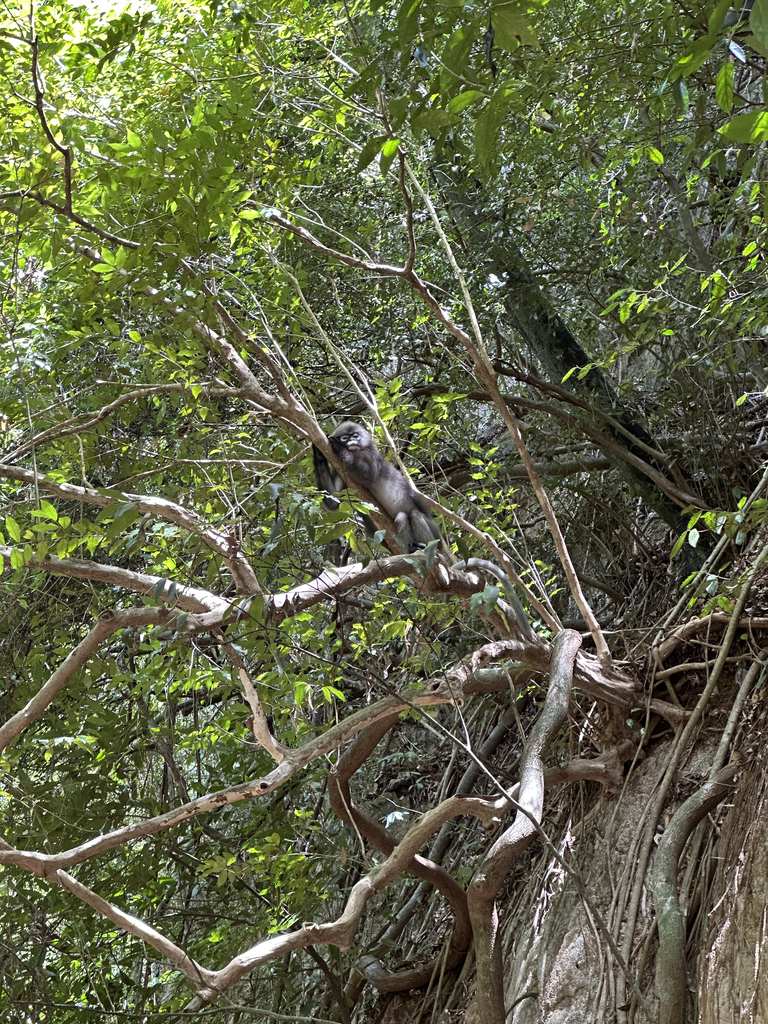
Macaques live along the paths and around Phra Nang and they are not shy. Do not feed them, do not carry food visibly in an open bag, and do not get between an adult and a baby. They will take sunglasses, water bottles and phones, and they are faster than you.
Sun, water and shade
Railay is 8 degrees north of the equator and the middle of the day is punishing. Reef-safe sunscreen, a hat, and more water than you expect to drink — particularly on the viewpoint trail, where there is no shade and nothing to buy. There is no hospital on the peninsula; the nearest medical care is in Ao Nang or Krabi Town, which is a boat ride away. Travel insurance is not optional if you intend to climb.
Entry formalities
All non-Thai nationals must file the Thailand Digital Arrival Card (TDAC) online within three days before arriving, whether by air, land or sea. It is free — file it only on the official government portal, never through a third-party site charging a “service fee”. Visa-exemption rules were under revision through 2026, so check your own nationality’s current allowance with the Tourism Authority of Thailand before you travel rather than relying on a number you read in a guide.
Railay or Ao Nang: Where Should You Base Yourself?
Almost everyone visiting this stretch of coast has to make this choice, and there is no universally right answer — only a right answer for the kind of trip you want.
Stay in Ao Nang if you want choice and convenience: hundreds of hotels at every price, streets full of restaurants and bars, pharmacies, hospitals, ATMs, car hire, tour desks, and boats to everywhere. You can be on Railay in fifteen minutes whenever you feel like it. The trade-off is that Ao Nang is an ordinary busy beach town with traffic, and the beach itself is nothing special.
Stay on Railay if the scenery is the point. You wake up under 300-metre cliffs, there are no vehicles, and you get the beaches in the early morning and the evening when the day-trippers are not there. The trade-offs are real: fewer restaurants, higher prices for basics, everything arriving by boat, no hospital, and a hard stop on the last boat if you want to go out in Ao Nang.
The compromise most people should take is two nights on Railay in the middle of a longer Krabi trip, with Ao Nang either side. You get the empty mornings without the logistics wearing you down. The full Ao Nang guide covers where to sleep in town, the official longtail fares to Railay and the Four Islands tour. If you only have one day, go early, take the first boat, and accept that you are seeing Railay at its busiest.
Read More
Koh Phi Phi
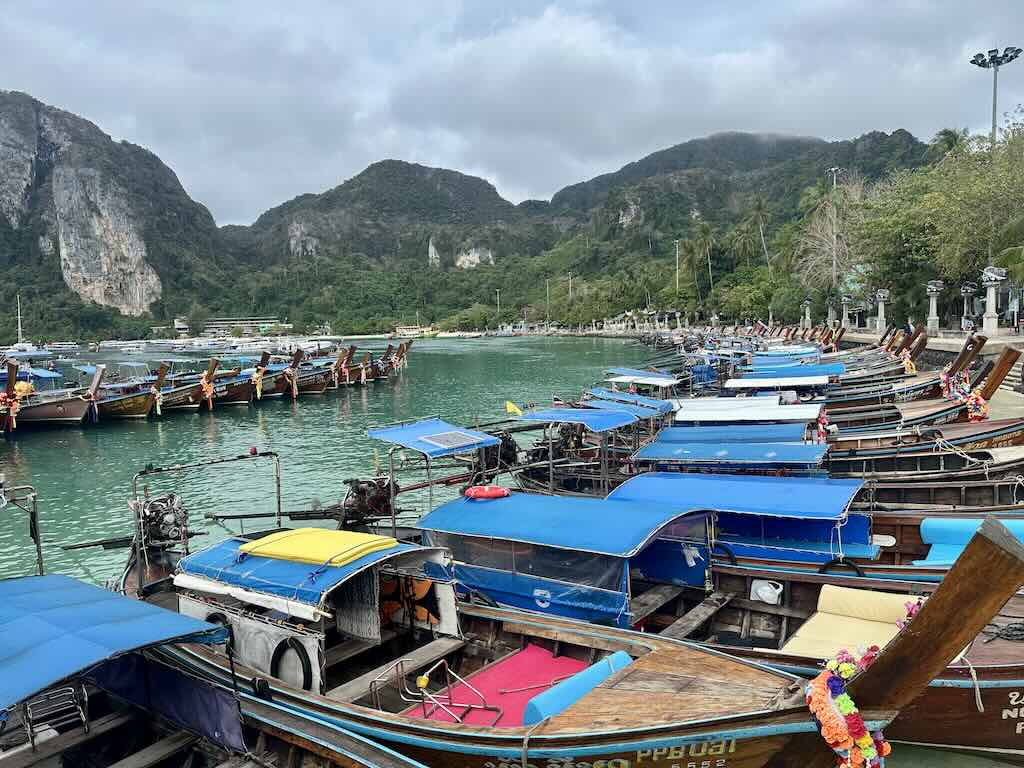
Maya Bay, Pileh Lagoon, Viking Cave and the viewpoint climb — how to visit Thailand’s most famous islands, and when to avoid them. Read more
Koh Lanta
The quiet one: long west-coast beaches, the national park at the southern tip, and some of the best diving in the Andaman. Read more
Krabi Islands Travel Guide
How Railay, Koh Phi Phi and Koh Lanta fit together, how to get between them, and how many days to give each one. Read more
Frequently Asked Questions About Railay Beach
Where is Railay Beach?
Railay is a peninsula in Krabi Province, on Thailand’s Andaman coast, about 20 kilometres west of Krabi Town. It is attached to the mainland but cut off from it by limestone cliffs, so there is no road — the only access is by boat, usually from Ao Nang.
How do you get to Railay Beach?
By longtail boat from Ao Nang beach — 10 to 15 minutes, around 150 THB per person each way. Boats run all day and leave when they have about eight passengers rather than on a fixed schedule. Longer crossings also run from Krabi Town pier and Ao Nam Mao pier.
Is Railay Beach an island?
No — Railay is a peninsula connected to mainland Thailand. It feels like an island because tall limestone cliffs block any road access, so every visitor and every delivery arrives by boat.
How many days do you need in Railay?
One day covers the highlights: Phra Nang, the viewpoint and Diamond Cave. Two nights is the sweet spot, because it gives you the peninsula in the early morning and the evening, when the day boats are gone. Climbers routinely stay a week or more.
Which is the best beach in Railay?
Phra Nang Beach, by a clear margin — white sand, calm shallow water, a limestone islet offshore and a huge overhanging cliff at one end. Railay West is the best beach to stay on and to watch the sunset from. Railay East is not a swimming beach at all.
Can you swim at Railay East?
Not really. Railay East is a shallow mangrove bay that empties almost completely at low tide, leaving mud and stranded boats. Stay on the east side for the cheaper rooms and restaurants, and walk five minutes to Railay West or ten to Phra Nang to swim.
Is the Railay viewpoint hike hard?
It is short but steep — 20 to 30 minutes of hauling yourself up bare clay on fixed ropes, gaining around 100 metres. The viewpoint itself is manageable for most reasonably fit people in decent shoes. Continuing down to the hidden lagoon is considerably harder and involves down-climbing rock faces.
Is there an entrance fee for the Railay viewpoint?
No. The viewpoint and lagoon trail is free and unstaffed — there is no ticket office, just a signposted path. Diamond Cave is different: there is usually a collection at the entrance, commonly around 200 THB for foreign visitors, so carry small notes.
Do you need to be experienced to climb in Railay?
No. Half-day beginner courses run roughly 1,200–1,800 THB per person including all equipment and instruction, and take complete first-timers up real routes on sectors like One-Two-Three Wall and Muay Thai Wall. Schools operate on Railay East and on Tonsai.
When is the best time to visit Railay Beach?
November to April, and December to February above all: calm seas, dry trails and reliable boat crossings. May to October brings cheaper rooms and fewer people but rougher seas, cancelled boats at the season transitions and a viewpoint trail that turns dangerous when wet.
Is Railay Beach worth visiting?
Yes. The combination of 300-metre limestone cliffs, four distinct beaches, no roads and no vehicles is not something you find elsewhere in Thailand. The one caveat is timing: visit between 11:00 AM and 3:00 PM on a day trip and you will see it at its most crowded, which is where most disappointed reviews come from.
Is Railay Beach expensive?
It is more expensive than the mainland because everything arrives by boat, but it spreads widely. Budget bungalows on Railay East and Tonsai start under 1,500 THB a night and Walking Street meals run 100–250 THB, while beachfront resorts on Railay West sit at 3,000–6,000 THB and Rayavadee starts around 20,000 THB.