Indonesian Food: A Complete Guide to What to Eat Across the Islands
By Blaise Jaeger · Updated August 16, 2026
Why Indonesian Food Is Really Twenty Cuisines, Not One
Ask someone to name an Indonesian dish and you will almost always get nasi goreng. Fair enough — it is on every menu from Sabang to Merauke. But treating nasi goreng as the summary of Indonesian food is a bit like treating a ham sandwich as the summary of European cooking. Indonesia spreads across more than 17,000 islands, only around 900 of them permanently inhabited, and the 2010 census counted over 1,300 distinct ethnic groups speaking more than 700 languages. Each of those groups cooks. Most of them cook differently.
What you get, in practice, is not one national cuisine but a series of regional ones that happen to share a pantry. A Minangkabau kitchen in West Sumatra simmers beef for six hours in coconut milk until the sauce disappears. A Sundanese kitchen two islands away serves the vegetables raw with a bowl of chilli paste and calls it lunch. In Manado the chilli count in a single dish can run past twenty; in Yogyakarta the same dish would be sweetened with palm sugar until it tastes almost like dessert. Eastern Indonesia often does not cook rice at all — it cooks sago, or corn.
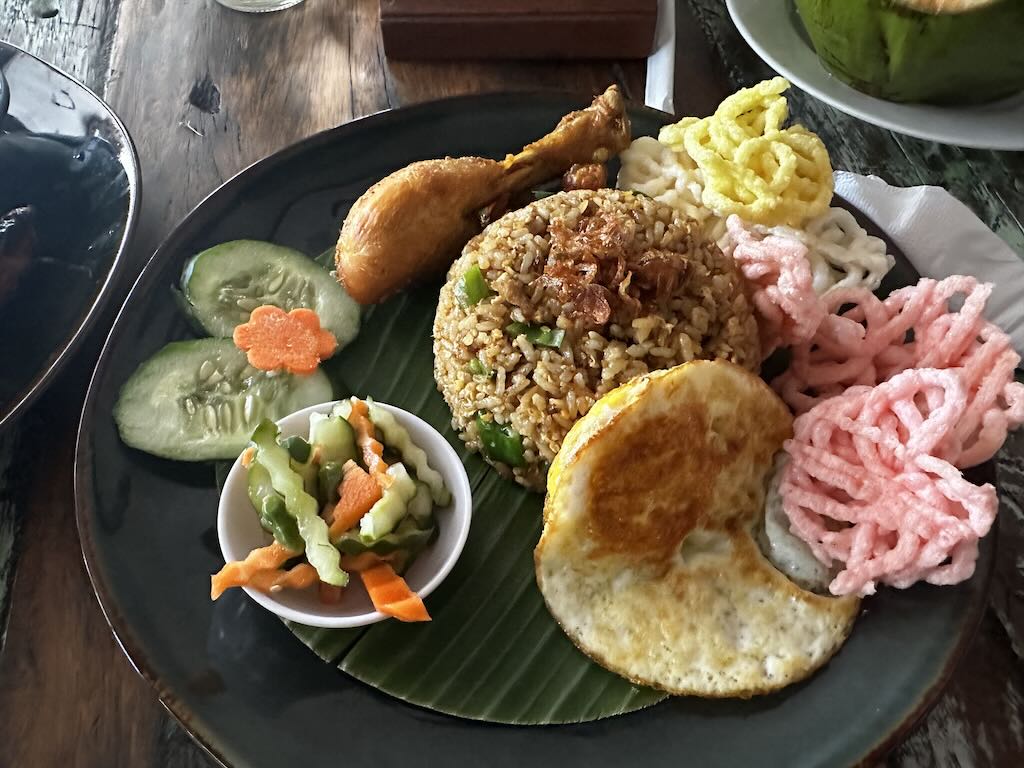
That variety is the reason Indonesia never settled on a single national dish. In September 2018 the Tourism Ministry gave up trying and declared five of them at once: soto, rendang, sate, nasi goreng and gado-gado. Five dishes, five different regions, five different techniques. It is the most honest thing any tourism ministry has ever done about food.
This guide is organised the way you will actually meet the food: the dishes you cannot avoid, then the regional cooking behind them, then the spice pastes that hold the whole thing together, then the practical business of ordering, paying and not making yourself ill. It is written from the eating side of the counter, not from a cookbook.
Indonesian Food at a Glance
- The staple: rice (nasi) almost everywhere, sago in Maluku and lowland Papua, corn in East Nusa Tenggara, sweet potato in the Papuan highlands.
- The five national dishes: soto, rendang, sate, nasi goreng, gado-gado — official since 2018.
- The flavour base: bumbu, a pounded paste of shallot, garlic, chilli and roots, fried in oil before anything else goes in the pan.
- The three things on every table: sambal, kecap manis (sweet soy sauce) and kerupuk (crackers).
- Spice level: most dishes are mild. The heat lives in the sambal on the side, which means you control it.
- Meal times: breakfast 6–8 AM (rice is normal), lunch 12–2 PM and it is the big meal, dinner 7–9 PM and usually lighter.
- What a local meal costs in 2026: roughly 15,000–35,000 rupiah at a neighbourhood warung — about $0.85–2.00, or €0.75–1.70.
- Cutlery: spoon in the right hand, fork in the left as a pusher. No knife — food arrives already cut.
- Religion shapes the menu: around 87% of Indonesians are Muslim, so most food is halal by default. Pork is normal in Bali, Tana Toraja, Manado, the Batak highlands, Flores, Papua and Chinese-Indonesian restaurants.
- The word you will use most: warung — a small, family-run eating house, and the backbone of the whole food culture.
What Nearly a Decade of Warung Lunches Taught Me
I opened Dune Penida, the first PADI dive centre on Nusa Penida, in 2017, and moved to Indonesia for good in August 2020 — Nusa Penida first, then Bali. Almost everything I know about this food I learned the slow way, one lunch at a time. I came for the diving and have logged more than 700 dives since; but the part of the day I would defend hardest is the hour after the second tank, when you come up salty and starving and walk to the warung.
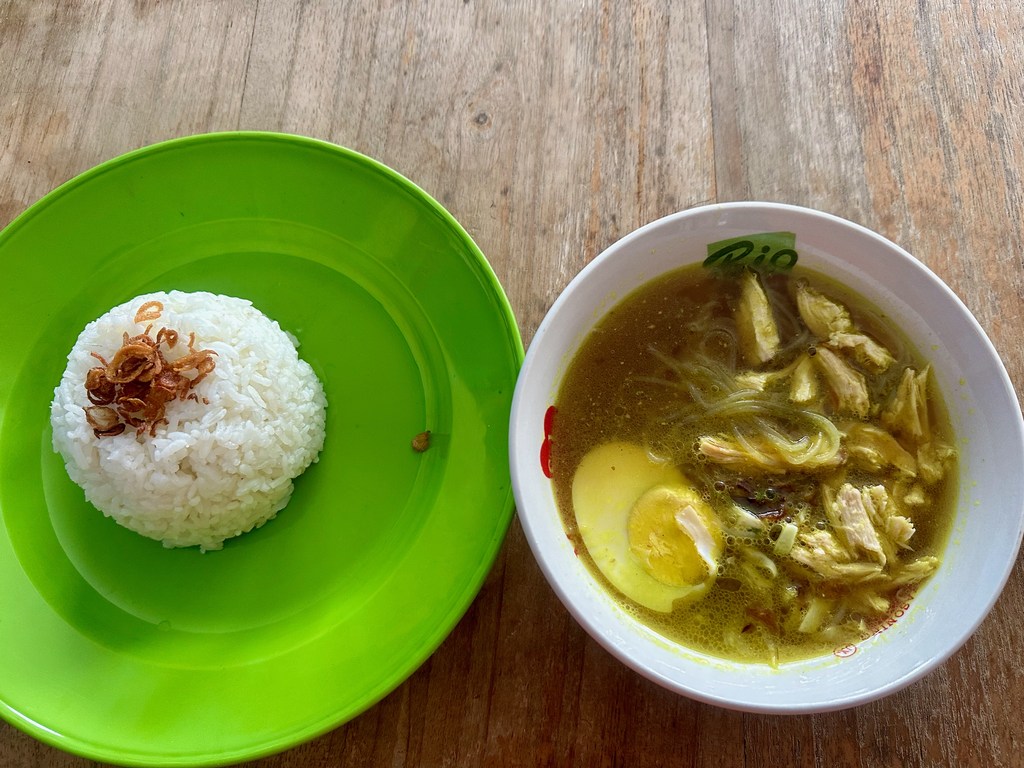
My order barely changes. Either a soto ayam at the warung a few steps from the dive centre — turmeric broth, shredded chicken, vermicelli, half a boiled egg, a plate of white rice with fried shallots on the side, 15,000 rupiah — or, if I want something more substantial, ayam bakar a little further along the same street, at 35,000. When there is more time, Pondok Bakar in Toyapakeh, which is the sort of unremarkable local place that quietly does grilled chicken better than anywhere with a view.
That is the everyday half. The other half came from travelling: I have eaten across Java, Sulawesi including Tana Toraja, Flores, Sumbawa, Sumba and Lombok. That is what convinced me there is no such thing as “Indonesian food” in the singular — the broth in Makassar has nothing to do with the smoked meat in Timor, which has nothing to do with what turns up on a plate in Yogyakarta. My own favourite, after all of it, is still beef rendang.
The thing that took me longest was not a dish. It was learning to eat with my hands properly — right hand only, fingertips, no cutlery — in the small warungs where that is simply how it is done. It looks easy and it is not, and getting it wrong is the kind of small thing everyone is too polite to mention.
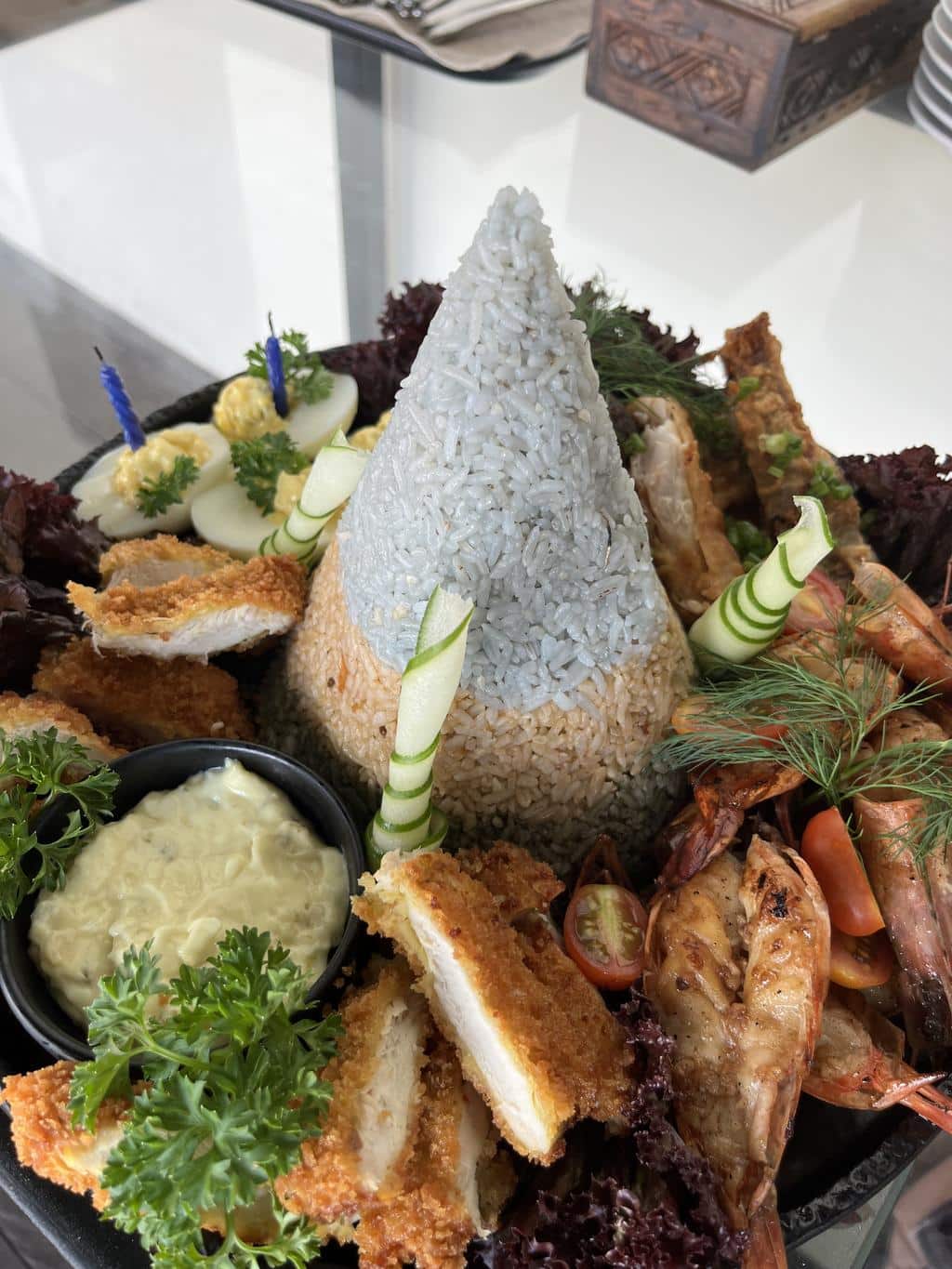
And when there is something to celebrate at Dune Penida, out comes a tumpeng: a cone of rice, ringed with fried chicken, prawns, eggs and vegetables. It is not just a centrepiece. The tip of the cone is cut first and given to the guest of honour, and watching who receives it tells you more about a room than any conversation will. Nobody explains this to you. You work it out by being there.
So this guide is not a list of dishes assembled from other lists. It is what the better part of a decade of pointing at glass cabinets, sitting on plastic stools, misjudging the sambal and eating on seven different islands actually teaches you — including the parts that are unglamorous, like what things really cost and which “vegetarian” dishes are not.
How Indonesian Food Became Indonesian
Almost nothing on an Indonesian table is purely local, and almost nothing on it is purely foreign. The cuisine is what happens when a set of islands sits on the busiest maritime trade route in the pre-modern world for two thousand years and absorbs a little of everything that passes through.
The spices came from here, not to here
This is the part most visitors have backwards. Nutmeg, mace and cloves were not imported into Indonesia — for centuries they grew nowhere else on earth. Nutmeg came from a handful of tiny volcanic islands in the Banda group, in Maluku, and cloves from Ternate and Tidore just to the north. Those specks of land are the reason Portuguese, Spanish, English and Dutch fleets spent two centuries fighting each other across the Indian Ocean, and the reason the Dutch East India Company came to exist at all.
The irony is that Indonesian cooking uses those two spices rather sparingly. They were an export crop, worth more abroad than at home. The everyday aromatic backbone of the archipelago is something else entirely: turmeric, galangal, ginger, lemongrass, candlenut, kaffir lime leaf, shallot and chilli.
Four waves of outside influence
India arrived first, with Hindu-Buddhist kingdoms from around the fourth century. It left behind the whole idea of a ground spice paste simmered in coconut milk — gulai and kari are cousins of the curry, and turmeric-yellow broths run from Aceh to Bali.
The Middle East came with Muslim traders from roughly the thirteenth century and brought goat, skewered grilled meat, cumin, cardamom, cinnamon and the enormous flat folded pastry that became martabak. Aceh, the first sultanate, still has the most Arab- and Indian-inflected cooking in the country.
China supplied the noodles, the soy sauce, the wok, tofu, bean sprouts and the meatball. Bakso comes from Hokkien bak-so, mie from Hokkien mī, siomay from shumai, bakmi, lumpia, kwetiau — a large part of everyday Indonesian street food is Chinese in origin and has been thoroughly naturalised for centuries.
The Netherlands ruled for three and a half centuries and, gastronomically, contributed less than you would expect: bread, some baked goods, the kroket and perkedel, and a few colonial-era inventions like klappertaart in Manado and lapis legit. The traffic went mostly the other way. The Dutch rijsttafel, that colonial parade of dozens of small dishes, was a European staging of Indonesian food rather than an Indonesian tradition — and its closest living descendant is the Minangkabau way of serving nasi Padang.
And one thing that came from the other side of the world
Chilli is not Asian. It is American, and it reached the archipelago with Portuguese and Spanish ships in the sixteenth century. Before that, heat in Indonesian cooking came from black pepper, ginger and, in the Batak highlands, from andaliman. Chilli arrived, spread with astonishing speed, and within a couple of generations had rewritten the entire flavour map. Peanuts, tomatoes, cassava, corn, papaya and sweet potato made the same crossing. Half of what now looks most typically Indonesian — sambal, peanut sauce, fried cassava, corn as a staple in Timor — is barely five hundred years old.
The Five National Dishes
If you eat nothing else, eat these. They are the five the Tourism Ministry made official in 2018, and between them they cover four islands and four completely different cooking methods.
Rendang — the slow one
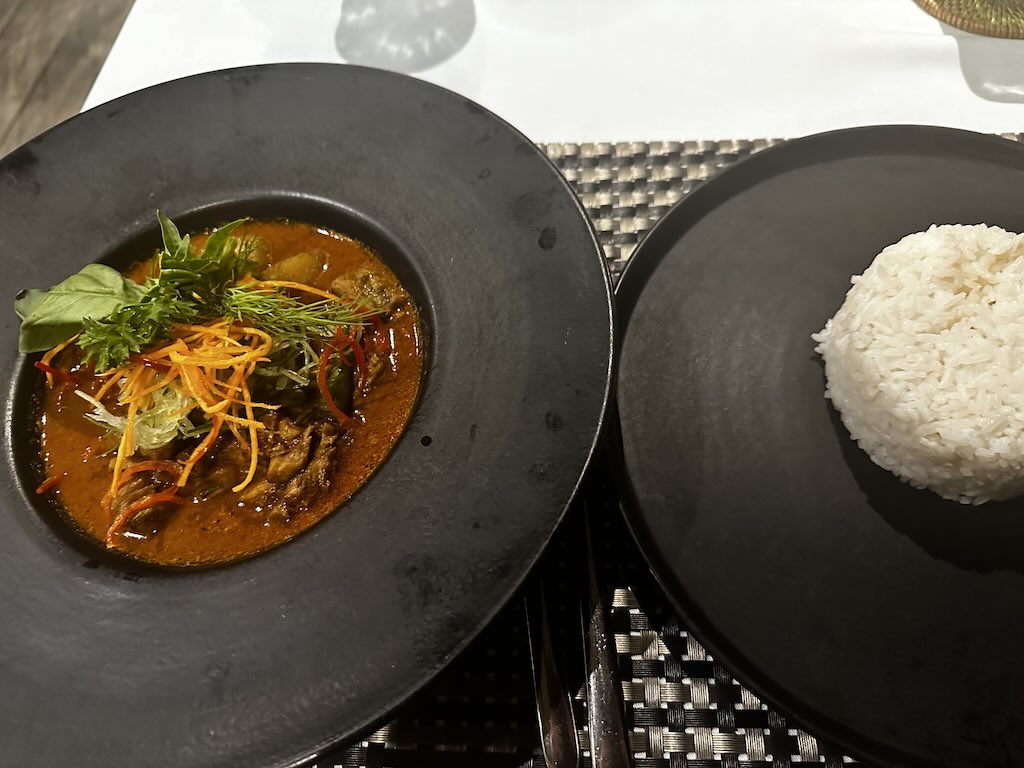
Beef simmered for four to six hours in fresh coconut milk with a paste of shallot, garlic and chilli, plus lemongrass, galangal, turmeric leaf and kaffir lime leaf. The point is what happens at the end: the liquid evaporates entirely, the coconut oil separates out, and the meat finishes by frying in it. That is why real rendang is dark, almost black, and dry rather than saucy.
Here is the detail that will make you look like you know what you are doing. If it is golden brown and still swimming in sauce, it is not rendang — it is kalio, the same dish stopped an hour or two early. Kalio is delicious and completely legitimate. It is also what most restaurants outside West Sumatra are serving you.
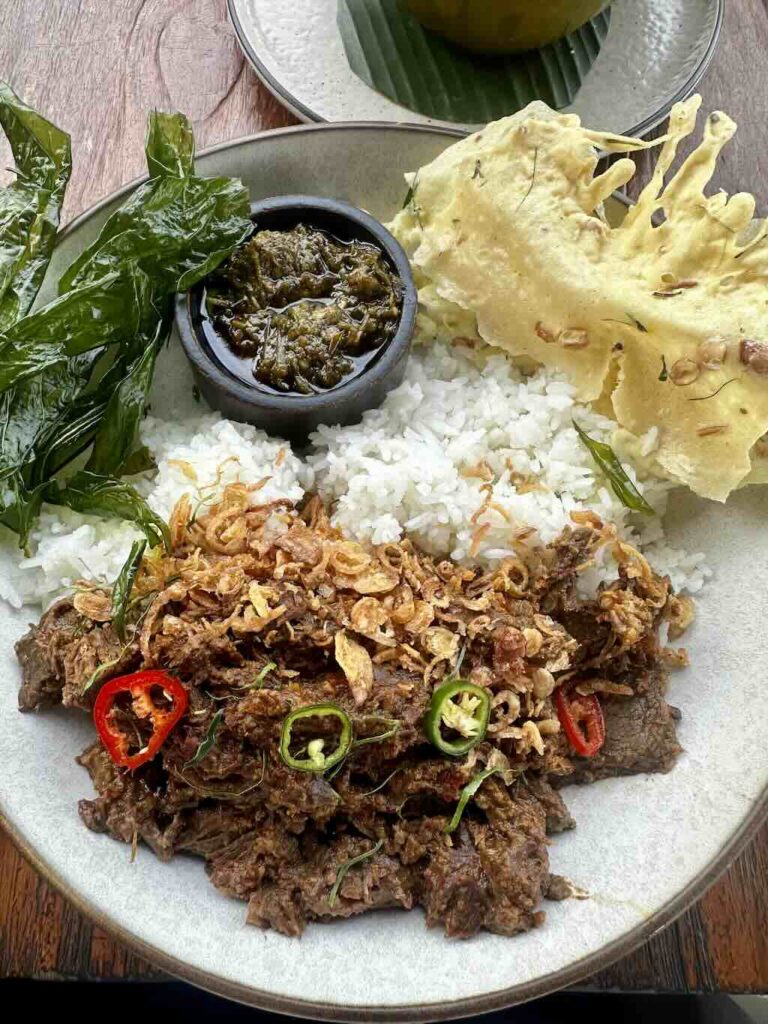
Rendang originates with the Minangkabau of West Sumatra, where it was ceremonial food: the long cooking was a preservation technique that let meat travel and keep for weeks in a climate with no refrigeration. It won a CNN Travel readers’ poll for the world’s most delicious food, then won it again on the re-run — a result Indonesia has never stopped mentioning, and quite reasonably so.
Sate — the smoky one
Thumb-sized cubes of meat on bamboo skewers, grilled hard over charcoal and fanned with a piece of cardboard until the fat drips and catches. Sate developed in Java out of Middle Eastern kebab, South Asian trader influence and Chinese skewering, and then splintered into dozens of regional versions.
The two sauce families are peanut (bumbu kacang) and sweet soy with raw shallot and chilli (sambal kecap). The ones worth seeking out by name: sate Madura, chicken in sweet peanut sauce, the version that colonised the whole country; sate Padang, beef and offal under a thick turmeric-yellow gravy thickened with rice flour and offal broth, and not a peanut in sight; sate klathak from Yogyakarta, mutton seasoned with nothing but salt so you can taste the meat; and sate lilit, minced fish and grated coconut wrapped around a lemongrass stalk, which belongs to Bali.
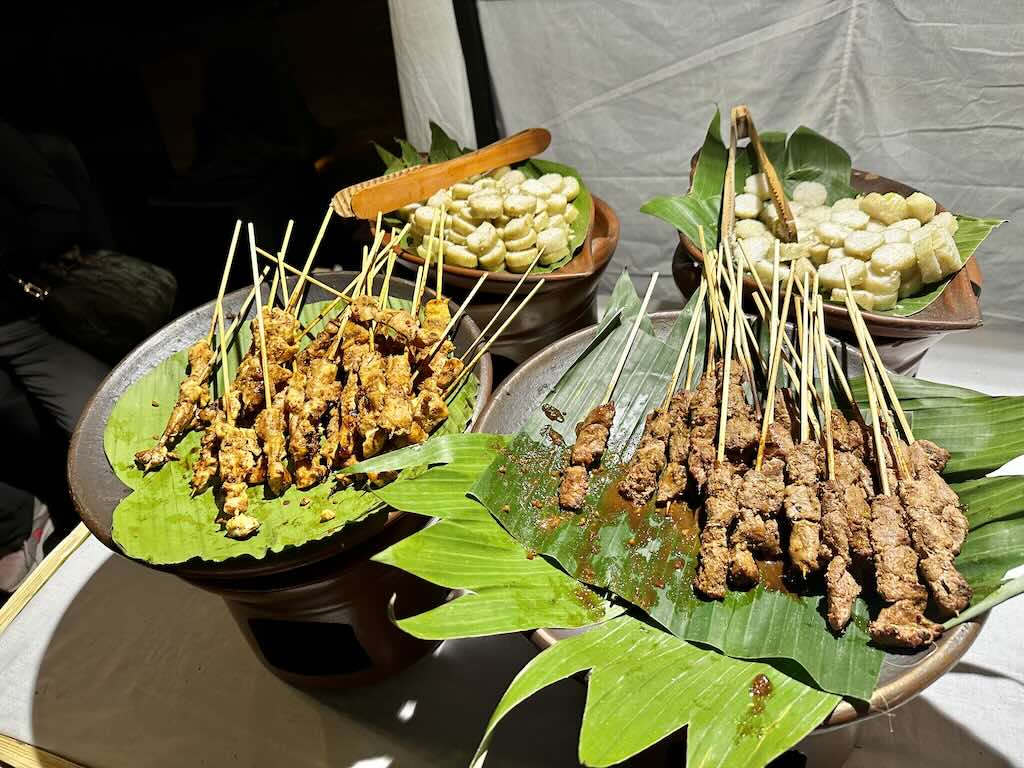
Sate is sold by the skewer, usually ten to a portion, with rice or compressed rice cake (lontong) and a small pile of pickled cucumber and shallot. Expect 30,000–45,000 rupiah for a plate in 2026.
Nasi goreng — the everyday one
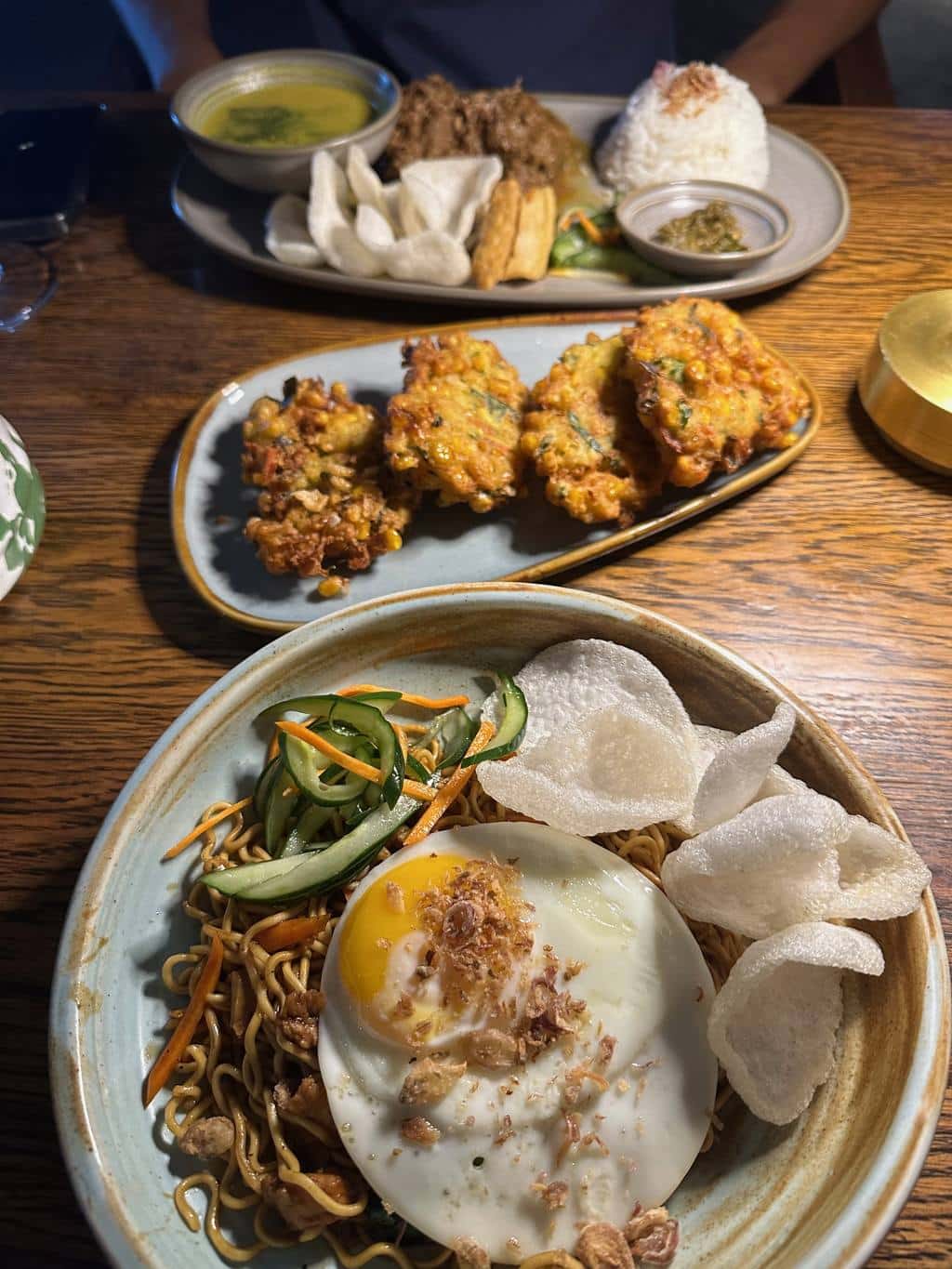
Fried rice, but the Indonesian version has a specific signature: kecap manis, the thick sweet soy sauce that gives it its brown colour and caramel edge, plus garlic, shallot, chilli and usually a little shrimp paste. It comes topped with a fried egg, prawn crackers and pickles.
It is worth understanding what nasi goreng actually is at home: it is a way of using yesterday’s rice, which is why it is a breakfast dish as much as a dinner one. Order it at 7 AM at a warung and nobody will blink. Its noodle twin, mie goreng, gets exactly the same treatment.
Gado-gado — the vegetable one
Blanched vegetables — cabbage, long beans, bean sprouts, spinach — with boiled potato, boiled egg, fried tofu and tempeh, under a thick sauce of ground fried peanuts, palm sugar, garlic, chilli, tamarind and lime. The name means something like “mix-mix”, and the dish is Betawi, from Jakarta.
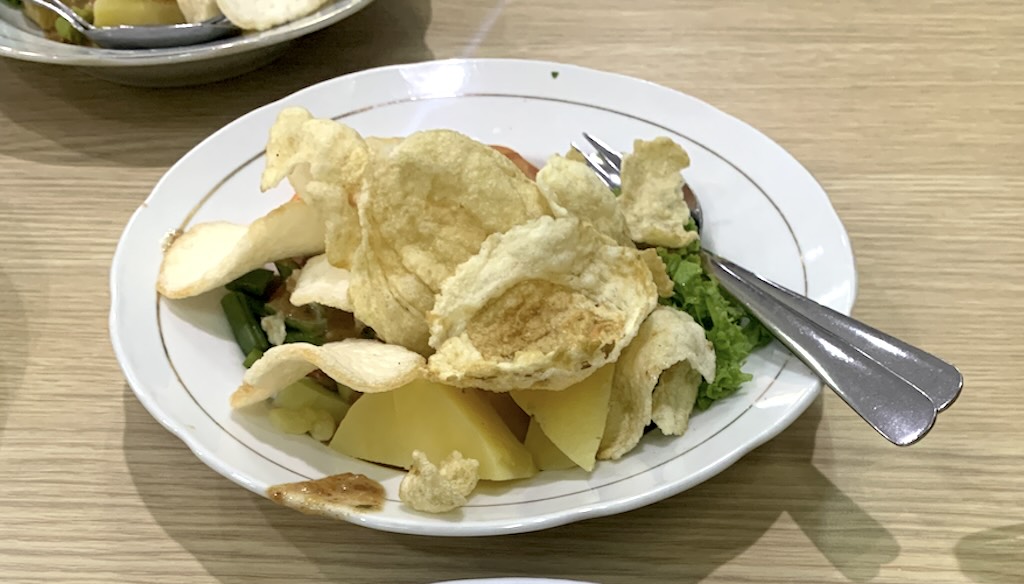
It looks like the obvious vegetarian order and often is not: the egg is standard, the crackers on top are usually prawn, and the peanut sauce quite often contains terasi, fermented shrimp paste. More on how to navigate that further down.
Soto — the one that is actually forty dishes
Soto is a category rather than a recipe: a spiced broth with meat, eaten with rice or vermicelli. Almost every region has its own, and they barely resemble each other.
Soto ayam is the one you will meet first — a clear golden chicken broth with turmeric, lemongrass and kaffir lime leaf, shredded chicken, vermicelli, boiled egg and bean sprouts, often dusted with koya, a powder of crushed prawn crackers and fried garlic. Soto Betawi from Jakarta is the opposite: beef and offal in a broth built on coconut milk or cow’s milk, sometimes finished with ghee. Soto Banjar from South Kalimantan is scented with cinnamon. Coto Makassar from South Sulawesi is a dark beef and offal broth thickened with ground peanuts, eaten for breakfast.
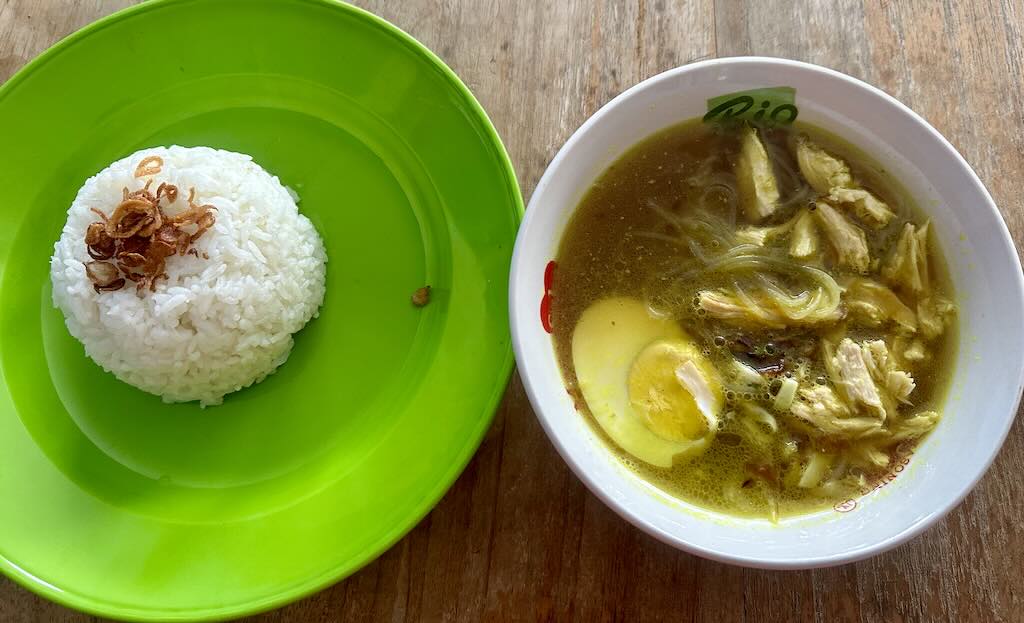
Squeeze the lime in, spoon in sambal, add sweet soy if you want it rounder. Soto is a dish you finish assembling yourself.
Beyond the Big Five: What Indonesians Actually Eat Every Day
The five official dishes are the ambassadors. These are the ones that fill warungs at lunchtime.
Nasi campur and nasi rames
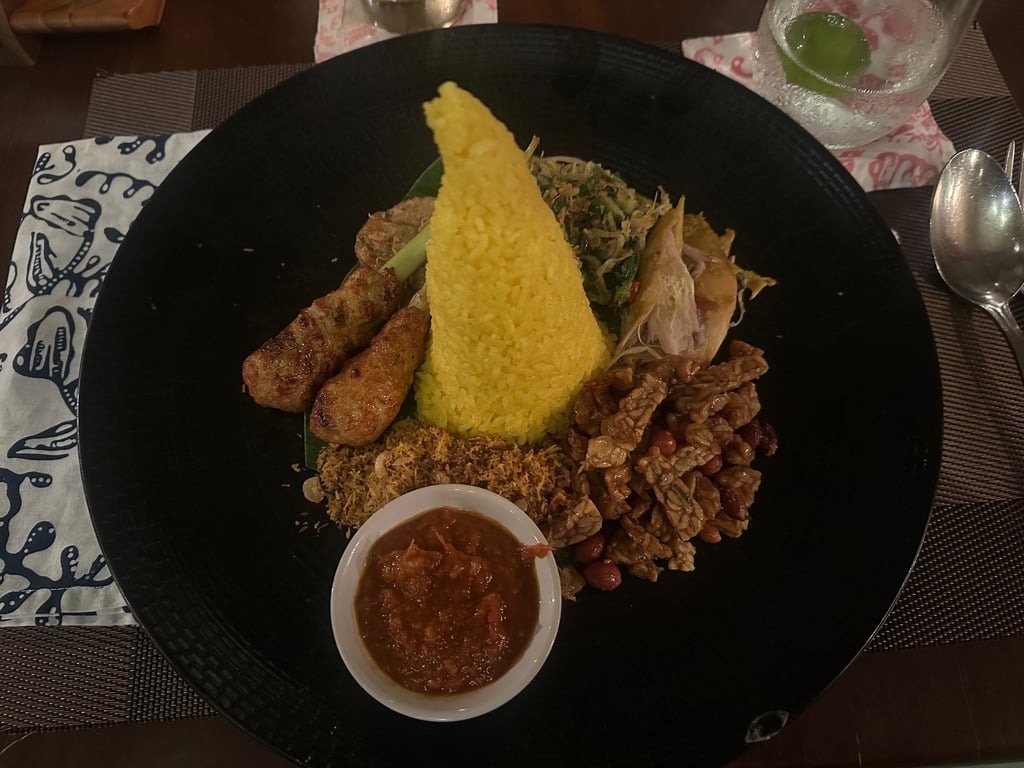
“Mixed rice” — a plate of rice with several small portions of whatever the kitchen cooked that morning: a vegetable, tempeh, tofu, a spoon of shredded chicken, half an egg, a smear of sambal. It is called nasi campur in Bali and eastern Indonesia and nasi rames in Java, and it is the single most common lunch in the country. You point at a glass cabinet, the owner assembles the plate, and you pay for what went on it — which is why the same dish can cost 15,000 rupiah or 45,000.
Bakso and mie ayam
Bakso is a springy beef meatball, bound with tapioca flour and boiled, served in clear broth with noodles, tofu and fried wonton skins. It is Chinese-Indonesian, it is sold from carts that announce themselves by knocking a spoon against a bowl, and it is the closest thing Indonesia has to comfort food. Barack Obama, who spent part of his childhood in Jakarta, has named it as the thing he missed most.
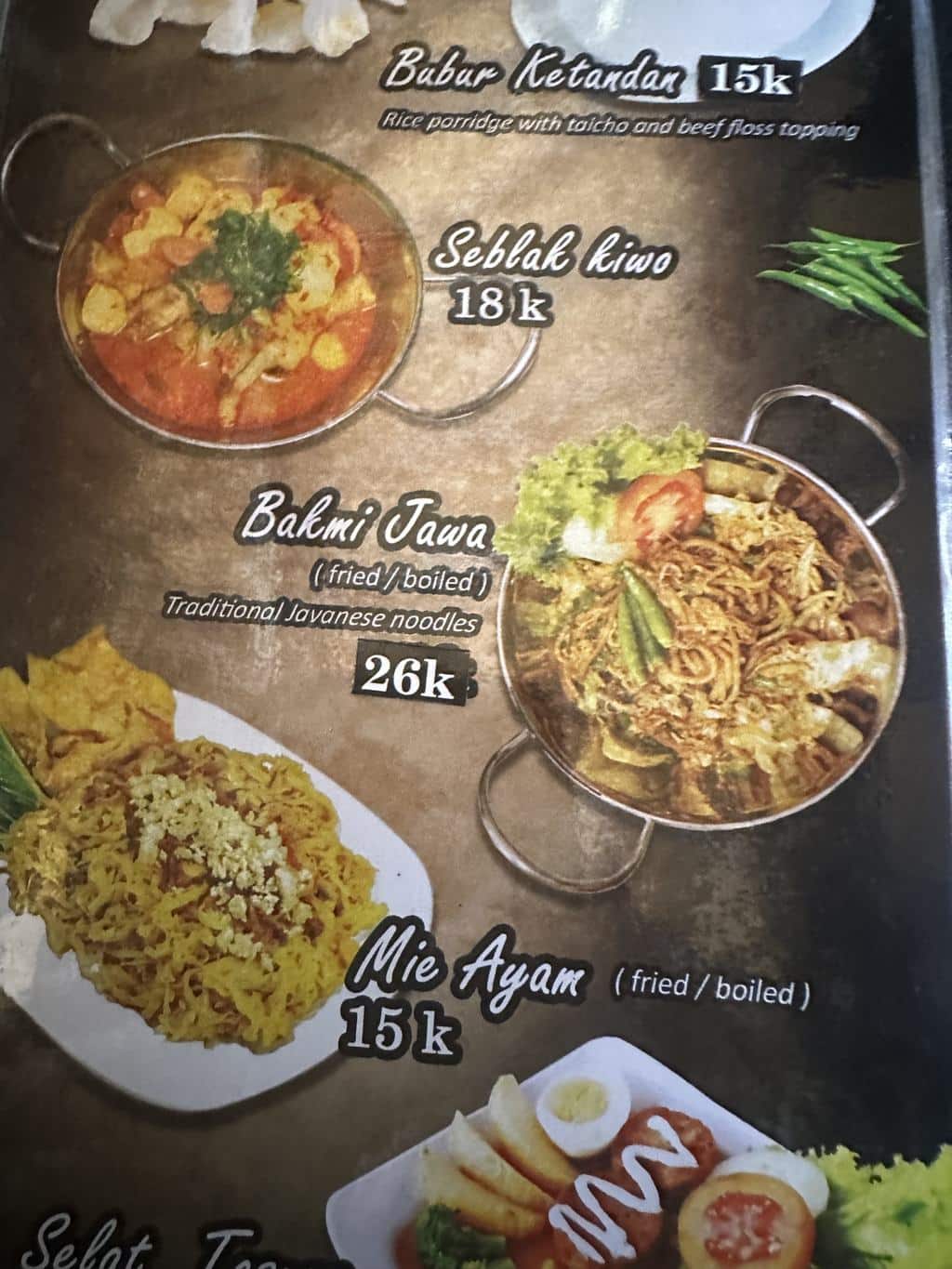
Mie ayam is its partner in the same cart economy: yellow wheat noodles tossed in garlic oil and soy, topped with chicken braised with mushrooms, with a separate bowl of broth on the side.
Ayam goreng, ayam penyet, pecel lele
Fried chicken, Indonesian-style, is marinated in spices and coconut water before frying, so the flavour goes all the way through. Ayam penyet takes that chicken and smashes it flat against a stone mortar full of sambal — penyet means “pressed” — so the meat shreds and soaks up the chilli. Pecel lele does the same thing with fried catfish. Both come with rice and a pile of raw vegetables called lalapan, and both are the standard cheap evening meal across Java.
Tempe and tahu
Tempeh is Indonesian, specifically Javanese, and it is one of the genuinely great contributions of this cuisine to the world: whole soybeans bound into a firm cake by a living mould culture, with a nutty, almost mushroom flavour that industrial supermarket tempeh abroad never quite gets right. Eat it here and you will understand what the fuss is about.
The forms to look for: tempe goreng (simply fried), tempe orek (cut into matchsticks and caramelised in sweet soy), tempe mendoan from Banyumas (wide thin sheets in a slack batter, deliberately fried soft rather than crisp), and tempe bacem (braised in palm sugar and coriander, then fried). Tofu — tahu — gets the same treatments.
Sayur lodeh and the vegetable dishes
Every warung plate needs a sayur. The most common is sayur lodeh, a gentle coconut-milk stew of long beans, chayote, aubergine, young jackfruit and tempeh. Others worth knowing: sayur asem, a sour tamarind broth with peanuts and corn, from West Java; urap, steamed vegetables tossed with spiced grated coconut; tumis kangkung, water spinach stir-fried with garlic and chilli.
Breakfast: bubur ayam, nasi uduk, lontong sayur
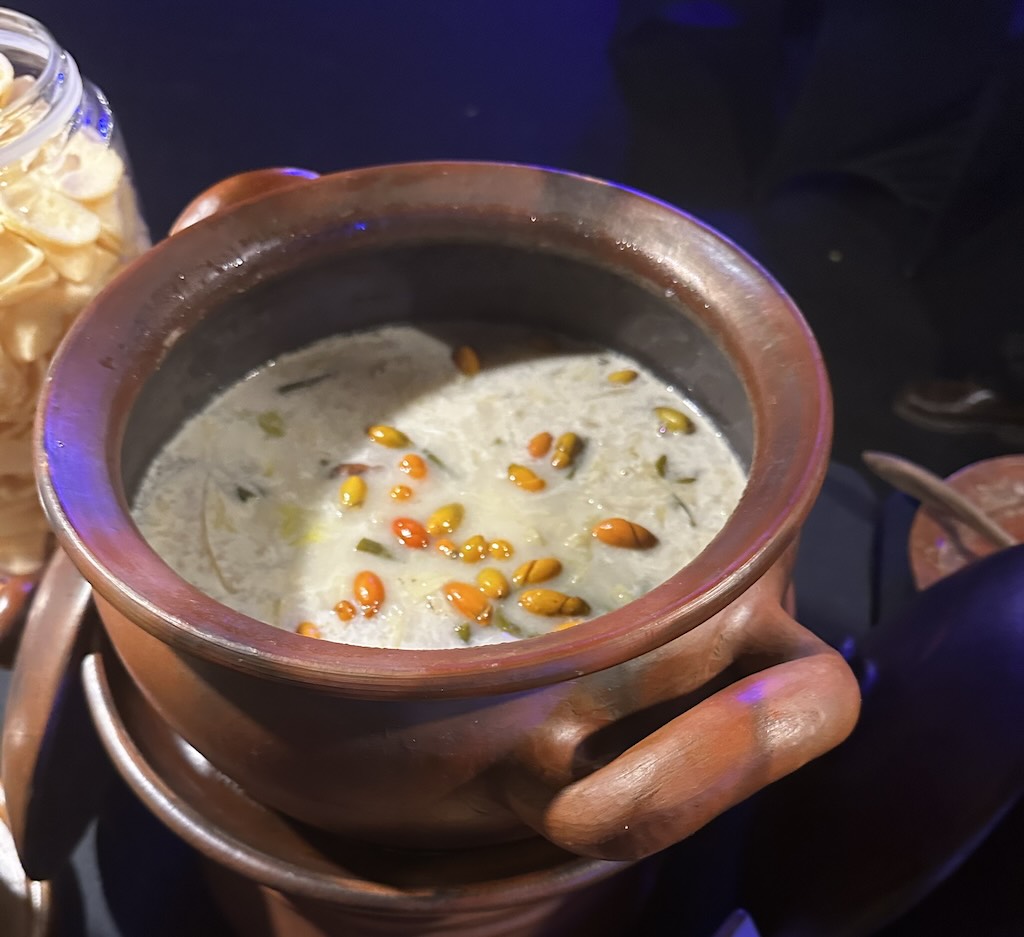
There is no separate category of breakfast food in Indonesia — there is just food, eaten earlier. Bubur ayam is a savoury rice porridge with shredded chicken, fried shallots, soy and crackers. Nasi uduk is rice cooked in coconut milk, served with fried chicken, tempeh, omelette and sambal. Lontong sayur is compressed rice cake in a coconut vegetable curry. All three are sold from carts and stalls between six and nine in the morning, and all three are gone by ten.
Indonesian Food Island by Island
This is where Indonesian food gets genuinely interesting, and where most visitors never go. Fly two hours in any direction and the menu changes completely.
West Sumatra: the chilli and coconut end of the spectrum
Minangkabau cooking, better known abroad as Padang food, is built on three things: gulai (curry), lado (chilli) and rice. Everything is simmered long and slow in coconut milk with a long spice list that betrays centuries of Indian and Middle Eastern trade. Rendang is the famous one, but the range is much wider: gulai tunjang made with beef tendon, gulai cubadak with young jackfruit, dendeng balado (beef sliced paper-thin, dried, fried crisp and buried under fresh red chilli relish), ayam pop (pale poached-then-fried chicken), and asam padeh, a sour-hot fish curry made with no coconut milk at all.
Nasi Padang is also the single most theatrical way food is served anywhere in Indonesia, and it has its own rules. There is a section on how it works further down — read it before you sit down at one.
North Sumatra: Aceh, and the Batak highlands
Aceh, at the very northern tip, has the most Indian- and Arab-inflected cooking in the country — cardamom, cumin, star anise, curry leaf. Mie Aceh is the dish to order: thick yellow noodles in a heavily spiced curry with beef, mutton or crab, served either dry-fried or soupy, with emping crackers, raw shallot and lime on the side. Ayam tangkap buries fried chicken under a mountain of crisp-fried curry and pandan leaves. Roti canai with curry is on every breakfast table, a direct inheritance from the Indian Ocean trade.
The Batak highlands around Lake Toba are the one Sumatran cuisine that never adopted the coconut curry template. The signature flavour is andaliman, a relative of Sichuan pepper that grows only here and produces a citrusy, tingling numbness rather than plain heat. Arsik — whole carp braised motionless in andaliman, turmeric and torch-ginger fruit until the sauce reduces onto the fish — is the ceremonial centrepiece. Mie gomak, thick noodles in a coconut-and-andaliman broth, is the everyday one. The Toba, Karo and Simalungun Batak are mostly Christian, so pork is the festive meat here and dishes like babi panggang Karo are a Medan institution; the neighbouring Mandailing Batak are Muslim and cook the same repertoire with beef and buffalo.
Java: four different palates on one island
Java is not one food region, it is four, and they disagree with each other.
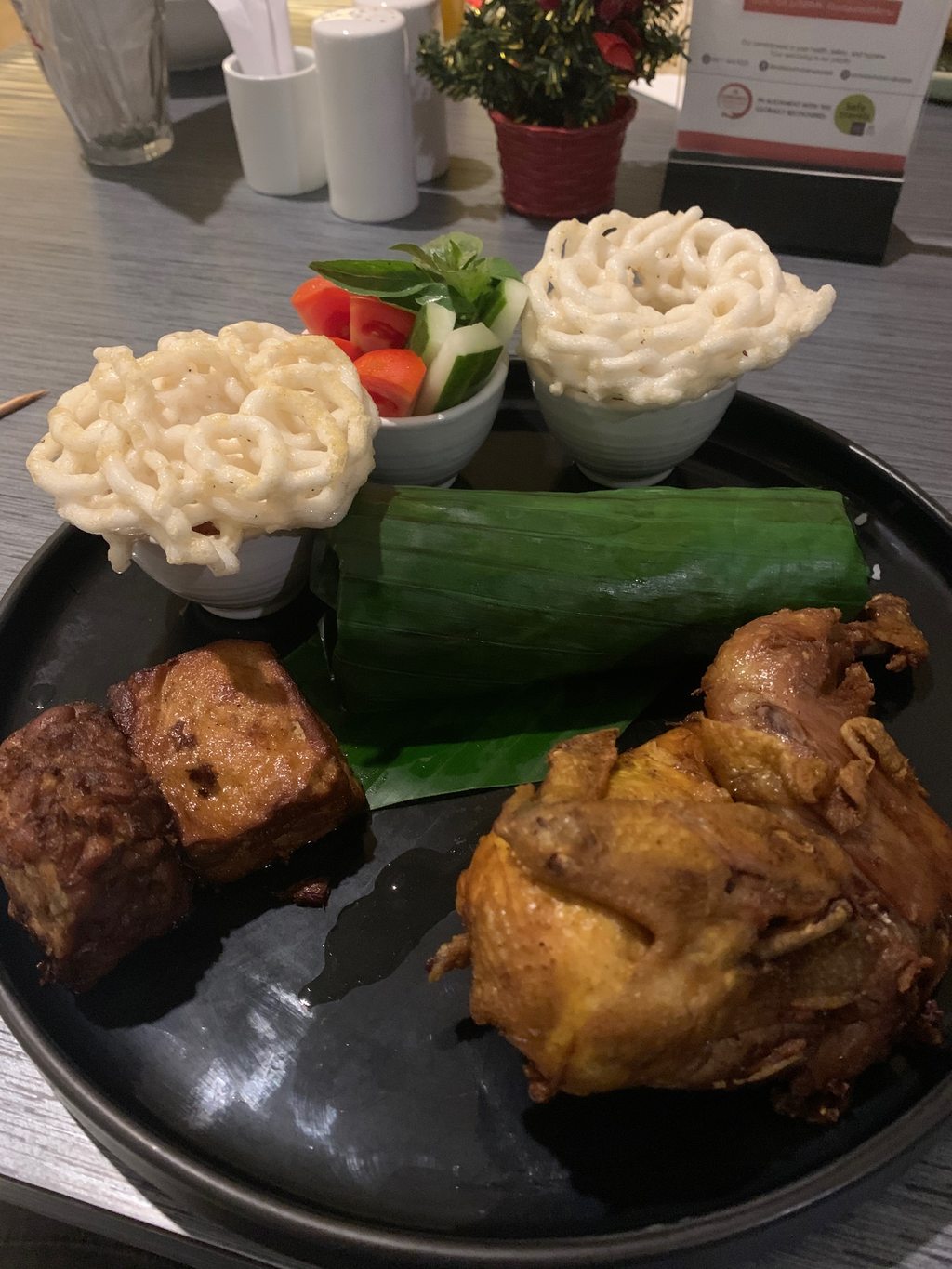
Central Java (Yogyakarta, Solo) is the sweet one — palm sugar in almost everything, chilli kept low. Its emblem is gudeg: young unripe jackfruit stewed for hours with palm sugar, coconut milk and teak leaves, which turn it deep reddish-brown, served with chicken, a hard-boiled egg and sambal goreng krecek, a stew of crisp beef skin. Nasi liwet from Solo is rice cooked in coconut milk and chicken broth, served on a banana-leaf cone.
East Java (Surabaya, Malang, Madura) goes the other way: salty, funky, chilli-forward, built on petis, a thick black fermented shrimp paste. Rawon is the one to try — beef soup turned genuinely black by keluak, a fermented nut, served with short bean sprouts, salted duck egg and sambal. It appears by name in a Javanese inscription from 901 CE, which makes it one of the oldest continuously eaten dishes on earth. Rujak cingur, a salad of fruit, vegetables and boiled beef muzzle in petis dressing, is Surabaya’s other calling card and rewards an open mind.
West Java — Sunda — is the fresh, sour, raw one, and the exact opposite of Padang. Coconut curry is rare; grilling and steaming dominate; and every meal comes with lalab, a plate of raw leaves and vegetables eaten by hand with sambal terasi. Karedok is the all-raw cousin of gado-gado, dressed with a peanut sauce sharpened with kencur (sand ginger). Nasi timbel — rice wrapped hot in banana leaf, which perfumes it — comes as a set with grilled fish, tofu, tempeh and a bowl of tamarind-sour sayur asem.
Jakarta cooks Betawi food, the creole of a port city: soto Betawi (beef and offal in a broth of milk and coconut milk), kerak telor (glutinous rice and duck egg crisped in an upturned wok over charcoal, with no oil at all), gado-gado, and the country’s densest concentration of Chinese-Indonesian cooking.
Bali: one master spice paste, and pork on the menu
Bali is the exception that proves how much religion shapes an Indonesian menu. The island is Hindu, so there is no halal restriction and pork is the festive meat, while beef is largely avoided — the inverse of nearly everywhere else in the country. Nearly every savoury dish starts from one master spice paste, base genep, and most of the classics began life as temple or ceremony food.
The four to know by name: babi guling (a whole young pig packed with spice paste and spit-roasted over coconut husks), bebek or ayam betutu (duck or chicken stuffed with spice paste and slow-cooked for hours), lawar (finely chopped vegetables with grated coconut, minced meat and spices, made fresh the morning it is eaten) and sate lilit. The Balinese sambal, sambal matah, is raw: sliced shallot, lemongrass, chilli and kaffir lime with hot coconut oil poured over it.
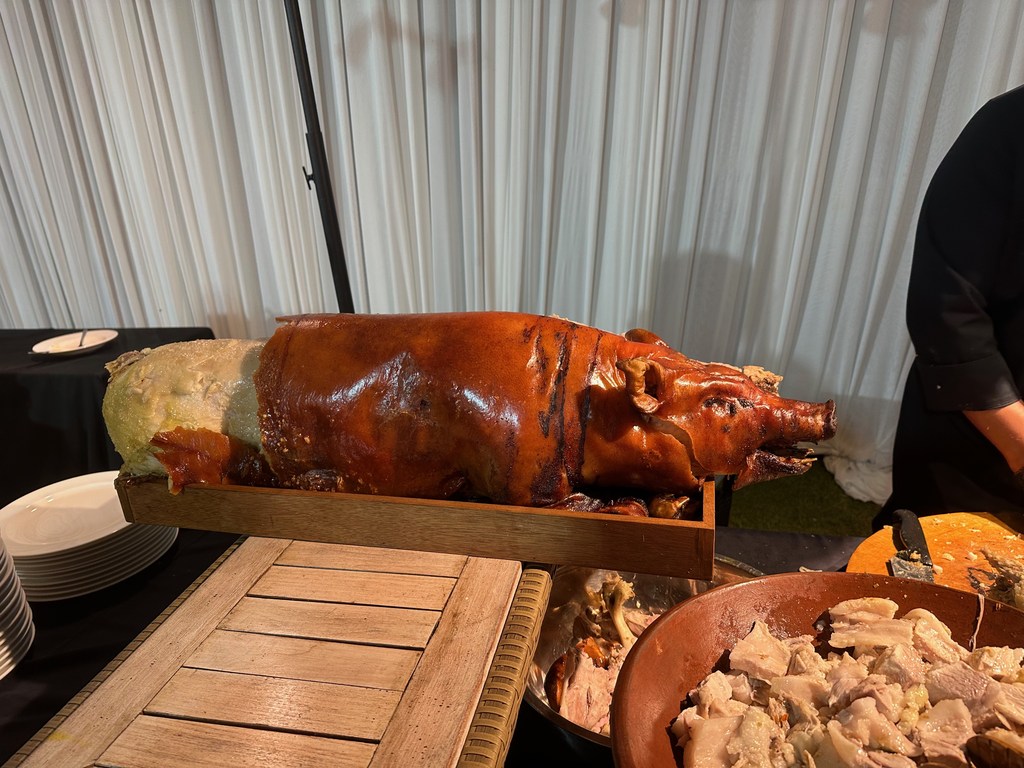
Balinese cooking deserves a guide of its own rather than a paragraph, and it will get one. This is the short version.
Sulawesi: the hottest cuisine in the country, and the richest broths
Sulawesi also contains two cuisines that share almost nothing.
South Sulawesi, around Makassar, does long-simmered beef and offal broths thickened with ground peanuts or toasted coconut: coto Makassar, pallubasa, and konro, beef ribs in a dark keluak broth. Rice usually arrives compressed into burasa or ketupat rather than loose. The sweet snack culture is exceptional — pisang epe (bananas grilled, pressed flat, grilled again and drowned in palm sugar syrup) and es pisang ijo (banana in a green pandan skin under coconut porridge and shaved ice) are both worth a detour.
North Sulawesi — Minahasa, around Manado — is the hottest cooking in Indonesia by some distance, and that is not a figure of speech: in a Minahasan dish, chillies and aromatics can make up more than half the volume. Rica-rica is not a dish but a paste of red and bird’s-eye chilli, ginger and lemongrass, applied to chicken, fish or pork. Woku is its turmeric-yellow, basil-heavy counterpart. Tinutuan, the Manado breakfast porridge of rice cooked to a pulp with pumpkin, corn and leafy greens, is the one gentle thing on the menu. Cakalang fufu — skipjack tuna clamped in a bamboo frame and smoked over coconut husks for four hours — is the ingredient the whole region is built around. Minahasans are largely Christian, so pork is everyday here too, and highland markets such as Tomohon sell game and other meats that a first-time visitor may not have seen on sale before; the seafood alternative is abundant everywhere.
Inland, in Tana Toraja, the highland Christian communities cook pa’piong — meat, coconut and greens sealed inside a bamboo tube and cooked over an open fire — and grow some of the best arabica coffee in Indonesia.
Nusa Tenggara: where rice gives way to corn
Lombok is Muslim and Sasak, and its name happens to mean “chilli” in Javanese — appropriately, since ayam taliwang (grilled chicken lacquered in chilli and shrimp paste) and plecing kangkung (water spinach under a fierce tomato-chilli-terasi sambal) are among the spiciest things you will eat in the country.
Keep going east and the rain runs out. East Nusa Tenggara — Timor, Flores, Sumba, Rote — is the driest part of Indonesia, and there the historic staple is not rice but corn. Jagung bose is dried corn hand-pounded to strip the husk, then boiled for around three hours with beans and often coconut milk. Alongside it comes se’i, strips of meat cold-smoked for hours over kosambi wood — pork in Christian areas, beef where the market is Muslim — with sambal lu’at, a sharp lime-and-chilli relish. Both techniques exist for the same reason: they survive a long dry season.
Maluku and Papua: the sago belt
In Maluku and lowland Papua the staple is neither rice nor corn but sago, the starch extracted from the pith of the sago palm. The sago palm thrives exactly where wet rice fails — swampy, waterlogged, poor-soil lowland — and needs no annual planting cycle, which makes a stand of palms a kind of standing carbohydrate bank.
Because it is a starch rather than a grain, it is eaten as porridge. Papeda is sago stirred into boiling water until it turns translucent and glutinous, twirled onto a wooden fork and slid into the bowl. It is deliberately bland, because it exists to carry ikan kuah kuning: fresh fish in a light, sour-hot yellow broth of turmeric, lemongrass, ginger and lime, with no coconut milk. Add colo-colo, Ambon’s raw chilli-and-tomato relish, and you have the eastern Indonesian meal in its classic three-part form — bland starch, sour broth, fierce fresh sambal. Maluku is also where nutmeg and clove come from, and where kenari nuts turn up in relishes and cakes.
Kalimantan: a river cuisine
Banjar cooking in South Kalimantan runs on freshwater fish rather than sea fish or red meat — above all haruan, the snakehead — in coconut broths perfumed with cinnamon, clove, cardamom and nutmeg, a spice profile you do not meet in Java. Soto Banjar is the cinnamon-scented chicken soup; ketupat Kandangan pairs smoked snakehead with a thick white coconut gravy over deliberately crumbly rice cake that you break up with your hands. Amplang, puffed mackerel crackers, is the souvenir everyone brings home from Samarinda.
Bumbu: The Spice Pastes Behind Every Dish
If you understand one thing about how Indonesian food is made, make it this. Almost every savoury dish in the country begins the same way: a set of raw ingredients is pounded into a paste in a stone mortar, and that paste is fried in oil until it stops smelling raw and starts smelling like dinner. The paste is called bumbu, and the dish is essentially built on top of it.
Javanese kitchens work from three base pastes. Bumbu dasar putih (white) is shallot, garlic, candlenut and coriander — the mild foundation for soups and coconut stews. Bumbu dasar kuning (yellow) adds turmeric and ginger, and gives you soto, gulai and yellow rice. Bumbu dasar merah (red) adds a great deal of chilli, and gives you balado, sambal goreng and most of what is fiery. Bali collapses all of this into one all-purpose paste, base genep. Manado has rica and woku. Padang has its own long list.
The aromatics you will keep meeting
Galangal (lengkuas) is not ginger, despite looking like it — it is woodier, more medicinal, faintly pine-like, and it is what makes a coconut curry taste Southeast Asian rather than Indian. Kencur (sand ginger) is a third root again, sharper and slightly camphorous, and it is the giveaway flavour in Sundanese peanut dressings. Candlenut (kemiri) is a waxy nut used purely as a thickener; it is mildly toxic raw and always cooked. Salam leaf is often called Indonesian bay leaf, which is misleading — it is a different plant with a gentler, tea-like flavour. Add lemongrass, kaffir lime leaf, turmeric, shallot and bird’s-eye chilli, and you have the working pantry of most of the archipelago.
Coconut, in four different forms
Coconut is not one ingredient here but four, and they do different jobs. Coconut milk (santan) is the body of every gulai, opor and lodeh. Grated fresh coconut is tossed raw into urap and lawar, or toasted into serundeng. Coconut water is a poaching liquid — it is why Indonesian fried chicken tastes seasoned all the way through. And coconut oil is what everything gets fried in, including the husks and shells that fuel the charcoal grills.
Kecap manis, terasi and palm sugar
Kecap manis is thick, black, syrupy sweet soy sauce, and it is the most distinctly Indonesian condiment there is. It is what browns nasi goreng, glazes sate and turns up in a saucer with sliced chilli on every table. The English word “ketchup”, incidentally, descends from the same Hokkien root as kecap.
Terasi is fermented shrimp paste: tiny planktonic shrimp salted, fermented, dried and pressed into dense dark blocks. It is toasted before use, it smells alarming and tastes essential, and it provides the savoury depth underneath most sambal. It is also the single biggest hidden trap for vegetarians in Indonesia, because it is in things that look entirely plant-based.
Palm sugar (gula jawa, gula merah, gula aren) is tapped from palm flower sap and set into hard discs. It is less sweet than cane sugar and distinctly caramel-and-smoke, and it is the reason Central Javanese savoury dishes taste the way they do. It is also the sweetener in most desserts and in the palm-sugar syrup that has made modern Indonesian iced coffee a national habit.
Sambal: Where the Heat Actually Lives
Here is the thing nobody tells you before your first trip: most Indonesian dishes are not spicy. Nasi goreng is not spicy. Sate is not spicy. Soto is not spicy. Rendang is warm rather than hot. The heat is served separately, in a small dish beside your plate, and how much of it ends up in your mouth is entirely your decision.
That small dish is sambal, and it is not one condiment. Researchers at Universitas Gadjah Mada catalogued 322 named sambals across the archipelago; a 2022 peer-reviewed survey of Indonesian cookbooks documented 110 distinct recipes, nearly two-thirds of them from Java alone. Every region has its own, most households have their own, and a good warung will make three.
The eight worth knowing by name
Sambal terasi — the national default. Chilli ground with toasted shrimp paste, sugar, salt, lime and often tomato. Raw or fried.
Sambal matah — Balinese, and raw by definition (matah means raw). Finely sliced shallot, bird’s-eye chilli, lemongrass and kaffir lime, with hot coconut oil poured over at the last second. More relish than paste, and the most refreshing sambal in the country.
Sambal ijo — the green one from Padang, made with green chilli and green tomato, steamed then coarsely pounded. Surprisingly mild. It arrives free with every nasi Padang.
Sambal dabu-dabu — Manado’s, and essentially a salsa: chopped tomato, shallot and chilli with citrus juice and hot oil, never cooked. The standard partner to grilled fish.
Sambal bajak — cooked and fried with palm sugar and candlenut until dark and thick. Sweeter, mellower, keeps for weeks.
Sambal kecap — the simplest and the one you will use most without noticing: sweet soy with raw sliced chilli, shallot and lime. It comes with sate and grilled fish.
Sambal roa — from Manado, built on smoked halfbeak fish shredded into a chilli base. Smoky, salty and deeply savoury; sold in jars and the best edible souvenir you can carry home.
Sambal andaliman — Batak, from North Sumatra, built on the citrus-numbing andaliman pepper. Unlike anything else in Indonesia.
One practical note. If a warung asks “pedas?” — spicy? — the honest answers are “tidak pedas” (not spicy), “sedikit pedas” (a little) or a confident nod. The confident nod is a decision you should make on your second visit, not your first.
Street Food and Jajanan Pasar
Indonesia has one of the world’s great street food cultures, and it runs on a specific piece of vocabulary: kaki lima. It means “five feet” and the usual explanation — two legs, two wheels and a prop stand — is folk etymology. The real origin is the English “five-foot way”, the roughly five-foot-wide covered walkway that colonial town planning mandated in front of shophouses, where vendors set up. Learn the word: pedagang kaki lima is the pushcart economy, and it is where a great deal of the best eating happens.
The savoury carts
Martabak is two entirely different foods with one name. Martabak telur is savoury: thin dough stretched paper-thin, filled with duck egg, minced beef and a great deal of spring onion, folded into a square and shallow-fried, served with pickles. Martabak manis — also called terang bulan in East Java — is a thick, spongy, cake-like pancake cooked in a heavy iron pan, split and loaded with crushed peanuts, condensed milk, chocolate sprinkles and, controversially but ubiquitously, grated cheddar. It is sold by the box, late at night, and it is the Indonesian celebration food.
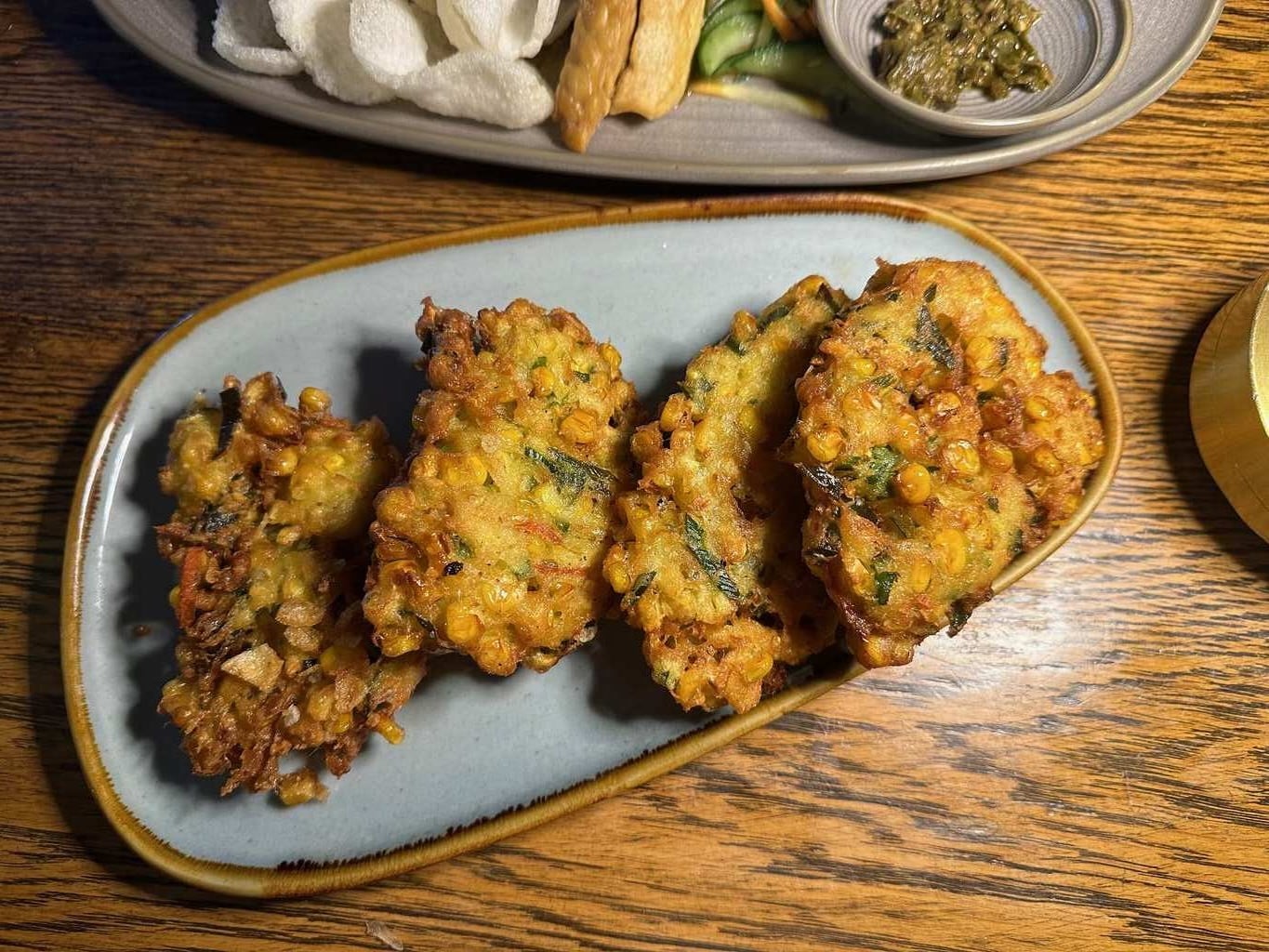
Gorengan is the general word for deep-fried snacks, sold from a glass-fronted cart with a basket of whole raw bird’s-eye chillies beside them — you are supposed to bite the chilli between mouthfuls. The line-up: bakwan (vegetable fritter), tahu isi (stuffed tofu), tempe mendoan (thin battered tempeh, fried deliberately soft), pisang goreng (fried banana), cireng, risoles and fried cassava.
Siomay and batagor are the same fish-paste family split by cooking method — siomay steamed, batagor deep-fried — both from Bandung, both cut up on the plate with potato, tofu, cabbage and boiled egg and drowned in peanut sauce and lime.
Pempek belongs to Palembang in South Sumatra: fish and sago dough, boiled then fried, dipped in cuko, a thin, dark, aggressively sweet-sour-hot sauce. The famous version is kapal selam, “submarine”, with a whole egg sealed inside.
Kerak telor is Jakarta’s, and increasingly a festival-only survival. Otak-otak is fish paste wrapped in banana leaf and grilled. Jagung bakar — grilled corn basted with margarine and chilli-sweet soy — is the standard beach and hill-viewpoint snack.
Angkringan and nasi kucing
In Yogyakarta and Solo, the evening runs on the angkringan: a cart with a tarpaulin and a few mats on the pavement, a charcoal brazier, and stacks of nasi kucing — “cat rice”, a fist-sized parcel of rice with a spoonful of anchovy sambal or spiced tempeh, wrapped in banana leaf and paper. You take what you want from the pile, add skewers of quail egg or chicken intestine grilled to order, drink hot ginger tea, and the owner counts the wrappers at the end. It costs almost nothing and it is one of the best food experiences in Java.
Jajanan pasar: the morning market cakes
Jajanan pasar means “market snacks” — the tray of small, brightly coloured steamed and boiled cakes sold at every morning market, almost all of them built from rice flour, tapioca, coconut and palm sugar. They are usually sold as a mixed plate rather than individually, which is the right way to meet them.
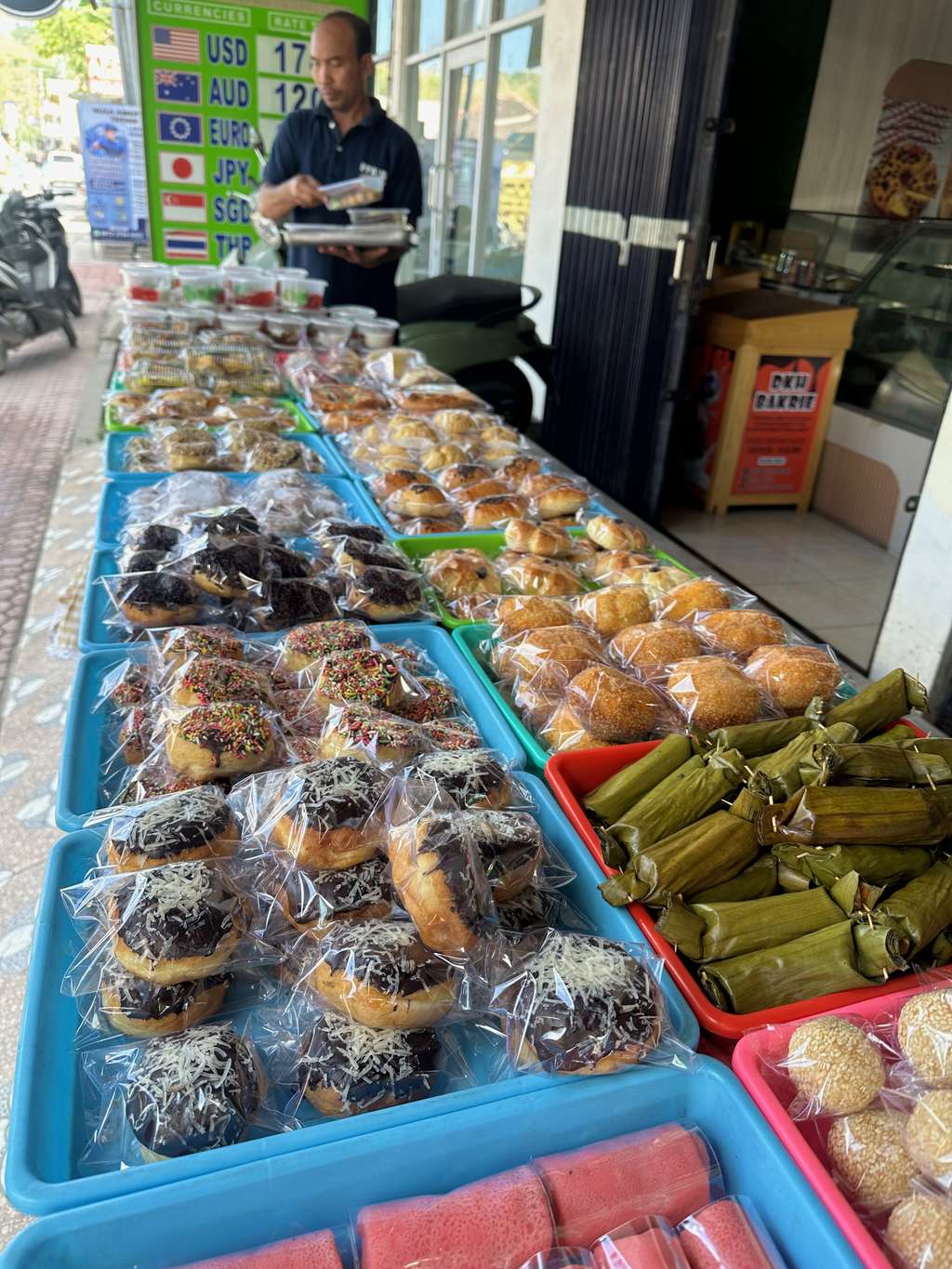
Klepon — boiled rice-flour balls, green from pandan, rolled in grated coconut, with a lump of solid palm sugar inside that liquefies during cooking and bursts in your mouth. Recorded in a Javanese text from 1814. Be warned about the burst; eat them in one bite. Onde-onde — sesame-coated fried balls filled with mung bean paste, Chinese in origin. Note the naming trap: in Sumatra and Malaysia, “onde-onde” means klepon. Dadar gulung — a pandan-green crepe rolled around coconut cooked down with palm sugar. Kue lapis — a bouncy steamed layer cake you peel apart layer by layer. Getuk — mashed cassava with coconut and sugar, often extruded into pastel ribbons. Serabi — a rice-flour pancake cooked in a small earthenware pan over charcoal, crisp-edged in Solo, swimming in palm-sugar syrup in Bandung. Kue putu — pandan rice flour packed into short bamboo tubes with a palm sugar core and steamed; you find the vendor by the whistle of escaping steam.
Indonesian Desserts and Sweet Things
Indonesian dessert is mostly cold, mostly built on shaved ice, coconut milk and palm sugar, and mostly drunk with a spoon.
Es campur, es teler, es cendol
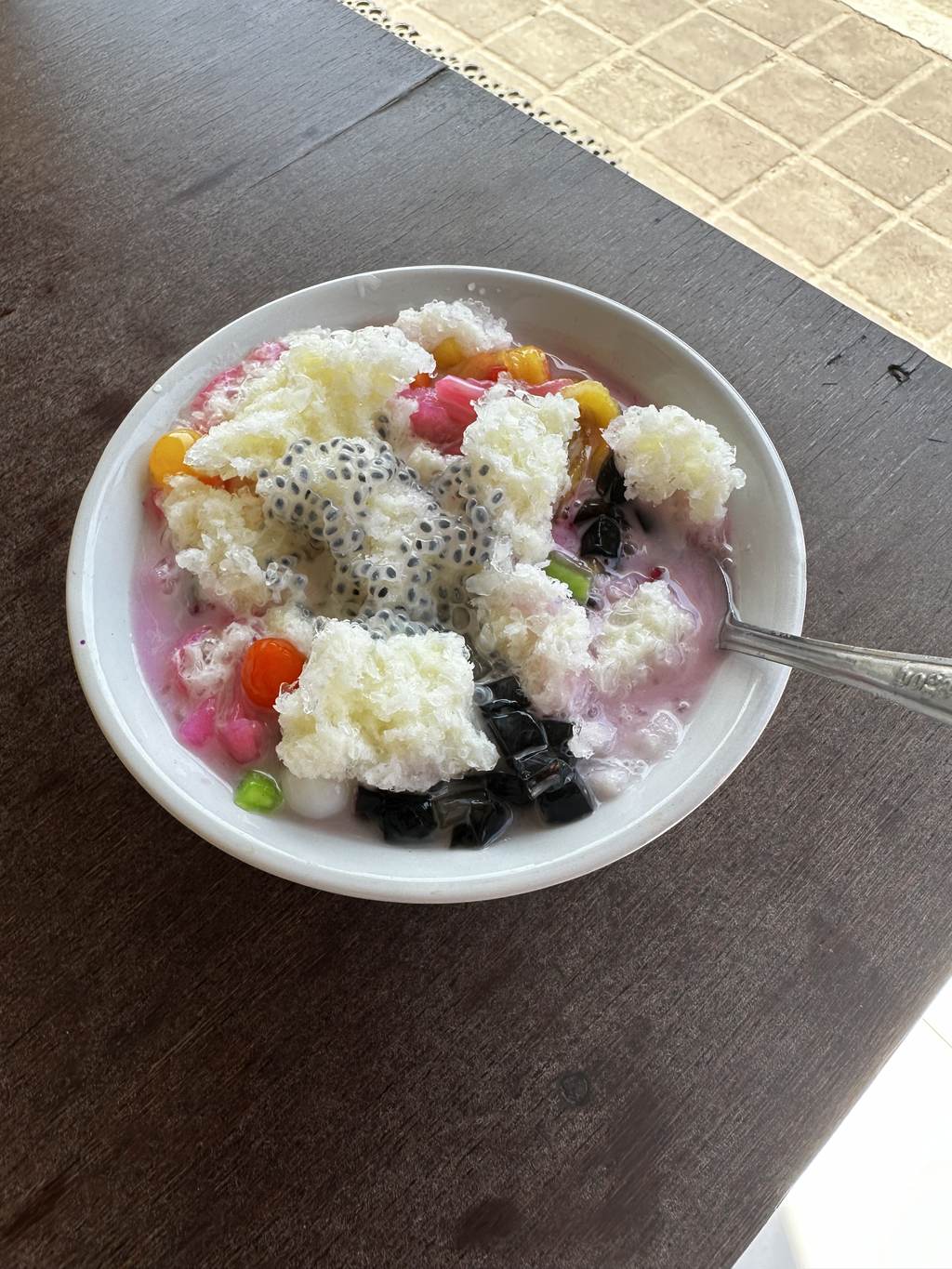
Es campur literally means “mixed ice”, and having no fixed recipe is the whole point: shaved ice with whatever the stall has — jackfruit, young coconut, grass jelly, tapioca pearls, cendol, seaweed jelly — under bright pink cocopandan syrup and sweetened condensed milk. It is the classic thing to break the fast with during Ramadan.
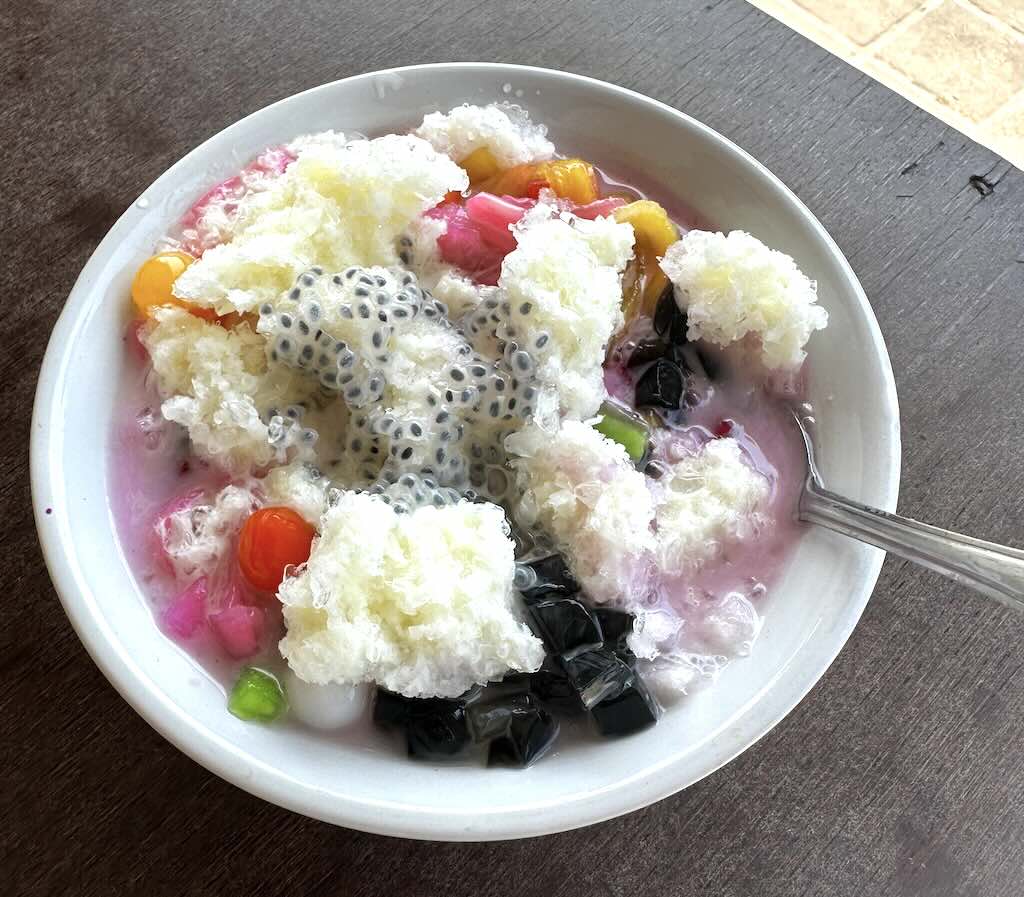
Es teler is the more defined version, and the one to order if you want the best of the family: avocado, young coconut flesh and jackfruit in coconut milk and condensed milk over ice, with a pinch of salt. It won a national competition for a signature Indonesian drink in 1982 and has never been improved on.
Es cendol — called es dawet in Central and East Java — is soft green worm-shaped rice-flour jellies scented with pandan, in coconut milk and palm sugar syrup over crushed ice. A sweet rice-flour drink of this kind is mentioned in a twelfth-century Javanese text, which makes it plausibly the oldest dessert in the country.
The warm ones
Kolak is a warm coconut-milk and palm-sugar stew, most often with banana (kolak pisang), sweet potato or pumpkin. It is the Ramadan dessert, sold at every roadside stall in the hour before sunset. Bubur sumsum is a soft white rice-flour porridge with thick palm sugar syrup poured over it — the name means “marrow porridge” and refers only to the colour.
Fruit, and the one everyone asks about
Learn a few names and the markets open up: manggis (mangosteen), rambutan, salak (snake fruit — scaly brown skin, crisp dry flesh, sweet with an astringent edge), sirsak (soursop), markisa (passion fruit), jambu air (water apple), nangka (jackfruit), duku, kedondong.
And then there is durian. The smell is genuinely not negotiable, and the reason it is banned in hotel rooms, on Singapore’s metro and on essentially every airline is that it permeates fabric and does not leave. If you want to try it, buy a small portion already opened at a market rather than a whole fruit, and eat it outside. One warning that is not folklore: do not drink alcohol with durian. Research at the University of Tsukuba found that durian’s sulphur compounds inhibit the enzyme that clears acetaldehyde from your system by around 70%, which is the actual mechanism behind the nausea people report.
What Indonesians Drink
Coffee, old and new
Indonesia is the world’s fourth-largest coffee producer, and more than nine-tenths of it is grown by smallholders on one or two hectares each. The traditional way to drink it is kopi tubruk — “collision coffee”: ground coffee straight into the glass, boiling water on top, sugar stirred in, and you wait a minute for the grounds to settle. There is no filter. You do not drink the last centimetre.
The origins are worth learning because they taste genuinely different. Most Sumatran coffee is wet-hulled (giling basah), a processing method unique to Indonesia that strips the parchment off the bean while it is still wet — a response to a humid harvest season, and the direct cause of the classic heavy-bodied, low-acid, earthy Sumatra profile. Gayo from Aceh is increasingly washed instead, which makes it cleaner and more floral. Toraja from Sulawesi is full-bodied with chocolate and sweet spice. Kintamani, grown on the Batur caldera and Indonesia’s first registered geographical indication, is famous for a citrus note. Java from the Ijen plateau is estate-grown and fully washed, so it is the bright, clean outlier. Flores Bajawa is cocoa with a citric lift.
Since around 2018 the country has also built an entire industry on one drink: es kopi susu, iced coffee with fresh milk and palm-sugar syrup, sold in a plastic cup for 18,000–25,000 rupiah by chains like Kopi Kenangan, Janji Jiwa, Fore and Tomoro. Kopi Kenangan became Indonesia’s first food-and-beverage unicorn in December 2021. If you want to know what young urban Indonesia actually drinks, it is this.
One thing to skip: kopi luwak. A joint Oxford WildCRU and World Animal Protection study assessed sixteen tourist-facing plantations in Bali holding forty-eight wild-caught civets and found every one failing basic welfare standards — wire-mesh floors, no clean water, no social contact, and constant daytime noise inflicted on a nocturnal animal. No certification scheme reliably distinguishes wild-collected beans from caged ones, which is why UTZ and Rainforest Alliance decline to certify it at all. The coffee is not expensive because it is good; it is expensive because of the story.
Tea, jamu and the cold sweet things
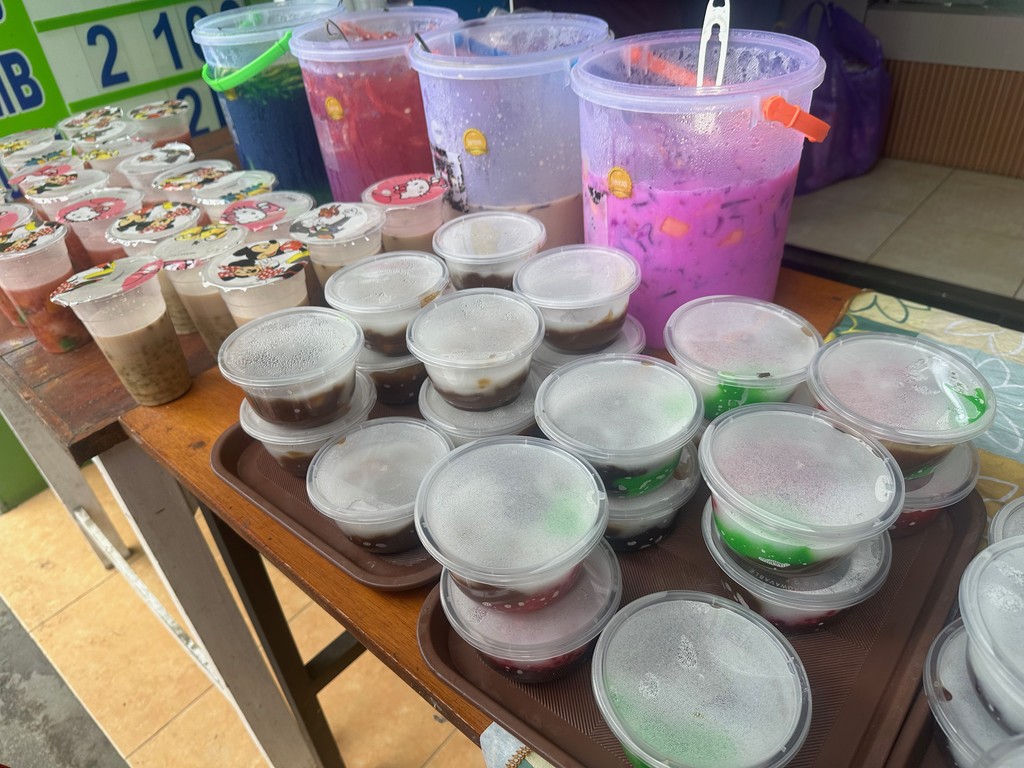
Es teh manis — weak tea, a great deal of sugar, ice — is the default drink with any warung meal, and Teh Botol, bottled sweet jasmine tea made by Sosro since 1970, is the default when it comes from a fridge. Ask for es teh tawar if you want it unsweetened.
Jamu is the one to seek out. It is Indonesia’s herbal tonic tradition, inscribed by UNESCO on the Representative List of the Intangible Cultural Heritage of Humanity in 2023 as “Jamu wellness culture”. It goes back more than a thousand years, it works on balancing opposing qualities, most of its makers are women, and recipes are adjusted to the individual drinker. The two you will meet everywhere are kunyit asam (turmeric and tamarind, sour and bright) and beras kencur (rice and sand ginger, sweeter and earthier). The seller who carries bottles in a cloth sling on her back is a jamu gendong.
Hot drinks worth ordering on a cool evening in the hills: wedang jahe (ginger boiled with palm sugar), bandrek (ginger with cinnamon and clove), bajigur (the Sundanese one, with coconut milk) and sekoteng (ginger with mung beans, peanuts and diced bread floating in it).
Alcohol
Bintang, a 4.7% pale lager brewed by a Heineken subsidiary in a brewery that dates to 1929, is the national beer. Expect 45,000 rupiah for a 620 ml bottle from a shop, 50,000–80,000 in a restaurant, and considerably more at a beach club.
Tuak is fermented palm sap, central to social life in the Batak areas, Nusa Tenggara and Toraja. Arak is what you get when you distil it. A 2020 Balinese regulation brought village arak distillers into the legal economy, and there are now around fifty labelled artisan brands.
One serious warning, and it is not a squeamish one: unregulated spirits in Indonesia have been adulterated with methanol, and this has caused documented deaths and permanent blindness among both locals and tourists. Several foreign ministries carry standing advisories about it. Drink arak only from sealed, labelled bottles from a licensed producer, and be sceptical of very cheap or free spirit-based cocktails.
Where to Eat: Warung, Rumah Makan, Kaki Lima
Indonesia does not really have a restaurant culture in the Western sense, and understanding the local vocabulary is worth more than any list of addresses. There are five kinds of place, and each works differently.
Warung — the default, and the best value
A warung is a small, usually family-run eating house, very often run by a woman, sometimes a permanent building and sometimes four poles and a tarpaulin. Most work on the display-cabinet model: a glass-fronted case (etalase) holding eight to twenty dishes cooked that morning, at room temperature. You take a plate of rice, point — “ini, ini, dan ini” — and the owner spoons it on.
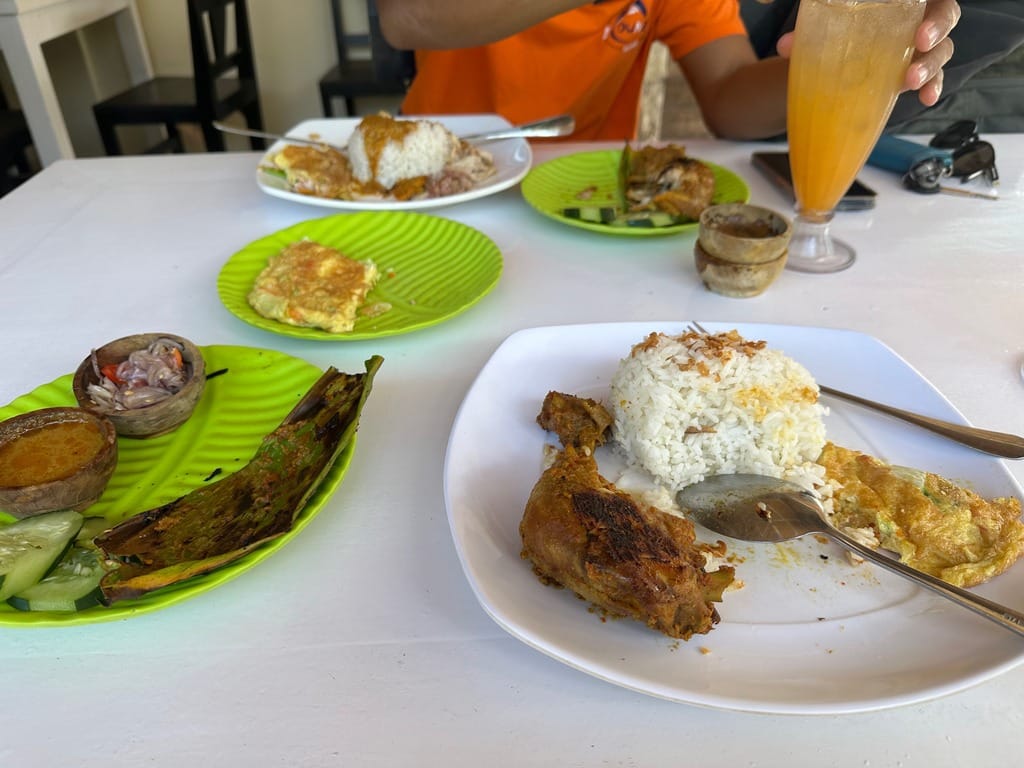
Two things surprise first-time visitors. First, you are usually not told the price until you have finished. The owner tallies mentally from what went on your plate. This is not a scam, it is just how it works, and it is why nasi campur has a price range rather than a price. If you want certainty, ask “berapa?” while pointing. Second, the food is cooked once, in the morning. By two in the afternoon the good stuff is gone. Arrive between 11:30 and 1 PM.
The Jakarta version, run by people from Tegal in Central Java, is called a warteg, and is the cheapest reliable meal in the capital.
Rumah makan — one step up
Literally “eating house”: a fixed building, proper tables, a wider menu, dishes cooked to order rather than assembled from a cabinet. A warung Padang that grows into a chain becomes a rumah makan Padang. Prices are perhaps double a warung and still very cheap by any international standard.
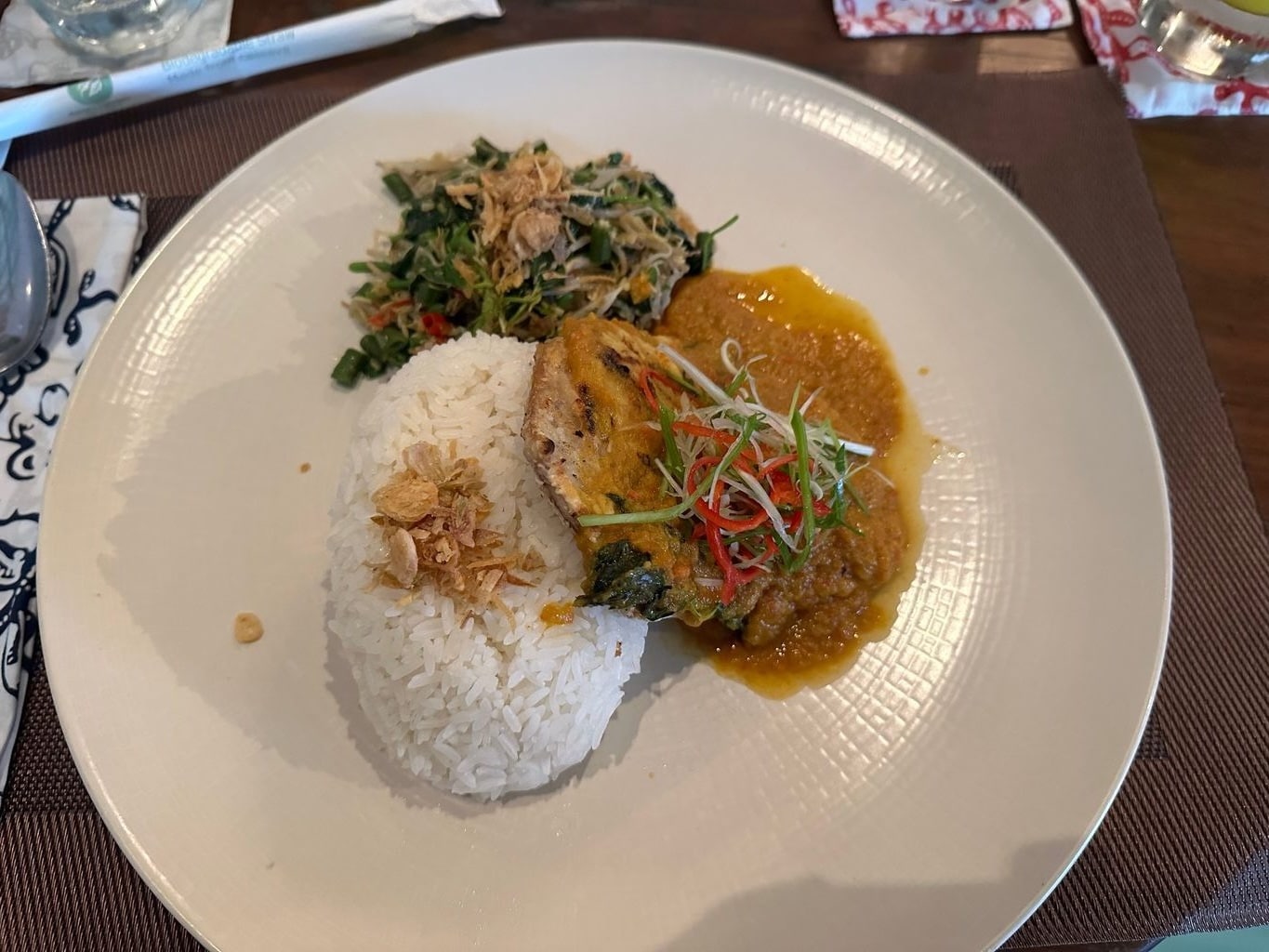
How nasi Padang actually works
This deserves its own explanation, because the traditional format alarms people who do not know the rules.
In the hidang style, you sit down and order nothing. A waiter arrives with ten to fourteen small saucers balanced up both arms and covers your table with them — rendang, gulai, fried lung, cassava leaves, sambal ijo, a fish, an egg. Rice, gravy and sambal are generally included. You are billed only for the dishes you actually eat; untouched saucers are collected and go back. It is honour-based and it has worked for a very long time.
The trap is precise: touched counts as eaten. Take one spoonful from a saucer and you have bought the whole saucer. So decide what you want before you start, and leave the rest alone.
The other, now more common format is pesan: you look at the glass display window at the front, point at what you want, and it is plated for you. Same food, no theatre, no risk of misunderstanding. If you are unsure, that is the one to use.
Kaki lima, angkringan and lesehan
Kaki lima is the pushcart economy: bakso carts knocking a spoon against a bowl, sate grills, martabak griddles, gorengan baskets. It sets up in the late afternoon and runs until late. Angkringan is the Yogyakarta pavement version with mats. Lesehan is not a type of place but a way of sitting — on woven mats on the ground, no chairs — and is the standard evening arrangement along Malioboro.
Pasar and pasar malam
The morning market (pasar) is where jajanan pasar, fruit, spices and breakfast live, and it is largely over by nine. The pasar malam is a different animal: a weekly night market in a town square or open field, with food stalls, produce, clothes and often fairground rides. If you are in a provincial town on the right evening, go — it is the single best way to eat six things you have never heard of in one sitting.
How to Eat Like a Local: Etiquette, Prices and Ordering
Your right hand, and only your right hand
Eating with your hands is called muluk and it is completely normal with rice, grilled fish and nasi Padang. The rule that matters: right hand only. The left is the toilet hand, and using it to eat, pass food or hand over money reads as genuinely rude. The technique is fingertips, not fist: gather the rice, compress it lightly, push it in with your thumb. Your left hand may steady the plate; it does not touch food.
In restaurants and anywhere formal, the default is spoon in the right hand, fork in the left as a pusher. There is no knife — Indonesian food arrives already cut or tender enough to break with a spoon edge. If a knife appears, you are in a Western restaurant.
The bowl of water with a lime in it is not a drink
It is called a kobokan, and it is a finger bowl for rinsing your fingertips before and after eating with your hands. The slice of lime is there to cut the grease and the smell, which is precisely why it looks like a beverage. This is the classic foreign-visitor mistake at an Indonesian table, and you now will not make it.
What things cost in 2026
The rupiah is at historic lows against both the dollar and the euro, which means Indonesia is, in hard currency, noticeably cheaper for a foreign visitor in 2026 than it was two years ago — even though local prices in rupiah have risen. Figures below convert at roughly 18,000 rupiah to the dollar and 20,600 to the euro; check the rate before you travel, because most price guides online are still converting at 2024 numbers and overstate the dollar cost by 10–15%.
- Warung meal, neighbourhood: 15,000–35,000 Rp ($0.85–1.95 / €0.75–1.70)
- Warung meal, tourist area: 25,000–60,000 Rp ($1.40–3.35)
- Nasi Padang, several dishes: 35,000–55,000 Rp
- Bakso or mie ayam: 15,000–40,000 Rp depending on the city
- Sate, ten skewers with rice: 30,000–45,000 Rp
- Nasi kucing at an angkringan: 2,000–3,000 Rp each
- Es teh manis: 5,000–10,000 Rp · es kopi susu: 15,000–25,000 Rp · bottled water: 5,000–15,000 Rp
- Bintang, 620 ml from a shop: around 45,000 Rp
- Western café dish in a tourist town: 60,000–120,000 Rp — three to six times a warung
What “++” means on the bill
If a menu is printed and the room has air conditioning, look for ++ or a footnote reading “subject to 10% government tax and X% service charge”. Restaurant food in Indonesia is not subject to VAT; it carries a separate local tax (PBJT, which everyone still calls PB1) capped at 10%, plus a service charge of typically 5–10% that is not a tax at all. Budget 15–21% on top of the printed price. An 11% line on a restaurant bill is an error — that is the VAT rate, and it does not apply here.
Warungs and street food have no ++. The number on the wall is the number you pay.
Tipping
Not traditional in Indonesia, and never at a warung or a street cart — rounding up is plenty. In tourist areas it has become semi-expected: 20,000–50,000 rupiah at a restaurant, 50,000–100,000 for a full-day driver or guide. Check the bill first, because a service charge is often already on it. Tip in cash; card terminals rarely pass it on.
Ten words that will change your trip
Bu (madam) and Pak (sir) — address the cook this way and the whole interaction changes. Berapa? — how much? Enak — delicious. Tidak pedas / sedikit pedas — not spicy / a little spicy. Bungkus — to take away. Tanpa es — no ice. Terima kasih — thank you. Air putih — plain water. Sudah kenyang — I’m full, said with a hand on the stomach and a smile, which is the polite way to stop a host refilling your plate.
Ramadan
During the fasting month, many local warungs in Muslim-majority areas close during daylight or hang a curtain across the doorway and serve discreetly. Malls, hotels and Chinese-Indonesian restaurants stay open; finding lunch is inconvenient, not impossible. Nobody expects visitors to fast, but eating and smoking conspicuously on the street reads badly. Bali, being Hindu-majority, is essentially unaffected.
The upside is real: buka puasa, the breaking of the fast at sunset, produces the best street food of the year. Pop-up stalls selling kolak, es buah and gorengan appear around 5:30 PM and the atmosphere is excellent. The genuinely disruptive period is not Ramadan but Idul Fitri immediately after it, when the whole country travels and independent restaurants close for three to seven days.
Vegetarian, Vegan, Halal and Allergies
Vegetarian and vegan: workable, with traps
The base repertoire is genuinely good: gado-gado, karedok, urap, sayur lodeh, sayur asem, tumis kangkung, every form of tempeh and tofu, nasi kuning, bubur kacang hijau, and the entire fried-snack economy. Indonesia invented tempeh; you will eat well.
The traps are specific and worth memorising:
- Terasi — fermented shrimp paste, in most sambal, in a lot of peanut dressing, in many vegetable dishes. This is the number one trap.
- Kaldu ayam — powdered chicken stock, near-ubiquitous in vegetable dishes at village warungs.
- Kerupuk — the crackers on the side are usually prawn or beef skin. Emping, made from melinjo nuts, is the plant-based one.
- Egg — assumed present in gado-gado, nasi goreng and nasi campur unless you exclude it.
- Oyster sauce and petis — in Chinese-Indonesian and East Javanese dishes respectively.
The single most useful sentence, and it is worth learning properly, is “Saya tidak makan daging, ayam, dan ikan” — I don’t eat meat, chicken or fish. Saying only “saya vegetarian” is understood but weak: many people will still consider fish or chicken stock compatible with it. And “tanpa daging” is unreliable on its own, because in everyday Indonesian daging tends to mean red meat specifically.
Then add, in the natural warung register: “Tidak pakai terasi, ya” — don’t use shrimp paste. Same construction for telur (egg), kerupuk and kaldu ayam. If all else fails, “sayur saja” means vegetables only.
Two reliable shortcuts: any restaurant signed Rumah Makan Vegetarian is Chinese-Buddhist and completely safe, and cities like Yogyakarta, Jakarta and the tourist towns of Bali have dense modern vegan scenes.
Halal, and where pork is normal
Around 87% of Indonesians are Muslim, so across most of the country food is halal by default and pork simply does not appear. Where it does appear, restaurants say so: look for the word babi on a menu, or a sign reading non-halal, which exists precisely so that Muslim diners can avoid the place.
Pork is everyday food in Bali, Tana Toraja, Manado and North Sulawesi, the Batak highlands of North Sumatra, Flores, Sumba, Papua, and in Chinese-Indonesian restaurants everywhere. Alcohol availability is a separate question — freely sold in Bali, restricted in conservative Aceh.
One thing that is changing as you read this: Indonesia’s mandatory halal certification programme reaches its second-phase deadline on 17 October 2026, covering micro and small businesses and imported food and drink. Expect visibly more halal logos on small vendors and packaged goods from late 2026 onwards. Businesses that serve pork are not required to certify — they must instead declare non-halal ingredients — so the change makes the boundary easier to read rather than narrowing what is on offer.
Peanut allergy: the one constraint that really limits you
Be straight about this. Peanut is structural in Indonesian cooking, not a garnish. Bumbu kacang is the base of sate, gado-gado, karedok, ketoprak, pecel, lotek and siomay — two of the five national dishes are peanut dishes — and fried peanuts are scattered over a great deal else. Awareness of severe allergy is low, and one mortar and one wok serve an entire menu, so cross-contamination is the real hazard rather than the listed ingredients.
If this applies to you: carry a printed card in Indonesian rather than relying on a spoken phrase, and be precise with the vocabulary. Kacang on its own means bean, nut or legume in general — kacang panjang is a long bean, kacang hijau a mung bean. The word you need is kacang tanah, peanut specifically, and bumbu kacang or saus kacang for peanut sauce. This is the one situation in Indonesia where a traveller should favour hotel restaurants and higher-end kitchens over the street cart.
Is Indonesian Street Food Safe?
Mostly yes, and the evidence is better than the folklore. A case-control study run at an airport clinic in Bali compared 87 travellers with diarrhoea against 87 matched controls. Street food consumption did come out as a significant risk factor, and one dish stood out sharply — spit-roast pork, which is cooked in the morning and then sold at ambient temperature all day. What did not come out as significant was the thing everyone worries about: drinks with ice cubes.
That is the whole lesson. The risk is not the street, it is time and temperature. Food held warm or at room temperature for hours is the problem; food cooked to order over high heat in front of you is among the safest things you can eat anywhere.
Ice and water
Most ice served in Indonesian cafés, warungs and restaurants is factory-made tube ice delivered in sealed bags, produced under an Indonesian national standard that requires drinking-water-quality input. The visual tell is easy: cylindrical ice with a hole through the middle is commercially produced and fine. Irregular hand-cut block ice at a remote roadside stall is the one to decline. Do not refuse all ice — it is unnecessary and it will cost you most of the best drinks in the country.
Tap water, on the other hand, is not potable anywhere in Indonesia. Bottled water costs 5,000–15,000 rupiah; refill stations and hotel filters are widespread and save a lot of plastic.
How to choose a stall
- Turnover beats appearance. A crowded cart with a queue cycles its food in minutes; a pristine empty restaurant may be serving four-hour-old rice.
- Prefer cooked-to-order: bakso ladled from a boiling pot, sate off the coals, nasi goreng out of a screaming wok, martabak off the griddle.
- Eat at peak local hours — 11:30 AM to 1:30 PM, and 6 to 9 PM. The batch is newest.
- Be careful with raw vegetables. The lalapan served with fried chicken and catfish may have been washed in tap water. Blanched gado-gado is a safer bet than raw karedok in your first few days.
- Sambal is generally fine — high chilli, salt and acid, and it turns over fast.
- Fruit you peel yourself is always safe.
If it does catch up with you, most cases resolve within one to three days and around nine in ten within a week. Rehydration salts from any pharmacy do most of the work. Seek medical attention for blood in the stool, high fever, symptoms past 48 hours or signs of dehydration.
Read More About Indonesia

Indonesia Travel Guide
Where to go across the archipelago, how to get there, how to move between islands, and which regions are worth the extra flight. Read more

Sulawesi Travel Guide
The island with two of Indonesia’s most distinctive cuisines — the beef broths of Makassar and the chilli-heavy cooking of Minahasa — plus Tana Toraja and some of the best diving in the country. Read more

Nusa Penida Travel Guide
Discover where to stay in Nusa Penida, the island’s most beautiful beaches, top viewpoints, manta ray snorkeling, practical travel tips, and detailed itineraries to plan the perfect trip. Read more
Frequently Asked Questions About Indonesian Food
What is Indonesia’s national dish?
Indonesia has five, not one. In September 2018 the Tourism Ministry officially designated soto, rendang, sate, nasi goreng and gado-gado as the country’s national dishes. The decision to name five rather than one was deliberate: with more than 1,300 ethnic groups cooking across 17,000 islands, no single plate could represent the archipelago.
What is the most popular food in Indonesia?
Nasi goreng is the most widely eaten and the most recognised abroad — fried rice with sweet soy sauce, garlic, chilli and a fried egg, eaten at any hour including breakfast. In everyday terms, though, the plate an Indonesian is most likely to eat at lunch is nasi campur or nasi rames: rice with several small portions of whatever the warung cooked that morning.
Is Indonesian food spicy?
Less than its reputation suggests. Most dishes are mild to moderate, and the heat is served separately as sambal, so you control it. Regional variation is huge: Padang, Manado and Sundanese cooking is genuinely hot, while Central Javanese food is often sweet. Say “tidak pedas” for not spicy or “sedikit pedas” for a little.
How is Indonesian food different from Thai or Malaysian food?
Indonesian cooking is sweeter and less sour than Thai. Thai food balances sour, salty, sweet and hot in every dish using lime and fish sauce; Indonesian food leans on palm sugar and kecap manis, and keeps the sourness in a separate condiment. Malaysian food is the closest relative — the two share a Malay-Chinese-Indian ancestry and many dishes — but Indonesian regional cooking is far more fragmented, and Indonesia’s sambal culture, tempeh and eastern sago traditions have no real Malaysian equivalent.
What is nasi campur?
“Mixed rice” — a plate of rice with several small portions of vegetables, tempeh, tofu, egg, meat and sambal, chosen by pointing at a glass display cabinet. It is called nasi rames in Java. You are charged per item added rather than per plate, which is why the same dish can cost 15,000 or 45,000 rupiah, and why you are usually not told the price until you have finished eating.
What is the difference between nasi goreng and mie goreng?
Nasi means rice and mie means noodles; otherwise the treatment is identical. Both are fried with sweet soy sauce, garlic, shallot and chilli, and both usually arrive topped with a fried egg, prawn crackers and pickled cucumber. Nasi goreng is one of the five national dishes; mie goreng is its Chinese-Indonesian twin.
How much does a meal cost in Indonesia in 2026?
A meal at a neighbourhood warung costs roughly 15,000–35,000 rupiah, which is about $0.85–2.00 or €0.75–1.70 at 2026 rates. A tourist-area warung runs 25,000–60,000, and a Western café dish in a tourist town 60,000–120,000. At any restaurant with a printed menu, add 10% government tax plus a 5–10% service charge. The rupiah is at historic lows, so Indonesia is cheaper in hard currency in 2026 than it was two years ago.
Do you eat with your hands in Indonesia?
Often, yes — it is called muluk and it is normal with rice, grilled fish and nasi Padang. Use the right hand only; the left is considered unclean. Gather the food with your fingertips and push it in with your thumb. In restaurants the default is a spoon in the right hand and a fork in the left as a pusher. Knives are not used, because the food arrives already cut.
What is the small bowl of water with a lime in it?
That is a kobokan, a finger bowl for rinsing your fingertips before and after eating with your hands. It is not for drinking, despite the lime, which is there to cut grease and smell. Rinse your fingertips, not your whole hand, and dry them on the tissue provided.
How does nasi Padang work — do you pay for everything they bring?
No. In the traditional hidang service, a waiter covers your table with ten to fourteen small dishes you did not order, and you are billed only for the ones you eat. Untouched saucers are taken away. The catch is that touching a dish counts as eating it, so one spoonful buys the whole saucer. Rice, gravy and sambal are generally included. Most places now use the simpler pesan format: point at the display case and they plate it for you.
Is Indonesian food halal? Can I eat pork in Indonesia?
Around 87% of Indonesians are Muslim, so most food nationwide is halal by default and pork simply does not appear on the menu. Pork is normal, however, in Bali, Tana Toraja, Manado and North Sulawesi, the Batak highlands, Flores, Sumba, Papua and in Chinese-Indonesian restaurants everywhere. Look for the word babi on the menu or a non-halal sign on the door — restaurants that serve pork label themselves precisely so that Muslim diners can avoid them.
Is Indonesia good for vegetarians and vegans?
Workable, but it requires a few phrases. Gado-gado, karedok, urap, sayur lodeh, cap cay and every form of tempeh and tofu give you a solid base — Indonesia invented tempeh. The hidden traps are terasi (fermented shrimp paste in most sambal and many dressings), powdered chicken stock in vegetable dishes, prawn crackers and egg. Say “Saya tidak makan daging, ayam, dan ikan” and “tidak pakai terasi”. Any restaurant signed Rumah Makan Vegetarian is Chinese-Buddhist and completely reliable.
Is it safe to eat street food in Indonesia?
Broadly yes, with judgement. A case-control study of travellers in Bali found the real risk is food held warm or at room temperature for hours, not street cooking itself — the single riskiest item identified was a tourist-favourite roast pork sold all day at ambient temperature. Food cooked to order over high heat in front of you is among the safest things you can eat. Choose stalls with a queue, eat at peak local hours, and be cautious with raw vegetables in your first few days.
Can you drink the ice in Indonesia?
Generally yes. Most ice served in cafés, warungs and restaurants is factory-made tube ice, delivered in sealed bags and produced under an Indonesian national standard requiring drinking-water-quality input — and the Bali study above found no significant association between iced drinks and traveller diarrhoea. Cylindrical ice with a hole through the middle is the visual tell. Be cautious only with irregular hand-cut block ice at remote roadside stalls. Tap water itself is not drinkable anywhere in Indonesia.
What do Indonesians eat for breakfast?
Rice, in most cases. The standards are bubur ayam (savoury chicken rice porridge), nasi uduk (coconut rice with fried chicken and sambal), lontong sayur and nasi goreng made from yesterday’s rice. Breakfast runs from 6 to 8 AM, and there is no separate category of “breakfast food” — a plate of rice with chilli at seven in the morning is entirely unremarkable.
What should I eat on my first day in Indonesia?
Walk into a busy warung at lunchtime, order nasi campur by pointing, and take the sambal on the side rather than mixed in. It costs almost nothing, it introduces you to six dishes at once, and it teaches you how the whole system works in ten minutes. Follow it with an es teh manis and, in the evening, ten skewers of sate off a charcoal grill.