How to Get Around Thailand: The Flights, Boats and Rides I Actually Took
By Blaise Jaeger · Updated October 13, 2026
Getting around Thailand is easier than in most of Southeast Asia, as long as you understand one thing: the country works as three separate blocks. Bangkok and the north are linked by cheap domestic flights. The Andaman coast, with Phuket, Krabi and Koh Phi Phi, and the Gulf of Thailand, with Koh Samui and Koh Phangan, are each a network of ferries and speedboats. Once you are on the ground, a Grab car or a rented scooter does the rest.
This guide is built on the journeys I actually made: five trips between 2022 and 2026, with domestic flights, a dozen boat crossings, Grab almost everywhere and scooters on the islands and in Chiang Rai. I have never taken a Thai train or a long-distance bus, so I say so where it matters.
Thailand Transport at a Glance
- Between Bangkok, the north and the islands: fly. Bangkok to Chiang Rai or Phuket takes about 1 h 20 in the air, against 10 to 12 hours by road.
- Between the islands: ferries, speedboats and longtail boats. Phuket to Koh Phi Phi is about two hours by ferry; Koh Samui to Koh Phangan is under an hour.
- In Bangkok: Grab, the BTS Skytrain and the MRT metro, and the Chao Phraya Express boats for the riverside.
- On the islands and in small towns: Grab where it exists, tuk-tuks and songthaews, or a rented scooter.
- Trains and buses: the cheapest way to cover long distances overland, slow but reliable.
- Booking: I compare flights, ferries and transfers on 12Go, which sells most domestic routes in one place.
My Journeys Across Thailand
In October 2022, we spent five days in Bangkok and flew to Siem Reap and back in the middle to see the temples of Angkor. In Bangkok we moved almost only by Grab.
In February 2024, we flew from Phuket to Koh Samui on February 3, took the Lomprayah high-speed ferry to Koh Phangan on February 7, rented a scooter there, crossed to Bottle Beach by longtail boat the next morning, and came back to Samui by boat on February 9, straight to the airport for a flight to Singapore.
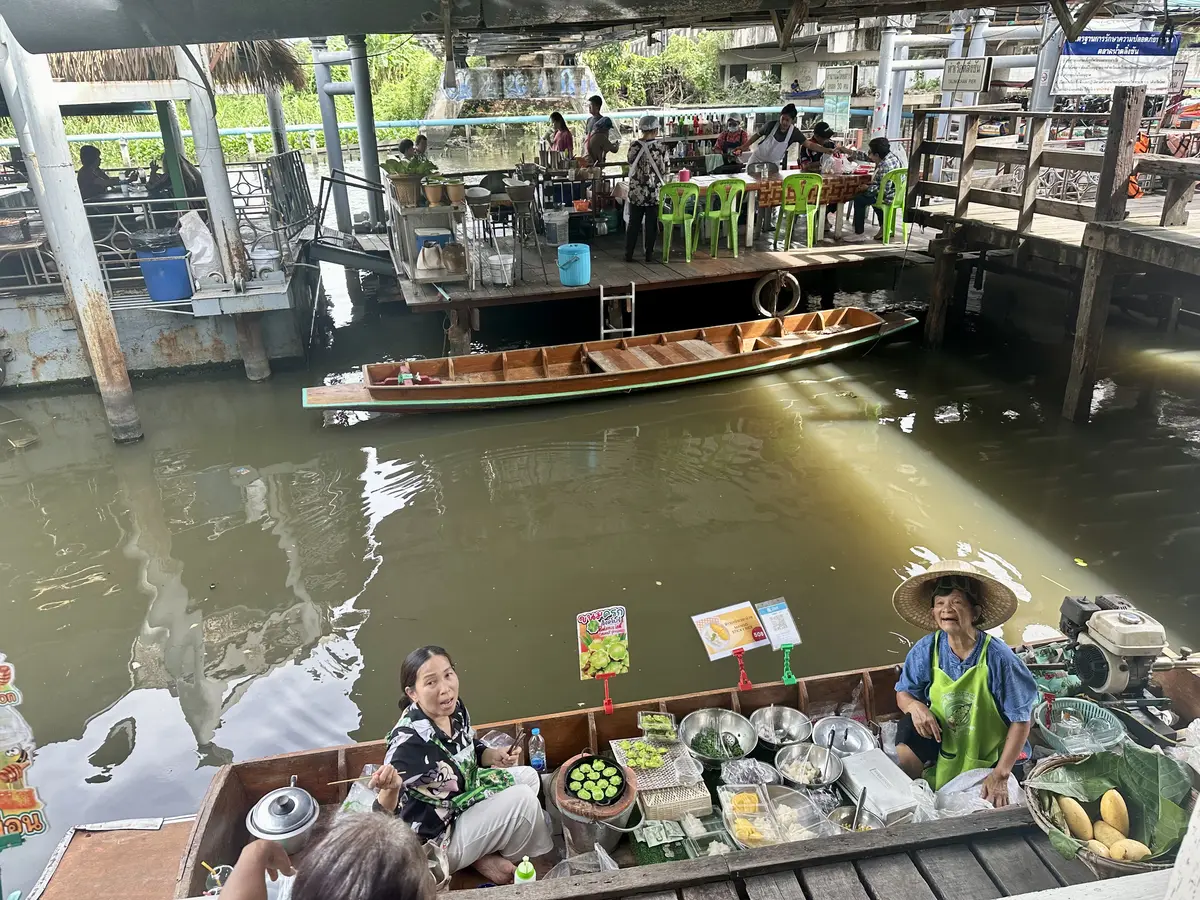
In October 2024, we flew from Bangkok Don Mueang to Chiang Rai on October 17, rented a scooter there, and flew back on October 20: we landed at Don Mueang in the late morning and were having lunch on a canal in Thonburi by 12:40.
In February 2025, I crossed the whole Andaman cluster by boat in five days: ferry from Phuket to Koh Phi Phi, speedboat to Koh Lanta, car ferry to the mainland, longtail from Ao Nang to Railay, and a speedboat back to Phuket. The detail of each crossing is in my guide on how to get to Koh Phi Phi.
In March 2026, I stayed in Patong and joined a boat tour of Phang Nga Bay, booked from a street agency. Across all these trips, one constant: in Phuket, where I have stayed three times, and in Bangkok, Grab was our default for everything on land.
Domestic Flights in Thailand
For any distance over 500 kilometres, flying is the obvious choice. A domestic flight costs little more than a long bus ride booked at the last minute, and it turns a day of travel into a morning.
Bangkok has two airports: choose the right one
Suvarnabhumi (BKK) handles most international flights and the full-service domestic ones, with Thai Airways and Bangkok Airways. Don Mueang (DMK), the old airport in the north of the city, is the hub of the low-cost airlines such as Thai AirAsia, Nok Air and Thai Lion Air. Check which one your ticket uses: the two are about an hour apart by road, and a connection between them needs a big margin.
Our flights to Chiang Rai left from Don Mueang. On October 17, 2024, we went through security at 9:26, and were waiting at the gate an hour later; the airport is busy, so give yourself time.


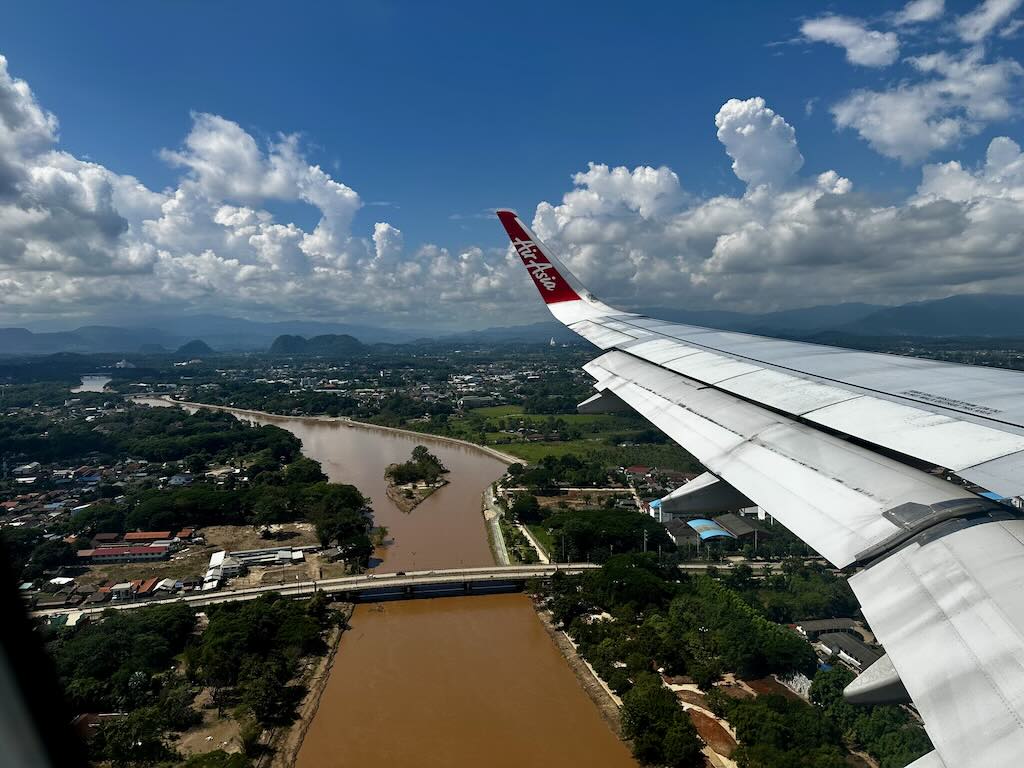
The flight takes about 1 h 20. On the descent into Chiang Rai, a few weeks after the September 2024 floods, the Kok River was still brown and swollen below the wing.
Flying to the islands
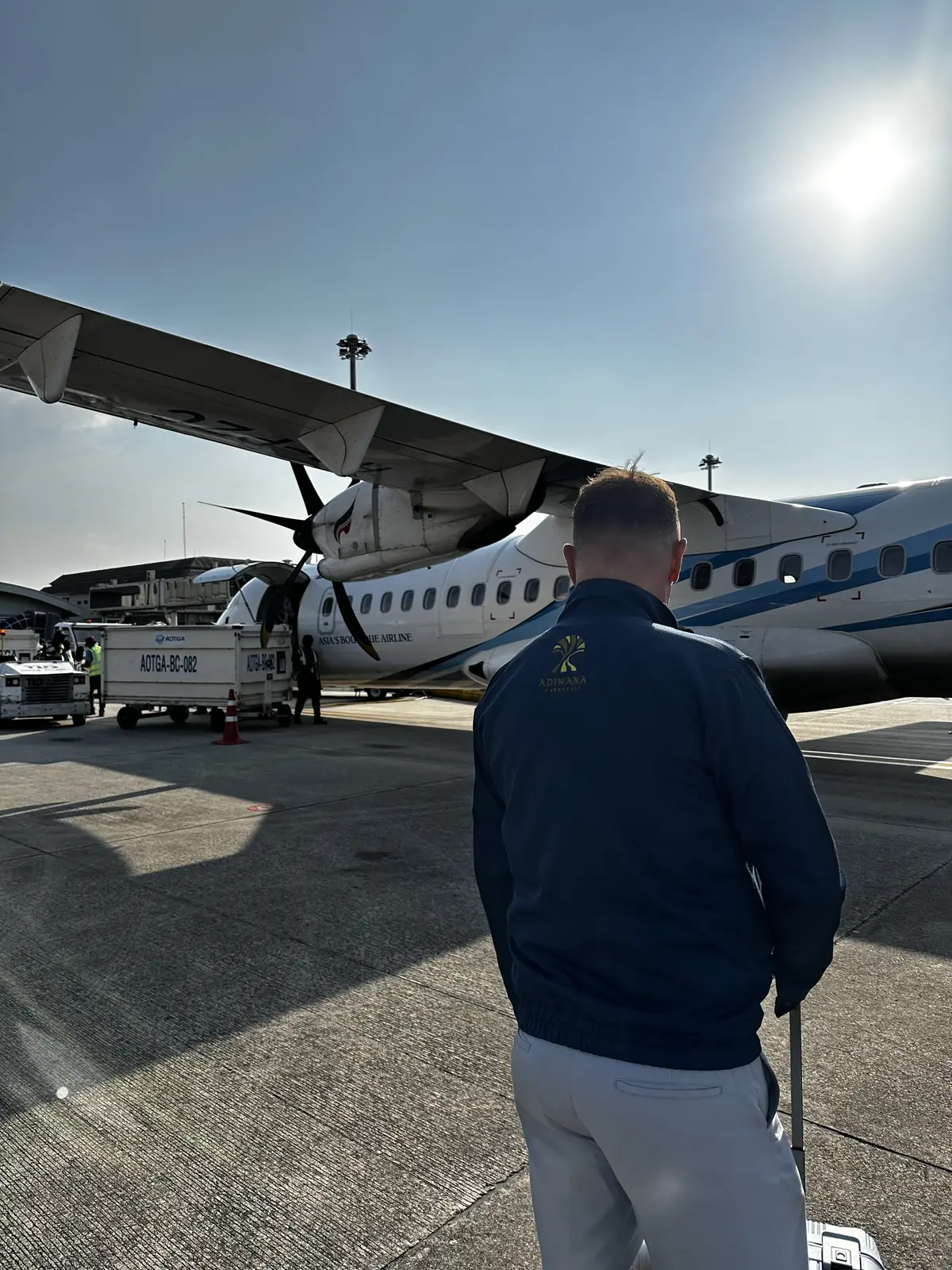
Phuket, Krabi and Koh Samui all have airports. Koh Samui is the exception to keep in mind: its small airport is owned by Bangkok Airways, which operates most of the flights, so tickets are often more expensive than to Phuket or Krabi. On February 3, 2024, we flew Phuket to Koh Samui with Bangkok Airways: an hour instead of a full day by van and ferry across the peninsula. The route is on 12Go.
Booking tips
- Book low-cost flights a few weeks ahead: prices rise sharply on the last days.
- Hold luggage is often not included with the low-cost airlines; add it when you book, it costs much more at the airport.
- From Bangkok, the most useful routes are to Chiang Rai, Phuket, Krabi and Koh Samui. For Cambodia, there are direct flights to Siem Reap, the way we went in 2022.
Ferries, Speedboats and Longtail Boats Between the Islands
Thailand has two island coasts, and they are not connected by sea: the Andaman Sea on the west side, and the Gulf of Thailand on the east side. To go from one to the other, you fly, or you cross the peninsula by van and take a ferry on the other side.
The Andaman coast: Phuket, Koh Phi Phi, Koh Lanta and Krabi
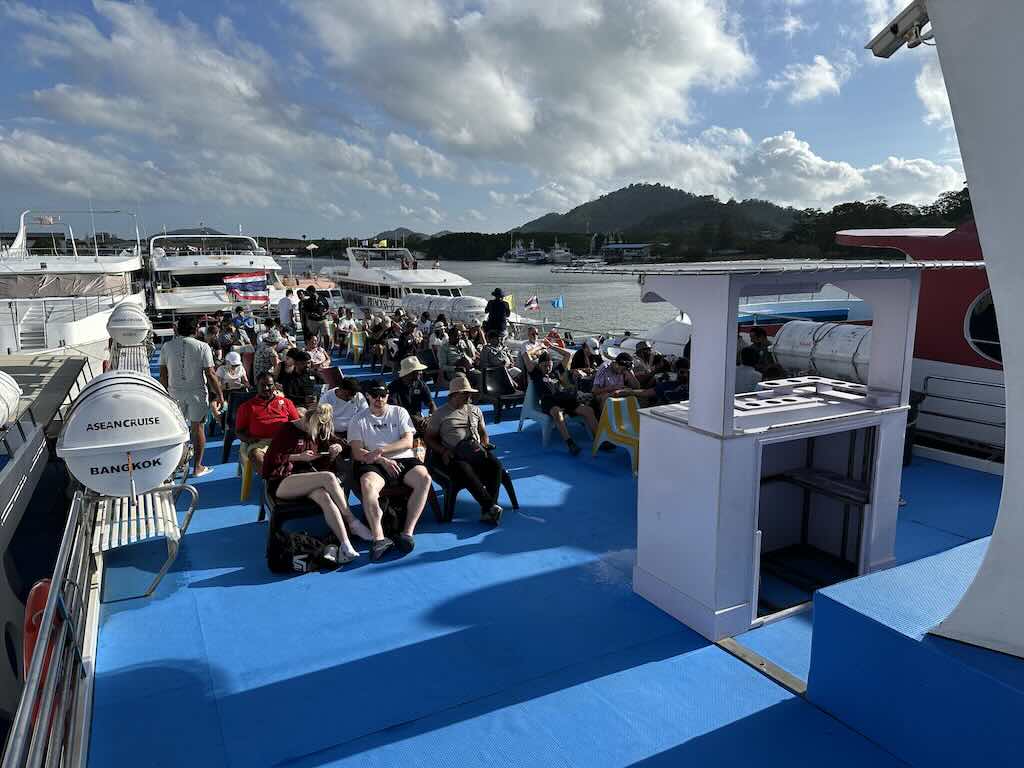
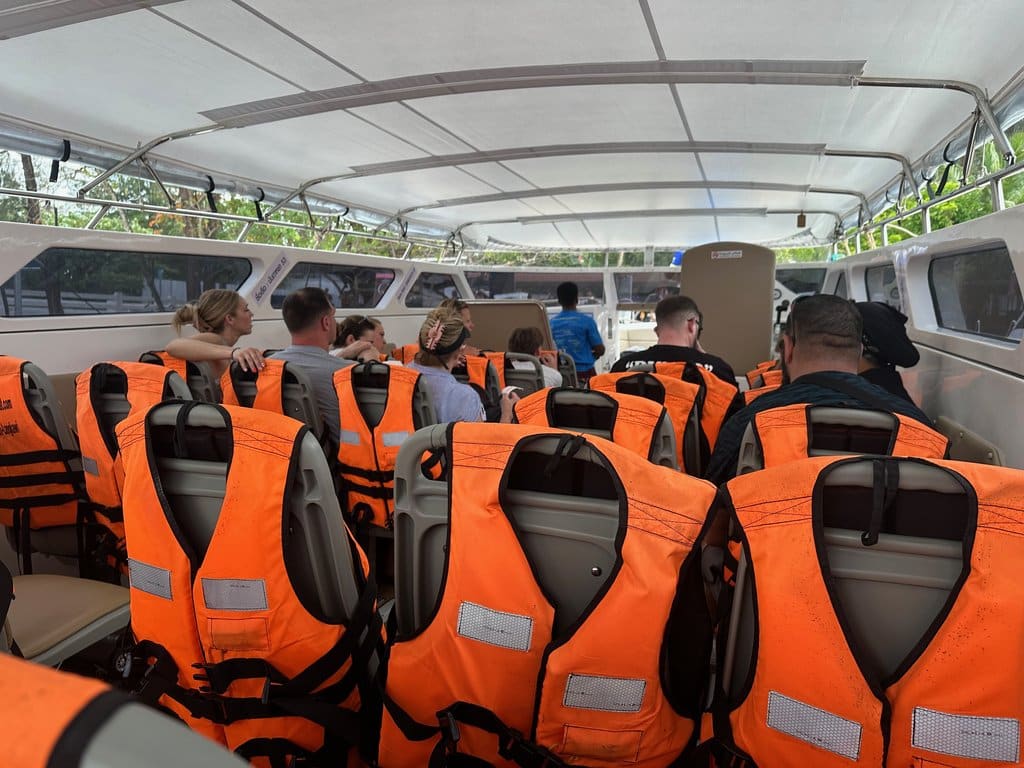
On February 23, 2025, I took the morning ferry from Phuket to Koh Phi Phi. It takes about two hours, and the open upper deck is where you want to be for the approach through the limestone cliffs. The next afternoon, the speedboat from Phi Phi to Koh Lanta took about half an hour. Both routes are on 12Go: Phuket to Koh Phi Phi and Koh Phi Phi to Koh Lanta.
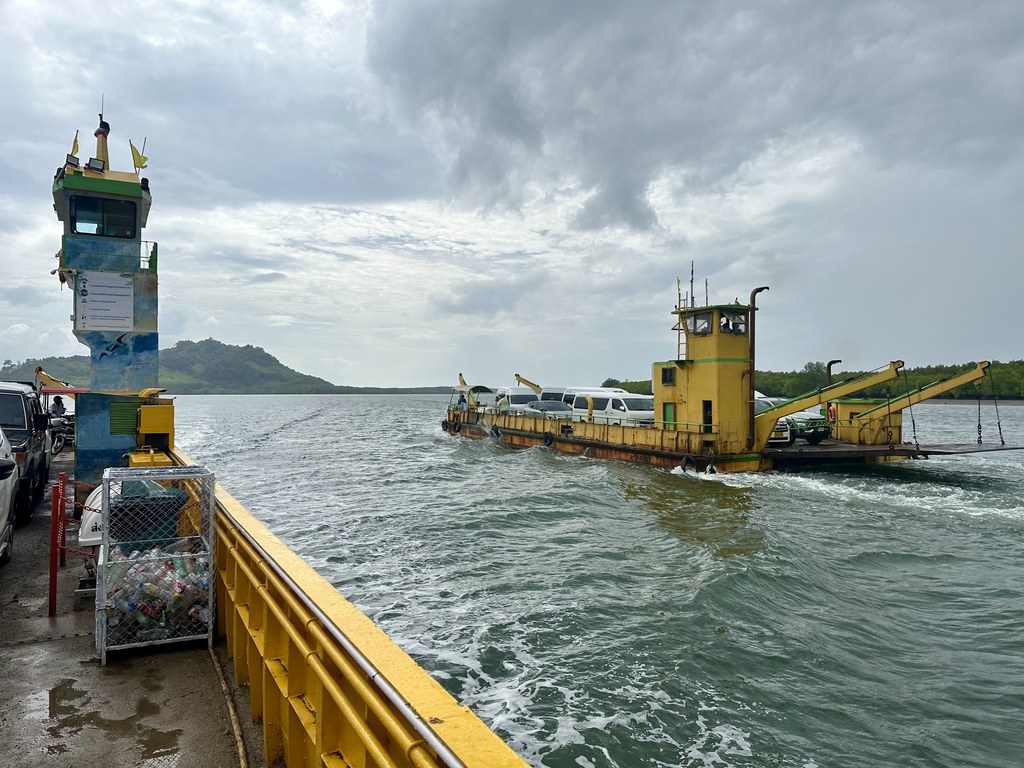
Koh Lanta is the only island of the group connected to the road network: a flat car ferry links Koh Lanta Noi to the mainland in a few minutes. I took the 3 pm crossing on February 25, which is also how the vans to Krabi and the airports travel.
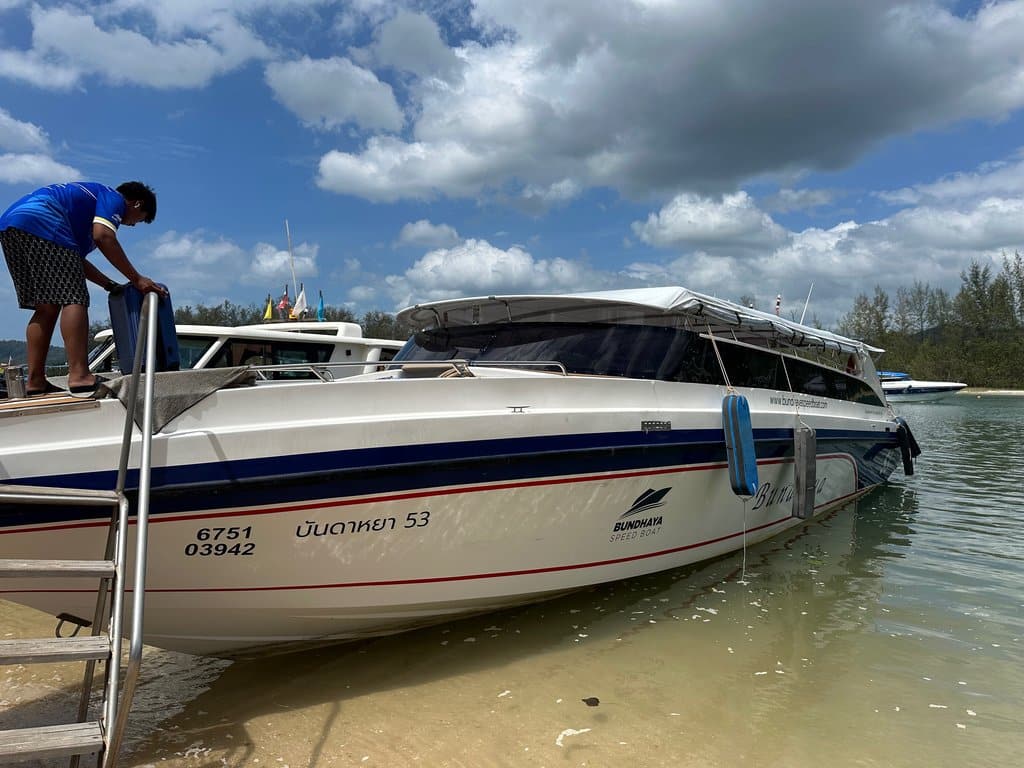
The last crossing, on February 27, was a speedboat from Nopparat Thara, next to Ao Nang, back to Phuket. There was no real pier: the boat was run up onto the sand and we walked aboard across the beach. Three big outboard engines make the crossing short, but the luggage travels uncovered on the back bench, so keep anything fragile on your knees. The route is on 12Go.
The Gulf of Thailand: Koh Samui and Koh Phangan
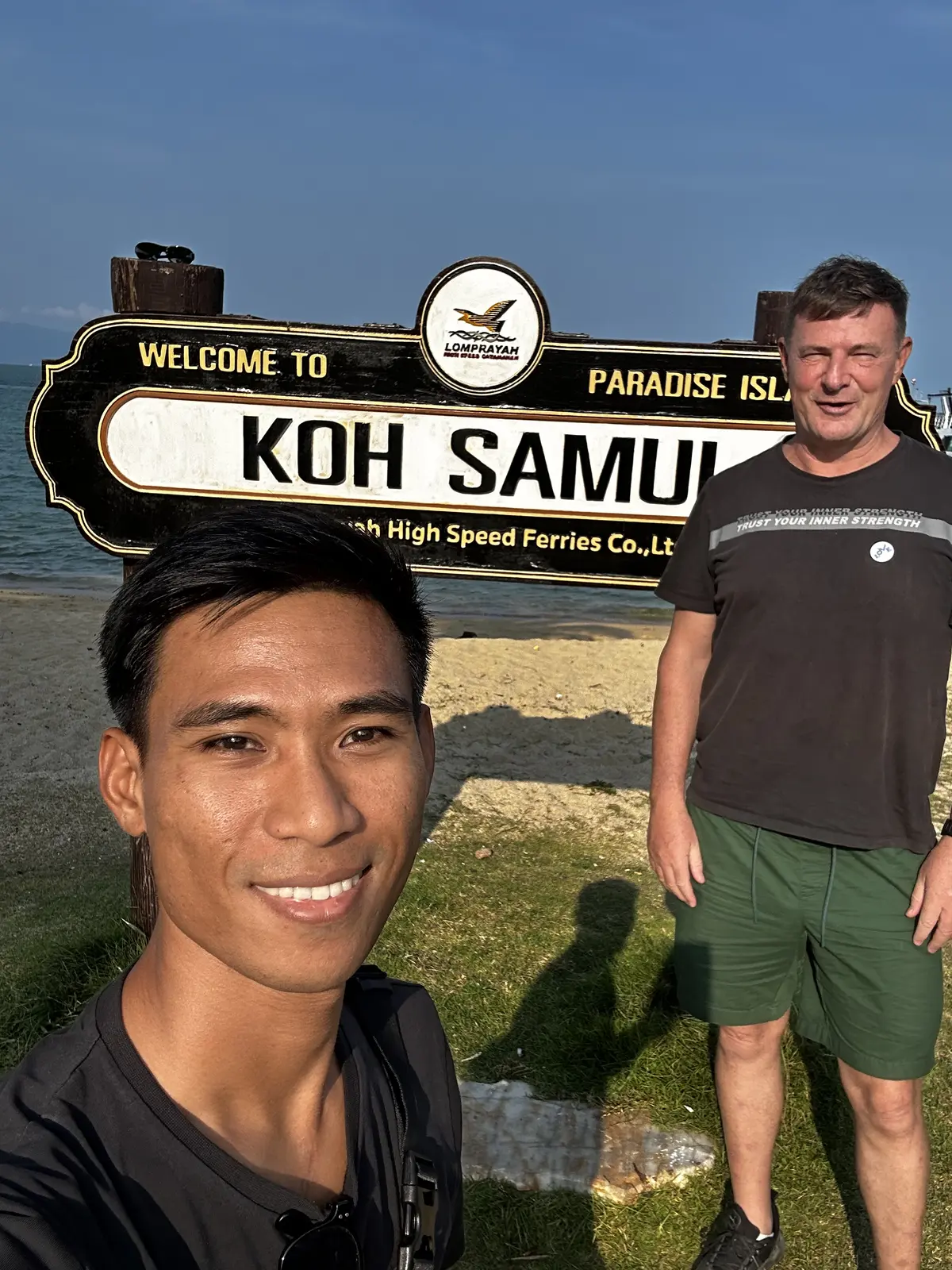
On the Gulf side, the main operators are Lomprayah, Seatran and the Raja car ferries. On February 7, 2024, we took the Lomprayah high-speed ferry at 4:30 pm from the pier of Mae Nam, on the north coast of Koh Samui; the crossing to Koh Phangan is short, and the boats continue to Koh Tao. Times and fares for Koh Samui to Koh Phangan and the return crossing are on 12Go.
Longtail boats: the taxis of the coast
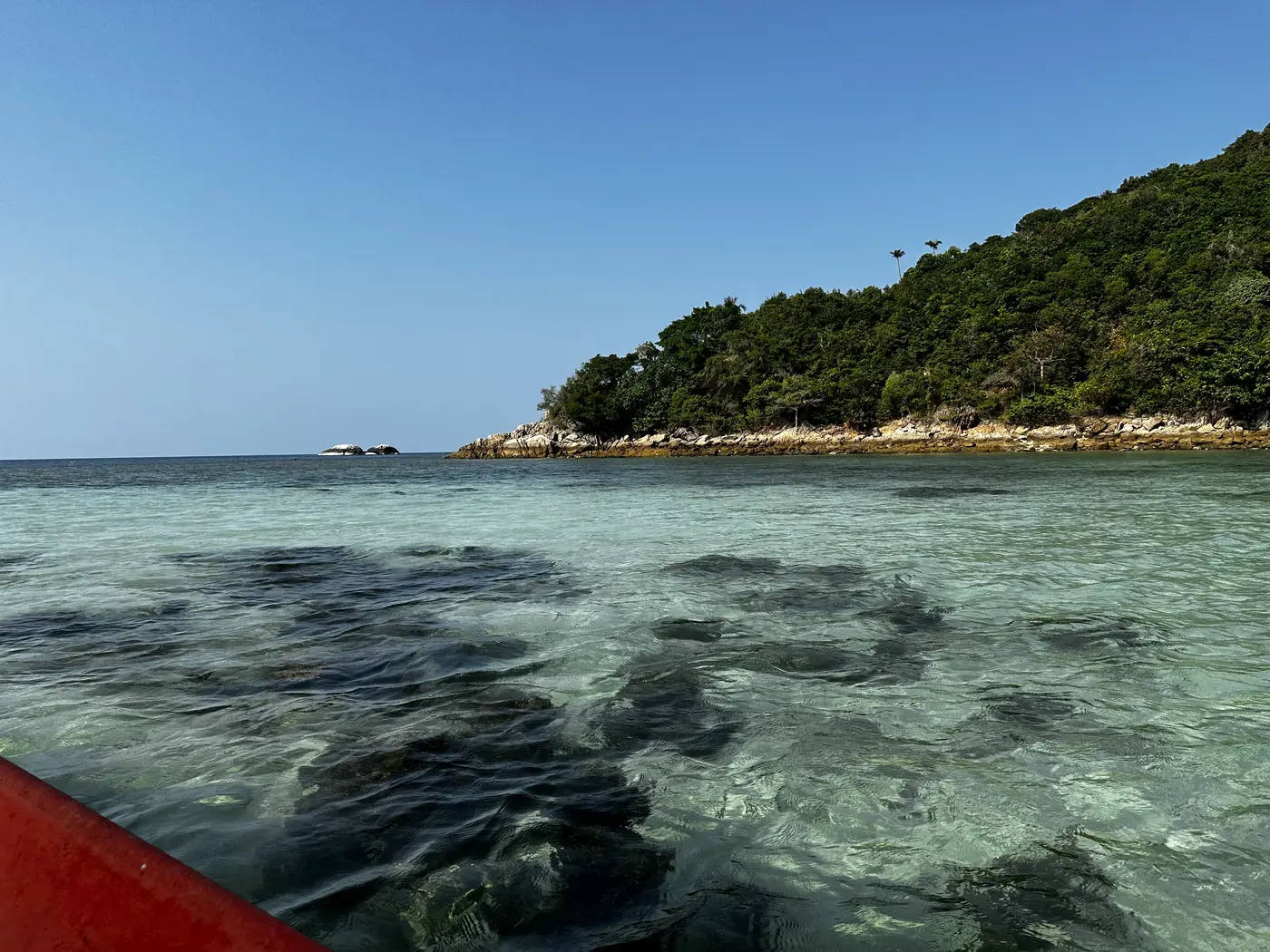
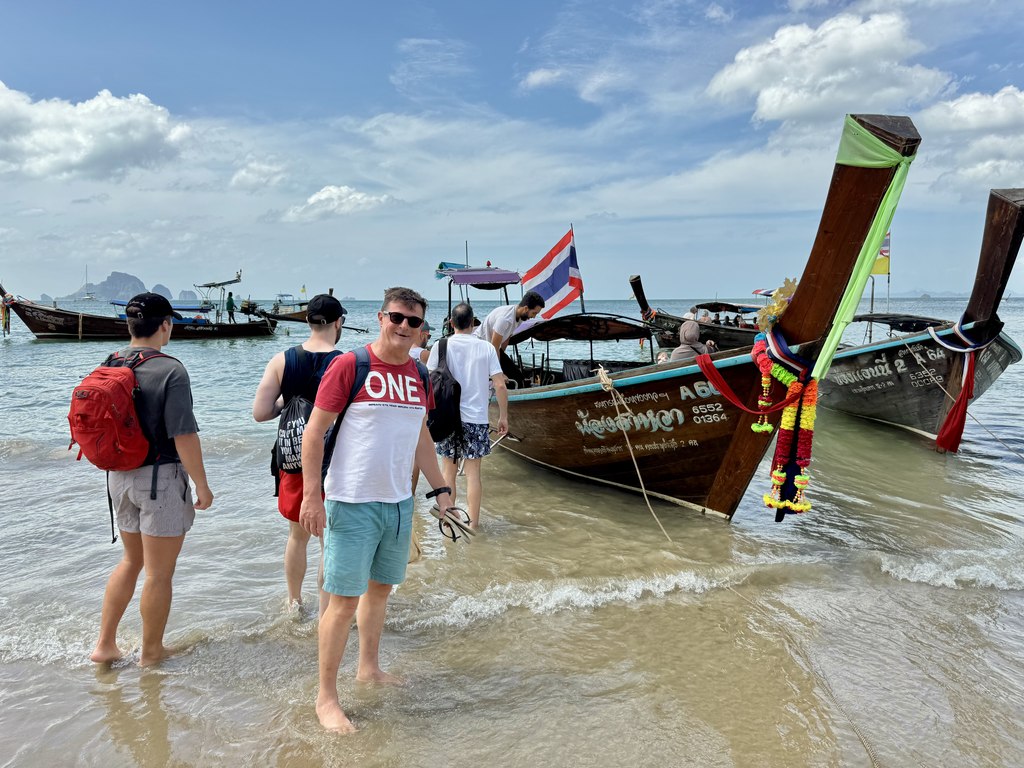
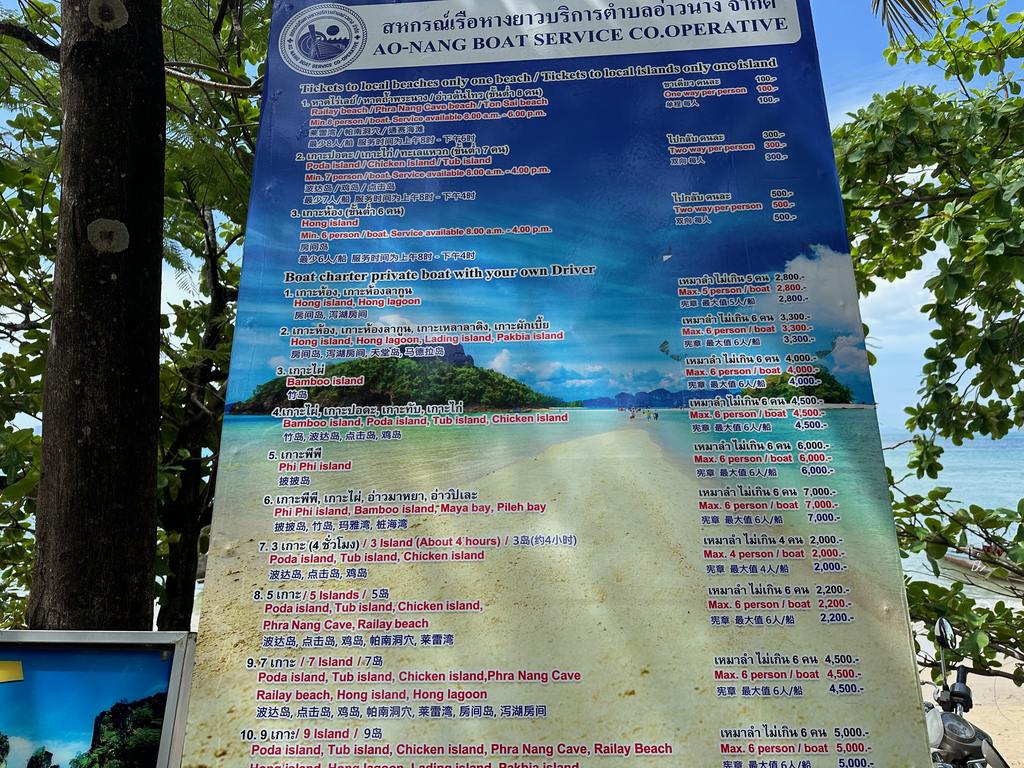
For short hops, the longtail boat is the local taxi: a wooden hull, a car engine on a long shaft, and a boatman at the back. On February 8, 2024, we took one from Chaloklum, on the north coast of Koh Phangan, to Bottle Beach, which has no real road. On February 26, 2025, a longtail took me from Ao Nang to Railay Beach, which is cut off from the mainland by cliffs. In Ao Nang, prices are fixed by the boat cooperative and displayed on a board at the ticket booth, which spares you the haggling.
What I learned on the boats
- Pay attention to the pier: on the same island, boats can leave from two or three different piers, sometimes far apart.
- Bring cash: many boats, piers and park fees are cash only. On Koh Phi Phi, the national park fee for Phi Phi Leh is separate from the boat ticket.
- Wear shoes you can take off: on beach boarding, you step into the water.
- Keep a dry bag for your phone and passport, especially on speedboats and longtails.
- From May to October, the southwest monsoon makes the Andaman Sea rougher and some routes are reduced or cancelled. The Gulf side follows a different calendar, with its rainiest months from October to December.
Getting Around Bangkok
In Bangkok, we used Grab almost everywhere: it is cheap, the price is fixed in advance, and you avoid discussing the fare with taxi drivers. I took the MRT metro once. For longer distances across the centre, the BTS Skytrain and the MRT are faster than any car at rush hour, when the traffic can be paralysing.
- From Suvarnabhumi: the Airport Rail Link runs to Phaya Thai, where you change for the BTS.
- From Don Mueang: the SRT Red Line runs to Krung Thep Aphiwat central station, connected to the MRT; Grab is simpler with luggage.
- On the river: the Chao Phraya Express boats serve the old town, the Grand Palace and the riverside hotels, and small ferries cross to Wat Arun in a few minutes.
- On the canals: on the Thonburi side, longtail boats and the floating markets are part of the visit itself.
For the rest of the city, see my Bangkok travel guide.
Grab, Taxis and Tuk-Tuks
Grab is the Southeast Asian equivalent of Uber, and it works in Bangkok, Phuket, Chiang Rai, Koh Samui and the other big tourist areas. In Phuket, where the taxis have a reputation for high fixed prices, we used it for almost every journey, including between the beaches. Bolt is also available in Bangkok and Phuket, and is sometimes cheaper.
Tuk-tuks are the iconic way to travel a short distance in Thailand. Agree on the price before you get in, and be wary of drivers who offer a very cheap tour: it usually ends in a gem or tailor shop. On Koh Lanta and in smaller places, the tuk-tuk is often a motorbike with a sidecar. Songthaews, pick-up trucks with two benches in the back, run fixed routes on the islands and in many towns.

Renting a Scooter in Thailand
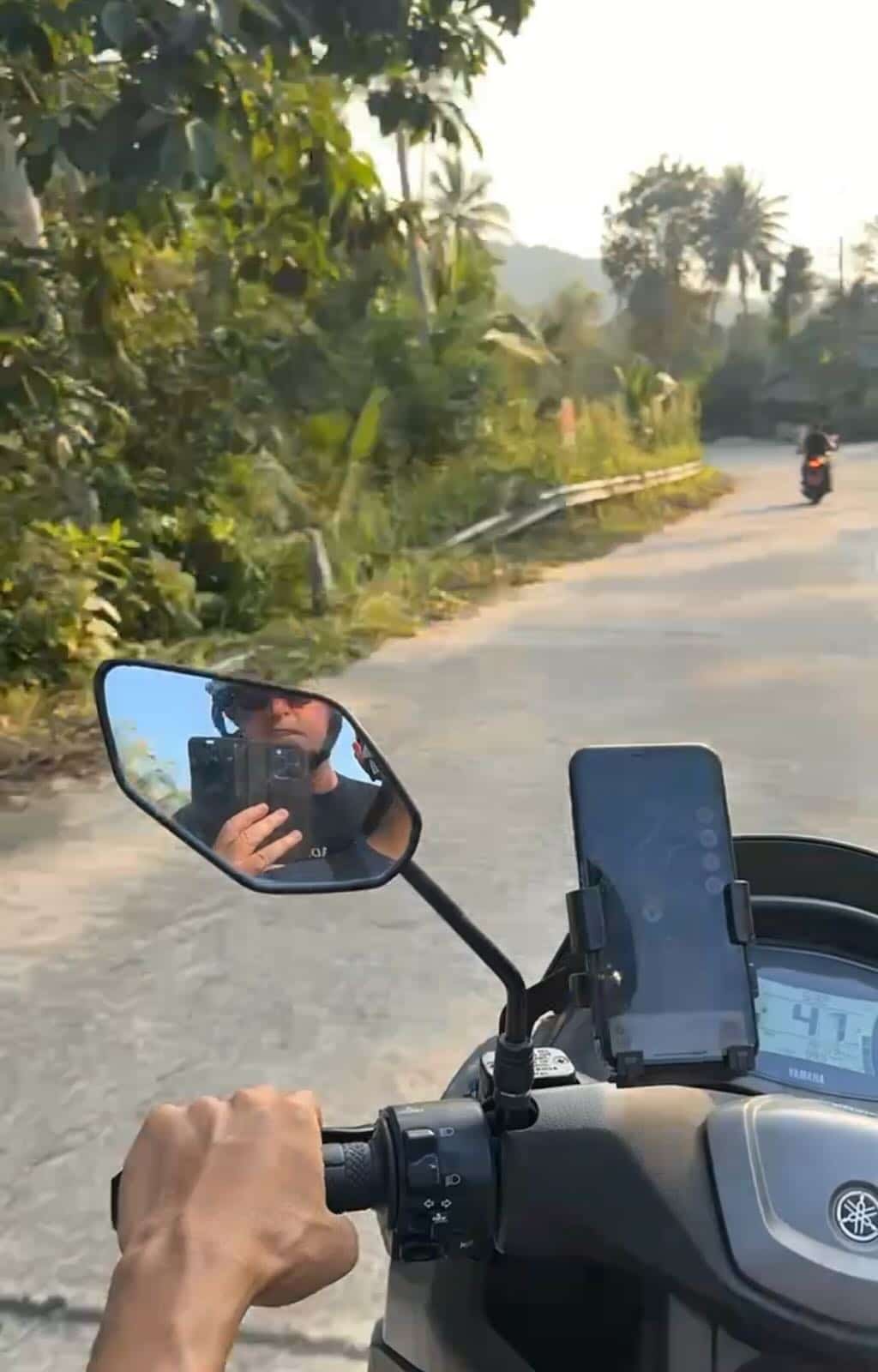
On the islands and in the north, a scooter gives you total freedom: deserted beaches, viewpoints and temples outside town. We rented one on Koh Phangan in February 2024, and in Chiang Rai in October 2024. Rentals cost a few hundred baht per day, and the shop usually keeps a deposit.
- Licence: legally, you need a motorcycle licence, with an International Driving Permit that covers motorcycles. Police checkpoints fine riders without one, and many travel insurance policies refuse to cover an accident if you were not licensed.
- Helmet: compulsory, for the driver and the passenger.
- Before you leave: photograph the scooter from every side, so you are not charged for scratches that were already there.
- Experience: the hills of Koh Phangan and Koh Samui are steep, and the roads can be sandy or wet. If you have never ridden, Thailand is not the place to learn.
Trains and Long-Distance Buses
I have never taken a train or a long-distance bus in Thailand: on our trips, flights were faster and often barely more expensive. They are still a good option on a budget or for those who enjoy overland travel. The State Railway of Thailand runs night trains with sleeper berths from Bangkok to Chiang Mai in the north and to Surat Thani in the south, where joint tickets continue by bus and boat to Koh Samui and Koh Phangan. Long-distance buses leave from the Northern and Southern bus terminals in Bangkok, and VIP buses with reclining seats are comfortable on overnight routes. Book trains ahead in high season, as the sleeper berths sell out.
Classic Routes: How to Connect the Main Destinations
- Bangkok to Chiang Rai or Chiang Mai: fly, about 1 h 20. See Bangkok to Chiang Rai.
- Bangkok to Phuket or Krabi: fly, about 1 h 30; overland it is a full day or a night. See Bangkok to Phuket and Bangkok to Krabi.
- Bangkok to Koh Samui: fly direct, or take a joint train or bus and boat ticket via Surat Thani. See Bangkok to Koh Samui.
- Phuket to Koh Samui: fly, about one hour, or a day by van and ferry. See Phuket to Koh Samui.
- Phuket to Koh Phi Phi and Koh Lanta: ferry or speedboat. See Phuket to Koh Phi Phi and Koh Phi Phi to Koh Lanta, and my guide to Krabi, Koh Phi Phi and Koh Lanta.
- Ao Nang to Railay: longtail boat, about 15 minutes. See Ao Nang to Railay.
- Phuket to Phang Nga Bay: by boat tour from Phuket or Krabi; see my guide to Phang Nga Bay.
- Bangkok to Siem Reap: fly, about one hour, to reach Angkor. See Bangkok to Siem Reap.
Practical Tips for Travelling Around Thailand
- Leave margins: a ferry delayed by the sea or a traffic jam to the airport is common. Do not plan a boat and a flight on the same day without a buffer.
- Cash and cards: Grab and flights are paid by card, but boats, tuk-tuks, scooter rentals and park fees are often cash only.
- Hotel transfers: on the islands, hotels and ferry companies often include the pickup between the pier and your hotel; ask when you book.
- Seasons: the best months are November to April on the Andaman side, and January to August on the Gulf side.
- Elsewhere in Southeast Asia: if you continue to Indonesia, see my guide to getting around Indonesia.
Getting Around Thailand: FAQ
What is the best way to travel between the Thai islands?
By ferry or speedboat within the same coast: Phuket, Koh Phi Phi, Koh Lanta and Krabi on the Andaman side, Koh Samui, Koh Phangan and Koh Tao on the Gulf side. To go from one coast to the other, the fastest option is a flight, for example Phuket to Koh Samui.
Does Grab work in Thailand?
Yes, in Bangkok, Phuket, Chiang Mai, Chiang Rai, Koh Samui and most tourist areas. It is the simplest way to avoid negotiating with taxis, and the price is fixed before you get in.
Which Bangkok airport is used for domestic flights?
Both. Don Mueang (DMK) is the base of the low-cost airlines such as Thai AirAsia and Nok Air; Suvarnabhumi (BKK) is used by Thai Airways and Bangkok Airways. Always check the airport on your ticket.
How long is the ferry from Phuket to Koh Phi Phi?
About two hours by standard ferry, and 30 to 50 minutes by speedboat, for roughly twice the price. The ferry is cheaper and has an open deck with a great view on the approach.
Can I rent a scooter in Thailand without a licence?
Rental shops rarely ask, but riding without a valid motorcycle licence and International Driving Permit exposes you to fines at police checkpoints and can void your travel insurance after an accident.
Is it worth taking the train in Thailand?
For the experience, the night train from Bangkok to Chiang Mai is a classic. For saving time, a domestic flight is much faster and often not much more expensive.
How do I get from Phuket to Koh Samui?
By plane, in about an hour with Bangkok Airways, or overland by van to Donsak pier and then by ferry, which takes most of a day.