Hoi An, Vietnam: The City of Lanterns
By Blaise Jaeger · Updated August 28, 2026
Why Visit Hoi An?
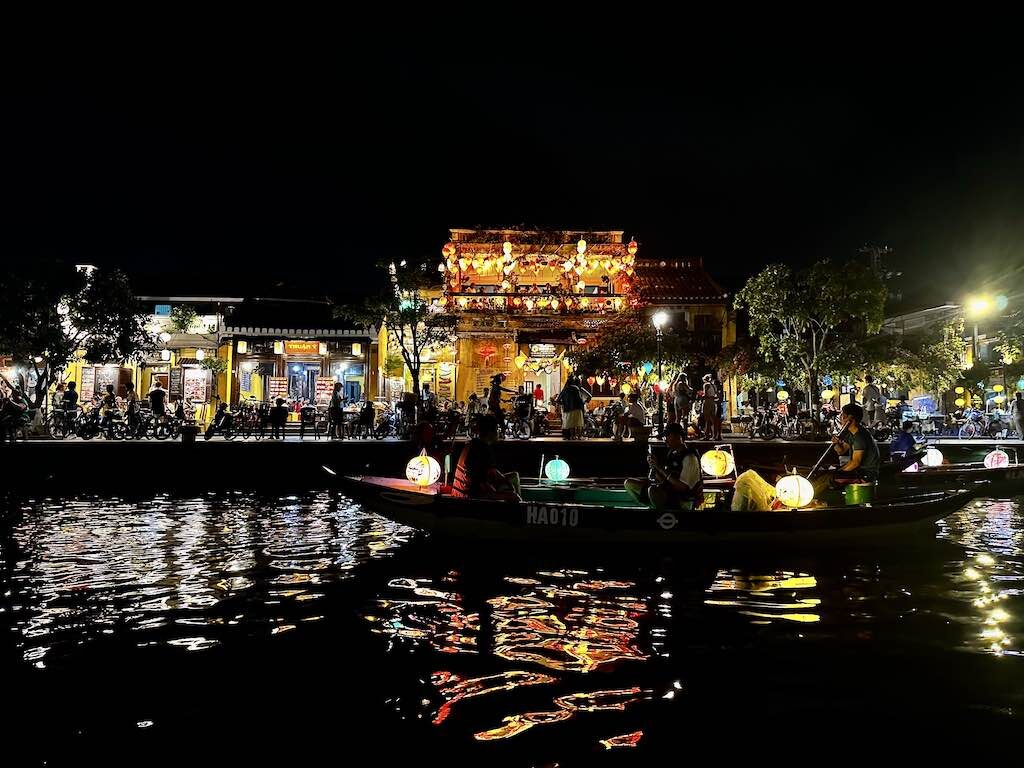
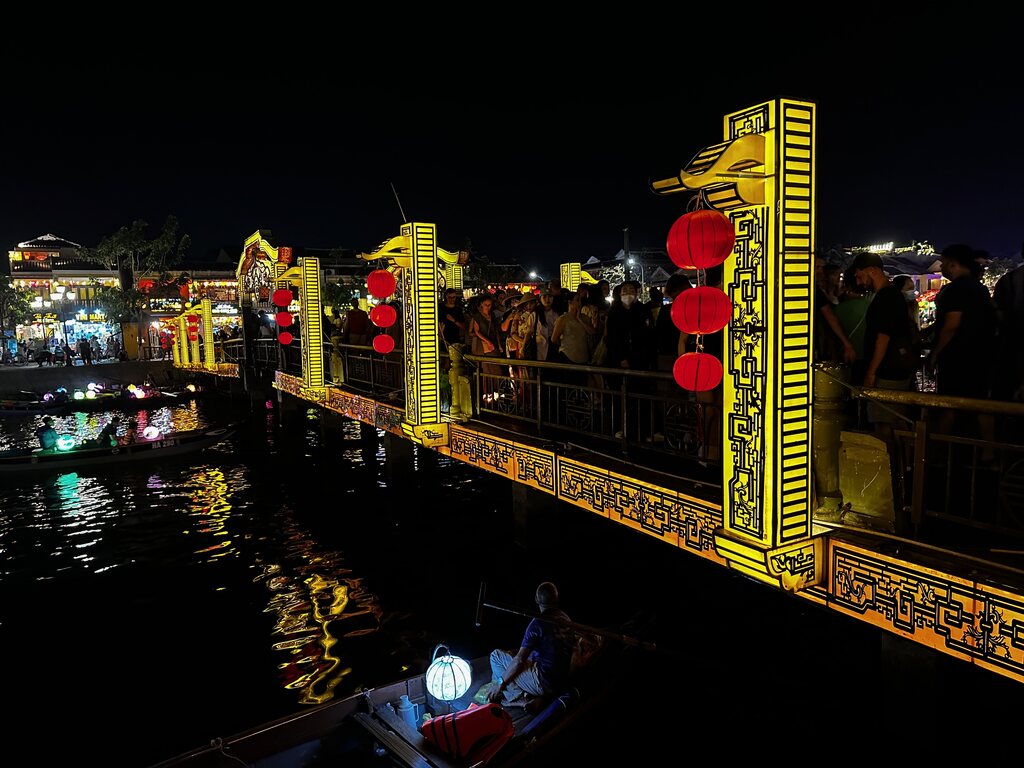
Hoi An is the one town in Vietnam where nobody is in a hurry. The old town is closed to cars, most of it is closed to motorbikes after 5:30 PM, and by the time the sun drops behind the tiled roofs the loudest sound on Bach Dang Street is a bicycle bell. Silk lanterns come on above the lanes in red, orange and magenta, wooden boats slide down the Thu Bon with a candle burning in the bow, and a town that spent four centuries trading pepper, silk and ceramics with Japan and China turns into something that looks staged and isn’t.
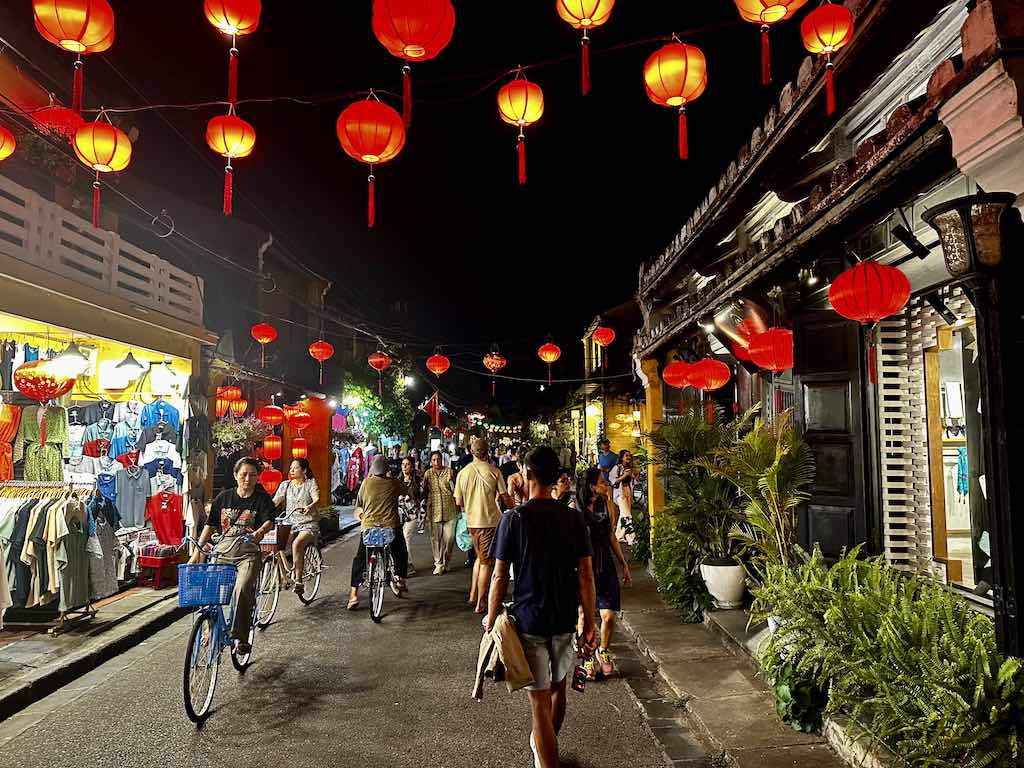
What makes it unusual is not that it is pretty. Plenty of Asian towns are pretty. It is that Hoi An is intact. When the Co Co river silted up in the 19th century and Da Nang became a French concession in 1888, the merchants left and the port died — and because it died, nobody knocked it down. Around 1,100 timber-framed buildings survived the 20th century untouched, which is why UNESCO added the ancient town to the World Heritage list in December 1999 as an exceptionally well-preserved South-East Asian trading port. Poverty was the conservation programme.
And Hoi An is small enough to walk and rich enough to keep you for days. In one morning you can eat a bowl of noodles that exists nowhere else on earth, have a jacket measured, cycle through rice paddies where people are still planting by hand, and stand in a 9th-century Hindu tower complex in the mountains. That combination — a walkable heritage core, a serious food culture, farms and beaches ten minutes out, and a Cham sanctuary an hour away — is why most people who plan two nights here end up staying four.
Hoi An at a Glance
- Where: central Vietnam, on the Thu Bon river, 30 km south of Da Nang International Airport
- Administratively: since 1 July 2025 Hoi An is part of Da Nang City — Quang Nam province no longer exists. Older guides and hotel listings still say “Hoi An, Quang Nam”
- UNESCO listed: 12 December 1999, criteria (ii) and (v) — 30 hectares of protected core, 280 hectares of buffer zone
- Famous for: silk lanterns, the Japanese Covered Bridge, cao lau noodles, tailors, the Full Moon Lantern Festival, My Son Sanctuary nearby
- Old Town ticket: 120,000 VND (~$4.60 / €4) — see the section below, the rules changed in February 2026
- Best time to visit: February to May. April is the driest month of the year
- Worst time: October and November — 419 mm and 459 mm of rain, and the old town floods most years
- Busiest hours: 6 PM to 9 PM on the riverfront. Quietest: before 8 AM, anywhere
- Getting around: on foot in the old town, by bicycle everywhere else — most hotels lend bikes free
- Typical lunch: 30,000–70,000 VND ($1.15–2.70) at a local place, 150,000–300,000 VND in a restored merchant house
- Currency: Vietnamese dong. Roughly 26,000 VND to the dollar, 30,000 to the euro in August 2026
My Two Nights in Hoi An, and Why It Became My Favourite City in Vietnam
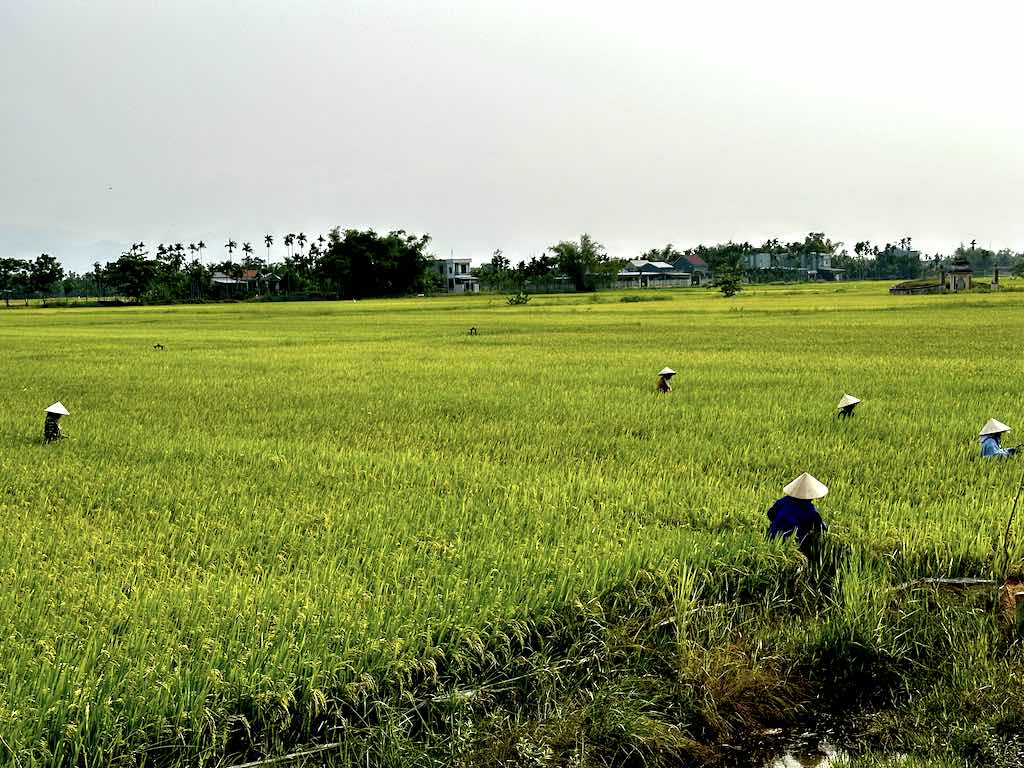
I came to Hoi An in April 2024, in the middle of a south-to-north trip through Vietnam. I flew from Ho Chi Minh City to Da Nang and spent five nights in the region, 6 to 11 April, of which two were in Hoi An — the 9th and the 10th — before flying on to Hanoi. I stayed at the Grand Sunrise Palace Hoi An, and I rented a motorbike, which turned out to be the easiest way to reach everything worth seeing around the town. Of every city I saw on that trip, Hoi An is the one I would go back to first. The old town is charming, it is calm, it sits on the river, and there is a great deal to see around it — that combination doesn’t exist anywhere else in the country.
The thing I remember most is also the most touristy thing you can possibly do here, and I am not going to pretend otherwise. You pay a boatwoman to row you twenty minutes down the Thu Bon, you buy a small paper lotus with a candle in it, you make a wish and you set it on the water. It is a cliché. It is also genuinely moving to watch your own small light drift off among the boats, and I would do it again. Do it late — after 9 PM, when the tour groups have gone and the river empties out.
A Short History of Hoi An: From Cham Port to UNESCO Town
Lam Ap Pho: the Cham trading port
People have been trading here for a very long time. Archaeologists have logged more than fifty Sa Huynh culture sites around Hoi An, and among the finds are Han dynasty coins and Western Han iron tools — evidence of commerce going back to the first century BC. From the 7th to the 10th century the Cham kingdom controlled this stretch of coast and ran it as a three-part system: My Son was the spiritual centre, Tra Kieu (Simhapura) the political capital, and the river mouth here — Lam Ap Pho — the commercial port. In 1471 the Vietnamese emperor Le Thanh Tong annexed Champa, and the town passed into Vietnamese hands.
Faifo: the golden age, 1570 to 1775
Westerners called the port Faifo, probably a corruption of Hoi An Pho — Alexandre de Rhodes’s 1651 dictionary defines “Hoai Pho” as a Japanese settlement in Cochinchina, “also called Faifo”. From 1570 the Nguyen lords ruled the south and, unlike their Trinh rivals in the north, bet everything on trade. Faifo became the busiest international port in South-East Asia.
The Japanese arrived first and in numbers: between 1604 and 1635, at least 356 Japanese merchant ships sailed for South-East Asia and 75 of them docked at Hoi An. By 1617 there was a constituted Japanese quarter, and a Dutch account from 1651 describes some sixty Japanese stone houses packed along the river — built in stone specifically as fire protection. Then Tokugawa Japan closed itself off, the Japanese merchants stopped coming, and Chinese traders took over. After the collapse of the Ming dynasty, waves of Chinese immigrants settled here, most of them from Fujian; by the 18th century they ran the port, which is why the town’s most spectacular buildings are Chinese assembly halls. Ten to twelve ships a year came in from Japan, Guangdong, Siam, Cambodia, Manila and Indonesia.
The decline that saved the town
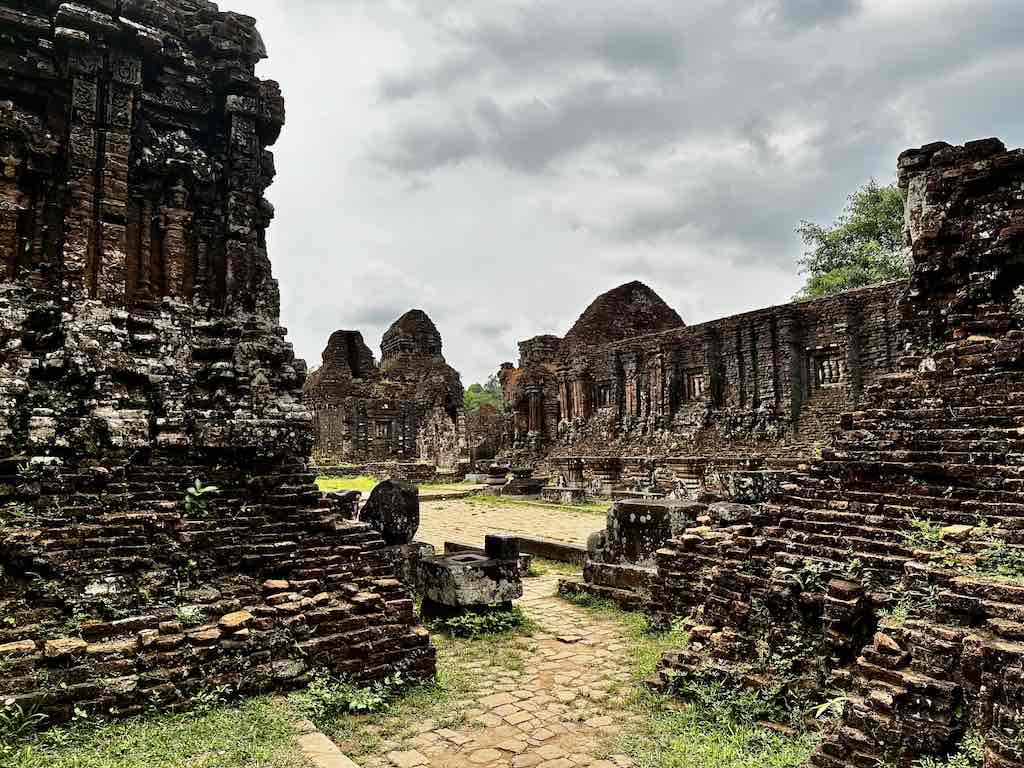
Three things killed Faifo. In 1775 the Trinh army, moving against the Tay Son rebellion, destroyed most of the merchant quarter and spared only the religious buildings; a visitor in 1778 found the brick houses gone and the paved roads deserted. Then the geography turned: the Dai estuary narrowed and the Co Co river silted up, so large ships could no longer reach the town. (You will read everywhere that “the Thu Bon silted up” — that is a simplification.) Finally, in 1888 Da Nang became a French concession, the Chinese merchants moved there, and Hoi An stopped mattering commercially. In 1976 Da Nang was made provincial capital and Hoi An was forgotten altogether — which is precisely why it still stands. In the 1990s a Polish architect, Kazimierz Kwiatkowski, led the conservation campaign that brought it back to the world’s attention. There is a street and a memorial named after him.
The Old Town: What to See, and How the Ticket Actually Works
The entrance ticket, explained (it changed in February 2026)
Almost every English-language guide is out of date on this. On 21 February 2026 a new Da Nang People’s Council resolution came into force setting the heritage fees, and it states explicitly that the rates apply identically to Vietnamese and foreign visitors. The two-tier pricing is officially gone.
In practice the booths sell two packages. The 80,000 VND ticket (~$3.10) covers the general old town plus one monument — either the Japanese Covered Bridge or Quan Cong Temple — plus two heritage buildings of your choice. The 120,000 VND ticket (~$4.60) covers the old town, one monument, museum access and three heritage buildings. Both are booklets of detachable coupons, and the practical version is: about five sites chosen from roughly twenty. Children under 16, students and anyone over 60 go free. Buy eight tickets or more and a free guide comes with them.
Two honest caveats. First, you do not need a ticket to walk the streets — an attempt in May 2023 to make it compulsory to enter the old town collapsed on day one and was never applied to independent travellers. You need it to go inside any of the heritage buildings, and there you will be asked for it. Second, official validity is quoted as anything from 24 hours to three days depending on the source; in reality nobody checks the date on an unused coupon. There are eleven to thirteen ticket booths at the entrances to the old town, open roughly 7:30 AM to 9 PM.
The Japanese Covered Bridge (Chua Cau)
Ten metres of covered wooden bridge with a small temple built into its northern side, dating from the early 17th century — the restoration file calls it 400 years old, so about 1624. It is on the 20,000 VND banknote and it is the single most photographed object in Vietnam.
If you were here between December 2022 and July 2024 you saw scaffolding. The major restoration ran from 28 December 2022 to the end of July 2024, and the bridge reopened on 3 August 2024 — so it has been fully visitable for two years. Nearly 60% of the original timber, 30% of the tiles and 80% of the old plaques were kept and put back, and the decision was taken not to repaint it. It was criticised on reopening for looking too new. Go early: at 7 AM you can photograph it empty, and by 10 AM you cannot.
The merchant houses: Tan Ky, Phung Hung, Duc An
Tan Ky Old House, 101 Nguyen Thai Hoc, open 8 AM–5:30 PM, is the one to pick if you only see one. Around 280 years old and still lived in by the seventh and eighth generation of the Le family, its frame is assembled without a single nail and its architecture is a straight fusion of Japanese, Chinese and Vietnamese carpentry. Look for the flood marks carved into the wall — the highest is 1964, when the water reached the ground-floor ceiling.
Phung Hung Old House, 4 Nguyen Thi Minh Khai, right across the Japanese Bridge, was built in 1780 and stands on about eighty ironwood columns. The eighth generation of the family still lives here. The detail nobody points out: there is a hatch in the ceiling so the furniture could be hauled upstairs when the river came in. That is flood architecture, working.
Duc An Old House, 129 Tran Phu, built in 1830, is the most interesting historically and the least visited. It was a bookshop specialising in Han-Nom literature, frequented by the patriotic scholars of the day including Phan Chu Trinh, and in 1927 the Hoi An branch of the Revolutionary Youth League was founded inside it — a step on the road to the Vietnamese Communist Party.
The Chinese assembly halls
There are five, and the ticket covers three of them. The Fujian Assembly Hall (Hoi quan Phuc Kien), 46 Tran Phu, founded in the 1690s and rebuilt in brick from 1757, is the largest and the most theatrical — a ceramic triple gate, and inside, Thien Hau, the sea goddess who protected sailors. The Cantonese Assembly Hall, 176 Tran Phu (1885) was manufactured in China, shipped over in pieces and assembled here; it was rededicated to Quan Cong in 1911. The Chaozhou Assembly Hall, 157 Nguyen Duy Hieu (1845) has the finest carved woodwork in town and almost no queue. Worth knowing: the Chinese All-Community Hall on Tran Phu is free, and the Hainan hall on Nguyen Duy Hieu commemorates 108 Hainanese merchants wrongly executed in 1851.
Quan Cong Temple and the museums
Quan Cong Temple, 24 Tran Phu (1653), open 6 AM–5 PM, is dedicated to the Three Kingdoms general Guan Yu, worshipped as the god of loyalty and good faith — which is to say, the merchants’ god. It is the alternative to the Japanese Bridge on the 80,000 VND ticket. The Museum of Trading Ceramics, 80 Tran Phu, sits in a beautifully restored 19th-century timber house and holds ceramics traded along the maritime routes from the 9th to the 19th century; it is closed on the 15th of each month.
And the one almost nobody tells you about: the Precious Heritage Museum at 26 Phan Boi Chau, 8 AM–8 PM, is completely free and outside the old town ticket system. It holds French photographer Réhahn’s portrait project documenting all 54 of Vietnam’s ethnic groups, with more than sixty traditional costumes, across 500 square metres of a 19th-century French building. It was the first museum in Vietnam listed on Google Arts & Culture.
Lanterns, Boats and the Full Moon Festival

The lantern boat ride: what it costs and how not to get fleeced
Prices are set by the municipality and posted, and they are per boat, not per person: 170,000 VND for one to three people, 220,000 VND for four to five. Maximum five per boat; toddlers travel free and don’t count. The ride lasts fifteen to twenty minutes, and boats run from 4 PM to 9:30 PM.
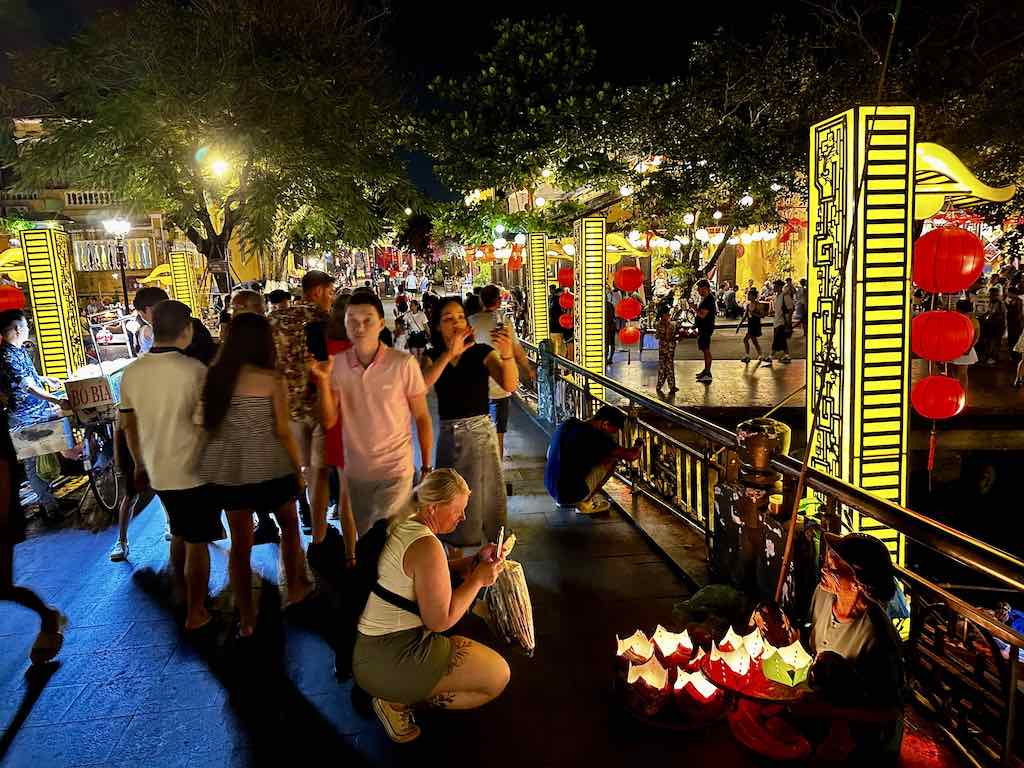
Buy only at the five official waterfront booths — three on Bach Dang, two near the night market and the An Hoi bridge. Tickets are colour-coded: yellow for one to three, red for four to five. Cash in dong; cards are not accepted. If someone approaches you on the street with a better price, walk on. The paper lotus lanterns are sold separately by vendors along the bank for 5,000 to 10,000 VND each — buy them from the older women who make them rather than from the kids who tout them. One thing worth saying out loud: thousands of candle lanterns a night is a real pollution problem for the Hoai, and the town knows it. One lantern is a nice thing to do. A dozen is not.
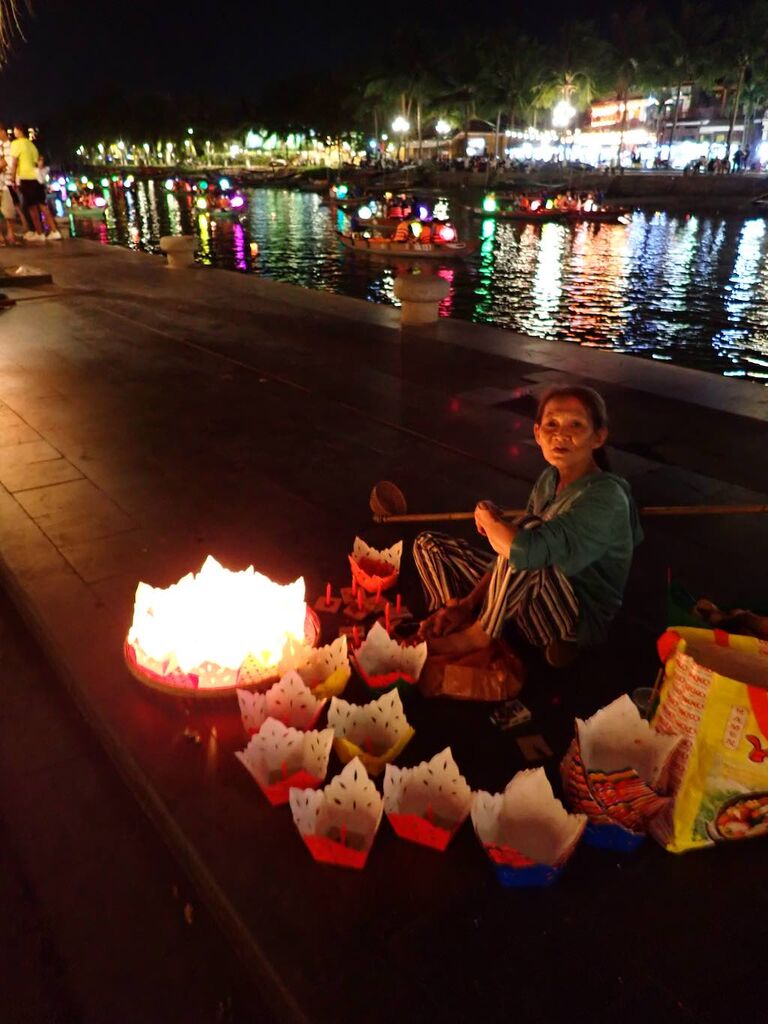
If you would rather have it organised, with the boat and the lantern arranged for you, you can book a night boat trip with a floating lantern in advance.
The Full Moon Lantern Festival
It happens on the 14th day of every lunar month — the eve of the full moon, not the full moon itself, which is what most blogs get wrong. That means twelve or thirteen times a year, not once. And yes, the electricity really is switched off: from about 6 PM to 10 PM the old town’s electric lighting goes dark and the lanterns are the only significant light there is. Motorbikes are banned from the core from 5:30 PM, and the floating-lantern release peaks between 7 and 9 PM along the Hoai riverbank between the An Hoi bridge and the Cam Nam bridge.
The remaining 2026 dates are 24 September (the eve of Mid-Autumn Festival — the most festive of the year), 23 October, 22 November and 22 December. In 2027 the first is 21 January, followed by 19 February (the first of the lunar year, and the biggest). Later 2027 dates are not yet officially published — check locally before building a trip around one.
Buying a lantern to take home
The craft goes back to Xa Duong village in the late 16th century, when Chinese and Vietnamese artisans worked the port together; more than fifty households still make them. A bamboo frame with silk stretched over it costs 50,000 to 250,000 VND at the night market and 250,000 to 400,000 in a proper shop, with big custom pieces well over a million. Buy the collapsible ones — the frame folds flat and goes in a suitcase. A one to two hour lantern-making workshop runs 250,000 to 375,000 VND.
Hoi An in One Day: A Walking Itinerary
7:00 AM – 9:00 AM: the old town before it wakes up
This is the hour that justifies staying overnight rather than day-tripping from Da Nang. Walk Tran Phu and Nguyen Thai Hoc while the shutters are still down, photograph the Japanese Bridge without a soul on it, and have breakfast at the Central Market on the corner of Tran Phu and Hoang Dieu — the food hall opens at 7 AM, there are twenty-four stalls, and a bowl costs 20,000 to 50,000 VND. Enter by a side door rather than the main entrance and you will be left alone.
9:00 AM – 12:30 PM: the ticket sites
Buy the 120,000 VND booklet at the first booth you pass and spend the morning on the four or five sites it covers. A good route: the Japanese Bridge, then Phung Hung Old House just across it, back along Tran Phu to the Fujian Assembly Hall, then Tan Ky at 101 Nguyen Thai Hoc, and Quan Cong Temple at the eastern end. That is a loop of about 1.5 km with everything on it. If you have any interest in photography, walk the extra five minutes to the free Precious Heritage Museum on Phan Boi Chau.
12:30 PM – 4:00 PM: lunch, then get out of the heat
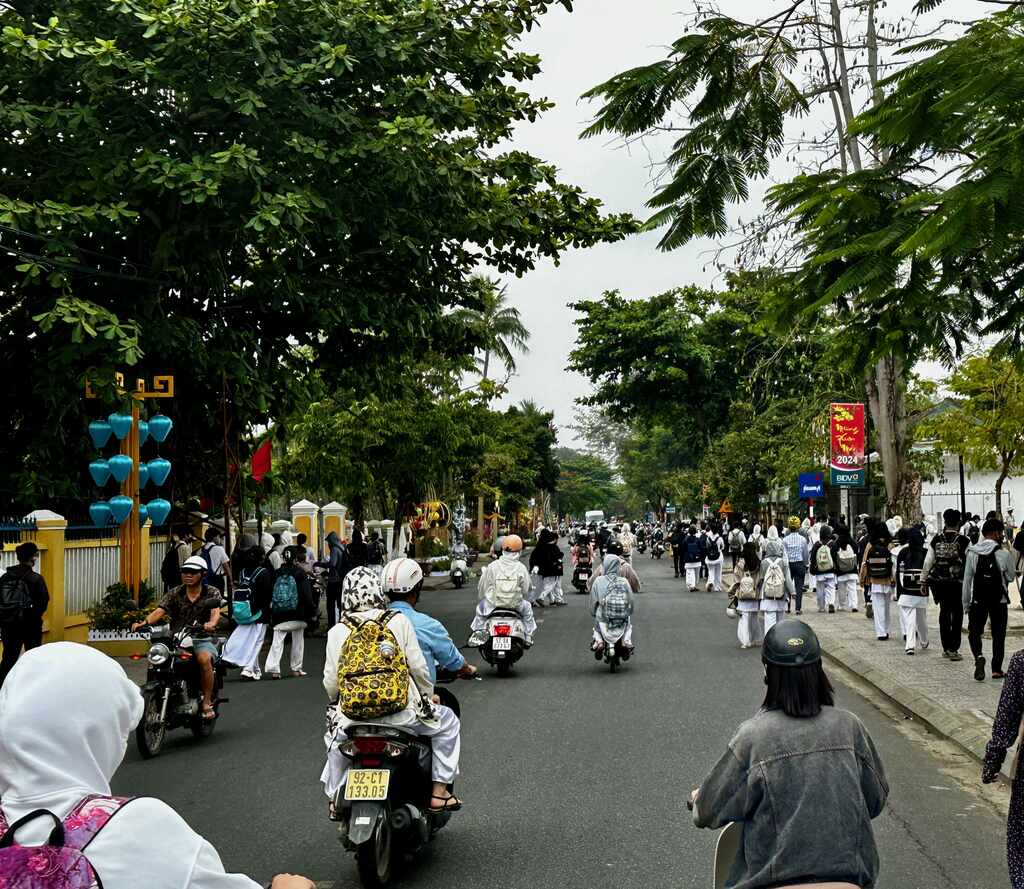
Eat cao lau. Then take a bicycle and ride the 3 km northeast to Tra Que vegetable village or the 3 km west to Thanh Ha pottery village — both are flat, easy rides through paddy fields, and both get you out of the old town at the exact hour the coach parties arrive. If you would rather be in the water, An Bang beach is 4 km out on the same flat road. This is also the window for a first tailor fitting, if you are having something made.
4:00 PM – 10:00 PM: lanterns
Be back on Bach Dang by 5:30 PM, when the motorbikes are barred and the lanterns come on. Cross to An Hoi for the night market on Nguyen Hoang — 150 stalls over 300 metres, open from about 5 PM to 10:30 PM. Have dinner on the An Hoi side facing the old town, then take the boat out at 9 PM when the queues have gone. Walk back over the bridge at 10 and the town will already be emptying.
Where to Eat in Hoi An
Hoi An has a food culture out of all proportion to its size, and several dishes that genuinely do not exist properly anywhere else. If you want the wider picture, we have a full guide to Vietnamese dishes; what follows is what is specific to this town.
Cao lau, and the truth about the well
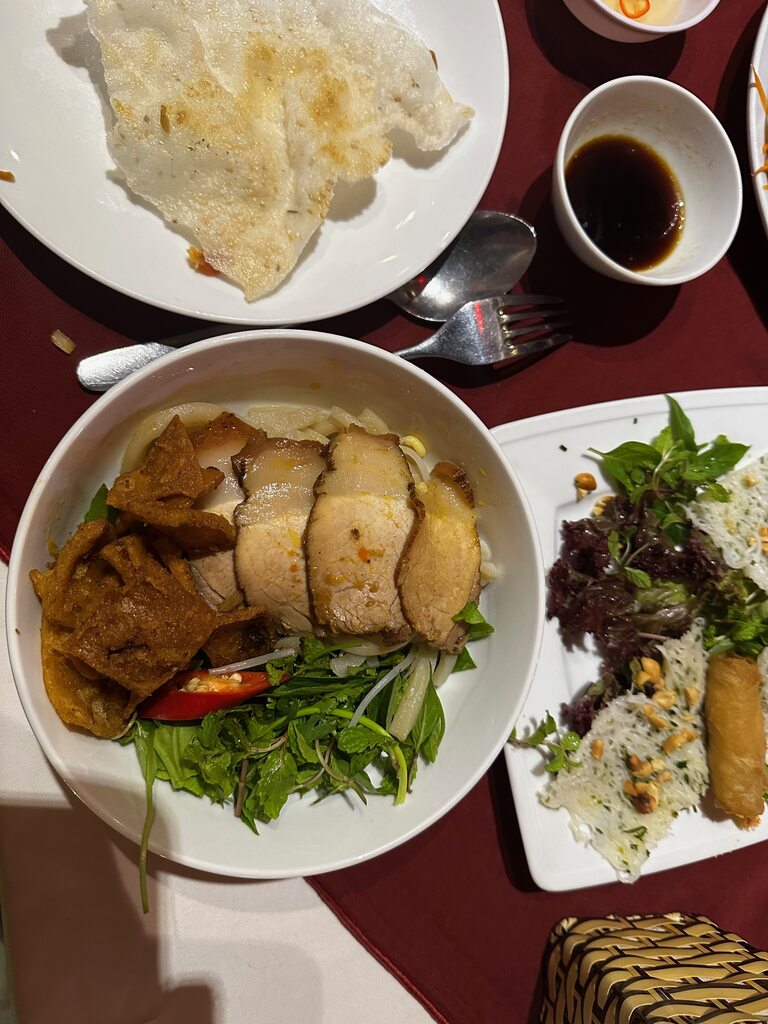
Thick chewy brown-yellow noodles, slices of char-siu-style pork, fresh herbs, bean sprouts, crisp croutons of fried noodle dough, and only a few spoonfuls of broth — it is not a soup. The noodles are treated with lye water made from wood ash, which is chemistry rather than folklore: the carbonates firm up the starch and give the colour.
Now the legend. You will be told that real cao lau requires water from the Cham-era Ba Le well and ash from trees on the Cham Islands. Both were true once and neither is reliably true now — the noodle-making family uses its own well, and the islands are a protected zone so the wood is sourced elsewhere. What actually makes cao lau specific to Hoi An is a small closed guild of noodle makers and a technique kept in the family for four generations. That is a better story than the magic well, and it has the advantage of being verifiable.
Where: Cao Lau Thanh, 26 Thai Phien, mornings only, closes when it sells out — 30,000 VND. Or Trung Bac, 87 Tran Phu, 7:30 AM–10 PM. Expect 30,000–70,000 VND depending on how tourist-facing the place is. If you want to know how it sits against the rest of the country’s cooking, our guide to Vietnamese food covers the regional differences.
White rose dumplings, wontons and com ga
Banh bao banh vac, the white rose dumplings, come two shapes to a plate: small flared shrimp-paste parcels and larger crescents of shrimp, pork and mushroom, both topped with crisp fried shallots. The wrapper is rice flour filtered fifteen to twenty times. You will read that a single family supplies every restaurant in town — that is overstated; it is a handful of families holding a century-old recipe. Go to the White Rose restaurant, 533 Hai Ba Trung, 7:30 AM–8:30 PM, 40,000–150,000 VND a plate.
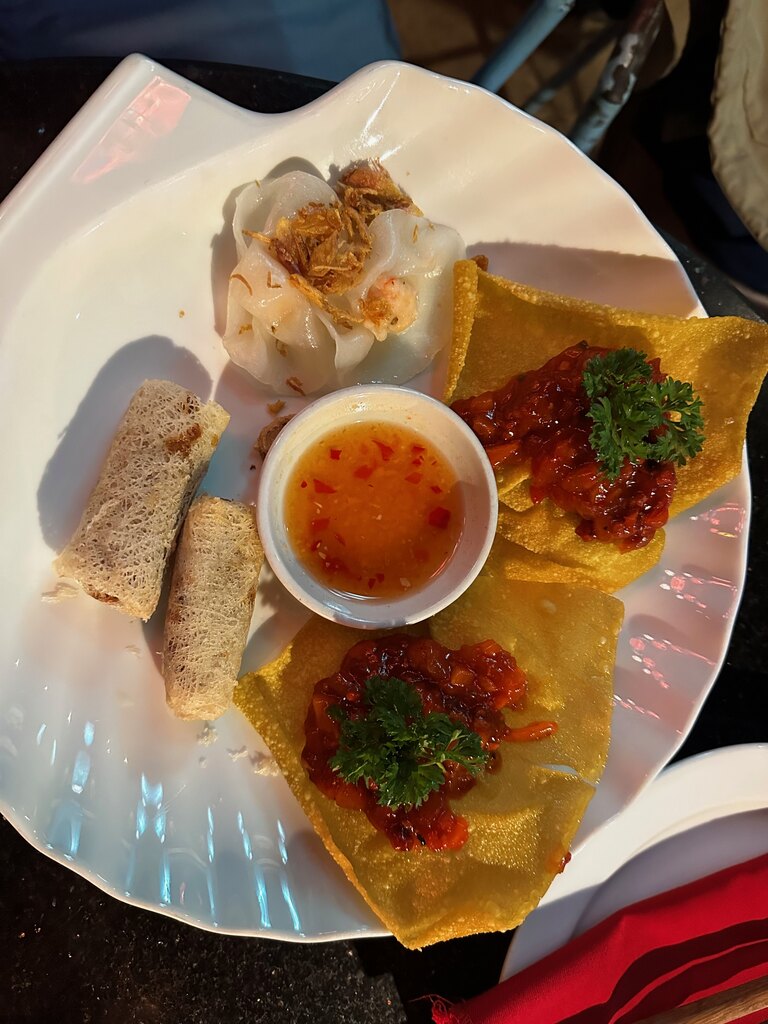
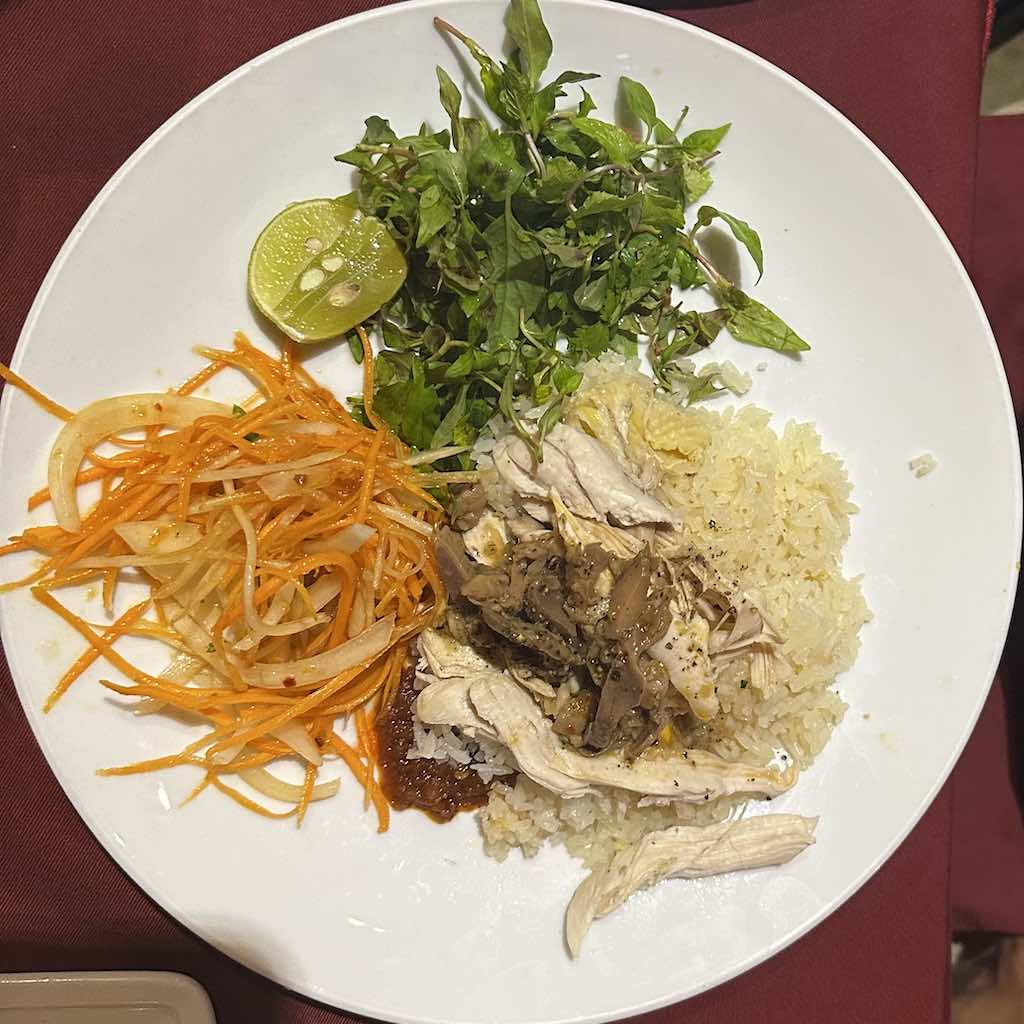
Hoanh thanh chien, fried wontons, are Chinese in origin and localised here by topping the crisp wrapper with a fresh salsa of tomato, shrimp and herbs — from 50,000 VND. Com ga Hoi An is poached free-range chicken shredded over rice cooked in the chicken broth with turmeric, served with a pickled onion and Vietnamese coriander salad. A word of warning on the famous address for it: Com Ga Ba Buoi at 22 Phan Chu Trinh is a sixty-year-old institution whose recent reviews have collapsed and whose opening is unreliable — as of mid-2026 it sits near the bottom of the town’s restaurant rankings. Try Com Ga Huong, 58 Le Loi, or the Central Market food court instead.
The banh mi question: Phuong or Madam Khanh
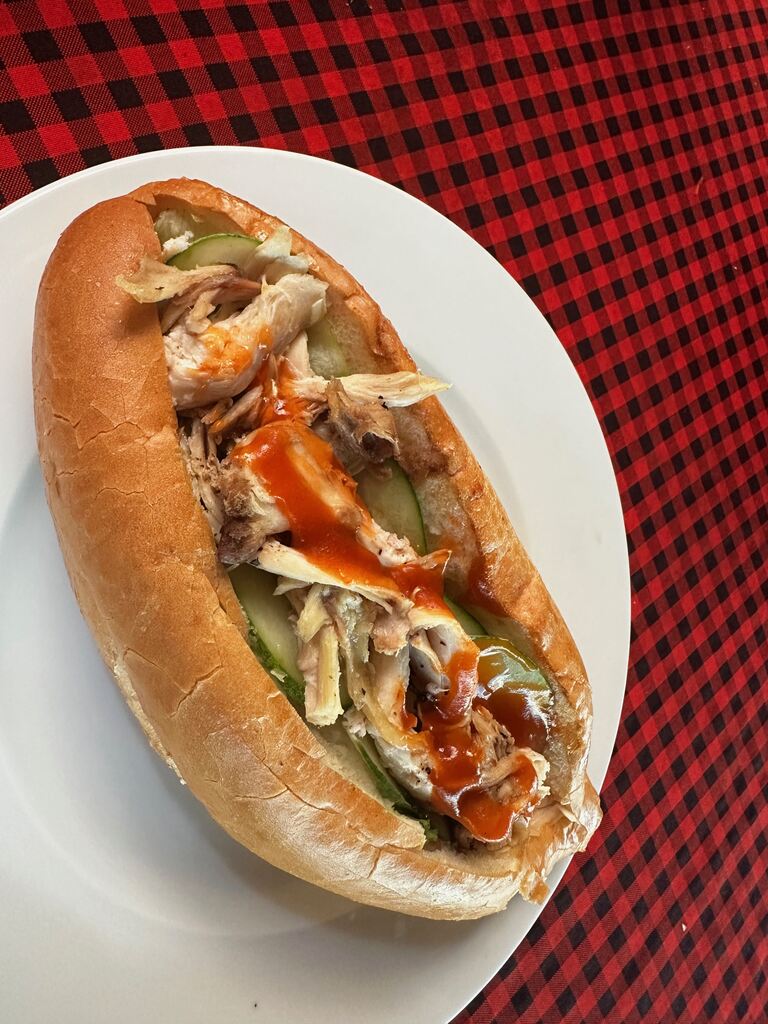
Banh Mi Phuong, 2B Phan Chu Trinh, 6:30 AM–9 PM, 30,000–50,000 VND, is famous because Anthony Bourdain filmed there for the 2009 Vietnam episode of No Reservations and called it a symphony in a sandwich. It is also the shop that was suspended for three months in September 2023 after a salmonella outbreak affected 313 people, 103 of them foreign visitors. It reopened on 17 December 2023, was fined around 100 million VND, and has operated normally since. You should know that before you queue, and then decide for yourself.
Madam Khanh — The Banh Mi Queen, 115 Tran Cao Van, 8 AM–7 PM, 20,000–30,000 VND, is a kilometre out of the tourist core and, for my money, the better sandwich. It has been going since 1975, founded by Nguyen Thi Loc and her husband Khanh, whose name foreign visitors gave the stall. Her daughter runs it now.
Sit-down restaurants, and a cooking class
Morning Glory, 106 Nguyen Thai Hoc, is Trinh Diem Vy’s flagship and the reliable choice for street food done properly in a heritage building. Nu Eatery, 10A Nguyen Thi Minh Khai, in a lane near the Japanese Bridge, is the best small-plates kitchen in town — closed Mondays, otherwise noon to 9 PM, and you should book. Mango Rooms has moved: every old guide gives 111 Nguyen Thai Hoc, but it is now at 37 Phan Boi Chau, 8 AM–11 PM, 400,000–500,000 VND a head. Its sister Mango Mango is at 45 Nguyen Phuc Chu on the An Hoi riverfront.
Cooking classes are a genuinely good use of half a day here, because they nearly all start at the market and travel by boat. Red Bridge Cooking School in Cam Thanh runs a 4.5-hour half-day for about $44 and a 7-hour day for about $64, both reached by boat downstream. Town-wide, classes run $26 to $92. The classic format — market visit, basket boat ride and cooking class — packs the three things people come to Cam Thanh for into one morning.
After Dark: the Night Market, Bars and the Midnight Rule
The night market on An Hoi
Nguyen Hoang Street, on the An Hoi islet directly across the bridge — 150 stalls over 300 metres, open from sunset to about 10:30 PM. Silk lanterns, Thanh Ha ceramics, embroidery, and street food at 20,000 to 50,000 VND. Go at 5 PM if you want to look at things, 6:30 to 9 PM if you want the atmosphere, and about twenty minutes after sunset if you want the photograph.
Bars, and why everything shuts at midnight
Hoi An is not a party town, by law. A municipal regime imposed in February 2018 and still in force requires bars and restaurants to stop serving before midnight, with a fifteen-minute warning to customers, and caps sound equipment at 50 decibels after 10 PM. Touting through xe om drivers is banned too. So the old town genuinely winds down early, and that is a feature rather than a failure — it is why the 7 AM walk is so good.
Where to go while it is open: Dive Bar, 88 Nguyen Thai Hoc, 11 AM to midnight, is the long-standing anchor and the base of Cham Island Diving, with a pool table and live music on Fridays. 7 Bridges Craft Beer, 36 Tran Phu and Market Bar, 2 Hoang Dieu are the dependable evening options; Mezcal Cocteleria, 38 Phan Chu Trinh and Mong Nguyet, 9 Nguyen Thai Hoc for cocktails; The Hill Station, 321 Nguyen Duy Hieu and Tadioto, 54 Phan Boi Chau for something quieter. On the An Hoi riverfront, Dublin Gate at No. 21 and Tiger Tiger at No. 35. At An Bang beach, Soul Kitchen and Barefoot Beach Club, 30–32 Nguyen Phan Vinh run later and looser than anything in town. One correction to the listicles still circulating: Q Bar closed in December 2018.
Tailors and Shopping: How Not to Waste Your Money
Why Hoi An, and how long it really takes
The tailoring cluster is the direct descendant of the silk trade that ran through this port in the 16th to 18th centuries. Counts vary — you will see “over 650” and you will see “hundreds”; call it several hundred and don’t trust a precise figure.
Now kill the “24 hours” myth, because it is the single biggest cause of disappointment here. A simple shirt can come back in 24 to 48 hours. Anything with structure needs two to three days including fittings, and a good shop will give you at least one fitting, a premium one two or three. Budget a minimum of three days in town, ideally four or five. The stalls in the cloth market that promise a garment in five hours are the ones that produce the stories.
What it actually costs, and the five traps
Realistic 2026 prices: a shirt $20–35, trousers $30–60, a dress $40–75, a jacket $50–105, and a wearable men’s suit from $150–250 and up to $400 or more in good cloth. Anything advertised far below that is a fabric decision, not a bargain.
- Fabric is where you get shortchanged. Synthetic blends are sold as wool and linen, and some of them will melt under an iron. Ask to see the bolt, ask the composition, and buy where the bolts are labelled.
- Hotel and driver recommendations are commission-based and the commission is in your price.
- The shop is often not the workshop. Many front shops outsource, and the gap between the two is the commonest reason a garment comes back wrong. Deal with whoever measures you.
- “Ready tomorrow” means one fitting or none.
- Get the price in writing before they cut, and inspect the seams before you pay the balance.
Established names, with their real addresses: Yaly Couture, which has four Hoi An stores including 47 Tran Phu and 47 Nguyen Thai Hoc, is the big reliable one. A Dong Silk, 62 Tran Hung Dao, BeBe Tailor, 05-07 Hoang Dieu and Kimmy Tailor, 70 Tran Hung Dao are the other frequently recommended workshops. The Tailory, 85 Tran Hung Dao and Mr Xe, 71 Nguyen Thai Hoc have good independent reputations.
What else is worth buying
Collapsible silk lanterns, obviously. Beyond that: Reaching Out, 131 Tran Phu is a social enterprise employing artisans with disabilities, selling ceramics, jewellery and housewares at fixed prices — it is the best souvenir shop in town and the one you can buy from without haggling. Viet A, 90 Tran Phu for lanterns and bags, Phuong Do, 26 Bach Dang for bamboo-root carving at $4–40. Custom leather shoes are made to order all over town from a photo or an existing pair, though I would not name a specific cobbler without having used one.
Beyond the Old Town: My Son, the Villages and the Beaches
This is the part people underestimate, and it is half the reason I would put Hoi An above anywhere else in Vietnam. I rented a motorbike for both days and it was easily the simplest way to reach all of it; if you would rather not ride, everything below is also reachable by bicycle, taxi or an organised half-day. Our guide to getting around Vietnam covers the licence question in detail — the short version is that anything above 50cc legally requires an International Driving Permit with a motorcycle endorsement, and riding without one voids your travel insurance.
My Son Sanctuary — go at six in the morning
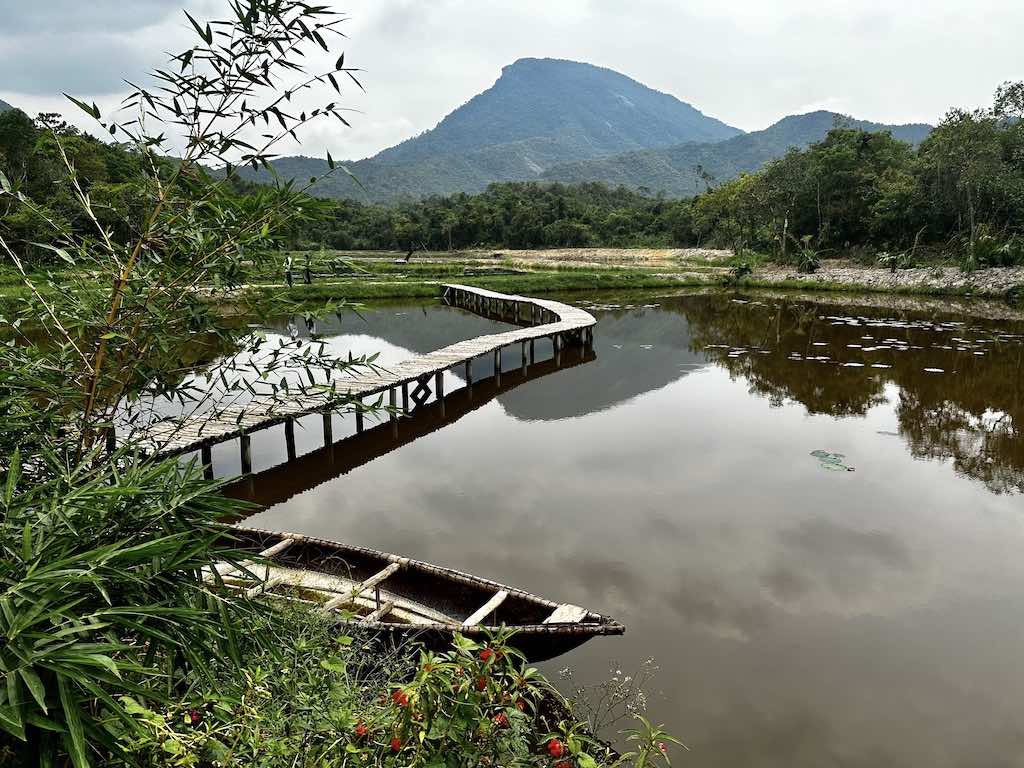
About 40 km west of Hoi An as the crow flies, 45 to 55 km by road, an hour to an hour and a quarter’s drive. My Son Sanctuary is 142 hectares of Hindu brick temples built by the Cham between the 4th and the 13th century — ten centuries of continuous construction on one site, which is extraordinary. The first documented temple was raised by King Bhadravarman I, who reigned from 380 to 413, and held a linga dedicated to Shiva. The French archaeologist Henri Parmentier catalogued 71 temples here in 1899 and grouped them A to K, which is still how the site is signposted; groups B, C and D are the best preserved.
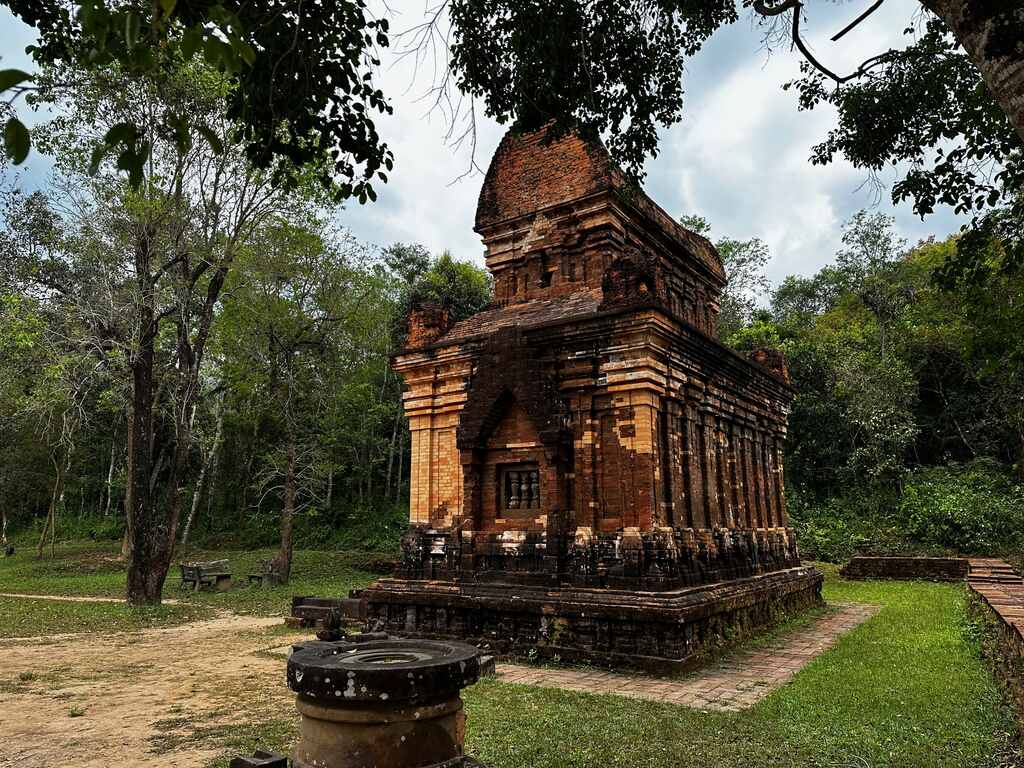
In August 1969 American aircraft bombed the valley, which the Viet Cong were using as a base. Tower A1, the masterpiece of Cham architecture and the centrepiece of the whole site, was destroyed — UNESCO’s own description now calls it little more than a formless pile of bricks. Unexploded ordnance is still present in the buffer zone and still holds back archaeological work. Stay on the marked paths; this is not a precaution to shrug off.
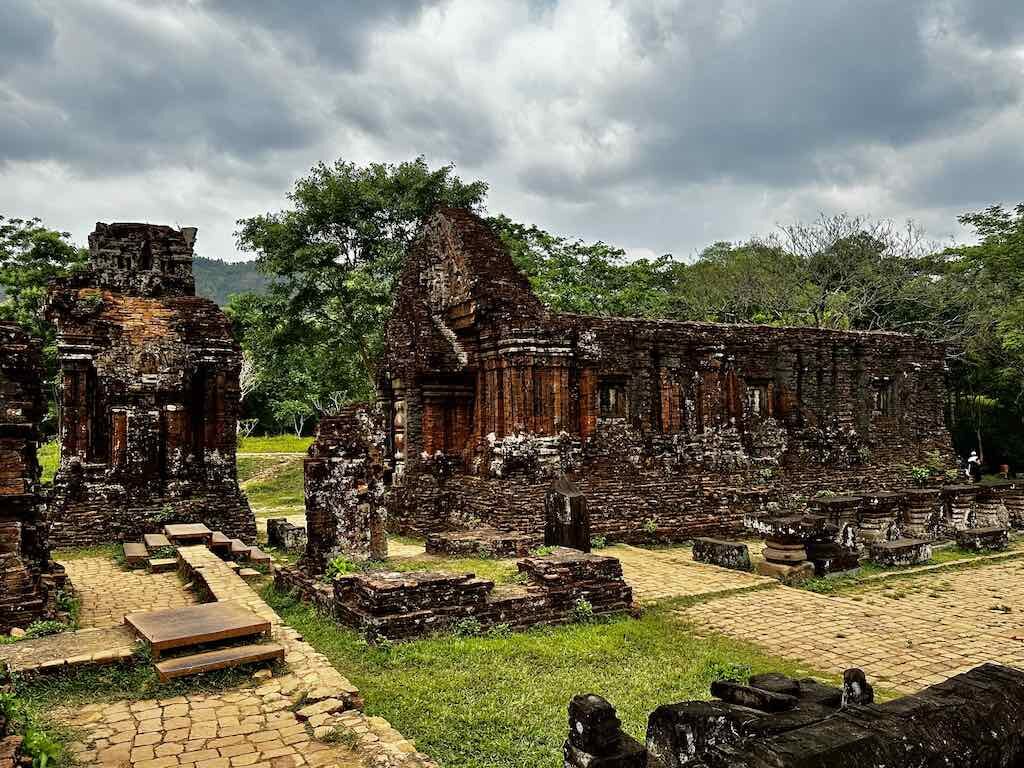
Practically: gates open around 6 AM, last admission 5:30 PM, and the ticket is 150,000 VND for foreign visitors at the counter, with the price currently being unified for everyone — it may move during 2026. That includes the free electric shuttle from the car park, the site museum, the Cham dance performances (roughly six or seven a day, first around 9 AM) and the craft workshops. An English audio guide is 50,000 VND.
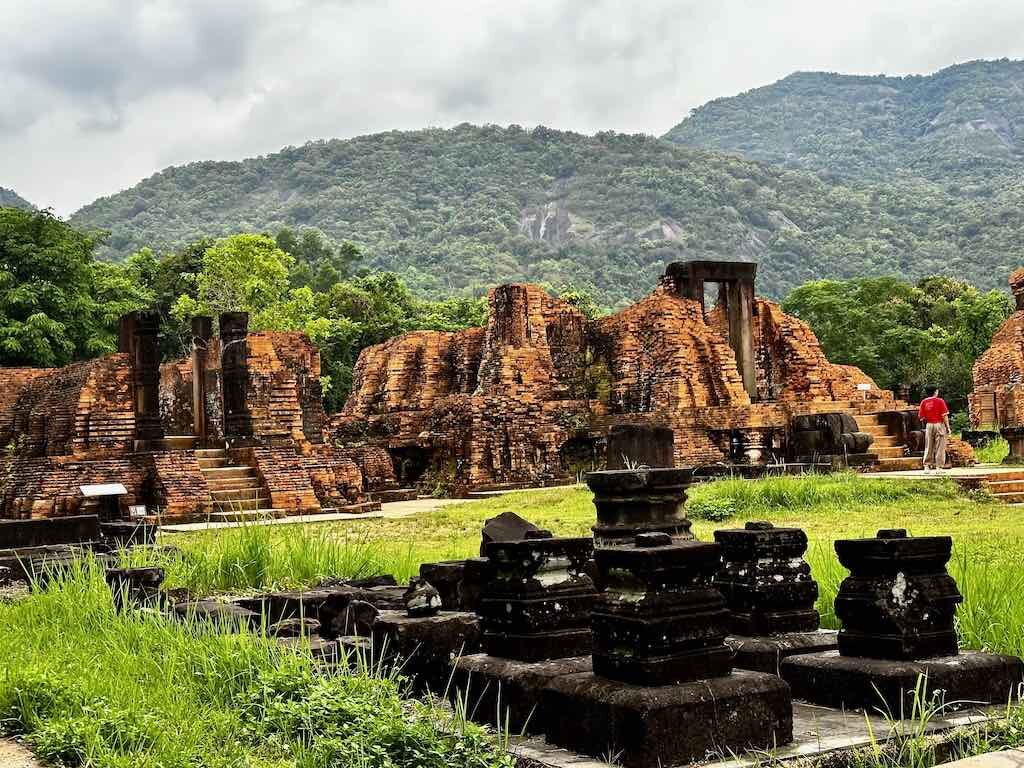
Go at opening. Every source agrees and so do I. The valley is a bowl ringed by mountains with no wind and almost no shade between the towers; by midday it is punishing. The tours from Hoi An and Da Nang leave at 7:30 and 8 AM and land between 9 and 11, so at 6 AM you have it more or less to yourself, with morning mist in the valley and low light on red brick. Second best is around 3 PM when the coaches leave. If you want it done for you, the early-morning My Son tour with breakfast exists precisely because of this.
Tra Que, Thanh Ha and Kim Bong
Tra Que vegetable village, 3 km northeast, a fifteen-minute bike ride: eighteen hectares, 202 farming households, founded in the 16th century, and fertilised with rong — lake weed dredged from the neighbouring lagoon, no chemical fertiliser at all, which is why the herbs are small and startlingly aromatic. You can work a plot alongside the farmers. Entry 35,000 VND including a herbal drink. It was named a UN Tourism Best Tourism Village in 2024, the only Vietnamese village recognised that year out of 260 candidates from 60 countries.
Thanh Ha pottery village, 3 km west on the river, has been throwing pots for 500 years. Entry 35,000 VND includes the village, the communal house, a turn at the wheel and a clay whistle to take away. Next door, the Thanh Ha Terracotta Park (8 AM–5:30 PM, 50,000 VND adults, 25,000 children) has a genuinely charming terracotta miniature-world of famous monuments plus a Sa Huynh–Champa museum.
Kim Bong carpentry village on Cam Kim island, across the river, is the quiet one. Founded in the 15th century by soldiers of the Huynh, Nguyen, Truong and Phan families, its carpenters built much of the old town you spent the morning in and worked on the imperial buildings in Hue. Reach it by the small ferry from the Bach Dang waterfront or by bicycle over the bridge; the island’s paddy lanes are the best easy cycling near Hoi An. Entry is either free or a small 35,000 VND heritage ticket depending which way you come in.
Cam Thanh, the coconut forest and the basket boats
Three to seven kilometres southeast depending which landing you use, ten to twenty minutes by bike. It is a nipa palm wetland — brackish channels planted with water coconut — that hid Viet Cong fighters during the war. The thung chai, the round bamboo coracle, is a real Vietnamese fishing craft, not a tourist invention.
You will have read that Bay Mau became a circus of loudspeakers, spinning-boat shows and tipping pressure. That was true, and it has measurably changed. Government Decree 282, in force since 15 December 2025, tightened the noise rules with specific reference to portable karaoke systems, and by May 2026 a local operator reported karaoke noise in the residential parts of the coconut forest down by close to 100% against 2024–25, with the ward’s public service director confirming residents had stopped complaining. What has not changed is the crush between 9 and 11 AM when the coaches land. Go at 6:30–8:30 AM or 3–5 PM. Entry to Bay Mau is 30,000 VND; book the boat at the waterfront, where it is 250,000–400,000 VND per boat for two adults and a rower, rather than through a hotel, where the identical ride is 300,000–500,000. A 50,000–100,000 VND tip to the rower is normal.
An Bang, Cua Dai and the Cham Islands
An Bang is the good beach: 4 km straight out Hai Ba Trung, fifteen to twenty minutes on a bicycle on flat road. Parking is 5,000–10,000 VND, free if you eat somewhere; a sun lounger is free with a food or drink purchase, otherwise 50,000–100,000. The southern end is eroded — walk north for open sand. Soul Kitchen, The DeckHouse, La Riva and Phuong Beach Restaurant are the established places to eat, and there is surf from September to January.
Cua Dai, 6 km out, has a better story than its reputation suggests. It lost most of its width to upstream dams, river sand mining and a 2014 typhoon; a restoration programme from 2020 to 2024 cost 550 billion VND (about $23.7 million) and rebuilt 2.3 km of beach behind a submerged breakwater sitting half a metre below the surface, 250 m offshore, with over 100,000 cubic metres of sand pumped in behind it. That central stretch has held through storms and floods since, and it is swimmable again. A second phase covering the remaining 5.2 km, budgeted at €42 million, is under way. It is an engineered beach and it feels like one — but it is no longer a ruin.
Cu Lao Cham, the Cham Islands, are eight islands 15 to 21 km offshore, a marine park since 2003 and a UNESCO Biosphere Reserve since 2009. Speedboats leave Cua Dai pier at 8, 9 and 10 AM and take 15 to 20 minutes; a round trip runs 500,000–600,000 VND, and a 100,000 VND conservation fee is usually bundled in. There are no ATMs on the island and there is a plastic-bag ban. The critical thing: boats are suspended for much of the season from around October to February. March to August is the reliable window, June to August the clearest water. Never build a Cham Islands day into a winter itinerary without a fallback.
Da Nang and the Marble Mountains
The Marble Mountains (Ngu Hanh Son) sit almost exactly halfway between the two, about 20 km from Hoi An — five limestone outcrops named for the five elements, of which only Thuy Son, the water mountain, is developed for visitors. It holds the Tam Thai and Linh Ung pagodas, cave shrines, the Xa Loi tower and views straight down the coast. Open 7:30 AM–5 PM, extended to 6 in summer. Entry is 40,000 VND; the lift is a separate ticket at 15,000 one way or 30,000 return and saves you 156 steps, though you walk everything above the plateau regardless. Am Phu — the Hell Cave, with its Buddhist hell tableau and its stairway to heaven — is another 20,000 VND and worth it. Both ticket offices are cash only.
Da Nang itself is 30 km and 45 minutes to an hour away, and makes an easy day out for the Dragon Bridge, My Khe beach and the Ba Na Hills.
Where to Stay in Hoi An
Hoi An has an unusually good spread of accommodation for a town this size, largely because the heritage rules cap what can be built inside the old town, so the resorts sit in the rice fields and on the beach instead. Where you sleep changes the trip more than usual here.
Which area to choose
In or beside the old town puts everything on foot and gets you the 7 AM streets, at the cost of street noise, smaller rooms, day-tripper crowds and the highest prices per square metre. An Hoi and Cam Nam, across the water, are ten to fifteen minutes’ walk from the centre and noticeably cheaper for the same standard, though An Hoi gets loud during festivals. The Cam Chau and Cam Thanh rice fields, 2 to 5 km out, are the quiet option and need a bike or a scooter. An Bang beach, 4 km and fifteen flat minutes by bicycle, has the better restaurants and a more local feel, and — the decisive argument in autumn — it is outside the flood zone.
On which note: if you are booking for late October to mid-December, Bach Dang Street floods first, followed by the lanes running down to it. Stay north of Ly Thuong Kiet, avoid ground-floor rooms near the river, and book a refundable rate. During the record flood of October 2025 some 40,000 visitors had to be moved from one hotel to another.
Luxury and resorts
Anantara Hoi An Resort is the one to take if you want luxury you can walk out of: 94 colonial-style rooms on the Thu Bon at 1 Pham Hong Thai, about 650 m from the old town, roughly $150–260 a night. Four Seasons The Nam Hai is in a different bracket altogether — private-pool villas on Ha My beach twenty minutes out, from around $650. Bel Marina Hoi An Resort at 127 Nguyen Phuc Tan, on the An Hoi side, is the value play at $70–140 — and note it is the former Hoi An Silk Marina, so reviews under the old name are the same hotel.
Boutique and mid-range
Little Riverside Hoi An faces the old town from the south bank and has a rooftop infinity pool over the river, around $90–170. Emerald Hoi An Riverside Resort sits on Cam Nam island between two arms of the river, five minutes by bike from the Japanese Bridge, and is the best value in this bracket at $45–90 — it used to be the Vinh Hung Emerald. Its sibling Vinh Hung Riverside Resort & Spa is in the old town proper.
Out in the paddies: Hoi An Chic – Green Retreat has rooms on stilts above the rice fields 2 km out ($60–100), Lasenta Boutique Hotel Hoian is the same idea in Cam Chau ($45–85), and Legacy Hoi An Resort — formerly Ancient House Village — sits among the coconut palms of Cam Thanh. Maison Vy Hotel is run by the same family as Morning Glory and does its own cooking classes.
Beach, budget and hostels
At An Bang, AIRA Boutique Hoi An Hotel & Spa is the structured option at $55–110, and Under The Coconut Tree Hoi An Homestay — bamboo huts six minutes from the sand at 169/1 Nguyen Phan Vinh — is the best-rated cheap bed near the beach, $8–12 in a dorm and $25–45 for a private room.
In town, Hoianese Tranquil Heritage Hotel at 30 Phan Boi Chau is the survivor of the old Tribee group and very well reviewed at $25–45, while Mad Monkey Hoi An — the former Hoi An Backpackers — is the pool-and-bar party hostel between town and the beach, $8–15 in a dorm.

Practical Tips: Getting There, Best Time, and the Floods
Getting to Hoi An
There is no airport and no railway station in Hoi An. Everything comes through Da Nang, 30 km north.
From Da Nang airport (DAD), 35 to 45 minutes: Grab costs 250,000–500,000 VND, a metered taxi 300,000–450,000, a pre-booked private transfer 350,000–700,000, and the yellow public bus No. 1 just 30,000 VND if you have an hour to spare. Many hotels include a free transfer for stays of two nights or more, so ask before you book anything. One warning: drivers outside the arrivals hall quote 800,000 to 1,200,000 VND, roughly double the real rate. Use the official rank or order a Grab from the app pick-up point — the airport wifi is open and free, so install it before you land.
By train, you arrive at Da Nang station, 791 Hai Phong Street, on the Reunification Express — 16 to 20 hours from Hanoi, 16 h 30 to 19 h 30 from Ho Chi Minh City at $36–62 depending on the class of berth. Odd-numbered SE trains run south, even-numbered north. The three-hour Hue–Da Nang section, where the line runs along the cliff above Lang Co bay, is the finest rail journey in Vietnam and worth planning around. If you are coming down from the northern mountains, note that there is no direct line — trains from Sapa run to Hanoi, and you pick up the southbound Reunification Express there.
From Hue, 130 km: three to four hours by bus at 120,000–300,000 VND, or two and a half to three hours by car through the tunnel — but take the Hai Van Pass instead and give it four to five hours with stops. “Sea-cloud pass” tops out at 496 m where the Annamite range drops into the sea, and it was historically the frontier between Dai Viet and Champa and is still the climate boundary between north and south. At the summit sits Hai Van Quan, an 1826 Nguyen dynasty fort with French and American bunkers layered on top, free to visit, with the Da Nang bay on one side and the Lang Co lagoon on the other. Motorbikes are banned from the 6.3 km tunnel, which is exactly why the pass stays rideable.
For the actual booking, the simplest tool is 12Go for the Da Nang to Hoi An transfer, or the Hue to Hoi An route if you are coming over the pass; it compares buses, vans, trains and private cars in one place and takes international cards. Coming the length of the country, book the Hanoi to Da Nang or Ho Chi Minh City to Da Nang leg the same way.
Getting around once you are there
Walk the old town — it is barely a kilometre end to end and largely car-free. For everything else take a bicycle: a town bike is 25,000–50,000 VND a day and most hotels lend them free, an electric bike 150,000–250,000, a 50cc scooter 125,000–175,000 and a 100–160cc scooter 150,000–250,000. Helmets are compulsory. Anything above 50cc requires an International Driving Permit with a motorcycle endorsement; fines for riding without one run $40–80 and, more to the point, your insurance will not pay out.
When to go
February to May is the season, and April is the driest month of the year at 77 mm — which is when I went, and the weather was faultless. June to August is hot at 29–30 °C average and humid, with short heavy showers and a lot of domestic holidaymakers. September to January is the wet season, and the numbers are brutal: those four months carry 1,538 mm of the annual 2,490 mm, about 62% of the year’s rain in a third of the year. Typhoon season runs September to November.
The floods, honestly
Hoi An floods. Not occasionally — most years, in October and November, and the town is built for it. Water reaches knee or waist height on the streets nearest the Thu Bon, shops move their stock upstairs, residents run errands by boat, the heritage sites shut for a few days and then the town cleans up and reopens. The carved flood marks at Tan Ky and the ceiling hatch at Phung Hung are three centuries of the same conversation.
The reference event is recent. On 30 October 2025 the Thu Bon hit 5.62 m, the highest in about sixty years; 35 people died nationally, more than 16,000 houses flooded, and around 40,000 visitors in Hoi An were moved between hotels. The old town reopened to visitors on 1 November — forty-eight hours after the peak. That is the honest shape of it: don’t dramatise, don’t book non-refundable in October or November, take cancellation cover, and keep slack in the itinerary. If you are planning the wider route, our guide to planning your trip to Vietnam sets out how the three regions’ seasons work against each other.
Read More About Central Vietnam
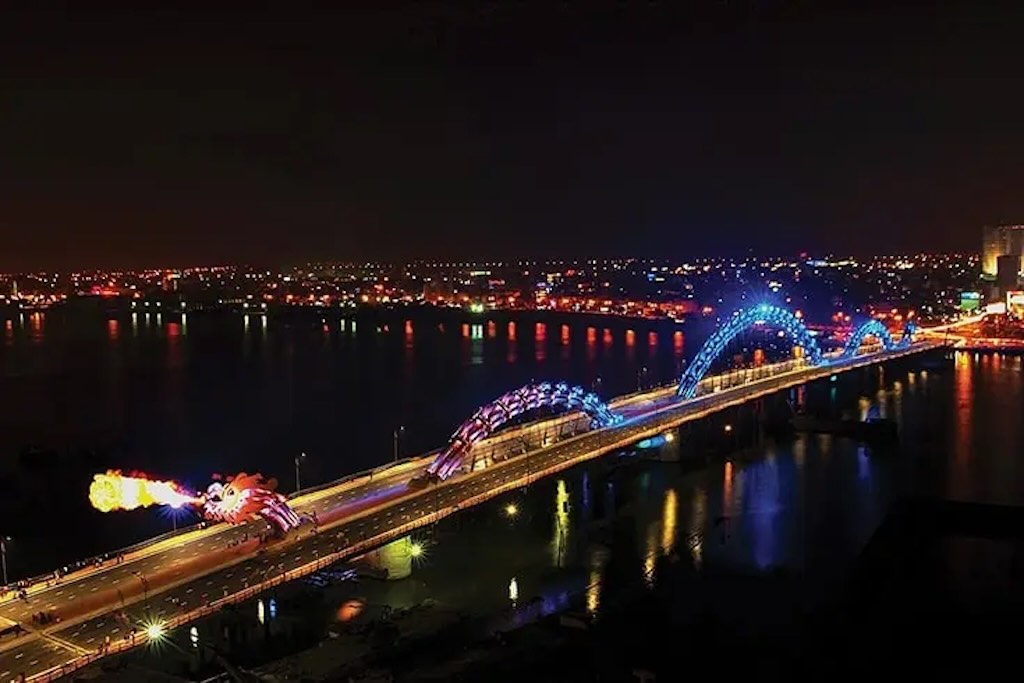
Da Nang
Thirty kilometres north: the Dragon Bridge, My Khe beach, the Marble Mountains on the way, and the Ba Na Hills above the city. Read more
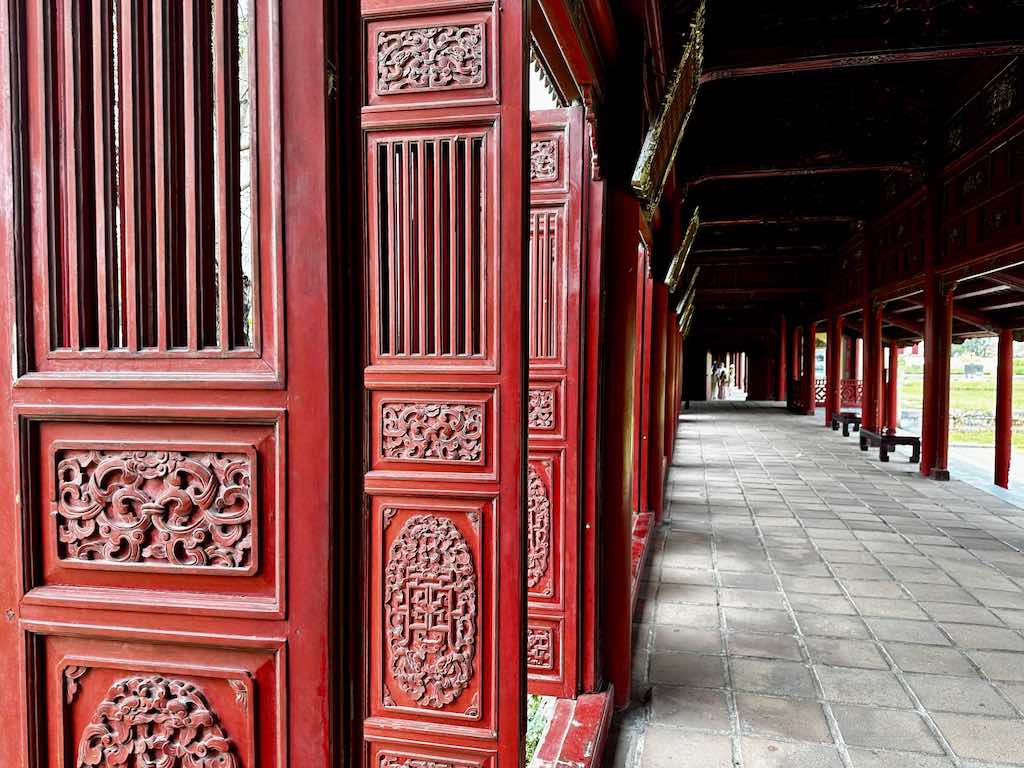
Hue
The imperial capital, three hours north over the Hai Van Pass. The Citadel, the royal tombs along the Perfume River, and the best food in central Vietnam. Read more

Vietnamese Food
Pho, banh mi, bun cha, cha gio and the regional dishes worth crossing the country for — the full guide to eating in Vietnam. Read more
Frequently Asked Questions About Hoi An
How many days do you need in Hoi An?
Three days is the right answer for most people. One day covers the old town and the lanterns, a second gets you My Son and a craft village, and a third gives you the beach or the rice fields — and, crucially, three days is also the minimum for having clothes made properly. I had two nights and it was one short.
Do you really have to buy the Hoi An old town ticket?
Not to walk the streets — that is free, and the 2023 attempt to change it was abandoned within a day. You do need it to go inside any of the twenty-odd heritage buildings, and you will be asked for it at the door. At 120,000 VND for about five sites it is good value, and a large share of the revenue goes to helping owners of the protected houses repair flood damage.
When is the Hoi An lantern festival?
On the 14th day of every lunar month — the eve of the full moon, twelve or thirteen times a year, not once. The remaining 2026 dates are 24 September, 23 October, 22 November and 22 December, and 2027 opens on 21 January and 19 February. The electric lighting in the old town goes off from about 6 PM to 10 PM.
Is the Japanese Covered Bridge open after its restoration?
Yes — it reopened on 3 August 2024 after nineteen months of work and has been fully visitable ever since. About 60% of the original timber was kept and reinstalled and the decision was taken not to repaint it, which is why some visitors complain it looks too new.
What is the best month to visit Hoi An?
April, which averages just 77 mm of rain and 27 °C. February to May is the reliable window overall. Avoid October and November, which get 419 mm and 459 mm respectively and bring the annual floods.
Does Hoi An flood, and should that stop me going?
It floods most years in October and November, and no, it should not stop you going the rest of the time. Even after the record flood of 30 October 2025 the old town reopened to visitors within forty-eight hours. If you must travel in autumn, book refundable rates, stay north of Ly Thuong Kiet or out at An Bang beach, and leave slack in the itinerary.
How do you get from Da Nang airport to Hoi An?
It is 30 km and 35 to 45 minutes. A Grab costs 250,000–500,000 VND, a metered taxi 300,000–450,000, and the yellow public bus No. 1 is 30,000 VND. Many hotels throw in a free transfer for two nights or more. Ignore the drivers touting outside arrivals at 800,000–1,200,000 VND.
Is My Son worth visiting from Hoi An?
Yes, if you go at opening. It is a 4th to 13th century Hindu temple complex — the spiritual centre of the Cham kingdom, UNESCO-listed since 1999 — about an hour away. The valley has no shade and no wind, and the coach parties land between 9 and 11 AM, so arriving at 6 AM changes the visit completely.
How long do Hoi An tailors actually take?
Two to three days for anything structured, including fittings. The “ready in 24 hours” promise means one fitting or none, and it is the commonest source of complaints. A wearable suit realistically starts at $150–250, a shirt at $20–35.
Is the basket boat ride at Cam Thanh a tourist trap?
It was heading that way, and it has genuinely improved. New national noise rules in force since December 2025 have all but ended the karaoke problem in the residential parts of the coconut forest. The crowding between 9 and 11 AM is still real, so go at 6:30–8:30 AM or 3–5 PM and book at the waterfront rather than through your hotel.
Which beach is better, An Bang or Cua Dai?
An Bang, for the food and the atmosphere, and it is closer at 4 km. Cua Dai is no longer the eroded ruin it was — a 550 billion VND restoration rebuilt 2.3 km of beach behind a submerged breakwater between 2020 and 2024 and it is swimmable again — but it feels engineered, because it is.
Is Hoi An still in Quang Nam province?
No. Quang Nam was merged into Da Nang City on 1 July 2025 as part of Vietnam’s reduction from 63 provinces to 34, and Hoi An is now a ward of Da Nang. Any address or listing that still reads “Hoi An, Quang Nam Province” is out of date, though you will see it everywhere for years yet.
Ja, Hoi An ist wirklich eine ganz besondere Stadt in Vietnam, und ich gehe sehr gerne dorthin. Kannst du mir sagen, wann die beste Reisezeit für Hoi An ist? Ich konnte das in deinem Artikel leider nicht finden.
Hallo Kai,
Klar, ich freue mich, dass du Hoi An so besonders findest! Die beste Reisezeit für Hoi An ist von Februar bis April, wenn das Wetter mild und trocken ist. In dieser Zeit sind die Temperaturen angenehm und die Luftfeuchtigkeit ist niedriger, was es ideal für Sightseeing und Aktivitäten im Freien macht. Ich war selbst im April in Hoi An, und es war wirklich perfekt!
Der Herbst (September bis Dezember) ist ebenfalls eine gute Reisezeit, da es weniger regnet, aber es kann gelegentlich noch etwas feucht sein. Im Sommer (Mai bis August) kann es sehr heiß werden, und die Regenzeit dauert von etwa September bis Januar, mit stärkeren Regenfällen, besonders im Oktober und November.
Blaise