Hue, Vietnam: The Imperial City, the Royal Tombs and the Perfume River
By Blaise Jaeger · Updated September 23, 2026
Why Visit Hue?
For 143 years, from 1802 to 1945, Hue was the capital of Vietnam and the seat of the Nguyen emperors, the last dynasty to rule the country. What they left behind is unlike anything else in Southeast Asia: a walled citadel with a palace city inside it, a Forbidden City inside that, and, scattered along the Perfume River, a set of royal tombs that are really landscaped parks, each designed by the emperor who would lie there.
Hue is also a calmer city than Hanoi or Ho Chi Minh City. The traffic is lighter, the river is wide, and in the evening half the town seems to be sitting on low plastic stools with a bowl of noodles. It is the natural stop between the north and the beaches and old towns of the centre: Da Nang is two to three hours south over or under the Hai Van Pass, and Hoi An 45 minutes beyond that.
Two things have changed recently. On 1 January 2025, Hue became Vietnam’s sixth centrally governed city, the first to earn that status for its heritage rather than its economy. And several of the Imperial City’s great halls have reopened after long restorations: Kien Trung Palace in 2024, Thai Hoa Palace in November 2024. If you last read about Hue before that, half of what you read is out of date.
Hue at a Glance
- Where: central Vietnam, on the Perfume River, about 100 km north of Da Nang and 690 km south of Hanoi.
- Status: a centrally governed city since 1 January 2025; the Complex of Hue Monuments has been a UNESCO World Heritage Site since 1993.
- Signature sights: the Imperial City, the tombs of Tu Duc, Khai Dinh and Minh Mang, Thien Mu Pagoda, the Perfume River.
- Tickets: 200,000 VND for the Imperial City, 150,000 VND per major tomb, or 530,000 VND for the four together.
- How long to stay: two full days; three if you add a DMZ tour or the caves of Phong Nha.
- Best months: late January to April. October and November are the wettest months and bring floods.
- The dish to try first: bún bò Huế, the city’s spicy lemongrass beef noodle soup.
- Getting there: Phu Bai airport is 15 km from the centre; the train from Hanoi takes around 13 hours; from Da Nang, the road over the Hai Van Pass is the one to ride.
- Currency: Vietnamese dong (VND). Cards in hotels, cash at the stalls and ticket booths of the smaller sites.
My Two Days in Hue: Over the Hai Van Pass by Scooter
I came to Hue on a rented scooter from Da Nang in April 2024. On the 7th I spent the morning at Ba Na Hills, left around 3 PM and rode north over the Hai Van Pass, reaching Hue about three hours later, at dusk. It was a long day, but the scooter made it easy to reach the tombs, which are spread out along the river, on my own schedule.
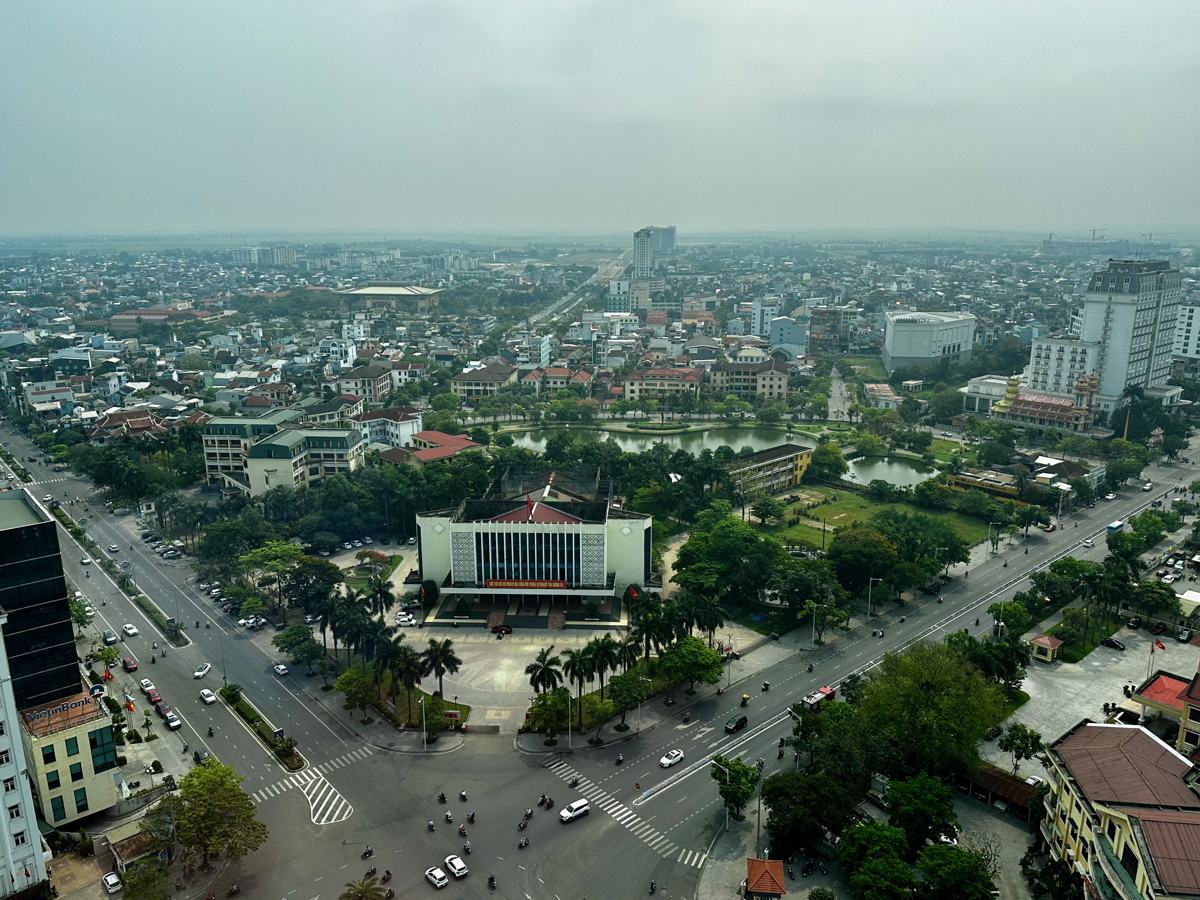
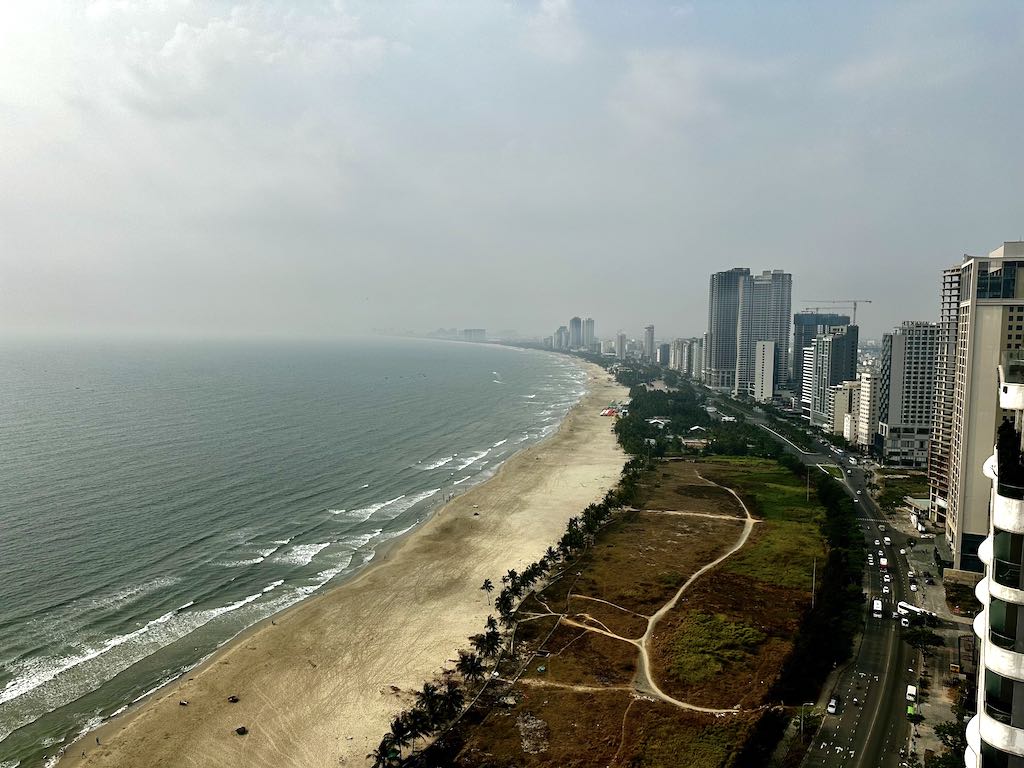
That first evening I ate caramelised clay-pot chicken at a small family restaurant, then went up to the rooftop bar of the Meliá Vinpearl, the tower where I was staying, to see the city lit up below. The next morning I had the same view by daylight, with the whole south bank laid out below the tower.
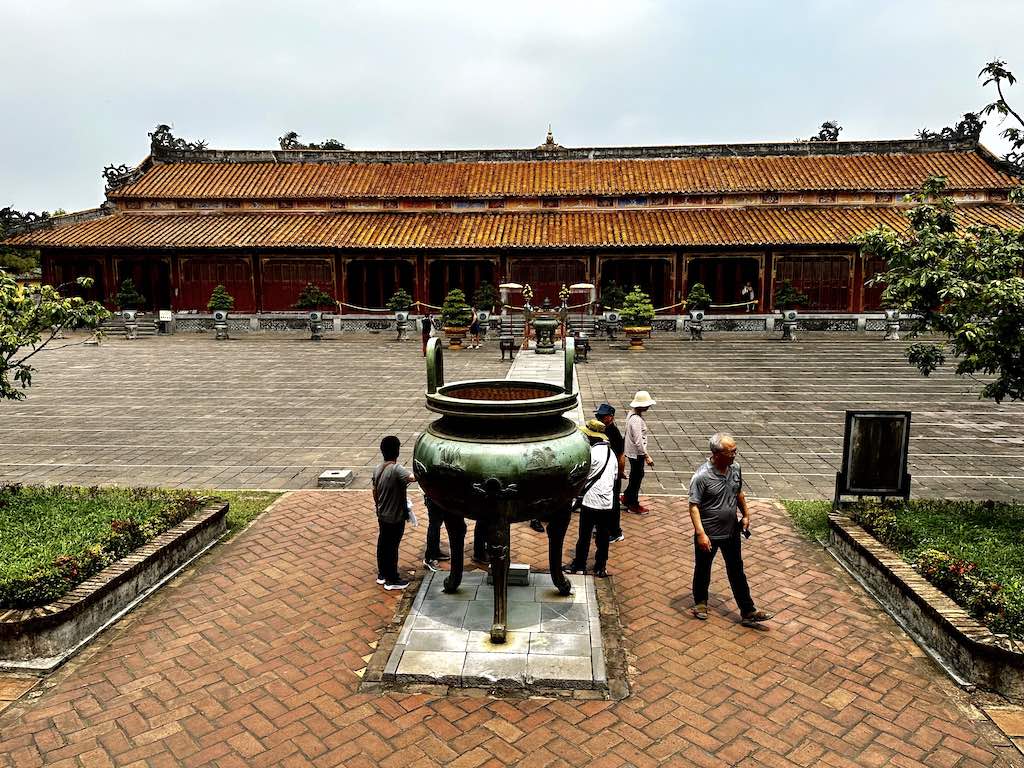
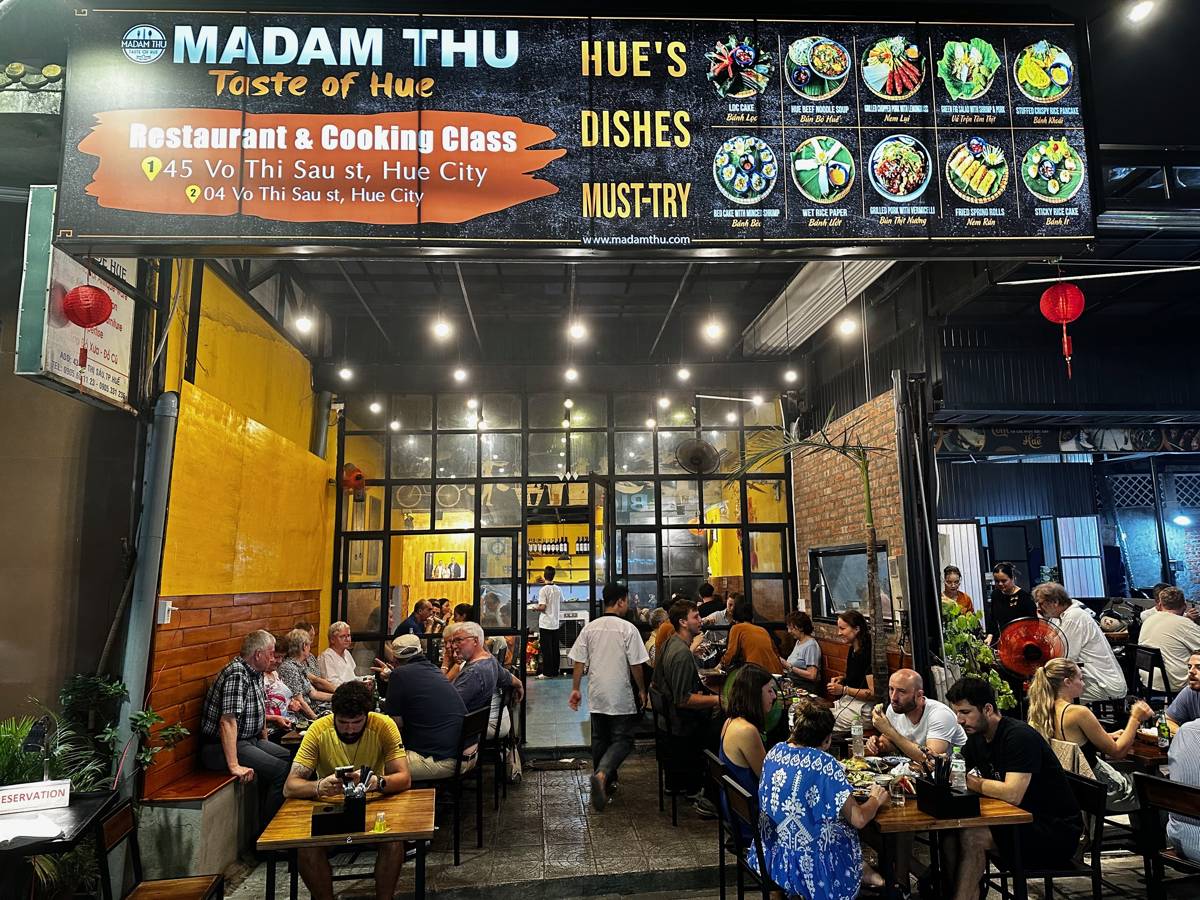
The 8th was the monuments. I was at the Noon Gate by half past ten and spent about an hour and a half inside the Imperial City: the Nine Dynastic Urns, the long red galleries, the rebuilt Kien Trung Palace. After lunch I rode out to the tomb of Tu Duc, where I arrived at half past three, then on to Khai Dinh, which I reached at five, shortly before closing. That evening I had dinner at Madam Thu, a restaurant that specialises in Hue dishes, and walked the bar streets around Pham Ngu Lao.
On the 9th I rode back south along the coast road, stopping at the Lap An lagoon at Lang Co before crossing the pass again. I did not have time for Minh Mang’s tomb or Thien Mu Pagoda; this guide covers both anyway.
The Imperial City (Dai Noi): What to See
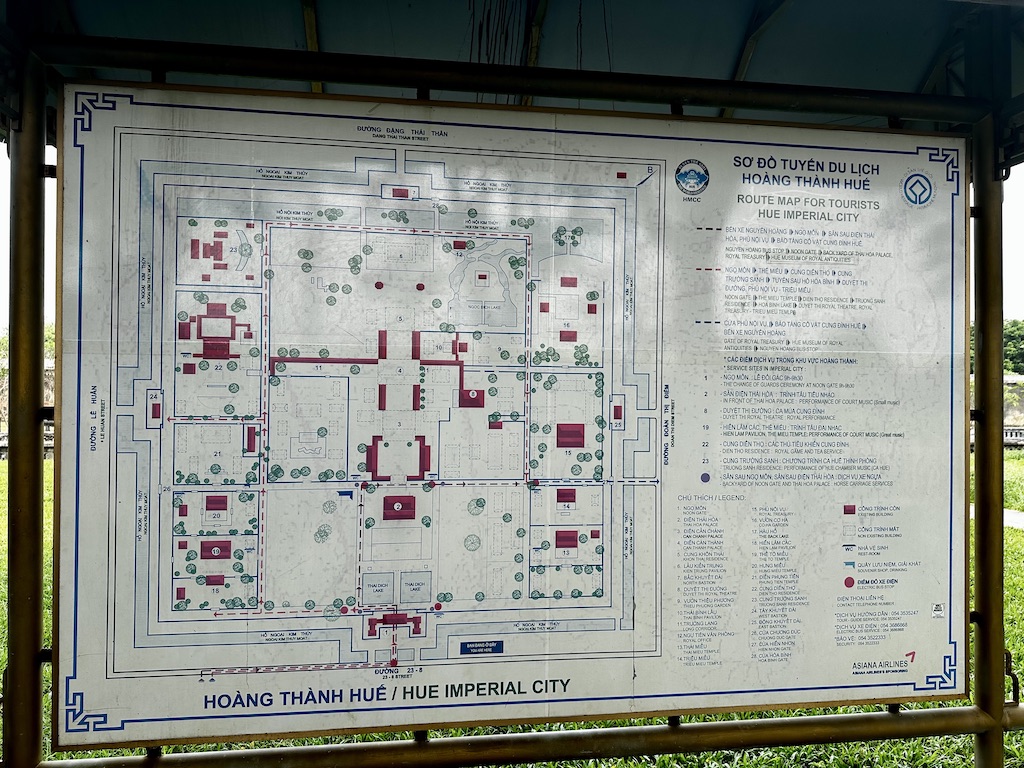
The citadel of Hue is a square of walls about 2.5 km on each side, on the north bank of the Perfume River. Emperor Gia Long surveyed the site in 1803 and building went on from 1805 to 1832, finished under his son Minh Mang. Inside the citadel is the Imperial City proper, the Dai Noi, with its own walls and moat, and at its heart was the Forbidden Purple City, reserved for the emperor and his household.
Much of it did not survive the 20th century. The battle of Hue during the Tet Offensive of 1968 destroyed most of the palace city: of around 160 buildings, only about ten major ones came through intact. What you visit today is a mix of original structures, careful reconstructions and open lawns where palaces used to stand. The UNESCO World Heritage listing covers the citadel, the tombs and the other monuments together.
The Noon Gate (Ngo Mon)
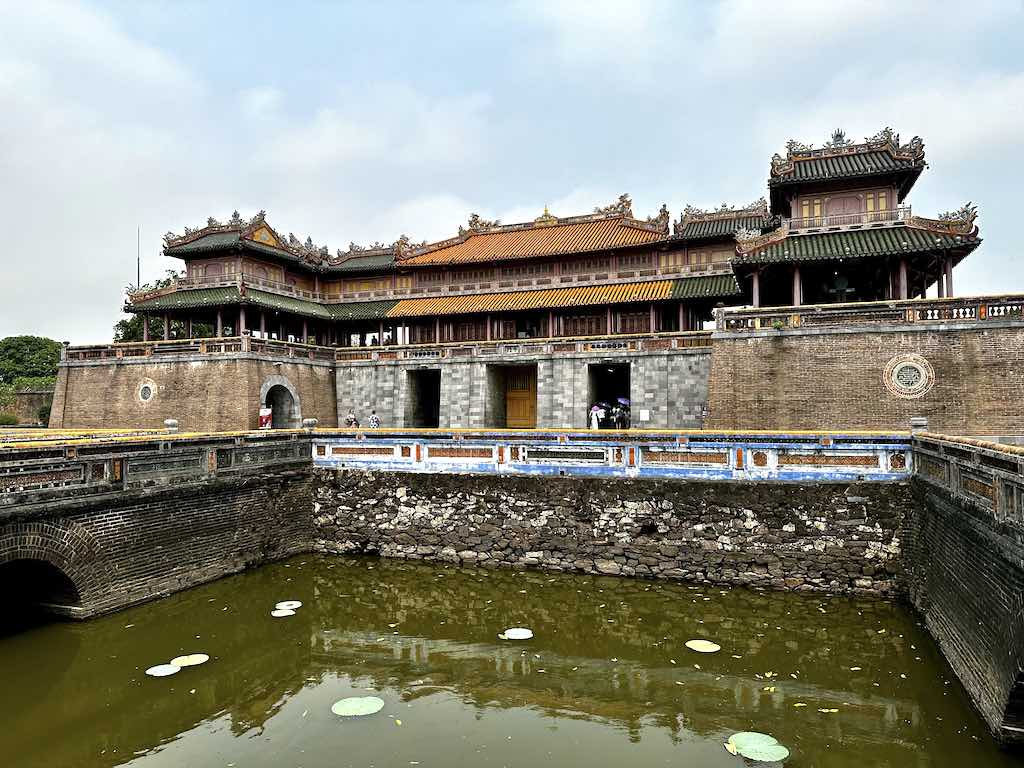
The main entrance, built in 1833, faces south towards the river. The central passage was reserved for the emperor; officials and soldiers used the side doors. Above it stands the Five Phoenix Pavilion, and only the central roof is covered in yellow tiles, the imperial colour. It was from this gate, on 30 August 1945, that the last emperor, Bao Dai, abdicated.
Thai Hoa Palace
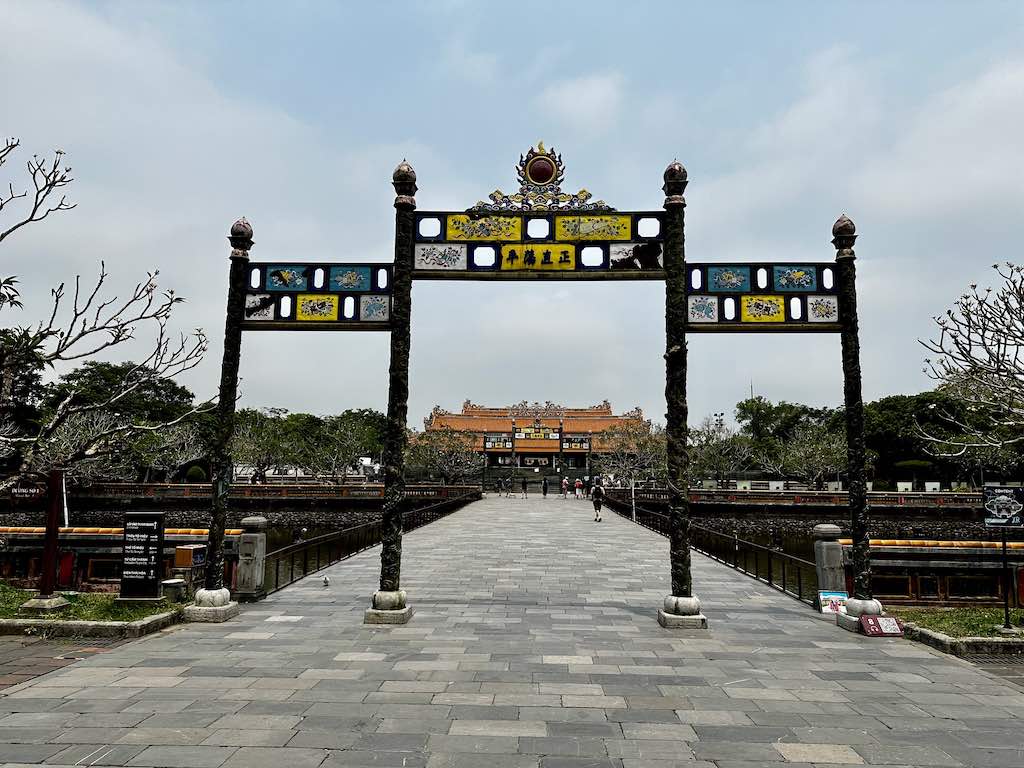
Straight ahead, across the Trung Dao bridge and the Esplanade of Great Salutation, is Thai Hoa Palace, the Hall of Supreme Harmony, where the emperors held court and were crowned. It was closed for a restoration that began in November 2021, cost more than 128 billion VND and ended on 23 November 2024. The red-lacquered columns and the throne are back on view.
Hien Lam Cac and the Nine Dynastic Urns
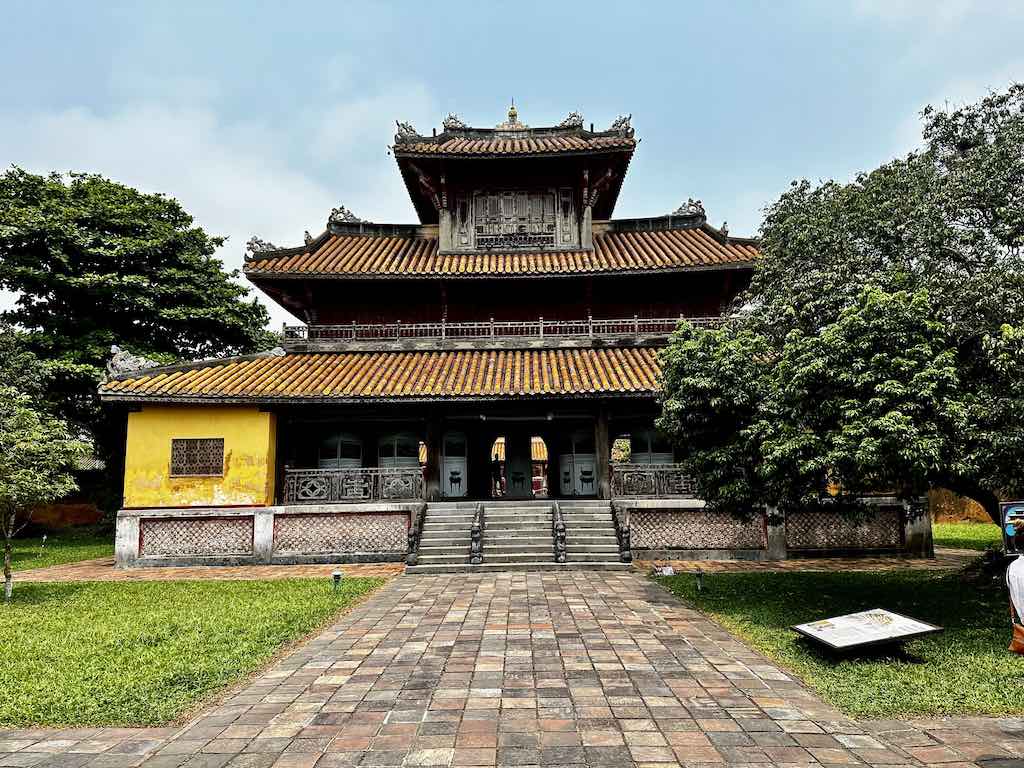
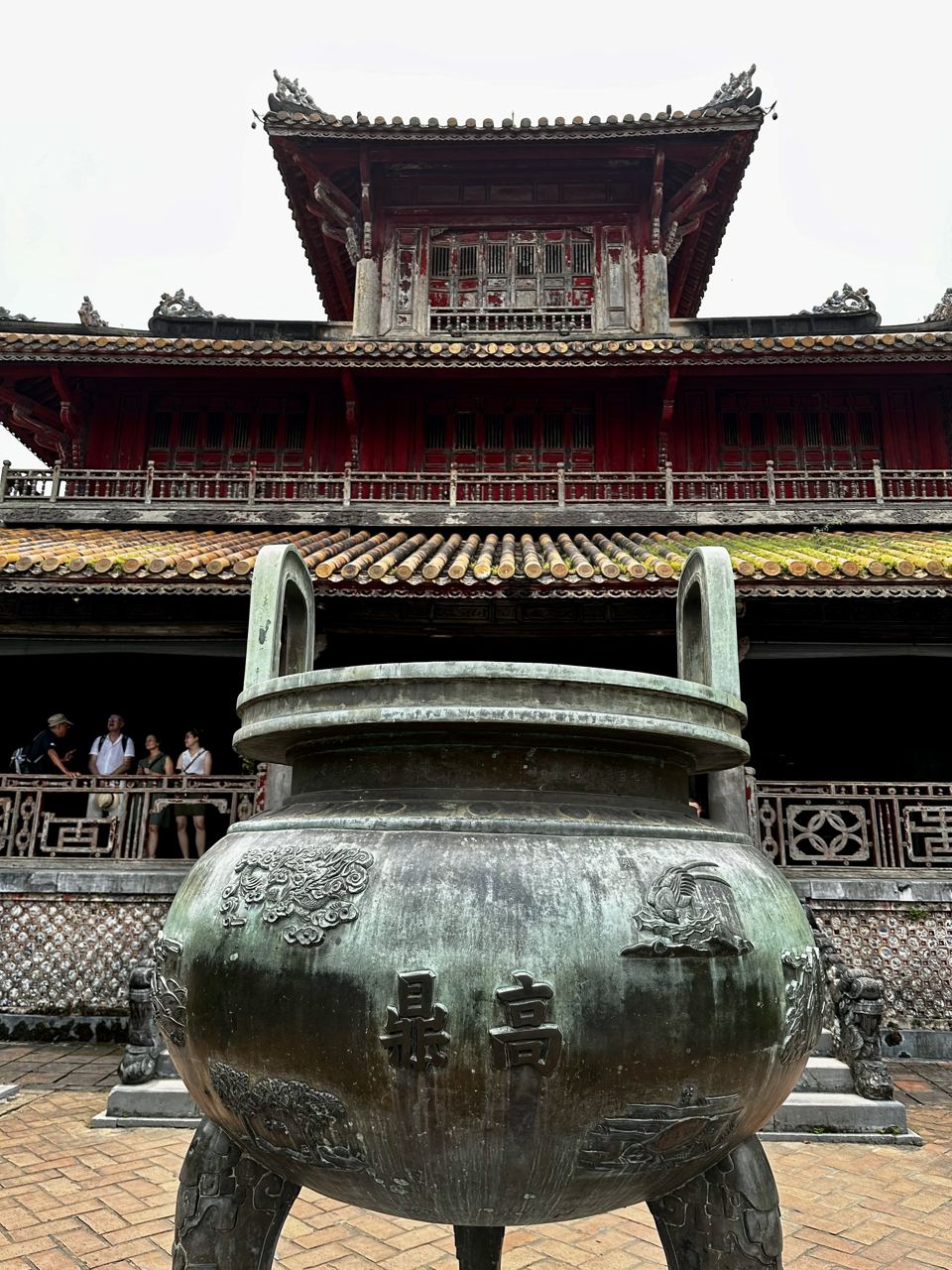
In the western half of the Imperial City, the three-tiered Hien Lam Cac pavilion (1821-1822) honours the mandarins who helped the Nguyen dynasty to power. In front of it stand the Nine Dynastic Urns, bronze vessels cast between 1835 and 1837, each weighing around two tonnes and decorated with 162 motifs of Vietnam’s landscapes, animals and weapons. They are a National Treasure, and in May 2024 UNESCO added them to its Memory of the World register for Asia and the Pacific. Behind them is The Mieu, the temple dedicated to the Nguyen emperors; you take your shoes off to enter.
The Forbidden Purple City and the red galleries
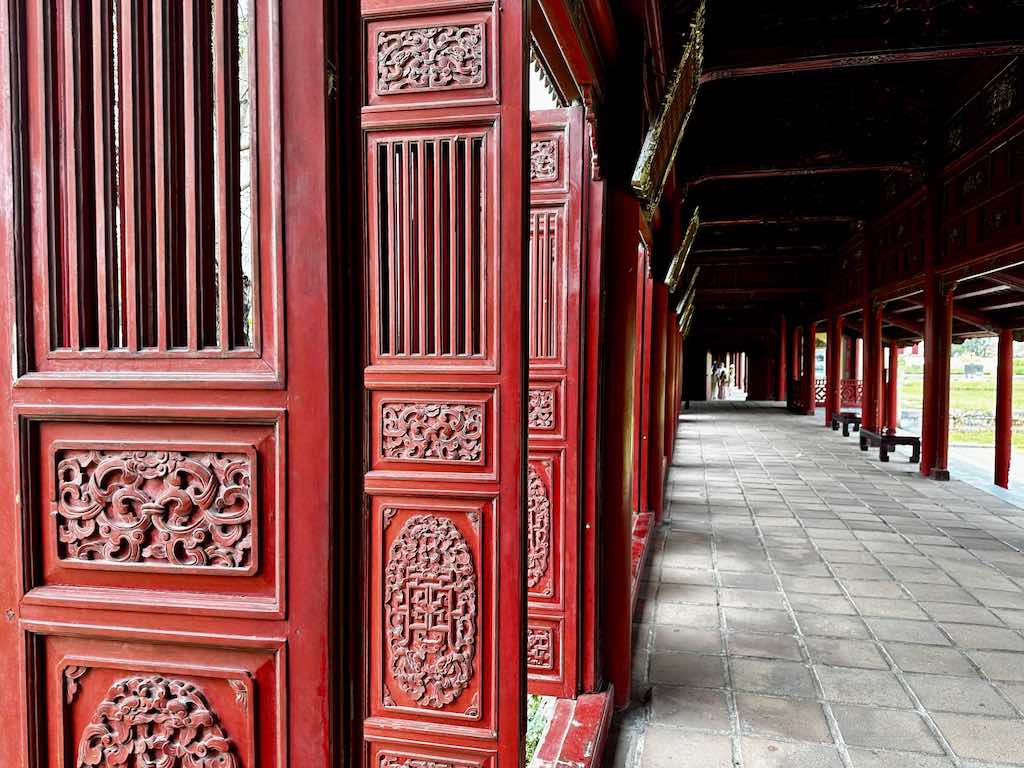
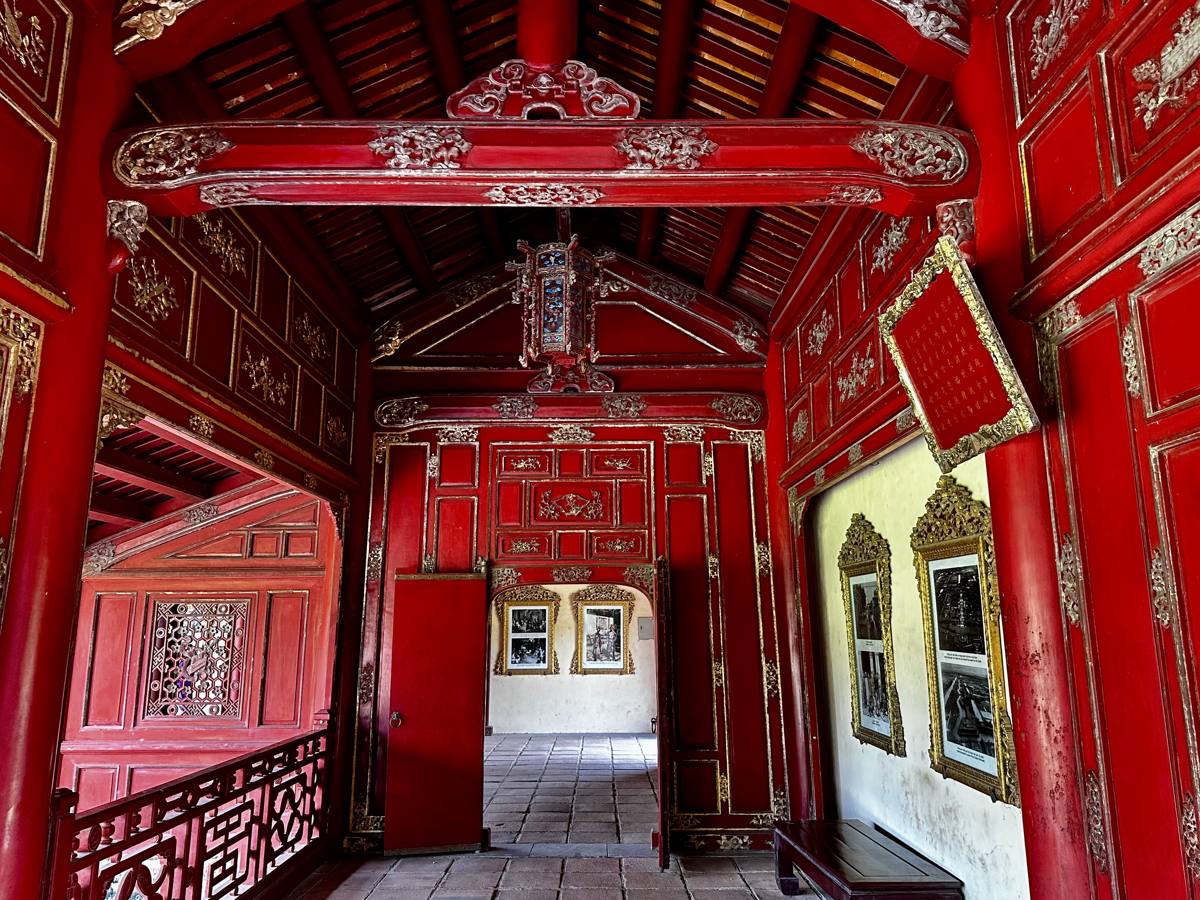
Very little of the Forbidden Purple City is standing, but the covered galleries that connect its surviving buildings are the most photographed part of Hue: long corridors of red lacquered columns and carved wooden doors, open onto the lawns on one side. Come here before noon, when the tour groups have moved on to lunch.
Kien Trung Palace
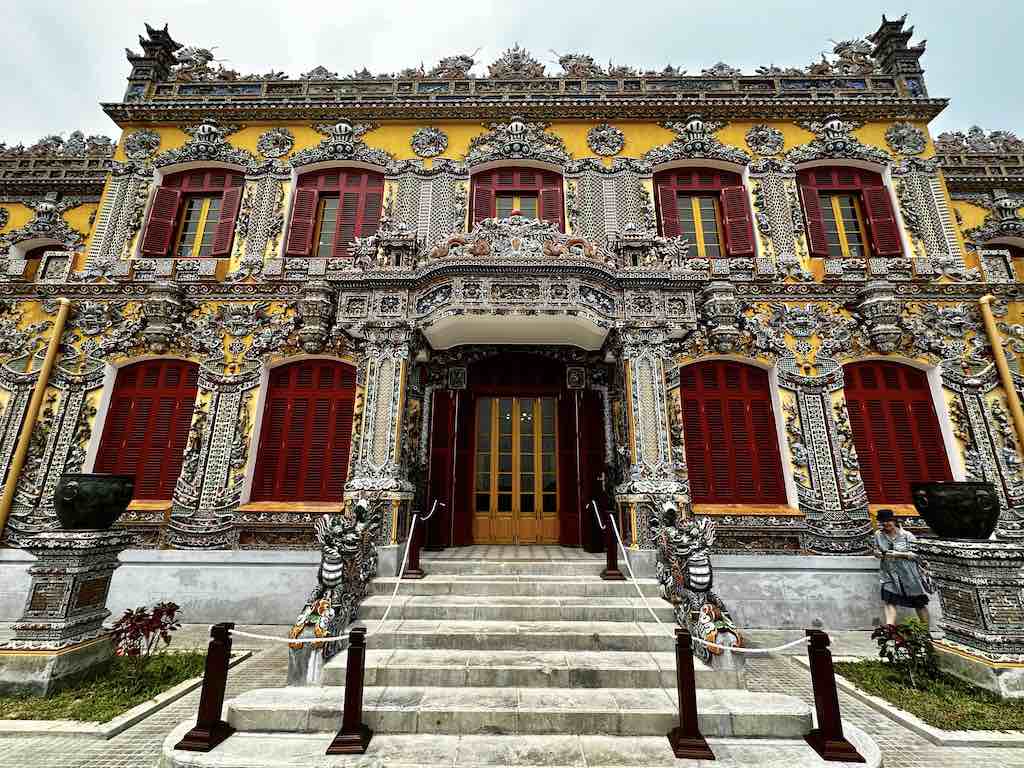
Kien Trung, built in 1921-1923 for Emperor Khai Dinh and later home to Bao Dai, is the odd one out: a two-storey palace with a European façade covered in Vietnamese ceramic mosaics. It was destroyed between 1945 and 1947 and rebuilt from photographs and archives; it reopened to visitors in 2024, with the reception rooms furnished as they were in Bao Dai’s time.
Imperial City tickets and opening hours
A ticket costs 200,000 VND per adult and 40,000 VND for children aged 7 to 12; under-7s go free. The Imperial City opens from 6:30 AM to 5:30 PM in summer and 7 AM to 5 PM in winter. Buy at the booths by the Noon Gate or online through the e-ticket service of the Hue Monuments Conservation Centre. Evening openings are held only for special events for now: in April 2026 the palace opened free at night for four evenings, and the city is still studying a regular schedule.
How to visit it well
Go early, bring water and a hat (there is little shade on the esplanades), and allow at least two hours. Enter by the Noon Gate, walk the central axis to Thai Hoa, turn west for the urns and The Mieu, then east for the galleries and Kien Trung. If you want the context rather than just the buildings, the guided walking tour of the Imperial City is the best-reviewed option in Hue.
The Royal Tombs of Hue
The Nguyen emperors built their tombs in the hills south and west of the city, along the Perfume River, and most of them designed their own while still alive. Seven are open to visitors; three are essential, and they could not be more different from each other. They are 7 to 12 km from the centre: by scooter, Grab or a half-day tour.
The Tomb of Tu Duc
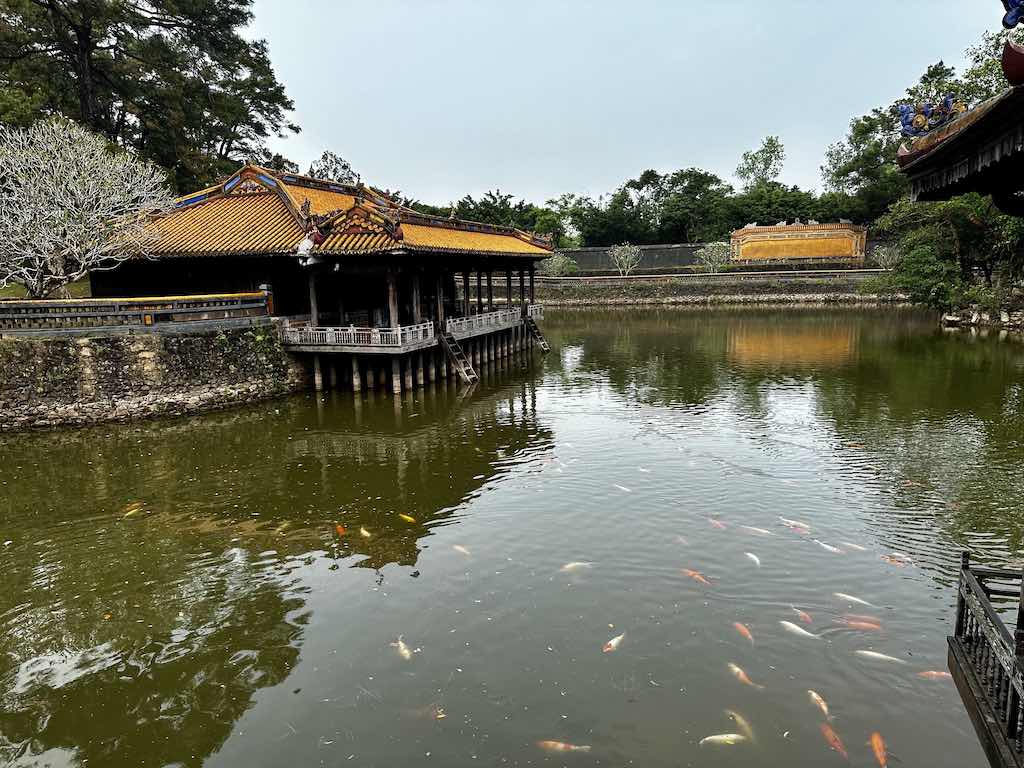
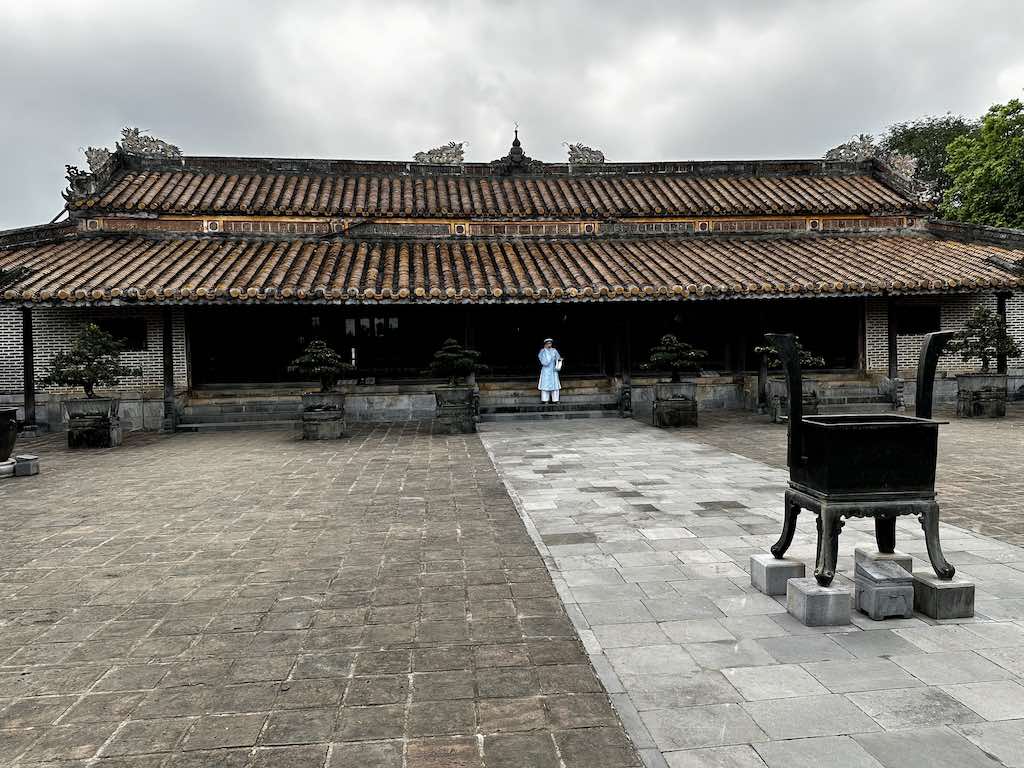
Tu Duc reigned for 35 years, the longest of the dynasty, and built his tomb between 1864 and 1867 as a place to live as much as to be buried. It is a park of pine trees, pavilions and ponds around the Luu Khiem lake, where the emperor came to write poetry and fish from the Xung Khiem pavilion. The forced labour used to build it provoked a rebellion in 1866. Tu Duc himself is not buried here: his body lies in a secret place, and the workers who buried him were reportedly executed to keep it so.
The Tomb of Khai Dinh
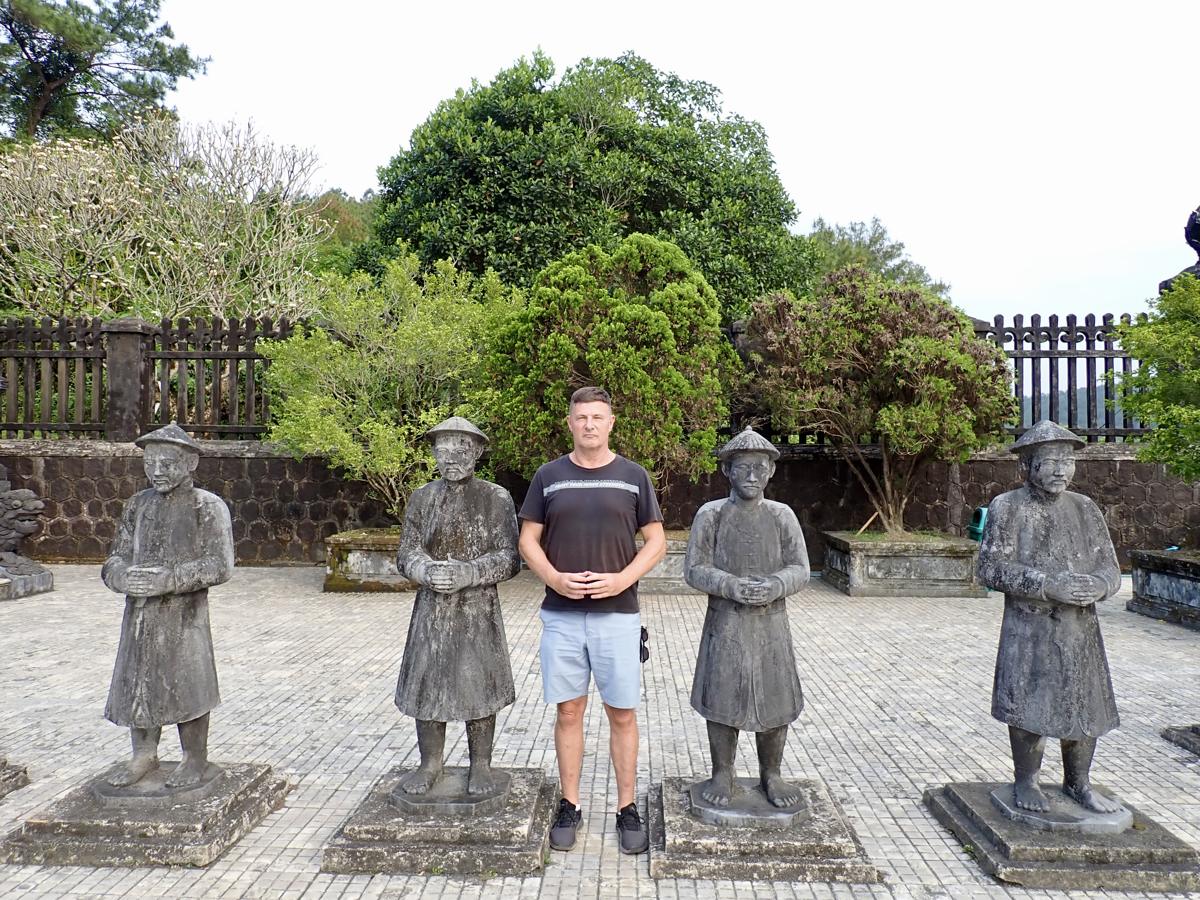
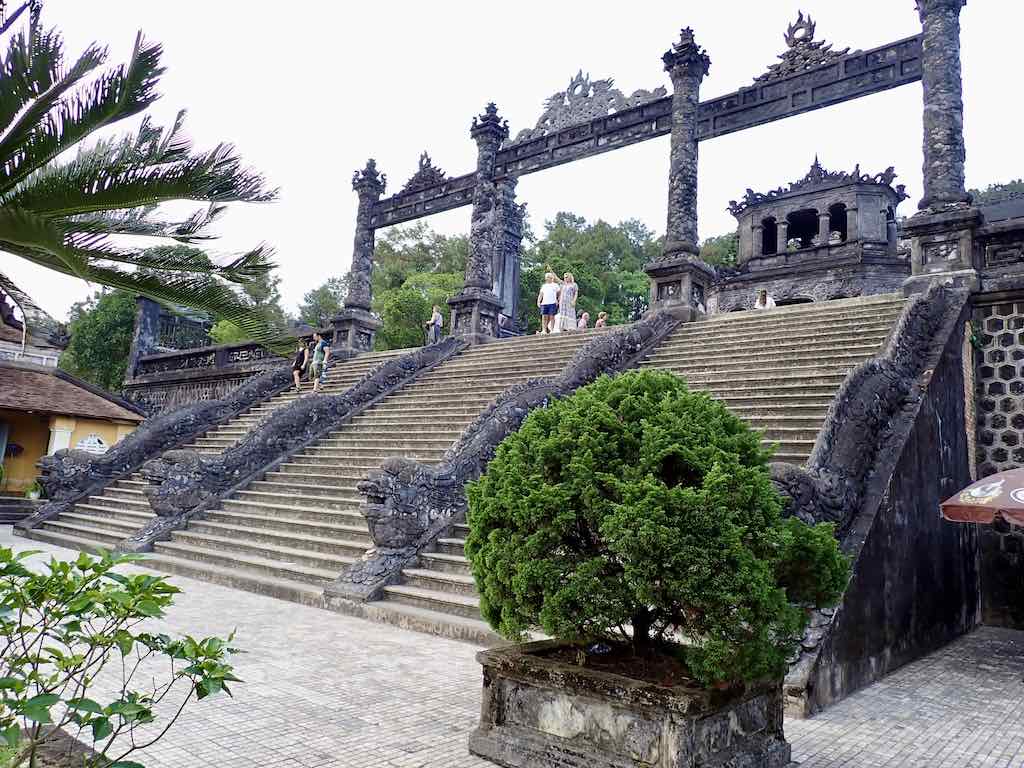
Khai Dinh’s tomb, built between 1920 and 1931 on the slope of Chau Chu mountain, is the last, the smallest and the most extravagant. It is made of concrete and slate rather than wood, climbs 127 steps past rows of stone mandarins, and ends in the Thien Dinh palace, whose walls and ceiling are entirely covered in mosaics of broken porcelain and glass. Khai Dinh was unpopular, seen as close to the French, and he raised taxes to pay for it. It is the one tomb where you will want to look up.
The Tomb of Minh Mang
The tomb of Minh Mang, begun in 1840 and completed in 1843 under his successor, is usually described as the most harmonious of all: a series of courtyards, gates and bridges set along a central axis of about 700 metres, between two lakes. It is the furthest of the three, about 12 km from the centre, and the one I did not have time for.
Tomb tickets and combo passes
Each of the three major tombs costs 150,000 VND (30,000 VND for children). The combos are better value: 420,000 VND for the Imperial City plus two tombs, 530,000 VND for the Imperial City plus Tu Duc, Khai Dinh and Minh Mang, valid over two days. Prices were confirmed unchanged for 2026. If you would rather not drive, the full-day Hue city tour covers the Imperial City and the tombs with lunch and transport.
Thien Mu Pagoda and the Perfume River
Thien Mu Pagoda
Four kilometres upstream from the citadel, on a hill above the river, Thien Mu is the oldest pagoda in Hue, founded in 1601. Its seven-storey octagonal tower, the Phuoc Duyen, was added in 1844 and has become a symbol of the city. In a garage behind the main hall stands the blue Austin car that drove the monk Thich Quang Duc to Saigon in 1963, where he burned himself to death in protest against the government of the time. Entry is free; it is still a working monastery, so dress accordingly.
Dragon boats and Ca Hue music
Dragon boats leave from the Toa Kham pier and the pier at 5 Le Loi, on the south bank. By day, a private boat to Thien Mu costs 600,000 to 700,000 VND an hour. In the evening, shared boats offer Ca Hue, the chamber music of the old court, for about 120,000 VND, at 7 and 8 PM; the night cruise with Ca Hue music and floating lanterns can be booked in advance.
Truong Tien Bridge
The steel bridge that links the two banks was completed in 1899, is 402 metres long and has six spans. At night it is lit with colour-changing LEDs, and the riverside park along Le Loi on the south bank is where Hue goes for its evening walk.
Beyond the Monuments: Markets, Palaces and Museums
Dong Ba Market
At 2 Tran Hung Dao, just outside the citadel walls, Dong Ba is the city’s main market, open from about 5 AM to 7 PM. Come in the morning for the food stalls, where the bún bò and bánh bèo are as good as anywhere in town, and for conical hats, which Hue is known for.
An Dinh Palace
Across the river, An Dinh is the European-style villa where Khai Dinh and then Bao Dai lived in the early 20th century, with painted walls that mix French décor and Vietnamese motifs. It is rarely crowded. Entry is 50,000 VND.
Museum of Royal Antiquities
In the Long An Palace, inside the citadel, the museum displays the everyday objects of the court: robes, porcelain, furniture, musical instruments. Entry is 50,000 VND, and it makes more sense after the Imperial City than before.
A Short History of Hue
The Nguyen lords ruled the south of Vietnam from Hue from the 17th century, but it was Gia Long who made the city the capital of a unified country when he founded the Nguyen dynasty in 1802. His successors built the citadel, the palaces and the tombs over the following decades. From 1883 the emperors ruled under a French protectorate, and the dynasty ended with Bao Dai’s abdication in August 1945.
The city was fought over street by street for almost a month during the Tet Offensive of 1968, and the damage is still visible in the empty lawns of the Imperial City. Restoration began in earnest after the UNESCO listing in 1993 and has accelerated over the past ten years. In January 2025, Hue became a centrally governed city, and in July 2025 its districts were reorganised into wards: the old centre on the south bank is now Thuan Hoa ward, the citadel side Phu Xuan ward.
Hue Itinerary: 1, 2 or 3 Days
One day in Hue
Imperial City from opening time until noon. Lunch near the citadel, then the tombs of Tu Duc and Khai Dinh in the afternoon, Khai Dinh last for the late light. Dinner on the south bank and a walk along the river to Truong Tien Bridge.
Two days
Add Thien Mu Pagoda by dragon boat on the morning of day two, then Minh Mang’s tomb, and Dong Ba market on the way back. In the evening, a Ca Hue boat on the river.
Three days
Give day three to a day trip: the DMZ and the Vinh Moc tunnels to the north, the caves of Phong Nha further north, or the Tam Giang lagoon and Thuan An beach to the east. Or leave for Da Nang over the Hai Van Pass, the most beautiful road in Vietnam.
Where to Eat in Hue
Hue cooking is the most refined in Vietnam, the legacy of a court that expected dozens of dishes at every meal, and also the spiciest. Many of its specialities are small, delicate cakes of rice flour steamed in banana leaves. My guide to Vietnamese food covers the whole country; here is what belongs to Hue.
Bún bò Huế
The city’s signature: round rice noodles in a beef and pork broth flavoured with lemongrass and fermented shrimp paste, with a red slick of chilli oil on top. It is a breakfast dish, eaten from early morning at street stalls and in the market.
Cơm hến and the little cakes
Cơm hến is rice with tiny river clams from the Perfume River, herbs, peanuts and crackling. The cakes come in a series: bánh bèo (steamed in little saucers, topped with shrimp and crackling), bánh nậm (flat, steamed in banana leaf) and bánh bột lọc (translucent tapioca dumplings with shrimp and pork). Bánh khoái is Hue’s crisp pancake, and chè, sweet soups served in glasses, finish the meal.
Where I ate
On the first night, the Cozy Restaurant at 6/27 Ha Noi, a small family place with a long menu of Hue dishes and clay pots: my caramelised chicken came bubbling in its pot. On the second, Madam Thu at 45 Vo Thi Sau, near the bar streets, which serves the Hue specialities in tasting sets and was full on a Monday evening. Neither is in the Michelin Guide, which in its 2026 edition covers only Hanoi, Ho Chi Minh City and Da Nang.
A food tour
The dishes of Hue are hard to find in a single restaurant, and a local guide saves you a lot of guesswork. The Hue local food tour with eight tastings is rated 4.9 by nearly 400 travellers.
Hue at Night
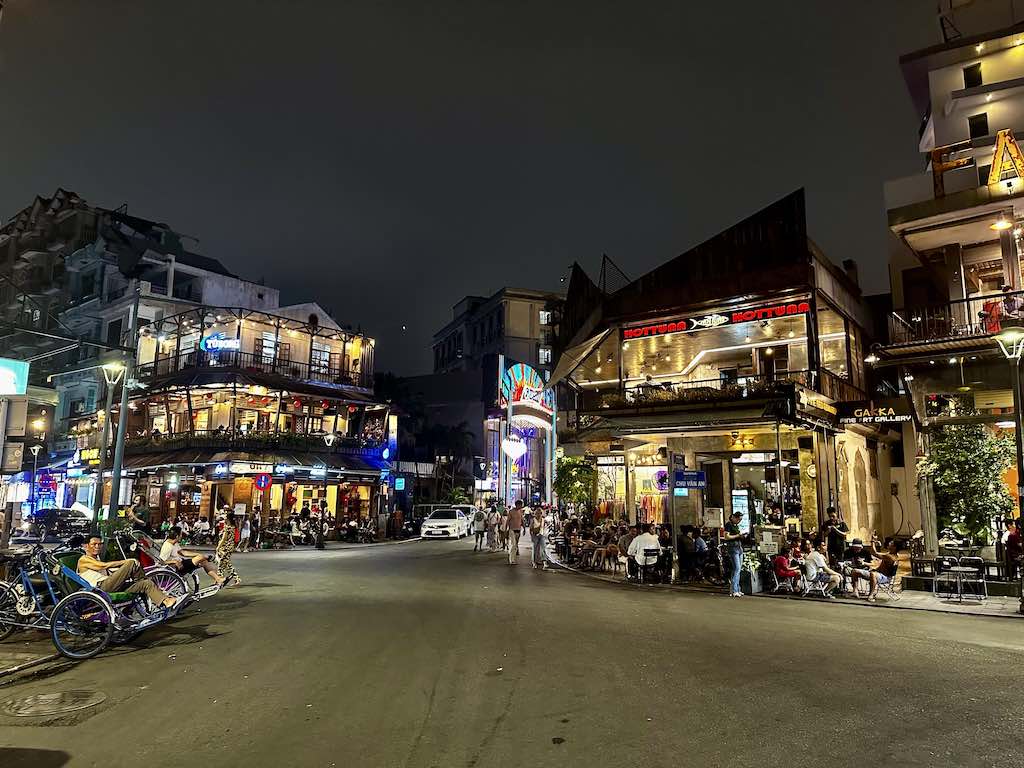
Hue is not a party city, but the south bank comes alive after dark. The blocks between Pham Ngu Lao, Chu Van An and Vo Thi Sau are full of bars and street food, and on Friday, Saturday and Sunday evenings they become a pedestrian street, from 6 PM to 2 AM (midnight on Sunday).
For a view, the rooftop bar at the top of the Meliá Vinpearl, on Hung Vuong, looks over the whole city and the river. For something calmer, the riverside park along Le Loi and Truong Tien Bridge lit up in colour.
Where to Stay in Hue
Most visitors stay on the south bank, between Le Loi and Hung Vuong: close to the river, the restaurants and the bar streets, and a ten-minute ride from the Imperial City. Staying inside the citadel is quieter and more local, but there is less to do in the evening. The resorts on the road to the tombs are for those who want calm and gardens.

Where I stayed: Meliá Vinpearl Hue
The Meliá Vinpearl Hue, at 50A Hung Vuong, is the 34-floor tower that dominates the skyline of the south bank. The rooms on the upper floors look over the whole city to the citadel, and the rooftop bar is the best view in Hue. Rated 9.4 on Booking.com. It is where I stayed.
On the river: Azerai La Residence
Azerai La Residence, at 5 Le Loi, occupies the former residence of the French governor, built in 1930 in Art Deco style, with a pool and gardens facing the Perfume River. It is the most elegant address in Hue, rated 9.6.
Garden resort: Pilgrimage Village
Pilgrimage Village Resort & Spa, at 130 Minh Mang, is a village of bungalows among lotus ponds and trees on the road to the tombs, about 6 km from the centre. Rated 9.6, and ideal if you have a scooter or don’t mind a Grab ride.
Good value near the bar streets: Jade Hotel
The Jade Hotel, at 43 Hung Vuong, is a small, well-run hotel in the same street as the Meliá, a few minutes’ walk from the restaurants of Vo Thi Sau. Rated 8.9, for a fraction of the price.
Day Trips from Hue
The DMZ and the Vinh Moc tunnels
The former demilitarised zone along the 17th parallel starts about 100 km north of Hue. The usual loop takes in the Vinh Moc tunnels, where a whole village lived underground during the American bombing, the Hien Luong bridge over the Ben Hai river and the Khe Sanh base. It is a long day; the full-day DMZ tour from Hue is rated 4.9 by more than a thousand travellers.
Phong Nha caves
The caves of Phong Nha-Ke Bang National Park, including Paradise Cave, are about four hours north by road. It can be done in a very long day from Hue, but it is better to spend a night there; buses and vans to Phong Nha are on 12Go.
Tam Giang lagoon and Thuan An beach
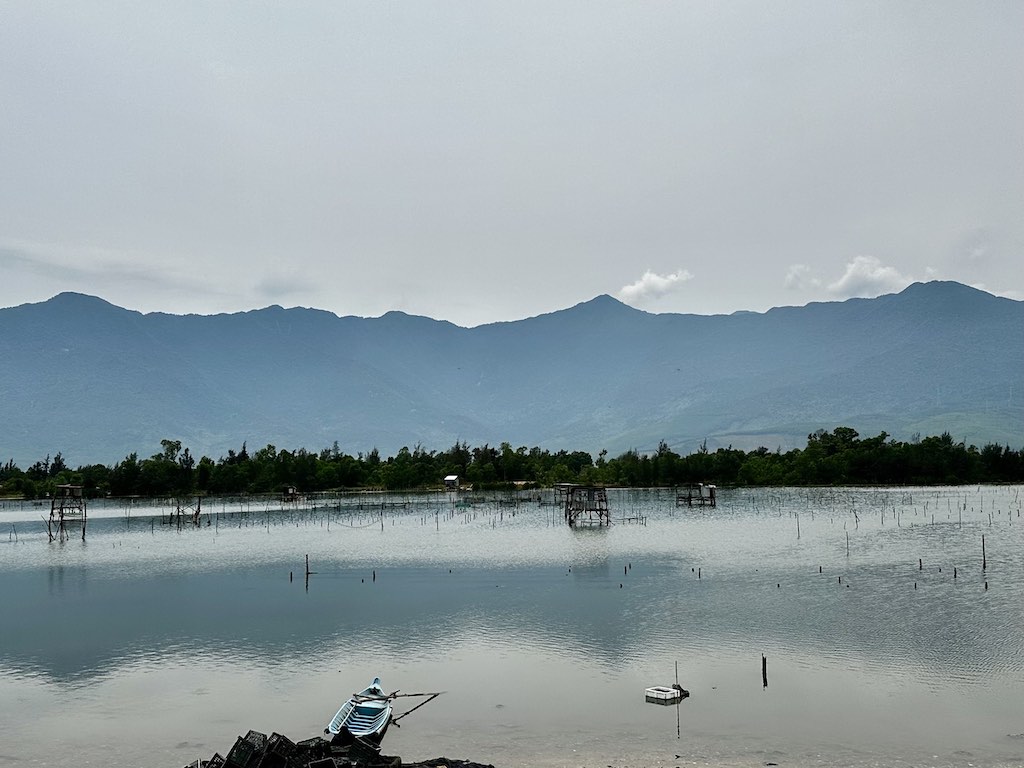
East of the city, the Tam Giang-Cau Hai lagoon system stretches for about 70 km along the coast, with fishing villages and fish traps on stilts. Thuan An beach, 15 km from the centre, is where the people of Hue go to swim.
Bach Ma National Park
Halfway to Da Nang, Bach Ma rises to 1,448 metres, with waterfalls, forest trails and the ruins of French villas from the 1930s. Entry is 65,000 VND; count an hour’s drive from Hue.
Practical Tips: Getting There, Getting Around, Best Time
Getting to Hue
Phu Bai International Airport (HUI) is 15 km south of the centre, 20 to 30 minutes by car; its new terminal opened in 2023. Grab or taxi costs about 250,000 to 300,000 VND, and bus no. 2 runs every half hour for a few thousand dong. By train, Hue is on the Reunification line: around 13 hours from Hanoi overnight. Compare trains, buses and flights from Hanoi or from Ho Chi Minh City on 12Go.
From Da Nang and Hoi An, and the Hai Van Pass
Da Nang is about 100 km away: two to three hours by road through the Hai Van tunnel, two and a half by the regular train. The more beautiful option is to go over the top, by scooter as I did or with an Easy Rider motorbike tour, or by the heritage train that runs along the coast below the road with a stop at Lang Co. Buses and trains from Da Nang and from Hoi An can be compared on 12Go.
Getting around
The centre is walkable on each bank, but the tombs are not: use Grab (car or bike), a scooter or a tour. Scooters rent for about 100,000 to 200,000 VND a day, and the roads to the tombs are easy. Vietnam only recognises an international driving permit issued under the 1968 Vienna convention. My page on getting around Vietnam covers the rest.
Best time to visit Hue
Late January to April is the best time: mild, mostly dry, with the least rain of the year. May to August is very hot, often above 35°C. From September to December the rains come, and October (around 750 mm) and November are the wettest months. In late October 2025, record rainfall flooded the city: the Perfume River rose 1.1 metres above the top alert level, and the Imperial City and the tombs closed temporarily. If you travel in autumn, keep a day in hand. The Vietnam trip planning guide gives the month-by-month picture for the whole country.
Festivals
Festival Hue, the city’s cultural festival, now runs as a four-season programme with around 80 events across the year; in 2026 it opened on 25 April, with its international arts week in June. Tet, the lunar new year, is also a beautiful time to be in Hue, but many restaurants close for several days.
Hue or Hoi An? How to Split Your Time
They are complementary rather than competing. Hoi An is a small, lantern-lit trading town where you walk, eat and shop; Hue is a former capital where you go to see monuments on a grand scale, and it needs transport. If you only have four days in central Vietnam, give two to Hoi An, one to Da Nang and one to Hue, travelling by the Hai Van Pass. If you have a week, give Hue two full days. And if you are coming from the north, Hue is the first stop: Hanoi is an overnight train away, and Sapa further still.
Read More About Central Vietnam
Da Nang Travel Guide
Over the Hai Van Pass from Hue: the Dragon Bridge fire show, My Khe Beach, the Marble Mountains and Ba Na Hills.

Hoi An Travel Guide
The lantern town south of Da Nang: the old town ticket explained, where to eat cao lau, My Son and the flood season.

Getting Around Vietnam
Trains, sleeper buses, domestic flights and scooters: how to move between Hanoi, Hue, Da Nang and Saigon.
Frequently Asked Questions About Hue
How many days do you need in Hue?
Two full days: one for the Imperial City and one for the royal tombs and Thien Mu Pagoda. Add a third for a day trip to the DMZ or the Phong Nha caves.
Is Hue worth visiting?
Yes. It has the most important monuments in Vietnam, the Imperial City and the royal tombs, a UNESCO World Heritage Site since 1993, and some of the best food in the country. It is also far calmer than Hanoi or Ho Chi Minh City.
How much is the Hue Imperial City ticket in 2026?
200,000 VND per adult and 40,000 VND for children aged 7 to 12; under-7s go free. The combo with the three main tombs costs 530,000 VND.
What are the Imperial City opening hours?
6:30 AM to 5:30 PM in summer and 7 AM to 5 PM in winter. Night openings are held only for special events for now.
Which royal tomb is the best in Hue?
Tu Duc for its gardens and lake, Khai Dinh for its extravagant mosaics, Minh Mang for the harmony of its layout. With half a day, see Tu Duc and Khai Dinh, which are close to each other.
What is Hue famous for?
The Imperial City of the Nguyen dynasty, the royal tombs along the Perfume River, Thien Mu Pagoda, and its cuisine, starting with bún bò Huế.
How do I get from Da Nang to Hue?
By road through the Hai Van tunnel in two to three hours, by train in about two and a half hours, or over the Hai Van Pass by motorbike or on the heritage train for the views.
Can you ride a scooter from Da Nang to Hue?
Yes, it is about 100 km and three hours over the Hai Van Pass, one of the most beautiful roads in Vietnam. You need an international driving permit under the 1968 convention.
When is the best time to visit Hue?
Late January to April, when it is mild and mostly dry. October and November are the wettest months and can bring floods, as in late October 2025.
Where should I stay in Hue?
On the south bank of the Perfume River, between Le Loi and Hung Vuong, close to the restaurants and a short ride from the Imperial City.
What food should I try in Hue?
Bún bò Huế, cơm hến (rice with river clams), the steamed rice cakes bánh bèo, bánh nậm and bánh bột lọc, the crisp bánh khoái pancake and chè for dessert.
Is Hue or Hoi An better?
They are different and close to each other: Hoi An for a walkable old town and relaxed days, Hue for imperial monuments. Most itineraries include both.