Diving in Bali: Best Dive Sites, Seasons & Costs (2026)
By Blaise Jaeger · Updated September 28, 2026
Bali is one of the very few places on earth where you can dive a 120-meter wartime shipwreck straight off the beach in the morning, hunt harlequin shrimp on black sand in the afternoon, and — an hour’s boat ride away — hang in a 20 °C current waiting for a three-meter sunfish to rise out of the blue. Diving in Bali is not one destination. It is five completely different ones, wrapped around a single island.
This guide covers all of them: Tulamben and its USAT Liberty wreck, Amed‘s easy reefs and muck sites, the wild three Gili of Padang Bai, the crystal water of Menjangan in the west, and the manta and mola-mola country of Nusa Penida. For each zone, you get the real dive sites, depths, certification levels, seasons, prices in 2026, and where to sleep so you’re in the water before the day-trippers arrive.
What follows is what I’d tell a friend flying in next month — including the parts most dive-shop websites leave out.
First-hand guide: I live in Bali, I opened and still run Nusa Penida’s first PADI dive center, and I have logged more than 700 dives — several hundred of them in Balinese water. Every zone below is one I have dived myself, and the prices and conditions are cross-checked against current operator information. More on how this guide was researched.
Bali Diving Guide: Quick Navigation
- Bali diving at a glance and the five dive zones
- Tulamben, Amed, Padang Bai, Menjangan and Nusa Penida
- Dive sites by certification level, best season and 2026 costs
- Where to stay, itineraries and safety
- About the author and FAQ
Bali Diving at a Glance
| Main dive zones | 5: Tulamben, Amed, Padang Bai / Candidasa, Menjangan / Pemuteran and Nusa Penida |
| Water temperature | 26–30 °C on most of the island; 17–26 °C at Nusa Penida in mola season; 19–28 °C at the Padang Bai Gili; 20–25 °C at Secret Bay year-round |
| Visibility | 15–30 m typical; 40–50 m on the best days at Menjangan; 8–15 m at Secret Bay and the Padang Bai Jetty |
| Best overall season | April–October for generally drier conditions; July–October for the main sunfish season |
| Signature encounters | Reef mantas, bump-head sunfish, pygmy seahorses, harlequin shrimp, Rhinopias, mandarinfish and reef sharks |
| Signature wreck | USAT Liberty, Tulamben — approximately 3 to 30 m, shore entry, suitable for most levels |
| Typical cost of 2 fun dives | IDR 1,000,000–2,000,000 (~$56–113 / €49–98) booked near the dive site; IDR 2,700,000 and up (~$153 / €132) booked from South Bali |
| Certification | Discover Scuba is widely available. Advanced certification and current experience are recommended or required for the most demanding sites |
| Time needed | 5–7 days for two zones; 10–12 days for a broader trip without spending every day in a car |
| Emergency planning | Carry dive insurance and confirm your operator’s evacuation procedure before diving. DAN Asia-Pacific emergency line: +61-8-8212 9242 |
The Five Dive Zones of Bali
Divers who come to Bali for a week and try to “do the island” usually end up spending three days in a car. Pick two zones. Here is how they compare — and what each one is actually for.
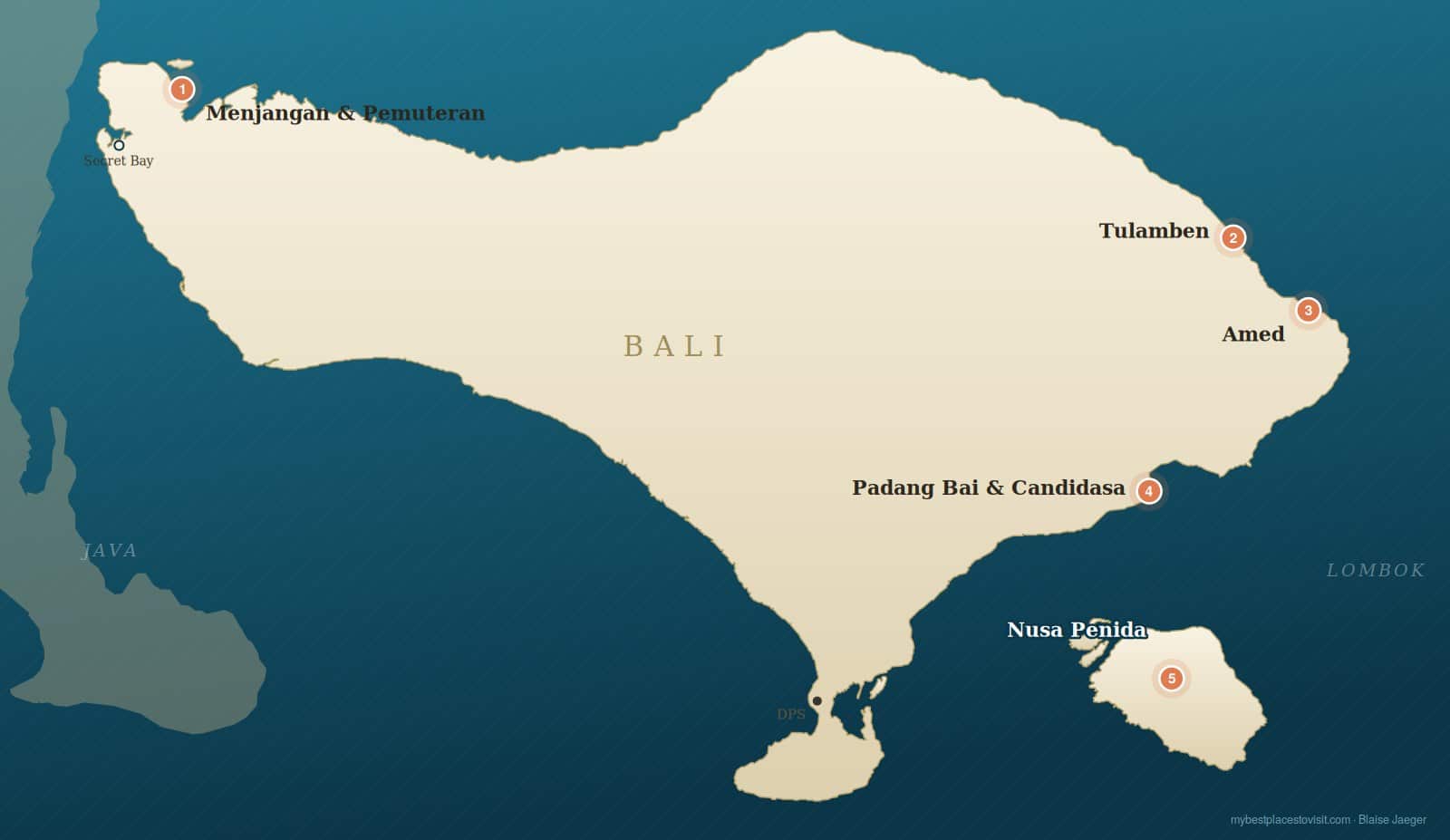
| Zone | What it’s for | Access | Level | From DPS airport |
|---|---|---|---|---|
| Tulamben (NE coast) | The Liberty wreck, macro, night dives | Shore | All levels | ~3 h |
| Amed (E coast) | Easy reefs, muck, freediving, learning to dive | Shore + jukung | Beginner-friendly | ~2 h 45 |
| Padang Bai / Candidasa (SE) | The three Gili: sharks, current, cold, sunfish | Boat (10–15 min) | AOW + experience | ~1 h 30 |
| Menjangan / Pemuteran (NW) | Walls, the clearest water in Bali, coral restoration | Boat (20–30 min) | All levels | ~4 h 30 |
| Nusa Penida (SE island) | Reef mantas, seasonal sunfish and major drift dives | Fast boat + dive boat | Beginners at selected sites; AOW and current experience for most drift and sunfish dives | ~1 h + 30–45 min boat |
The classic pairing is Tulamben + Amed: 25 minutes apart by road, wildly different underwater, and both shore-diving. Add Nusa Penida if you’re chasing big animals — Manta Point is open to everyone, but the drift sites and the mola corners want an Advanced card. Add Padang Bai if you want sharks and don’t mind being cold. Save Menjangan for a trip where you can give the west coast three days of its own — it’s a 3.5-hour drive from Tulamben and doesn’t fold neatly into a short itinerary. Most of the eastern zones sit within the regency covered in our East Bali guide to Amed, Tulamben and Sidemen.
Why Dive in Bali?
Bali sits on the western edge of the Coral Triangle, at the exact point where the deep, cold Indian Ocean squeezes north through the Lombok Strait into the Java Sea. That single piece of geography explains almost everything about diving here. The strait acts as a pump: between July and October it drags cold, nutrient-heavy water up from depth around Nusa Penida, feeding a plankton bloom that in turn brings a fish which normally lives 200 to 600 meters down up to the surface at Crystal Bay to be cleaned. Ninety kilometers northwest, in the sheltered lee of Menjangan Island, the same island produces the calmest, clearest, warmest water in Bali. Same island, 10 °C apart.
Then there is the volcanic factor. Gunung Agung’s 1963 eruption is the reason the Liberty wreck is in the water instead of on the beach, and the black volcanic sand of the north-east coast is what makes Tulamben, Amed and Secret Bay world-class muck grounds. Black sand hides nothing: a frogfish, a Rhinopias or a mimic octopus stands out against it in a way it never would on a coral reef.
Practically, three things make Bali unusually easy: most north-east coast sites are shore dives, so no boat and no schedule; the island is a single road trip, so you can dive four wildly different ecosystems in a week without a domestic flight; and competition between operators keeps prices among the lowest in Asia. For the bigger picture, we’ve mapped out the best diving in Indonesia across the archipelago.
Tulamben: The USAT Liberty and Bali’s Best Shore Diving
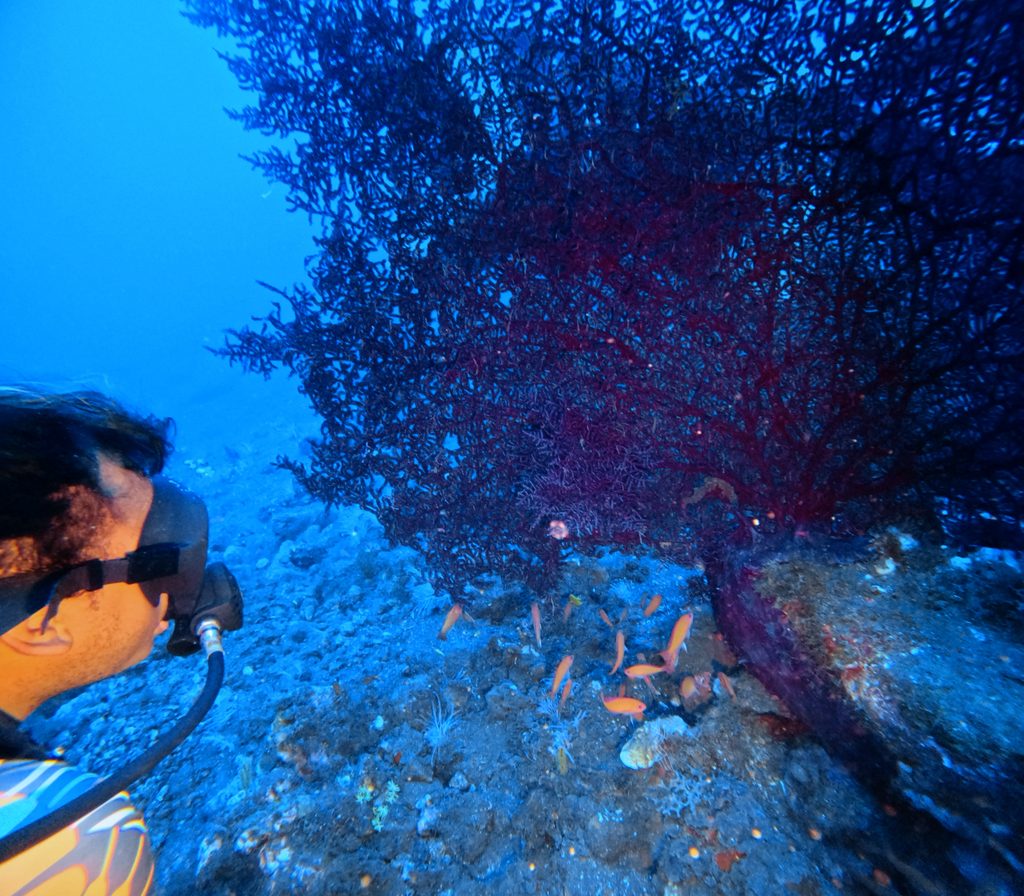
Tulamben is Bali’s best-known wreck-diving destination, centered on the USAT Liberty, which lies between about 5 and 30 meters just off the black pebble beach. I first dived here in 2015 and returned in 2020, 2024 and 2026, which gives me more than a decade of perspective on the site. Beyond the Liberty, Tulamben offers easy shore diving, the Drop Off wall and some of Bali’s best macro life at Seraya — very different from the current-driven diving around Nusa Penida.
→ Read my complete Tulamben diving guide, including how the Liberty and the diving experience have changed since 2015.
Best for: wrecks, macro and night dives · Level: beginner to advanced · Typical water: 25–29 °C · Stay: 2–3 nights · Don’t miss: the Liberty at sunrise
Amed: Easy Reefs, Muck Diving and Freediving
Amed isn’t one village but a string of seven along a dry, dramatic stretch of coast twenty-five minutes south of Tulamben. Traditional jukung outriggers are pulled up on the black sand and salt is still made by hand in the flats behind the road. It is the friendliest place in Bali to learn to dive, and simultaneously one of its best muck-diving grounds — a combination almost nowhere else offers.
Best for: learning, relaxed reefs, muck and freediving · Level: beginner to advanced · Typical water: 26–30 °C · Stay: 2–4 nights · Don’t miss: Jemeluk and a night macro dive
Jemeluk Bay and the Underwater Gallery
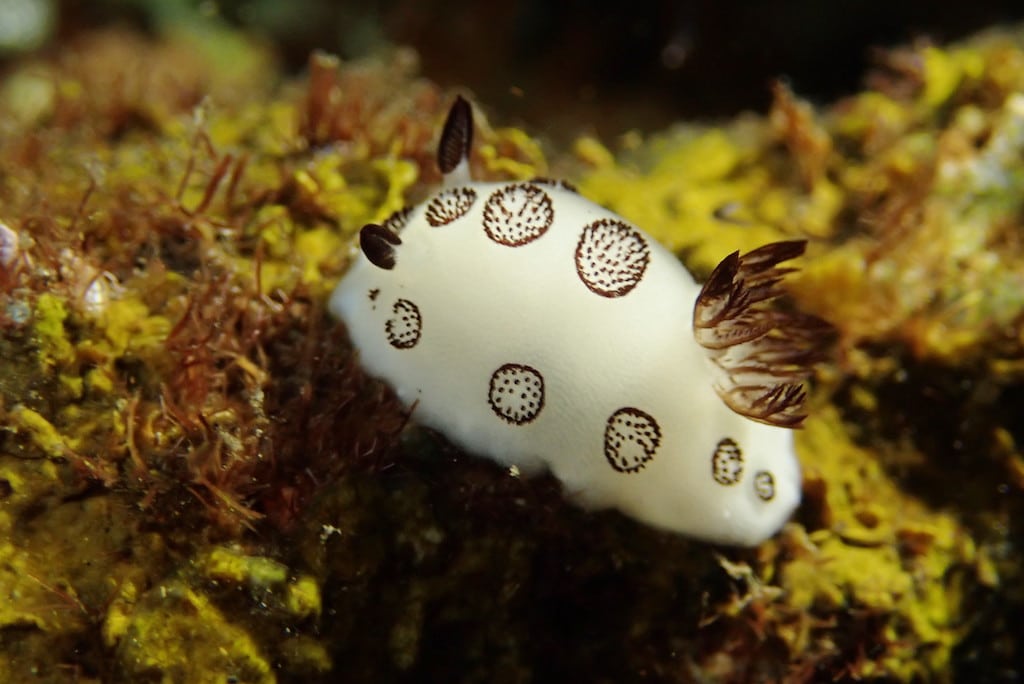
Jemeluk Bay (5–30 m, all levels) is Amed’s training bay and its most-dived site. A gentle black-sand slope holds nudibranchs, leaf scorpionfish, seahorses, ghost pipefish, mimic octopus and peacock mantis shrimp; turtles are routine; and the wall on the north side runs from 10 to 40 m with black-tips and white-tips patrolling the deeper section.
The bay also holds the Jemeluk Underwater Gallery: a sunken Balinese temple and statue complex at 5–7 meters, a giant child’s head by the Indonesian sculptor Eddi Prabandono, a mermaid by Wayan Winten, treasure chests and Hindu nymphs, installed progressively since around 2014. There is even a working underwater post box on Jemeluk Wall — buy a waterproof postcard on the beach before you descend. It’s shallow enough for snorkelers and a standard reward stop for Open Water students after buoyancy drills. The temple and statues at 5–7 m are also Amed’s reference spot for freediving, which the village has quietly become Indonesia’s capital of.
The Japanese Wreck at Lipah — an unsolved mystery
Sitting at just 6 to 12 meters, between 15 and 60 m off Lipah beach and marked by black buoys, the “Japanese Wreck” is about 20 meters long, snorkel-accessible, and covered in black coral and sea fans that hold pygmy seahorses, ghost pipefish, dragonets, demon stingers and clouds of anthias. It is one of the easiest wreck dives in Asia.
What it actually is, nobody knows. Some operators call it a Japanese WWII patrol boat that ran aground; others insist it’s a small wooden fishing boat from Java, the “Japanese” label coming from a local pronunciation mix-up; a third version has it as a small Japanese steel freighter. No archival or naval record confirms any of them, and the more honest dive centers in Amed say so openly. I’d rather tell you it’s a genuine open question than repeat a story I can’t source.
Ghost Bay, the Pyramids and Gili Selang
Ghost Bay (also Café Garam) at Bunutan is Amed’s muck site: a 150-meter-wide plateau at 4–7 m dropping to 20–25 m on black volcanic sand, named by the local guide Wayan Suanda for its ornate ghost pipefish. Mimic octopus, Wonderpus, painted and clown frogfish, stonefish, flying gurnard, sea moths and sleeping white-tips. There’s a small speedboat wreck on the slope at 22–25 m.
The Pyramids are hollow concrete structures dropped by local fishermen in the early 1990s to build an artificial reef, now sitting between roughly 10 and 25 m. Thirty years on it works spectacularly: turtles are close to guaranteed, there’s a stingray cleaning station, and you’ll find snapper schools, pygmy seahorses and giant barracuda. Usually dived as a gentle drift, suitable from beginner level up.
Gili Selang (5–40 m) is the exception in an otherwise easy zone. Bali’s easternmost point has strong, unpredictable currents where two bodies of water collide, and delivers bumphead parrotfish, giant trevally, white-tips, mola-mola and — rarely — hammerheads. Advanced divers with current experience only, and only when the guide says conditions are right.
For night dives, Melasti (3–20 m) is the local classic: frogfish, harlequin shrimp, seahorses, coconut octopus and decorator crabs.
My verdict: choose Amed for a relaxed dive holiday, an Open Water course, or several days of macro. It pairs naturally with Tulamben, 25 minutes up the road.
Padang Bai and Candidasa: The Three Gili
These are not the Gili Islands of Lombok. Off the coast between Padang Bai and Candidasa sit three uninhabited rocks — Gili Tepekong, Gili Mimpang and Gili Biaha — that produce the most demanding and, on the right day, the most rewarding diving on mainland Bali. Ten to fifteen minutes by boat. Sharks, big current, and water that will surprise you with how cold it gets.
Best for: sharks, current and seasonal sunfish · Level: easy inshore sites plus advanced offshore sites · Typical water: 19–28 °C · Stay: 2–3 nights · Don’t miss: the three Gili when conditions allow
Gili Tepekong and The Canyon
Tepekong is fifteen minutes north of Padang Bai and is dived from 10 to 40 m. Reef sharks, schooling barracuda, sweetlips, jacks, grouper, turtles, frogfish and seasonal mola. The signature feature is The Canyon, a boulder-strewn chute on the south side that local guides nickname “The Toilet” or “the washing machine” — for good reason. It generates heavy surge and genuine down-current risk, and is at its worst around the full and new moon.
Minimum for the site is Advanced Open Water; several reputable operators add a minimum of 10 logged dives, and for the Canyon itself they restrict it further to highly experienced divers. This is not a place to inflate your logbook.
Gili Mimpang — Shark Point
Ten minutes from Candidasa, Mimpang is a cluster of three large and six small rock formations dived between 10 and 35 m, with the sharks generally below 25 m. White-tip reef sharks are the draw, along with two rarer prizes: wobbegong and coral cat shark, both unusual sightings anywhere in Indonesia. Trevally and sweetlips school here, and mola-mola turn up from August to October. Visibility is reliably good — operators quote around 30 m year-round. AOW or equivalent, and you need to be comfortable in current.
Gili Biaha and the Shark Cave
Four kilometers from Tepekong, Biaha has a wall that falls beyond 80 m and, at 10–12 meters, a cave where white-tip reef sharks sleep. Getting into it means timing the surge at the mouth correctly — miss it and you get pushed into rock. Experienced divers only, and only with a guide who dives it regularly. Outside the cave: moray, cuttlefish, Napoleon wrasse, octopus, nudibranchs and leaf scorpionfish.
The cold — and the easy alternatives
Across the three Gili, water runs from 19 °C to 28 °C with cold thermoclines common around 20 m, and Blue Lagoon nearby drops from 26–28 °C (November–May) to about 20 °C (June–October). If you’re used to 29 °C bathwater in south Bali, a 5 mm suit here is not overkill.
Padang Bai also has genuinely easy sites, which is why so many people learn here. Blue Lagoon (5–25 m, calm) is one of Bali’s best beginner dives — turtles, cuttlefish, seahorses, nudibranchs and leaf scorpionfish; Tanjung Jepun (15–25 m) adds a small 20-meter wreck; Bias Tugal (15–35 m) has green turtles and pygmy seahorses. And then there’s the Jetty — Bali’s best-kept muck secret, the murkiest water in the area (5–15 m) and Advanced-only because of boat traffic, but it produces Rhinopias, frogfish, octopus and ghost pipefish with a consistency that keeps photographers coming back. Ugly water, extraordinary animals.
The three Gili are usually dived as a single boat day out of Padang Bai or Candidasa — but they can also be reached directly from Nusa Penida, which is how I dive them and a route most visiting divers never consider. Which of the three you actually get depends entirely on the current and swell that morning. For the site-by-site breakdown, and for how to organize the day from either side of the strait, see my guide to diving the Gili of Padang Bai.
My verdict: choose Padang Bai or Candidasa for demanding offshore diving, sharks and seasonal sunfish — with Blue Lagoon and the Jetty in reserve for the days the boats stay in.
West Bali: Menjangan, Pemuteran and Secret Bay
Bali’s north-west is four and a half hours from the airport and feels like a different country: dry savannah, almost no tourism, and the calmest, clearest water on the island. It’s also where the island’s most important coral restoration work is happening, and where its strangest dive site sits.
Best for: calm walls, visibility and coral restoration · Level: beginner to advanced · Typical water: 26–30 °C, far colder at Secret Bay · Stay: 2–3 nights · Don’t miss: the Menjangan walls and the Pemuteran Biorock
Menjangan Island: walls and the clearest water in Bali
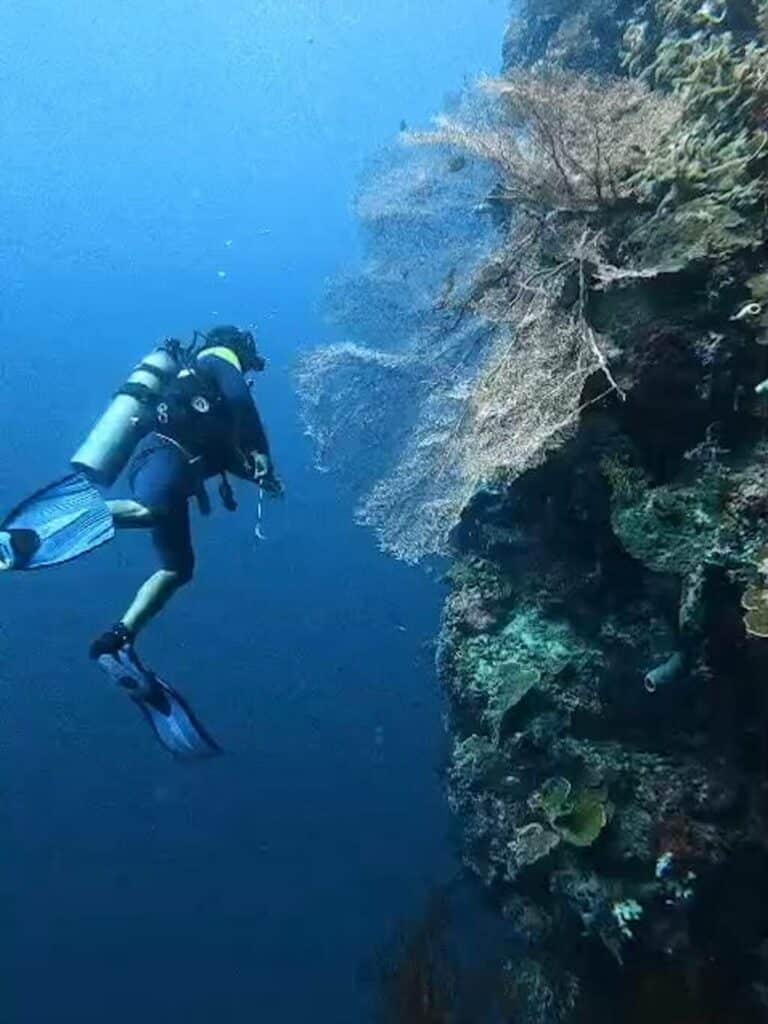
Menjangan — “deer” in Balinese — is a small uninhabited island inside West Bali National Park, about five miles off the north-west coast. It is Bali’s premier wall diving, and the sheltered position means conditions are calm almost year-round with water at a stable 26–30 °C.
The headline sites: Eel Garden (4–30 m), where a colony of garden eels carpets a white sand slope before a vertical wall drops into open ocean, with pygmy seahorses, turtles, reef sharks and trevally. Pos II (6–30 m), a wall of sponges, soft corals and giant gorgonians. Coral Garden (3–27 m), shallow enough for snorkelers, with an enormous gorgonian fan, batfish and eagle rays. Bat Cave and Temple Point, caverns along the wall beneath a giant Ganesha statue perched on the cliff top. And Sandy Slope (1.5–20 m), the training site, where bumphead parrotfish and the occasional manta pass through.
Nearby Bajul Bay (5–24 m) is one of only two confirmed mandarin fish sites in Bali — the dusk window is roughly 17:30 to 19:00.
On the visibility claim: you’ll see “50 meters” quoted everywhere for Menjangan. The honest version is that it runs routinely 20–30 m and reaches 40–50 m on the best days — genuinely the clearest water in Bali, but 50 m is a best case, not an average. Uniquely, Menjangan holds up in the rainy season, when it often posts 25–30 m while the rest of the island is at 8–25 m.
The Anchor Wreck
Menjangan’s most atmospheric dive. A large anchor sits at 5 m; follow its chain down the wall, and a wooden hull materializes somewhere between 30 and 40 m — some operators put parts of it as deep as 45 m. It’s described as a 19th-century wooden trading vessel, “over 200 years old”, roughly 25 m long, with ceramics and glass bottles still scattered around it. Batfish, scorpionfish, turtles, white-tips, black-tips, gorgonians and pygmy seahorses. Be aware that the ship’s age and origin are dive-industry lore, not archaeology — no one has properly surveyed it. Advanced Open Water and real comfort below 30 m required.
A safety note specific to Menjangan
PADI’s own destination page states that Menjangan has the highest rate of decompression sickness of any dive site in Bali. What it doesn’t do is explain why, and I haven’t found a published analysis that does — so treat what follows as the two most plausible contributing factors rather than an established cause.
The first is the depth profile: the Anchor Wreck sits between 30 and 40 m, and deep repetitive dives load more nitrogen. The second is what happens after the dive. The fast route from north-west Bali back to the south climbs well above 1,000 m over the central mountains, and decompression risk is known to rise above 610 m (2,000 ft) — so a diver who finishes a deep day and drives straight over Bedugul is adding an altitude exposure on top of their nitrogen load.
Whichever factor weighs more, the precaution is the same and costs nothing: take the coastal road back, or better, sleep in Pemuteran. The same applies to Bedugul, Munduk, Pupuan and Kintamani after any dive day on the north coast. It’s the part of Bali dive planning I see overlooked most often.
Pemuteran: the Biorock project and the Temple Garden
Pemuteran Bay is the base for Menjangan, and a serious dive destination in its own right. The Karang Lestari Biorock project, started in June 2000, uses low-voltage electrical current to accelerate mineral accretion and coral growth on submerged steel structures. It now covers over 60 structures across roughly 300 meters of coastline, won the UNDP Equator Prize in 2012, and is at minimum the largest Biorock restoration effort in Indonesia. It’s a shore dive to 15–18 m, suitable for all levels, and superb at night.
The Temple Garden is a modern art installation, not an archaeological site: Buddha and Ganesha figures and an ornate Balinese candi bentar gateway rising from 30 m back up to a temple wall at 15 m. Advanced or Deep certification recommended, and not snorkelable.
Secret Bay, Gilimanuk: Bali’s coldest, weirdest dive
Just outside Gilimanuk, beside the Java ferry terminal, is a shallow bay that ranks among Asia’s best muck dives. Maximum depth is about 12 meters, and the water is 20–25 °C — the coldest recreational water in Bali, dragged up from the deep Bali Strait channel on the incoming tide and funneled through a reef at the bay mouth where flows can reach seven knots. A 5 mm suit and a hood are not overkill.
The bay functions as a giant larval catch tank, which is why the species list reads like a wish list: mandarinfish, picture dragonets, frogfish, seahorses, ornate and robust ghost pipefish, snake eels, cockatoo waspfish, bobbit worms and clingfish riding long-spined urchins. Dive it on the incoming tide — that’s when the clear water arrives; time of day and season matter far less than tide. Buoyancy is everything: the bottom is silt, and one careless fin kick ends visibility for the whole group.
Access and the national park permit
Menjangan sits inside West Bali National Park, so a per-person daily entrance fee applies on top of your dive price (amounts in the cost section below). Boats leave from Labuhan Lalang — the main departure point, about 5 km from the island — or from Banyuwedang, Teluk Terima, or directly from Pemuteran. The crossing takes 20 to 30 minutes depending on whether you’re in a fiberglass or wooden boat, and 30 to 45 minutes direct from Pemuteran. You can’t just hire any boat: a permit, a registered vessel and a guide are mandatory.
My verdict: choose West Bali for calm wall diving, the island’s clearest water and a slower trip. Give it at least two nights, and do not rush back over the mountains after a deep day.
Nusa Penida: Manta Rays, Mola Mola and Drift Diving
Nusa Penida is where Bali does big animals. Thirty to forty-five minutes by fast boat from Sanur, sitting in the full force of the Lombok Strait, it has reef mantas year-round, the world’s heaviest bony fish in season, and drift dives that will genuinely test you. It also has, by some distance, the strongest currents in this guide.
Best for: manta rays, seasonal sunfish and drift diving · Level: selected beginner sites, advanced for the main drifts · Typical water: 17–29 °C depending on site and season · Stay: at least 3 nights · Don’t miss: Manta Point and a north-coast drift
Manta Point and Manta Bay
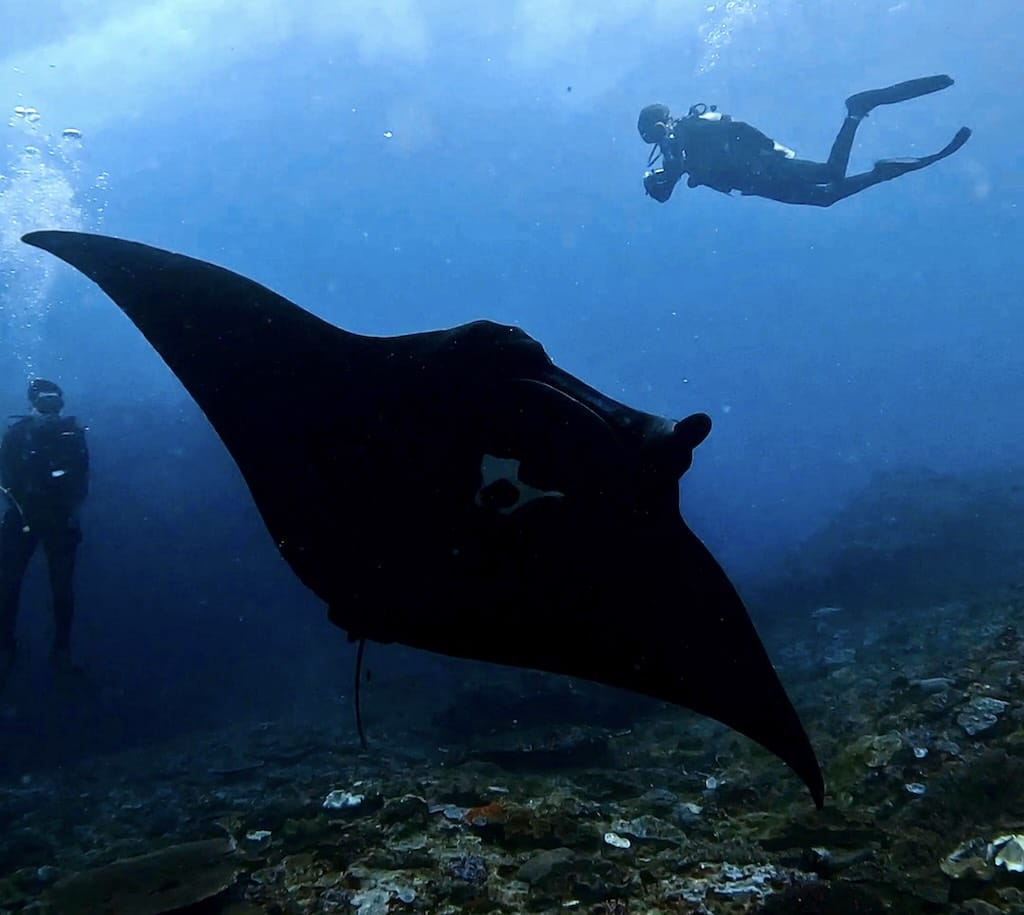
The species here is the reef manta, Mobula alfredi — reclassified out of the genus Manta in 2017, typically 3 to 3.5 m across, and Vulnerable on the IUCN list since 2019. It is also one of the best-studied manta populations anywhere: an eleven-year photo-ID study published in February 2025 tracked abundance rising from 170 individuals in 2012 to 447 in 2022, with 79.5 % of animals resighted more than once. Earlier work found that Manta Bay functions as a foraging ground and probable nursery, while Manta Point is the social and reproductive hub.
Practically: Manta Point runs 8–35 m, but the mantas are usually in the top ten meters, which makes it accessible from Discover Scuba level. Visibility 10–20 m, current weak — swell is the limiting factor, not current, and it’s why trips get cancelled. About 45 minutes by boat from Toyapakeh. Mantas are there all year; December–January regularly produces 5 to 12 on one dive with four or five boats on site, versus around twenty on a peak-season morning.
Mola mola season: what it actually is
Two corrections are worth making, because most guides get them wrong. I use “mola-mola” throughout this page because that is the term every dive center in Bali uses — but the animal you will actually meet is a different species.
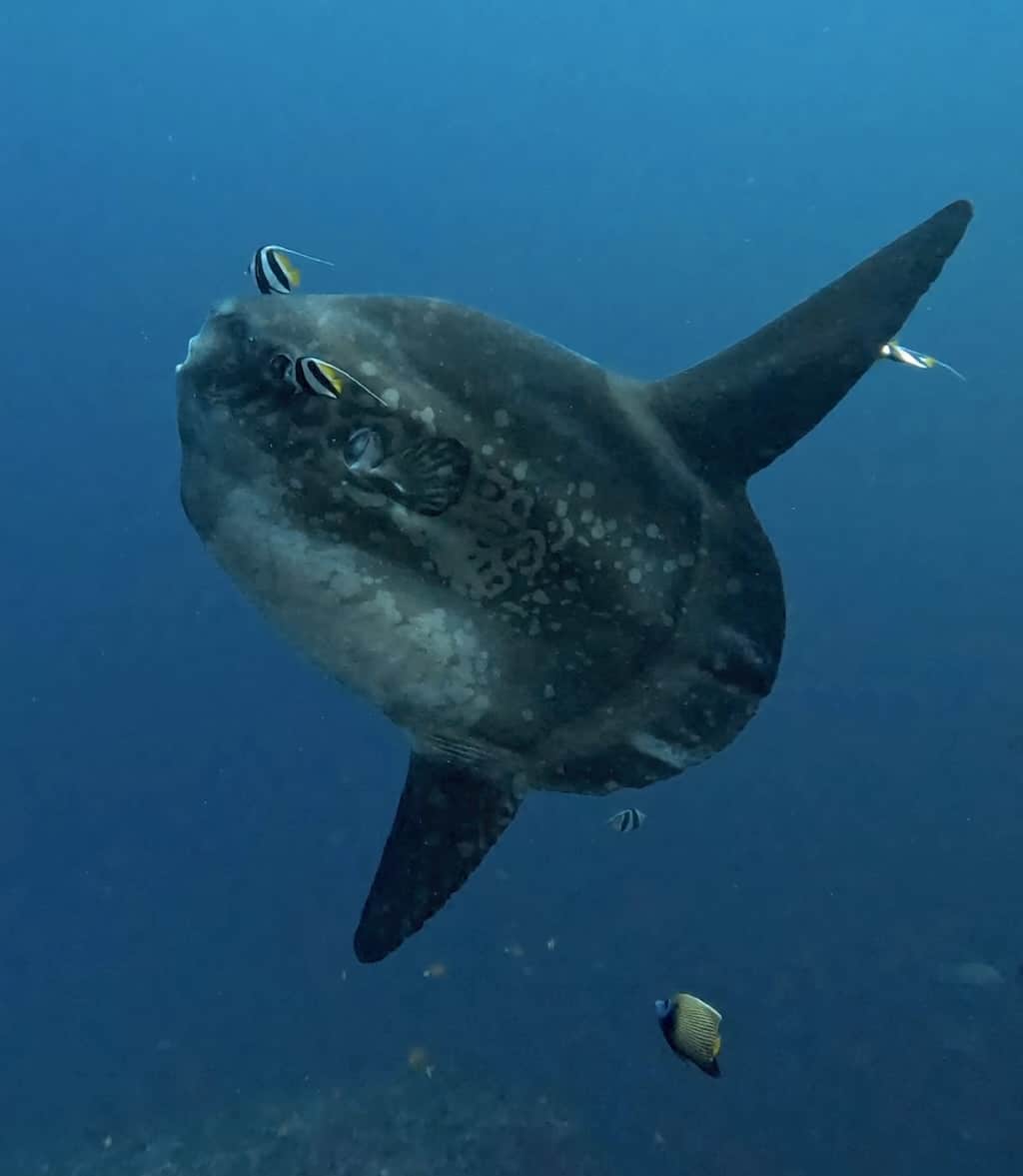
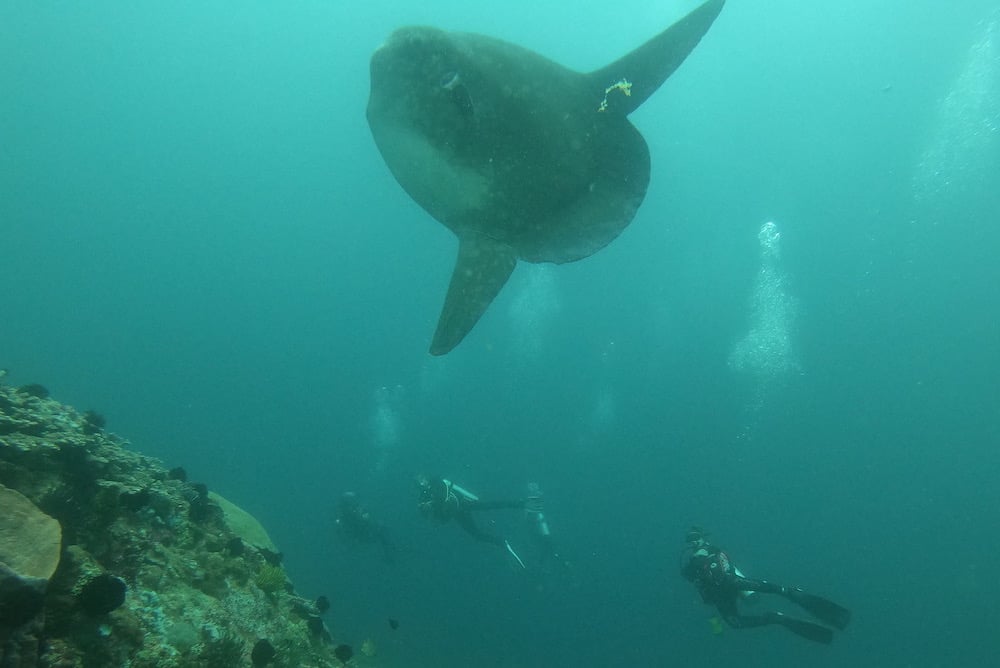
First, the species. It is the bump-head sunfish, Mola alexandrini — established by Sawai, Nyegaard et al. in 2017 and confirmed for Nusa Penida by the Coral Triangle Center in March 2018. It reaches 3.3 m and the record specimen weighed 2,744 kg, making it the heaviest bony fish ever recorded. Note also that the “Vulnerable” IUCN status people quote belongs to Mola mola; M. alexandrini has not yet been assessed.
Second, the cold. Mola season is July to October, peaking August–September, with encounters typically at 25–35 m at cleaning stations. What people underestimate is the temperature: research on the south coast has recorded 16–17 °C and occasionally 13–14 °C. Divers show up in 3 mm shorties and abort shivering at fifteen minutes. Bring a 5 mm suit with a hood, or rent one. The mola disappear once surface water goes above roughly 24 °C — the cold isn’t an inconvenience, it’s the whole mechanism.
The drift sites — and a word of caution
The north coast — Toyapakeh, Gamat Bay, Sental, Ped and Buyuk — is drift-diving country: healthy hard coral, huge fish density, turtles on every dive. Crystal Bay is the famous one, and its second corner in mola season is a serious dive. Blue Corner, Batu Bolong and Ceningan Wall are advanced sites with powerful, sometimes vertical current.
My worst dive in twenty years happened here. Down-current at Gamat Bay: I grabbed the wall to stop being driven deeper, and while I was hanging on I got tangled in discarded fishing line. My buddy came in with a knife and cut me out. Nothing about that day was exotic — Gamat is a site I’d dived many times. For the main drift and sunfish sites, come with Advanced certification and around 50 logged dives, plus recent experience in current. Dive with a guide who works these sites daily, and accept it when they call a site off. The current here is not decoration.
My best dive also happened here, four hundred meters away: fourteen mola-mola on one immersion at Gamat Bay. That’s Nusa Penida.
This guide keeps Nusa Penida to a single section so the rest of Bali gets its due. For site-by-site detail — depths, entry points, current behavior and boat times — I maintain a dedicated guide: the complete Nusa Penida diving guide, plus the 20 best dive sites of Nusa Penida.
My verdict: choose Nusa Penida for Bali’s best big-animal diving — but match the site to your actual experience, and stay on the island rather than day-tripping.
Where to Dive in Bali by Certification Level
Beginners and Discover Scuba
If you’re doing your first dives or your Open Water, base yourself in Amed or Padang Bai. Amed gives you gentle black-sand slopes with no current — Jemeluk Bay, the Japanese Wreck at Lipah, the Pyramids. Padang Bai gives you Blue Lagoon plus real training pools at the established resorts. Tulamben’s Liberty is also genuinely beginner-friendly once you’re past the pebble entry, and Menjangan’s Coral Garden and Sandy Slope are as easy as diving gets.
Manta Point at Nusa Penida is the one big-animal site accessible to true beginners, since the mantas sit shallow and the current is weak. Everything else at Penida is not.
Avoid as a beginner: the three Gili of Padang Bai, Gili Selang, Crystal Bay in mola season, and the Nusa Penida drift sites. No exceptions, whatever a shop tells you.
Advanced Open Water
An AOW card opens up the Boga wreck and Batu Kelebit at Tulamben, Seraya Secrets (where the limit is buoyancy, not depth), the Padang Bai Jetty, Menjangan’s Anchor Wreck and Pos II, Pemuteran’s Temple Garden, Bunutan at Amed, and the mola sites at Nusa Penida.
Experienced and current-competent
Gili Tepekong and The Canyon, Gili Mimpang, the Gili Biaha shark cave, Gili Selang, and Blue Corner / Crystal Bay’s second corner in mola season all want AOW plus real logged experience — operators commonly ask for 10 to 50 dives depending on the site — and genuine competence in current, including recognizing and reacting to a down-current. If you haven’t dived in a year, do a check dive at Jemeluk or Blue Lagoon first. Nobody’s logbook is impressive enough to make a down-current at Tepekong safe.
Best Time to Dive in Bali
You can dive Bali every day of the year. The question is what you want to trade.
Dry season (May–October) vs rainy season (November–April)
The dry season brings the best all-round visibility, the upwelling that produces mola-mola, and the biggest crowds and highest prices. The rainy season is misunderstood: it doesn’t rain all day, the water is at its warmest (27–30 °C), Manta Point empties out, macro life is at its most active, and dive packages run 20 to 35 % below July–August pricing. Menjangan actually posts better visibility in the rain than in the dry.
| Site | Rainy season | Dry season |
|---|---|---|
| USAT Liberty / Tulamben | 18–25 m (mornings) | 15–30 m |
| Menjangan | 25–30 m | 15–30 m |
| Padang Bai | 10–20 m | 15–30 m |
| Nusa Penida | 8–25 m (variable) | 15–30 m |
Those averages hide the regional spread that actually decides what wetsuit you pack. Amed and the east coast run slightly warmer at 27–30 °C. Pemuteran and Menjangan are the warmest and most stable, 27–29 °C year-round. Nusa Penida is consistently colder — down to 26 °C at the surface in August, with thermoclines far below that. Secret Bay sits at 20–25 °C all year. And expect to lose roughly 1 °C for every 10 m of depth anywhere on the island.
The big-animal calendar
Mola-mola: July–October, peak August–September, at Nusa Penida and — less known — at Gili Tepekong and Gili Mimpang off Padang Bai. Operator estimates put sighting probability around 60 % in July, 85 % in August–September and 50 % in October.
Reef mantas: year-round at Nusa Penida. Peer-reviewed data found a sightings peak in May; operators report the best numbers per dive in December–January when the boat traffic collapses.
Whale sharks: genuinely rare and entirely opportunistic, most often on the north-coast drift sites of Nusa Penida (SD, Ped, Buyuk) and around Batu Bolong, roughly July to November. Never book a trip on this.
Mandarinfish: year-round at dusk, 17:30–19:00, at Bajul Bay near Menjangan and at Secret Bay.
What Diving in Bali Costs in 2026
Here is the single most useful fact in this guide: the same two dives on the USAT Liberty cost around IDR 1,000,000 booked in Tulamben and around IDR 2,700,000 booked from Seminyak. Nearly three times the price, for the same wreck.
The difference isn’t a scam — the South Bali price includes six hours of driving, hotel pickup, lunch and gear. But it means the calculation is simple: if you’re diving more than one day in a zone, sleep in that zone. You’ll save money, dive at dawn, and avoid three hours in a car with a full tank of nitrogen and a mountain pass.
Fun dives: local operator vs South Bali operator
| 2 fun dives | Booked locally | Booked from South Bali |
|---|---|---|
| Tulamben | IDR 990,000–1,000,000 (~$56 / €49) | IDR 1,850,000–2,700,000 (~$105–153 / €91–132) |
| Amed | from IDR 800,000 (~$45 / €39) | IDR 2,200,000–2,700,000 (~$124–153 / €108–132) |
| Padang Bai / the three Gili | IDR 1,100,000–1,880,000 (~$62–105 / €54–92) | IDR 1,950,000–2,700,000 (~$110–153 / €95–132) |
| Nusa Penida | IDR 1,500,000–1,950,000 (~$85–110 / €73–95) | IDR 2,500,000–3,150,000 (~$141–178 / €122–154) |
| Menjangan | IDR 1,600,000–1,990,000 (~$90–111 / €78–97) | IDR 4,500,000 (~$254 / €220) |
Night dives run IDR 550,000–650,000 (~$31–37 / €27–32). A third dive typically adds IDR 320,000–400,000.
Courses
| Course | Local operator | South Bali operator |
|---|---|---|
| Discover Scuba (2 dives) | IDR 950,000–1,200,000 (~$54–68 / €47–59) | IDR 2,900,000–3,500,000 (~$164–198 / €142–171) |
| PADI Open Water | IDR 4,250,000–6,900,000 (~$240–390 / €208–338) | IDR 7,200,000–9,900,000 (~$407–560 / €352–485) |
| PADI Advanced Open Water | IDR 3,950,000–7,500,000 (~$223–424 / €193–367) | IDR 6,100,000–9,000,000 (~$345–509 / €299–441) |
| Rescue Diver | — | IDR 6,500,000–8,000,000 (~$368–452 / €318–392) |
Fees and extras nobody quotes you
- Bali tourist levy (Love Bali): IDR 150,000 (~$8.5 / €7.30), once, on arrival for all international visitors
- Nusa Penida Marine Protected Area: IDR 100,000 per day for diving, snorkeling or swimming
- Nusa Penida island retribution: IDR 25,000 adult / 15,000 child on arrival
- West Bali National Park (Menjangan): IDR 200,000 weekday / 300,000 weekend and holidays, per person per day
- Fast boat Sanur–Nusa Penida: IDR 117,000–170,000 one way (standard public fare IDR 150,000)
- Speedboat fuel surcharge at some Nusa Penida dive centers for the run to Manta Point: IDR 150,000–250,000
- Standalone gear rental: IDR 650,000–850,000 per day
- Card payment surcharge: 2–3 % at most centers — bring cash
Where to Stay: Best Dive Resorts by Zone
On a dive trip, where you sleep isn’t a comfort question — it’s an access question. Sleeping in Tulamben is what gets you on the wreck at 05:55; sleeping in Pemuteran is what lets you skip the mountain pass after a deep dive. These are the properties I’d point a diving friend to in each zone — starting, in each case, with the ones I’ve slept in myself.
Tulamben — sleep next to the wreck
- Tauch Terminal Resort Tulamben & Spa — around $76–157 / €67–138. I’ve stayed here. Roughly 100 meters from the wreck entry — a three-minute walk along the beach, which makes the 05:30 start about as easy as it gets in Bali. Full beachfront, in-house dive center with rental gear and SSI courses.
- Mimpi Resort Tulamben — around $47–115 / €41–101. I’ve stayed here too. Four hundred meters from the Liberty, with direct beach access: you kit up on the sand and swim out, no boat. A house reef sits right in front, and there are natural thermal spring pools on site, which after three dives is not a gimmick. One caveat — no nitrox fills.
- Liberty Dive Resort — around $43–74 / €40–68. Five minutes’ walk from the wreck, on-site center, nitrox available, macro specialist guides, and three pools with a view of Agung. The best all-round pick in Tulamben.
- Siddhartha Oceanfront Resort & Spa Bali — around $100–226 / €92–208. At Kubu, a few minutes north. Full-service SSI center, nitrox, direct house-reef access, 30 oceanfront bungalows, and daily trips to the Liberty. The comfortable option.
Two more worth knowing: Ocean View Tulamben Dive & Resort ($41–90 / €38–83), roughly 50 meters from the entry — the closest of all — and Tulamben Dive Resort ($28–38 / €26–35), the cheapest way to be first in the water.
Amed — learn to dive, or shoot macro
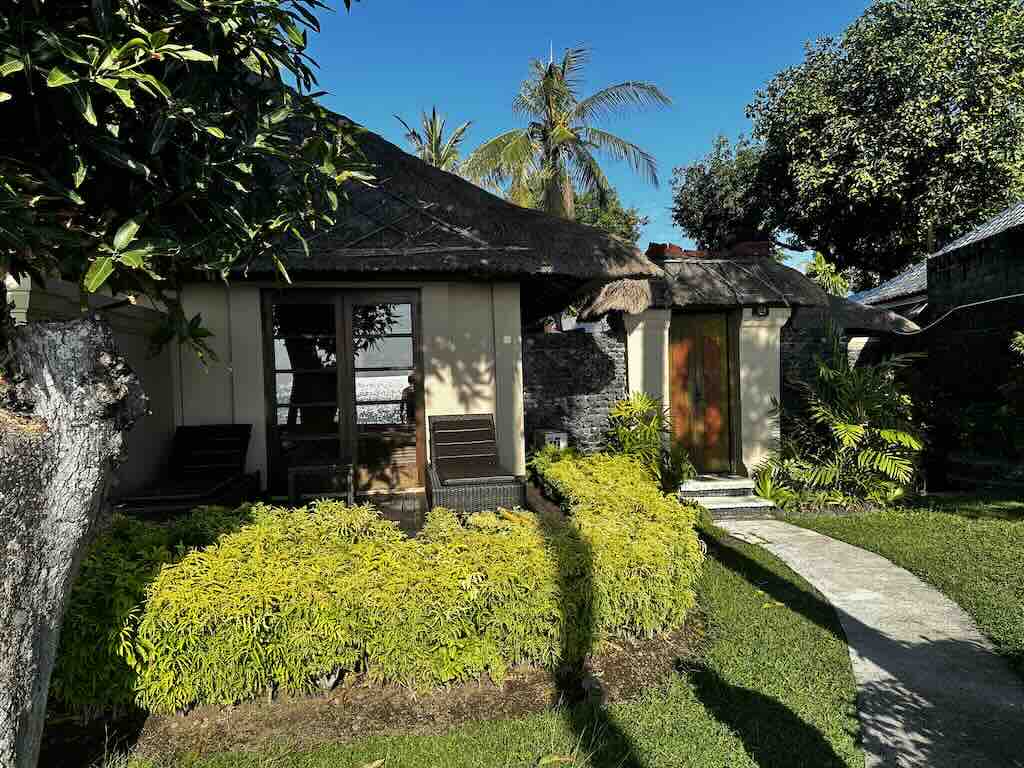
- Villa Bukit Segara — around $139–273 / €122–240. I’ve stayed here. Beachfront at Bunutan, eight rooms in six thousand square meters of garden, with direct water access for snorkeling. No dive center on site — Amed’s operators are minutes away — so it’s the pick if you want the evenings quiet.
- Alami Resort, Restaurant and Dive Center — around $21–43 / €19–40 at Bunutan. Dive shop on site and a pool. The best value in Amed if you want diving built in.
- Puri Wirata Dive Resort and Spa Amed — around $60–95 / €55–88. On-site 5-star dive center, direct beachfront, a house reef you can shore-dive straight off the pebble beach, two pools and a spa. The workhorse choice.
- Palm Garden Amed Beach & Spa Resort Bali — around $96–182 / €88–168. Bungalows on the water with a reef directly in front. No in-house center, but several PADI operators are minutes away.
Padang Bai and Candidasa — base for the three Gili
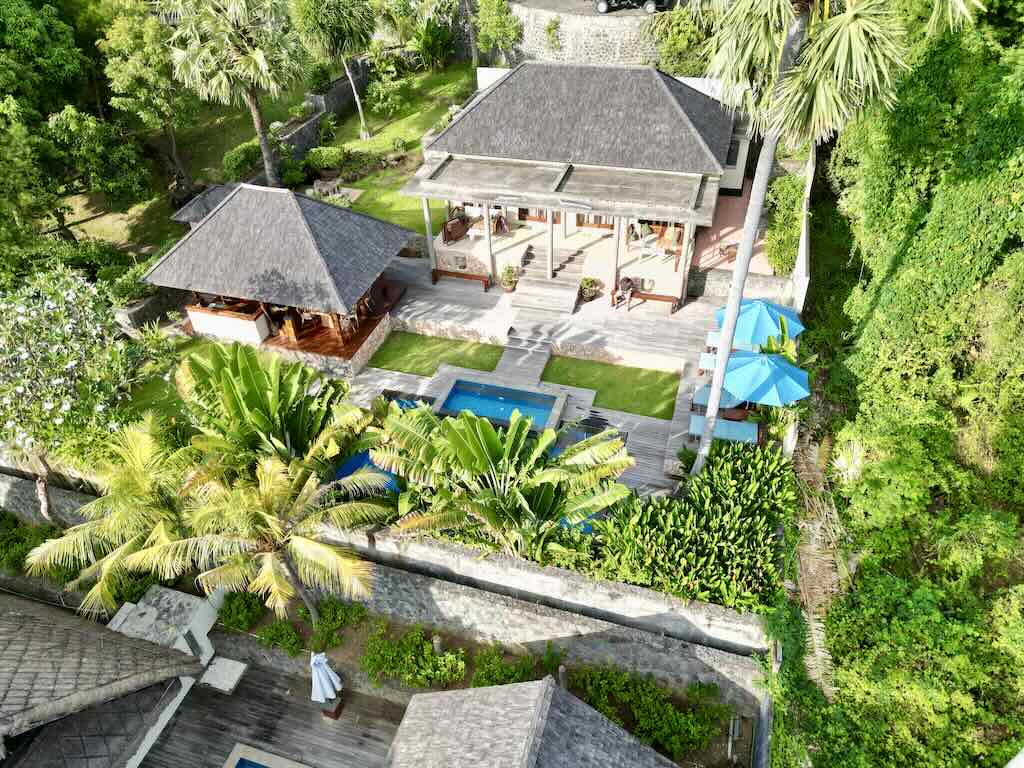
- Sea Breeze Candidasa — around $39–96 / €34–84. I’ve stayed here. Beachfront at Mendira Beach, about fifteen minutes from Padang Bai and the boats to Tepekong, Mimpang and Biaha. No dive center on site, but the calmest base in the area and materially cheaper than the village itself.
- Bali 85 Beach Inn — budget, walking distance from the harbor and Blue Lagoon. Every dive center in the village is five minutes away.
- Absolute Scuba Bali Dive Resort — around $49–75 / €45–69. Rooms directly above the PADI center, training pool, house boats to the three Gili.
- OK Divers Resort & Spa — around $63–102 / €58–94. The best-rated property in Padang Bai and a full-service PADI dive resort: two pools, spa, restaurant, minutes from the harbor.
Menjangan and Pemuteran
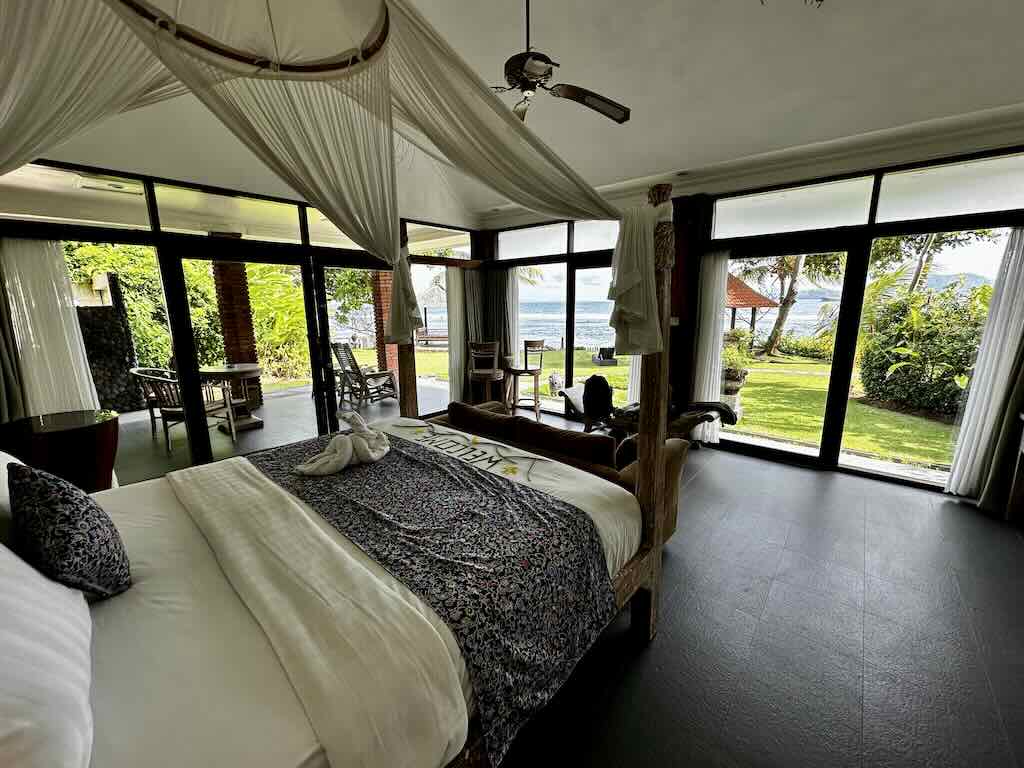
- Menjangan Dynasty Resort — around $99–265 / €87–233. I’ve stayed here. The only property in the zone with a PADI 5-star center and its own jetty: boats leave from the resort beach and reach Menjangan in 30 to 40 minutes, skipping the road transfer to Labuhan Lalang entirely.
- Biorock Homestay & Dive Center Pemuteran — around $33–68 / €30–63. On-site dive center, 100 m from the beach, with the Biorock structures directly out front — night dives and macro without a boat.
- Reef Seen Divers’ Resort — around $32–43 / €29–40. Beachfront, long-established, houseboats to Menjangan (30 min) and a turtle hatchery on site. The conservation pick.
- Taman Sari Bali Resort and Spa — around $37–214 / €34–197. Walk-on boat access from the resort’s own beach, on-site dive shop, 52 bungalows and villas.
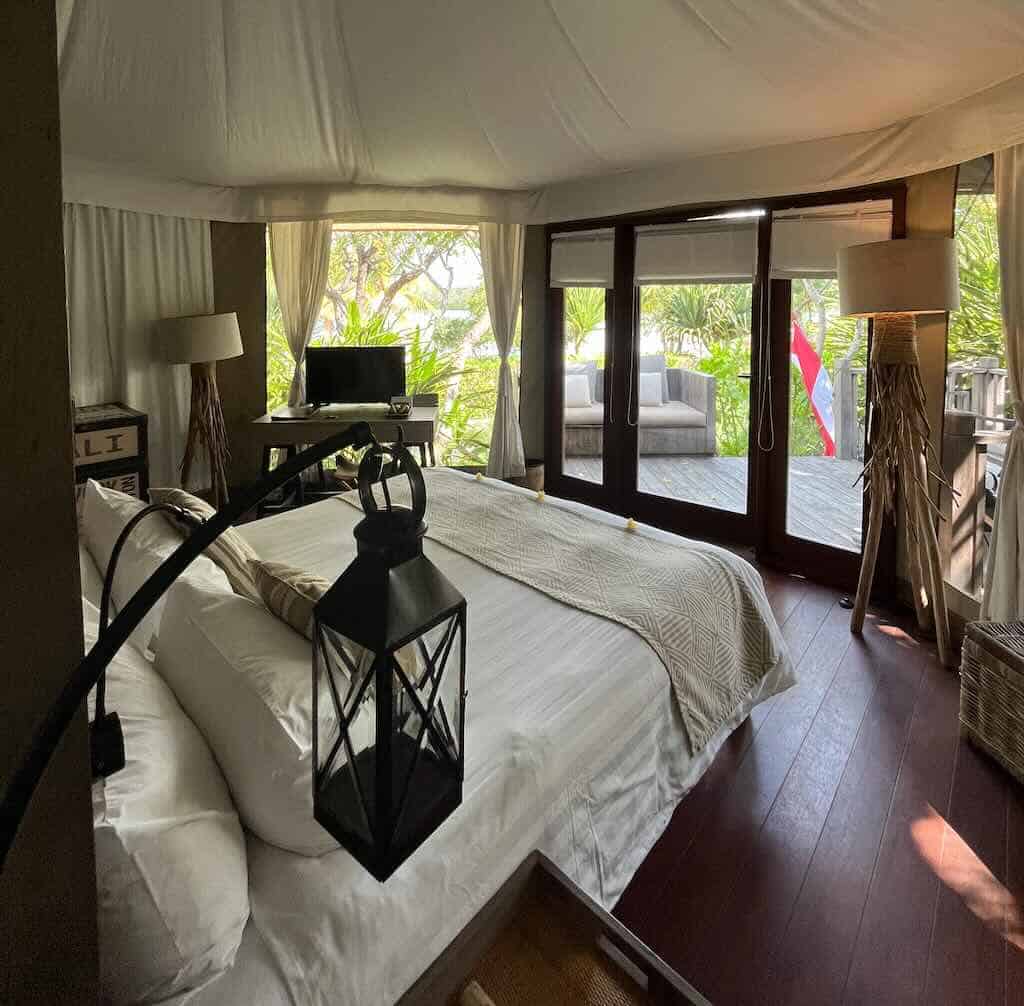
Nusa Penida — mantas and mola
- MAUA Nusa Penida Bali — around $120–207 / €106–182. I’ve stayed here. A clifftop resort at Sakti, perched directly above Gamat Bay — you look down on the dive site from your room. Twenty minutes from the harbor. Be clear about what it is, though: no sea access and no dive center, so it’s a beautiful base, not a dive resort.
- Semabu Hills Hotel Nusa Penida — around $47–101 / €43–93. On the hill above Toyapakeh, 5–10 minutes from the harbor where every Manta Point and Crystal Bay boat leaves. Two pools, no dive center.
- Adiwana Warnakali Resort — around $104–232 / €96–215, between Toyapakeh and Crystal Bay. PADI 5-star Dune Penida on site, direct access to the cove twenty meters below the rooms. Full disclosure: I oversaw the opening of this hotel, and I run the dive center. It is also, factually, the only high-end dive resort on the island.
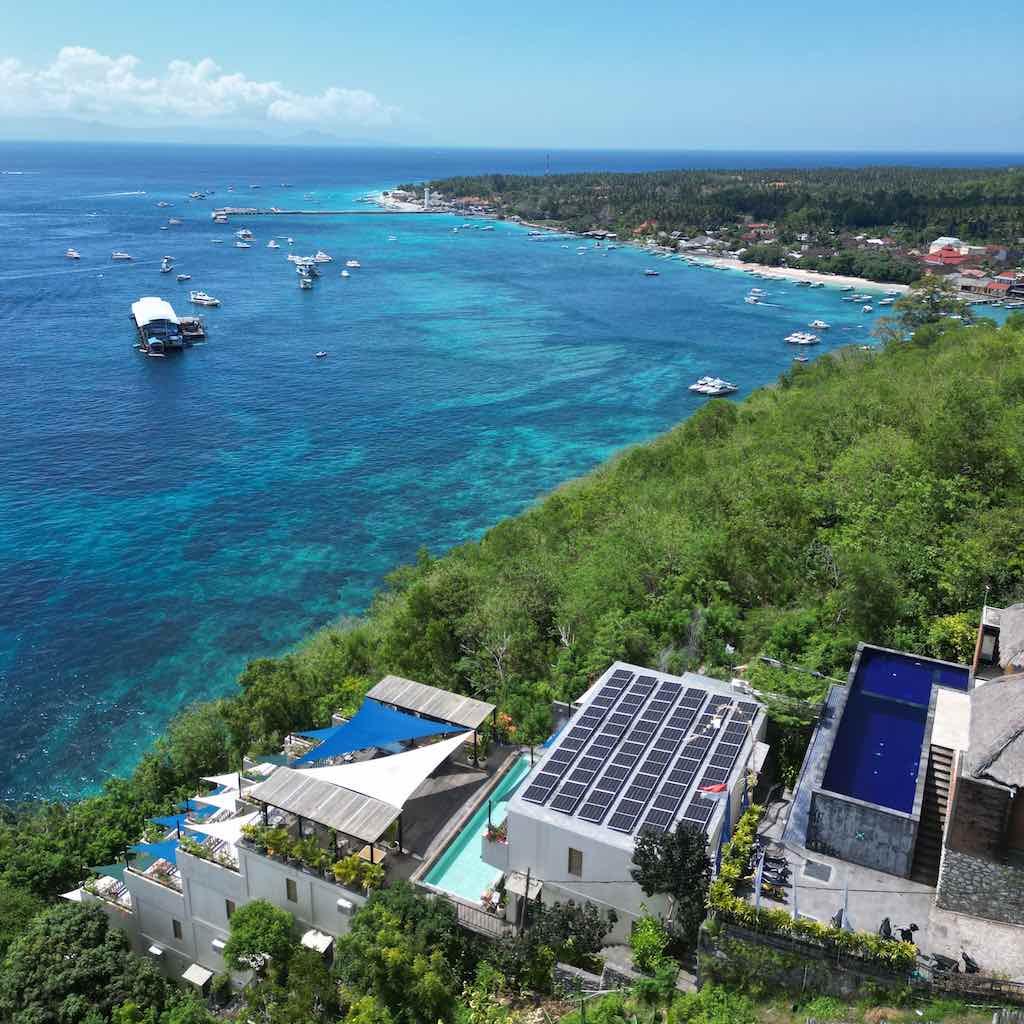
Nusa Penida has far more options than a diving guide can usefully cover, and where you sleep changes your travel times a lot. I keep a full breakdown by area in my guide to where to stay in Nusa Penida.
Which base for which diver?
| You are… | Base yourself in | Because |
|---|---|---|
| A beginner | Padang Bai, then Amed | Sheltered sites, training pools, no current |
| A macro photographer | Tulamben | Seraya Secrets and Coral Garden 10 min apart; sunrise and night entries on foot |
| Chasing big animals | Nusa Penida | Mantas year-round, mola July–October — and the three Gili are reachable by boat from here, so one base covers both |
| Travelling with family | Pemuteran, then Amed | Flat bay, snorkel-accessible Biorock, turtle hatchery, easy boat rides |
Planning Your Bali Dive Trip
How many days do you need?
Five to seven days is the realistic minimum to dive two zones properly. Ten to twelve lets you cover four. Anything under five days should be spent in a single zone — the driving will eat the rest.
A 7-day itinerary: east coast
- Day 1 — Arrive, transfer to Padang Bai (1 h 30 from DPS). Afternoon check dive at Blue Lagoon.
- Day 2 — Gili Mimpang and Gili Tepekong. Cold, sharky, current. The most demanding day of the trip.
- Day 3 — Gili Biaha’s shark cave in the morning, the Jetty for Rhinopias in the afternoon. Drive to Amed (1 h 30).
- Day 4 — Jemeluk Bay, the Underwater Gallery and the Japanese Wreck at Lipah. Easy day. Night dive at Melasti.
- Day 5 — Ghost Bay for muck in the morning, the Pyramids in the afternoon. Drive to Tulamben (30 min).
- Day 6 — 05:30 sunrise dive on the USAT Liberty, then Coral Garden. Afternoon at Seraya Secrets. Night dive on the wreck.
- Day 7 — Drop Off in the morning, then transfer back to south Bali. No dives on the day you fly.
For a 10-day trip, add three days on Nusa Penida at the front (fast boat from Sanur), which gives you mantas, drift diving and — in season — mola-mola before you head east. To fit in Menjangan instead, budget three days and a night in Pemuteran; it doesn’t combine with the east coast in under twelve days.
Getting there and getting around
| Route | Distance | Time |
|---|---|---|
| DPS airport → Tulamben | 98 km | ~3 h 15 |
| Tulamben ↔ Amed | 14 km | 25–30 min |
| Amed ↔ Padang Bai | 54 km | ~1 h 30 |
| Padang Bai ↔ Sanur | 55 km | 1 h 15 – 1 h 45 |
| Pemuteran ↔ Tulamben | 127 km | ~3 h 30 |
| DPS → Labuhan Lalang (Menjangan) | — | ~4 h 30 |
| Sanur → Nusa Penida | — | 30–45 min by fast boat |
Fast boats to Nusa Penida leave Sanur Beach Harbor from about 07:00 to 16:30, with fifteen-plus operators running to Toyapakeh, Banjar Nyuh or Sampalan. You board from the beach, in shallow water — pack accordingly. For a scooter or car, the only option is the public ferry from Padang Bai at IDR 31,700 one way.
Between the mainland zones, a private driver is the simplest solution and costs around IDR 700,000 (~$40 / €34) for the Denpasar–Tulamben leg. If you’d rather drive yourself, you can compare car hire prices at Denpasar airport on DiscoverCars. Full details in our guides to getting to Bali and getting around the island.
Safety: flying, mountains and chambers
Flying after diving. The DAN guidelines call for a minimum of 12 hours after a single no-decompression dive and a minimum of 18 hours after multi-day repetitive diving — which is what a Bali dive trip is. The blanket “24 hours” you hear on boats is a conservative simplification; 18 hours is the actual floor for the diving most people do here, and longer is better.
The mountain trap. The same waiting times apply to driving over Bali’s mountain roads, and this is the bit almost every guide omits. DCS risk climbs above 610 m (2,000 ft) — and the routes crossing central Bali go well beyond that, with Bedugul sitting around 1,200 m and Kintamani higher still. Do not dive Menjangan and then drive back to Ubud over Bedugul the same afternoon. Do not dive Tulamben and drive up to Kintamani for sunrise the next morning. Take the coastal road, or wait.
Hyperbaric support. Two facilities serve Bali: Kasih Ibu Hospital’s Hyperbaric & Diving Medicine Center in Gianyar (+62 361 3003333), the most relevant to the east-coast dive zones, and the chamber at Prof. Ngoerah Hospital in Denpasar (+62 361 227911). Treat both as needing confirmation rather than as a guarantee — Ngoerah publishes weekday clinic hours rather than a 24/7 dive-emergency service, and chamber availability across Indonesia fluctuates. So in an emergency call DAN Asia-Pacific first, on +61-8-8212 9242, and let them route you. Confirm your operator’s evacuation procedure before your first dive, and carry insurance covering evacuation and hyperbaric treatment — it is not optional here.
What to pack
- Hard-soled booties — non-negotiable for Tulamben’s pebble entry
- A 5 mm wetsuit and hood if you’re diving Nusa Penida in mola season, the three Gili, or Secret Bay. A 3 mm shorty is fine everywhere else
- An SMB you know how to deploy for the drift sites — follow your guide’s instructions, and never hook or hold on to living coral
- A cutting tool — I got tangled in fishing line at Gamat Bay and my buddy’s knife is the reason that story is a paragraph and not something worse
- Cash in rupiah — card surcharges run 2–3 % and rural centers often don’t take cards at all
- Reef-safe sunscreen and your certification card — every operator will ask for it, and the good ones will ask for your logbook too
About the Author and How This Guide Was Researched
I first set foot on Nusa Penida in June 2015, when a single fast-boat company served the island, the roads were mostly rubble, and there was almost nothing written online that a traveler could actually use. I went back more than thirty times over the next five years. In August 2020 I moved to Indonesia to oversee the opening of the Adiwana Warnakali resort and lived at the hotel itself for eight months, in room 401. I have been based in Seminyak, in south Bali, since April 2021, and I still return to Penida most weeks.
I learned to dive in 1986, but the obsession really started in 2011 with my PADI Open Water in the Seychelles, followed by Advanced Open Water in 2012. I have been a PADI Master Scuba Diver since 2018. In 2017, I opened the Warnakali dive center — the first PADI center on Nusa Penida, now operating as Dune Penida.
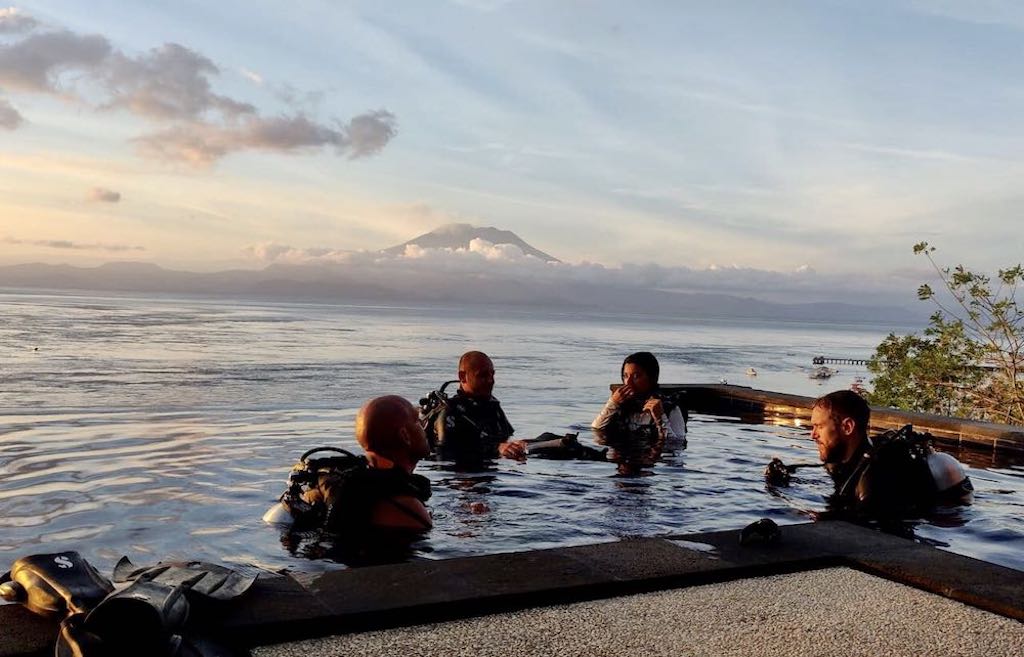
How this guide was put together. I have dived all five zones covered here myself. Everything I could verify from experience is written in the first person; everything I could not — 2026 operator pricing, national park fees, boat schedules — is drawn from current published rates and marked as a range rather than a single figure, because centers vary and rates move. Where the sources contradict each other, as they do on the age of the Menjangan Anchor Wreck, I say so instead of picking the more flattering version. Conditions, prices, access rules and emergency arrangements all change: reconfirm anything time-sensitive with a reputable local operator before you travel.
Commercial disclosure. I own or operate businesses on Nusa Penida, including the Dune Penida dive center, the Amok Sunset bar and the Adiwana Warnakali hotel. Where they appear in this guide, that commercial connection is stated on the spot. Accommodation links are affiliate links, which cost you nothing and pay a commission if you book. I do not accept paid placement from any operator.
Beyond Bali: Where to Dive Next in Indonesia
Bali is the gateway, not the destination. Once you’ve done the east coast and Nusa Penida, the archipelago opens up.
Komodo National Park is the natural next step — an hour’s flight from Denpasar, with current-driven diving that makes Nusa Penida feel gentle, plus mantas at Karang Makassar and the pinnacles of Castle Rock and Crystal Rock. Raja Ampat is the reef-biodiversity summit of the planet and worth the two flights it takes to get there. Sulawesi splits into Bunaken’s walls, Lembeh’s legendary muck and Wakatobi’s coral — if Seraya Secrets got under your skin, Lembeh is where that obsession goes next.
For the sites that are only reachable by boat, a liveaboard diving cruise in Indonesia is usually the better value than island-hopping on flights. And for the wider regional picture, we’ve ranked the top 10 dive sites in South East Asia.
Not diving every day? Bali above water is worth the non-dive days — start with the complete Bali travel guide, or head inland to Ubud for a surface interval among the rice terraces.
Read More
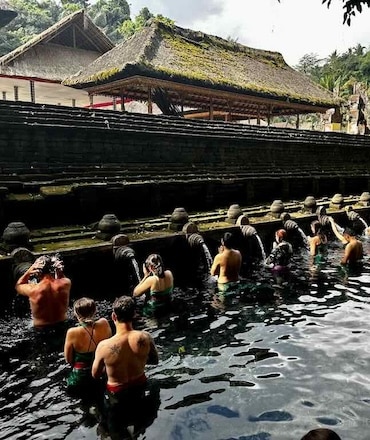
Bali Travel Guide
Where to stay, what to see and how to move around the island of the gods — beaches, temples, rice terraces, food and practical tips for planning the trip around your dives.
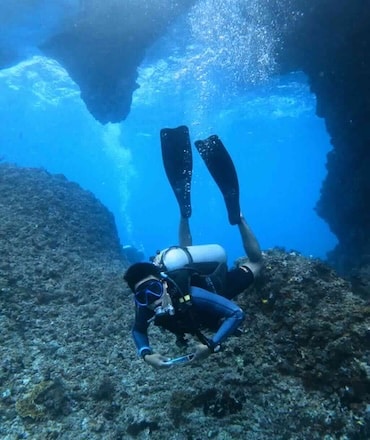
Best Diving in Indonesia
From Raja Ampat’s reefs to Komodo’s currents and Lembeh’s muck, here are the dive destinations worth crossing the archipelago for — and when to go to each one.
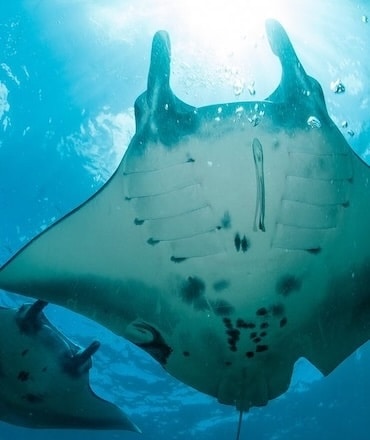
Nusa Penida Diving Guide
The full site-by-site guide to the 20 best dive sites of Nusa Penida — manta rays, mola-mola, drift diving, conditions, certification levels and how to organize your dive days.
Frequently Asked Questions About Diving in Bali
What is the best dive site in Bali?
The USAT Liberty at Tulamben is the most-dived and most accessible: a 120-meter wreck between 3 and 30 meters, reachable on foot from the beach and open to every level. For big animals, Manta Point at Nusa Penida is the standout, with reef mantas present year-round in the top ten meters. For visibility and wall diving, Menjangan in West Bali National Park is unmatched on the island.
Do I need to be certified to dive in Bali?
No. Discover Scuba programs are available in every zone and cost IDR 950,000–1,200,000 (~$54–68 / €47–59) with a local operator. An Open Water certification opens roughly 70 % of Bali’s sites, including most of the Liberty. Advanced Open Water plus real current experience is required for the three Gili off Padang Bai and the main Nusa Penida drift sites.
How much does diving in Bali cost?
Two guided fun dives cost IDR 990,000–1,950,000 (~$56–110 / €49–95) when booked with an operator based in the dive zone, and IDR 1,850,000–4,500,000 (~$105–254 / €91–220) when booked from South Bali with transfers included. A PADI Open Water course runs IDR 4,250,000–9,900,000 (~$240–560 / €208–485) depending where you book it. Budget a full dive week at roughly €900–1,400 excluding international flights.
When is the best time to dive in Bali?
April to October offers the best overall conditions, with visibility of 20–30 m at most sites. July to October is the only window for mola-mola. November to March brings the warmest water (27–30 °C), the fewest divers, the most active macro life, and prices 20–35 % lower than the July–August peak — and Menjangan actually has better visibility then than in the dry season.
Where can you see manta rays in Bali?
Manta Point and Manta Bay on the south coast of Nusa Penida, where reef mantas (Mobula alfredi) are present all year. An eleven-year photo-ID study published in 2025 estimated the population at 447 individuals in 2022, up from 170 in 2012, with very high site fidelity. The mantas usually stay in the top ten meters, so the site is accessible to beginners — trips are cancelled for swell, not current.
Where and when can you see mola mola in Bali?
From July to October, peaking in August and September, primarily around Nusa Penida (Crystal Bay, Blue Corner, Gamat Bay) and also at Gili Tepekong and Gili Mimpang off Padang Bai. The species is the bump-head sunfish Mola alexandrini, not Mola mola. Encounters happen at 25–35 m at cleaning stations, and the water can drop to 16–17 °C — bring a 5 mm suit with a hood.
Can you see whale sharks while diving in Bali?
Yes, but it is rare and entirely opportunistic. The most frequent sightings are on the north-coast drift sites of Nusa Penida — SD, Ped and Buyuk — and around Batu Bolong, mainly between July and November. Never plan a trip around it. For reliable whale shark encounters in Indonesia, Saleh Bay in Sumbawa and Cenderawasih Bay in Papua are the real destinations.
Which dive sites in Bali are good for beginners?
Jemeluk Bay, the Japanese Wreck at Lipah and the Pyramids in Amed; Blue Lagoon at Padang Bai; the USAT Liberty and Coral Garden at Tulamben; Coral Garden, Sandy Slope and Pos I at Menjangan; and Manta Point at Nusa Penida. Avoid the three Gili off Padang Bai, Gili Selang, Crystal Bay in mola season, and the Nusa Penida drift sites until you have an Advanced card and current experience.
Is diving in Bali dangerous?
It is safe with the right operator and honest self-assessment, but Bali has real hazards that gentler destinations don’t. Down-currents at Gili Tepekong’s canyon, Batu Kelebit and the Nusa Penida sites can push a diver deep fast. Menjangan has the highest recorded DCS rate of any Bali site; one likely contributing factor is the return route over mountain roads that climb well above 1,000 m, since decompression risk rises above 610 m. Dive with guides who work your chosen sites daily, respect certification limits, and carry insurance covering hyperbaric treatment.
How long should I wait to fly after diving in Bali?
DAN recommends a minimum of 12 hours after a single no-decompression dive and a minimum of 18 hours after multi-day repetitive diving, which is what most Bali trips involve. The same waiting time applies to driving over Bali’s mountain roads, since decompression risk rises above 610 m (2,000 ft) — a factor that catches out divers heading from the north coast back to Ubud, Bedugul or Kintamani.
Should I stay in South Bali or near the dive sites?
Stay near the dive sites if you’re diving more than one day in a zone. The same two dives on the USAT Liberty cost roughly IDR 1,000,000 booked in Tulamben and IDR 2,700,000 booked from Seminyak. Sleeping locally also lets you do the 05:30 sunrise dive before the day-trip groups arrive at 09:00, and avoids driving a mountain road with a fresh nitrogen load.
How many days do I need for a diving trip to Bali?
Five to seven days is the minimum to dive two zones properly — the classic pairing being Tulamben and Amed, which are 25 minutes apart. Ten to twelve days lets you add Nusa Penida and Padang Bai. Menjangan needs three days of its own because it sits 3.5 hours from Tulamben and 4.5 hours from the airport. Under five days, pick one zone and stay there.