Diving in Tulamben, Bali: USAT Liberty Wreck, Pikachu & Jackfish
By Blaise Jaeger · PADI Master Scuba Diver · Updated September 28, 2026
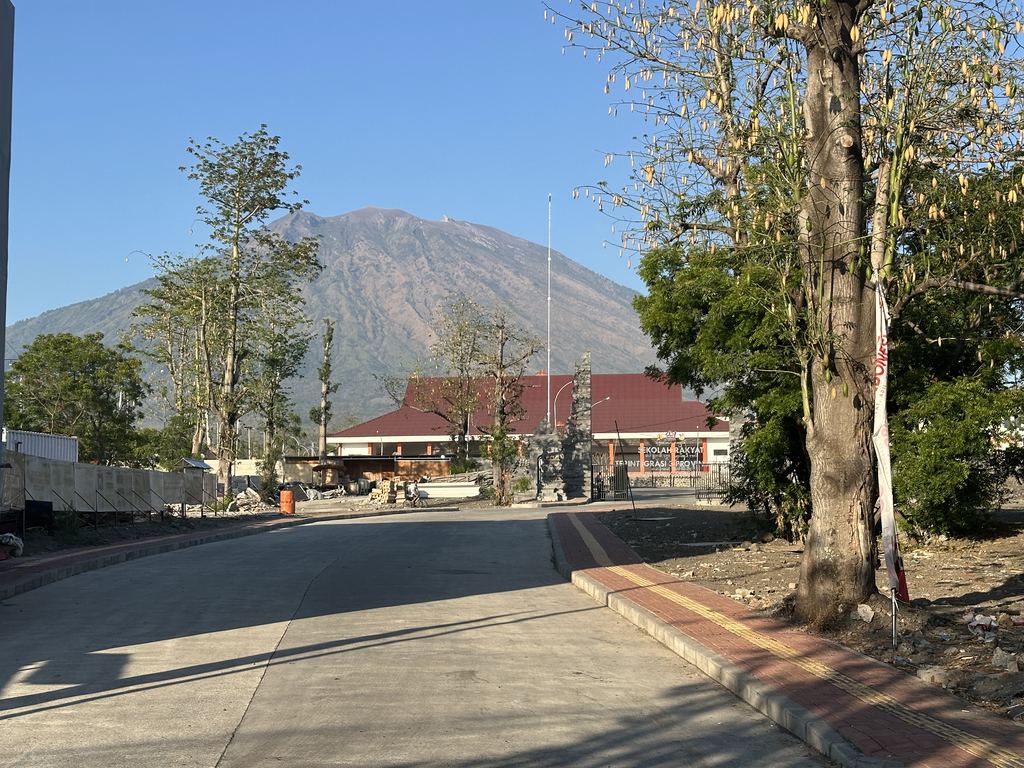
Tulamben is a single street of dive resorts on Bali’s north-east coast, a black pebble beach, and — a few fin kicks off that beach — a 125-meter Second World War cargo ship lying on its side between 5 and 30 meters. There is no boat to catch and no schedule to follow. You walk in, you swim thirty meters, and you are on one of the most famous wreck dives in Asia.
I first dived here in 2015. I came back in 2020, in 2024, and again on September 27, 2026 with the team of the Dune Penida dive center, for three dives on a day when the sea around Nusa Penida was closed: it was Nyepi Laut, the island’s day of silence for the sea, when no boat, diver or fisherman goes out for 24 hours. This page is what I would tell a friend before their first Tulamben trip: the sites, the season, how the shore entry really works when the waves are up — and what I have seen change over eleven years.
First-hand guide: I have logged more than 770 dives, the three described below were numbers 772, 773 and 774 in my logbook, and I run a PADI dive center on Nusa Penida. For the wider picture — Amed, Padang Bai, Menjangan and Nusa Penida — see my complete guide to diving in Bali.
Why Dive in Tulamben?
Three things make Tulamben unusual, even by Indonesian standards.
A major wreck from the beach. Most wrecks of this size need a boat, a descent line and decent conditions offshore. The USAT Liberty sits parallel to the shore, its shallowest parts at around 5 meters, so an Open Water diver can explore most of it and a snorkeler can see the stern from the surface.
Macro on black volcanic sand. Gunung Agung, the volcano that towers over the village, is the reason the seabed here is dark sand and rubble. Against that background, small animals stand out: pygmy seahorses on the sea fans, ghost pipefish, frogfish, nudibranchs, shrimps of every kind. Seraya, ten minutes down the road, is one of the reference macro sites in Bali.
Several dives a day without a boat. The wreck, Coral Garden and the Drop Off are all shore entries within a short walk or a two-minute pick-up of each other. You can dive at sunrise, at midday and at night from the same beach — which is exactly why I recommend sleeping here rather than day-tripping from the south.
Tulamben Diving at a Glance
| Tulamben | |
|---|---|
| Location | North-east coast of Bali, Karangasem regency — about 98 km and 3 hours from Denpasar airport |
| Signature dive | USAT Liberty wreck, roughly 5 to 30 m (16–100 ft), shore entry |
| Other main sites | Coral Garden, Tulamben Drop Off, Seraya Secrets, the Boga wreck at Kubu |
| Entry type | Shore diving from a black pebble beach; short pick-up to Drop Off and Seraya |
| Water temperature | Around 26–29 °C (79–84 °F); 28–29 °C (82–84 °F) on my three dives in late September 2026 |
| Visibility | Typically 15–25 m (50–80 ft); reduced when waves stir up the shore |
| Current | Slack on most days at the main sites — surf at the entry is the real variable |
| Level | Open Water for the Liberty and Coral Garden; Advanced for Drop Off and Seraya below 18 m |
| Best for | Wreck diving, macro photography, night dives, relaxed multi-dive days |
| Typical price | Around IDR 1,000,000 (~$56 / €49) for two guided dives booked locally |
| Time needed | 2–3 nights to dive the wreck at dawn plus Seraya and the Drop Off |
USAT Liberty Wreck
The Liberty is the reason Tulamben exists as a dive destination, and her story is stranger than most wrecks. Launched in New Jersey in June 1918, the US Army transport was torpedoed by a Japanese submarine in the Lombok Strait on January 11, 1942. Towed toward Bali, she was deliberately beached at Tulamben so her cargo could be saved. She stayed there, on the pebbles, for more than twenty years. In 1963 the tremors of the Gunung Agung eruption pushed her off the beach and she settled on her starboard side on the sandy slope, where she lies today. You can read more on the USAT Liberty’s service history.
Depths and layout
The ship is about 125 meters long. The stern is the shallowest part, at roughly 5 meters; the midship section lies between 12 and 22 meters; the bow drops to about 30 meters. The wreck starts some thirty meters from the waterline, so the swim out is short. On my September 2026 dive, a 50-minute circuit around and through the hull took me to a maximum of 24.9 meters with an average depth of 13.2 meters — a profile any Open Water diver comfortable at 18 meters can follow for most of the dive.
What it looks like underwater
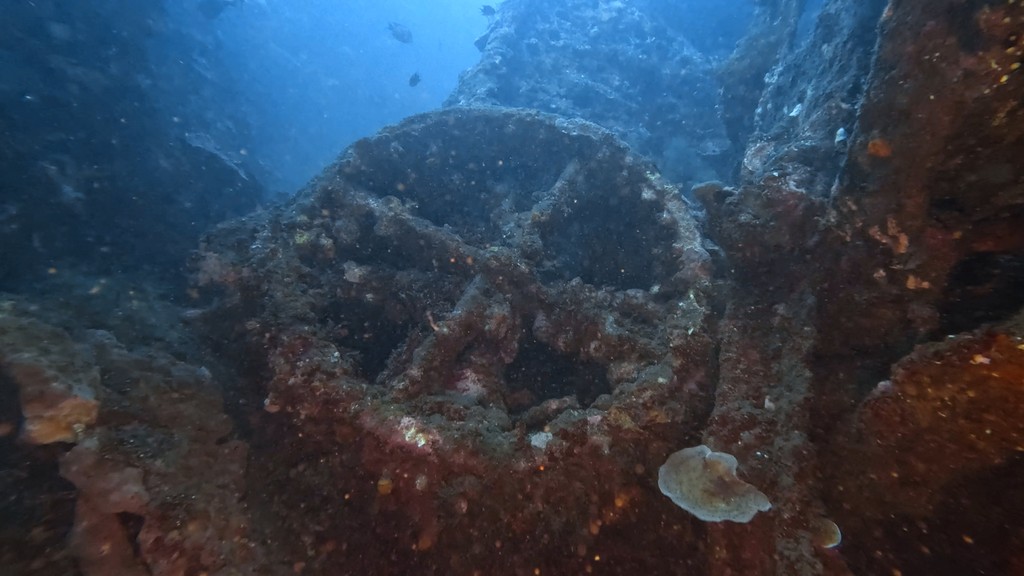
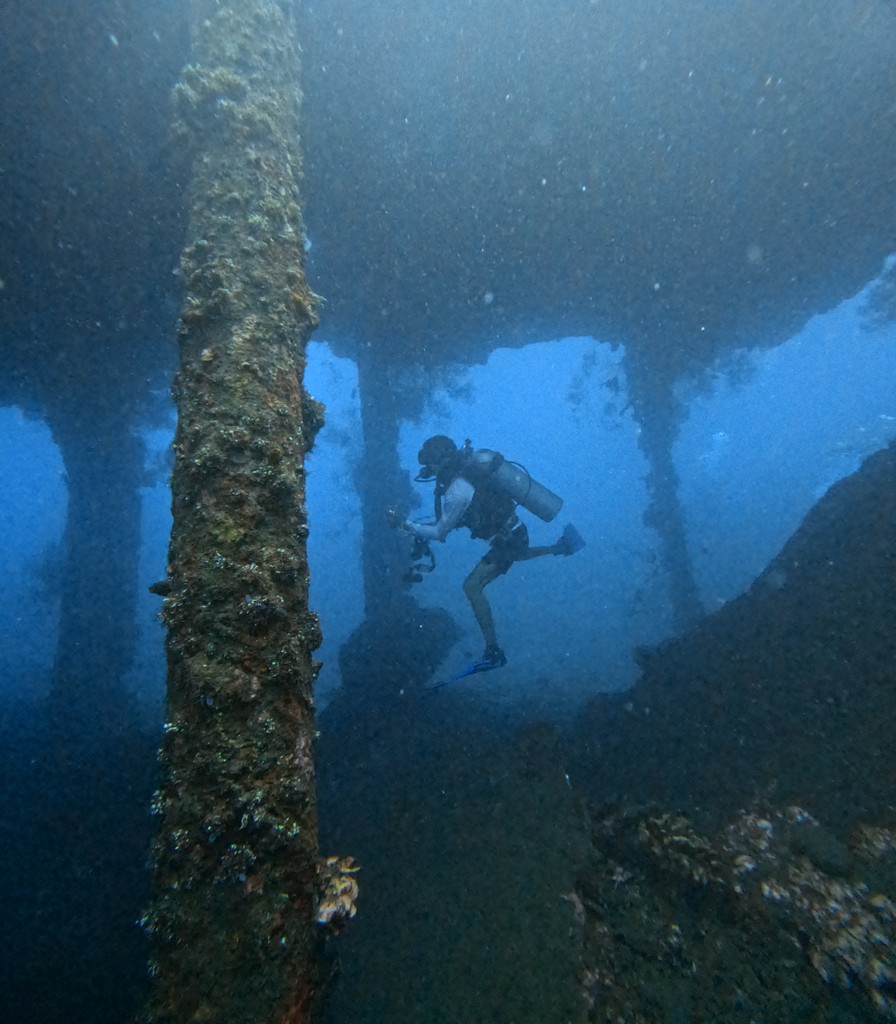
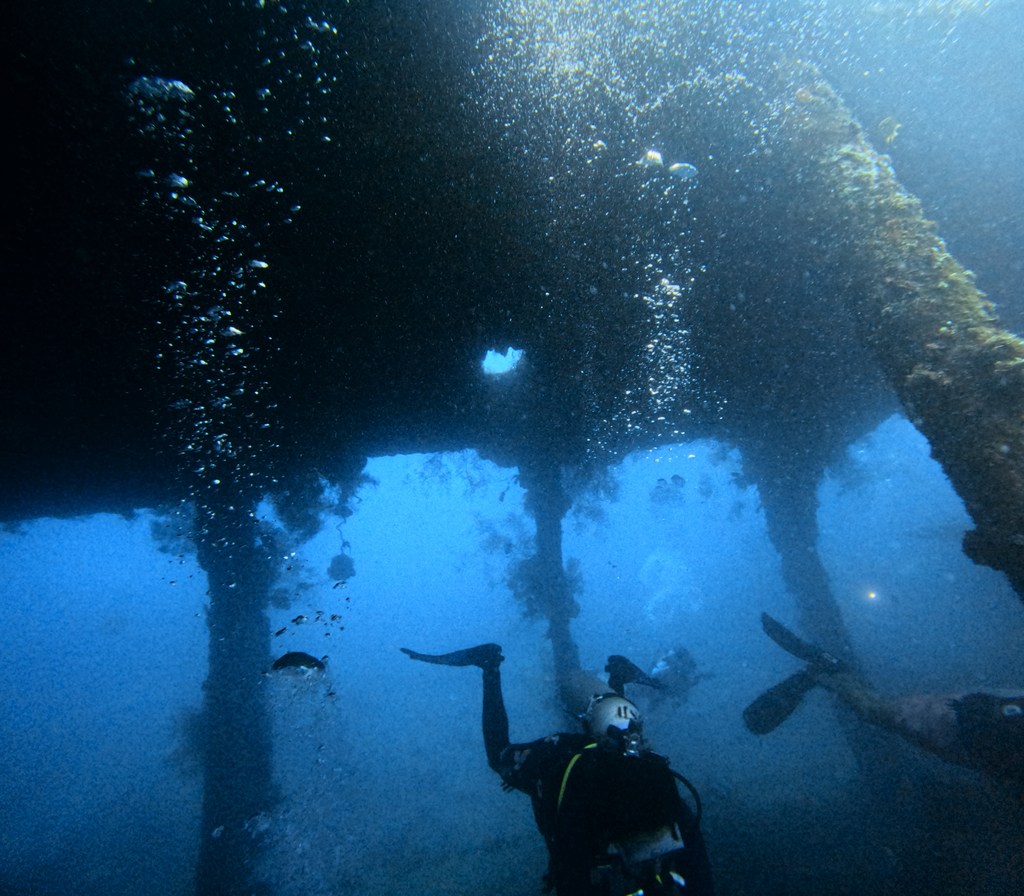
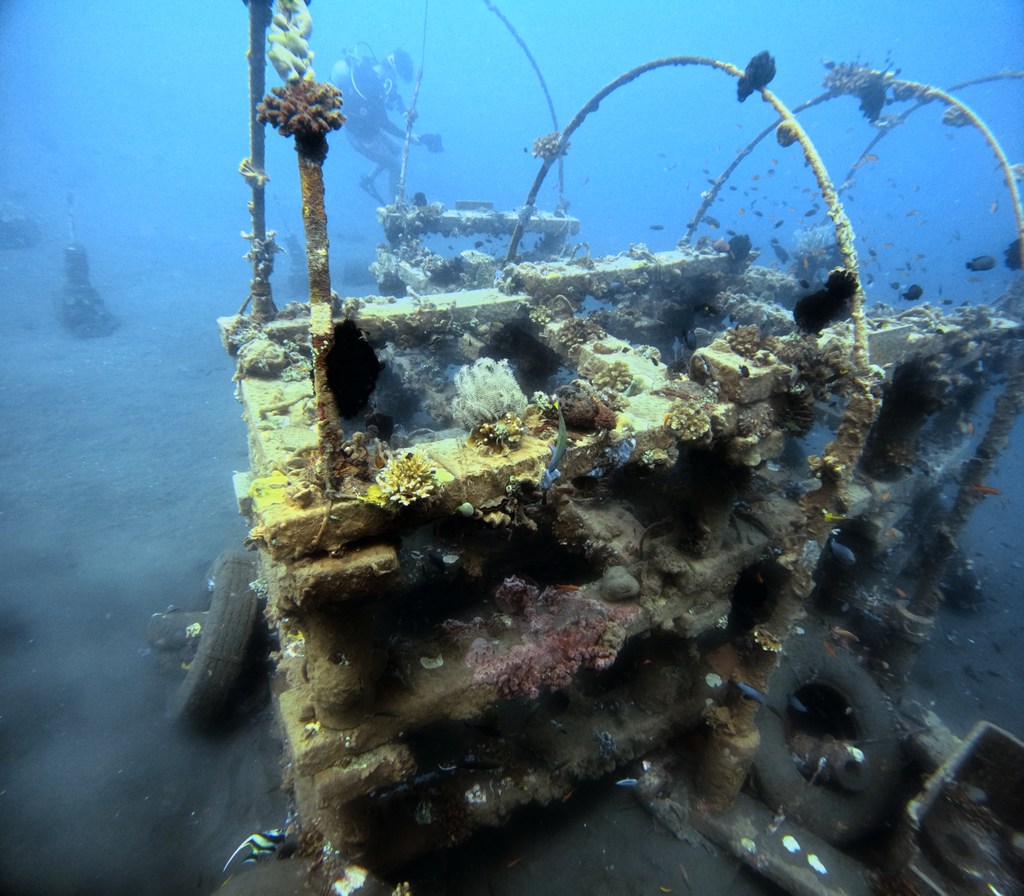
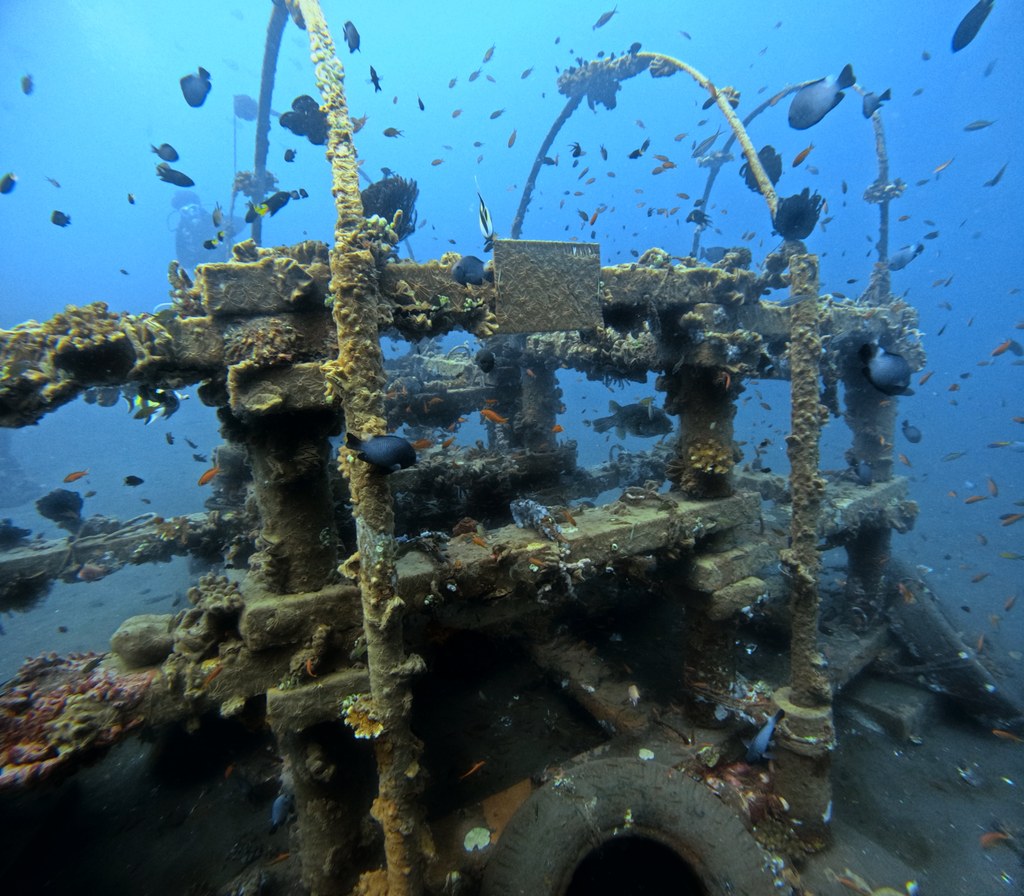
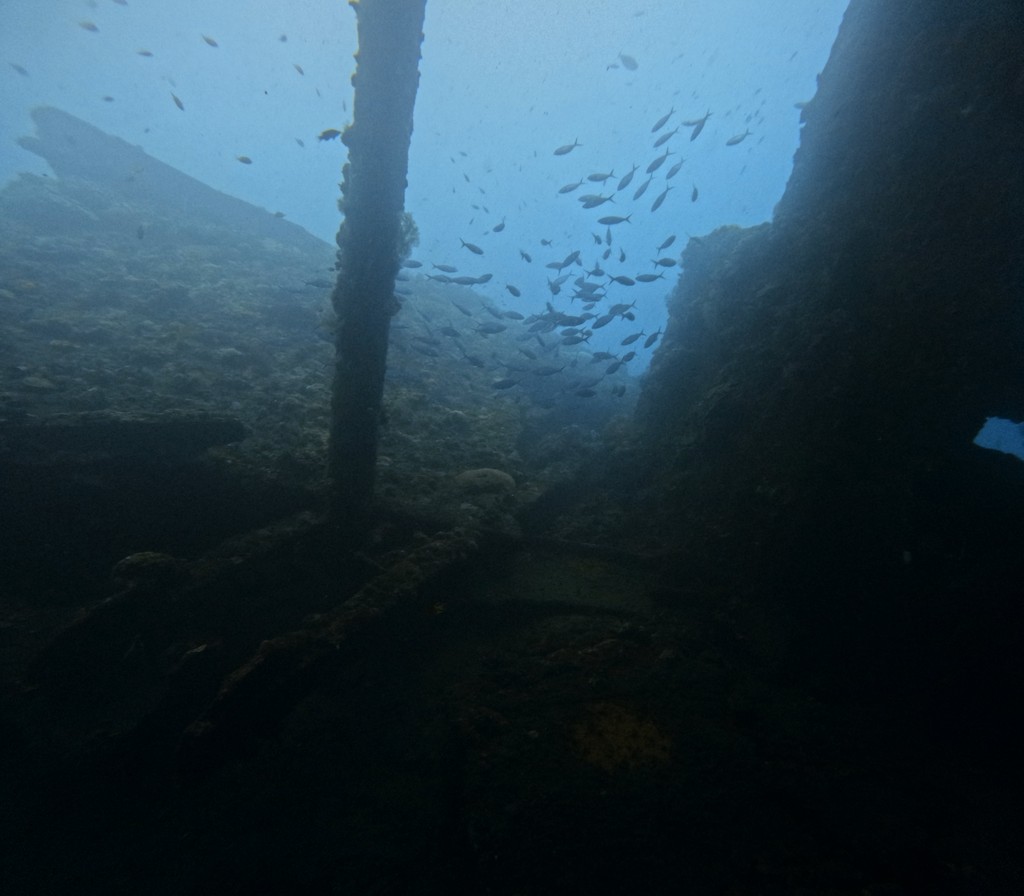
Eighty years of coral growth have turned the Liberty into a reef shaped like a ship. The hull has opened up in places, and the most striking views are from inside: frames and columns standing against the blue, openings in the plating that let the light in, and schools of fish hanging in the gaps. You can swim right around her, and you can swim inside the open sections of the hull without any real overhead environment — which is why it works for so many levels. Keep an eye out for the large circular structure, now completely encrusted.
Marine life on the wreck
The Liberty is a busy wreck in every sense. Expect schools of jacks and sweetlips, batfish, groupers, surgeonfish and clouds of small fish in the open sections, and look at the gorgonians and sponges for smaller life — nudibranchs, shrimps, and pygmy seahorses for those who know where to look. Garden eels line the sand around the hull.
One animal I do not promise you here any more: the bumphead parrotfish. More on that in the section on how Tulamben has changed.
Best Dive Sites in Tulamben
Tulamben is not only the wreck. Within a few minutes of the beach you have a range of sites that could fill a week, and they are very different from each other.
Coral Garden
Right along the shoreline between the wreck and the Drop Off, 3 to 15 meters deep. It is an artificial reef: statues and purpose-built structures placed on the sand have been colonized by coral and fish. It is gentle, shallow, excellent for a second or third dive of the day and one of the best night dives in the area.
Tulamben Drop Off
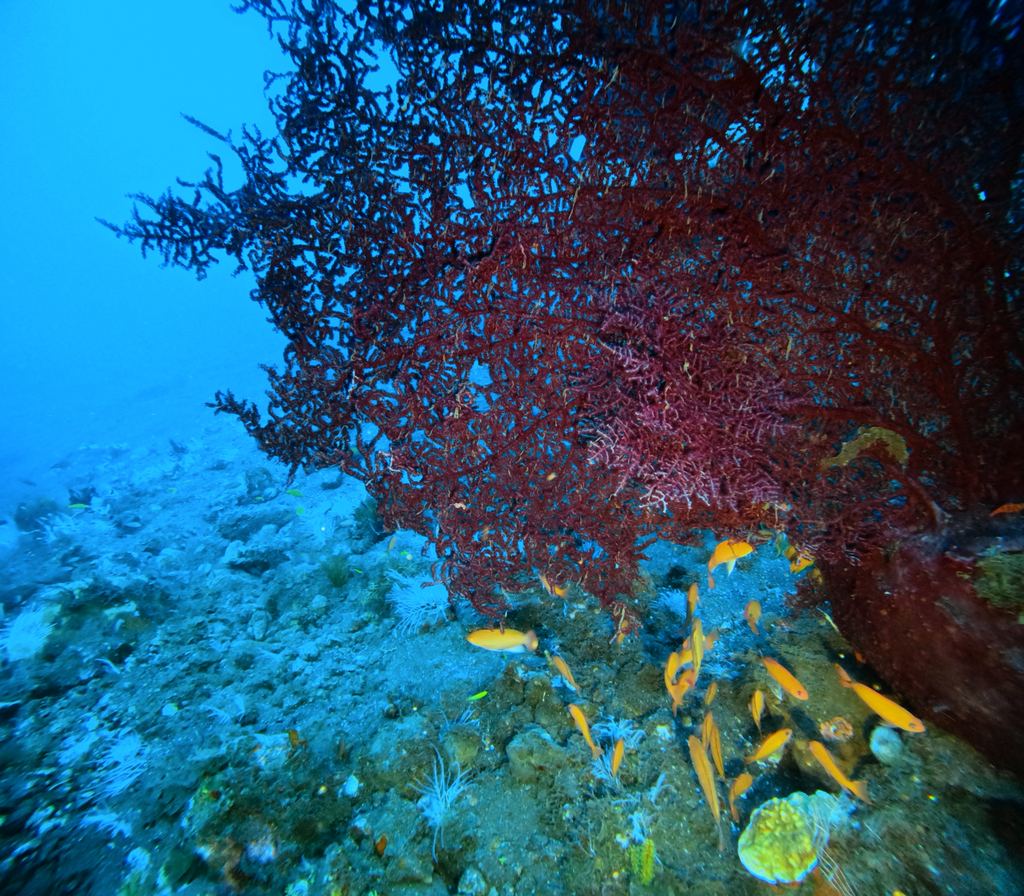
At the eastern end of the bay, a wall and slope that falls well beyond recreational depths. Large sea fans, barrel sponges, schooling fish and — on my last visit — a tornado of jackfish at around 10 meters, near the end of the dive. The deeper sections are normally dived at 20–30 meters, and the shallow top of the wall makes an easy safety stop. On busy days it gets crowded: when the waves made the wreck entry harder on September 27, 2026, many groups moved here and we changed plans.
Seraya Secrets
A few kilometers east, reached with a short pick-up. Seraya is the macro site of the area: a sand and rubble slope where photographers spend whole dives on a single square meter. On our dive the highlight was a large pink sea fan at 32 meters holding four pygmy seahorses, pink like their host; shallower, a set of artificial structures has become a small reef packed with fish. Seraya demands good buoyancy — one careless fin kick and the sand ends the visibility for everyone.
The Boga wreck at Kubu
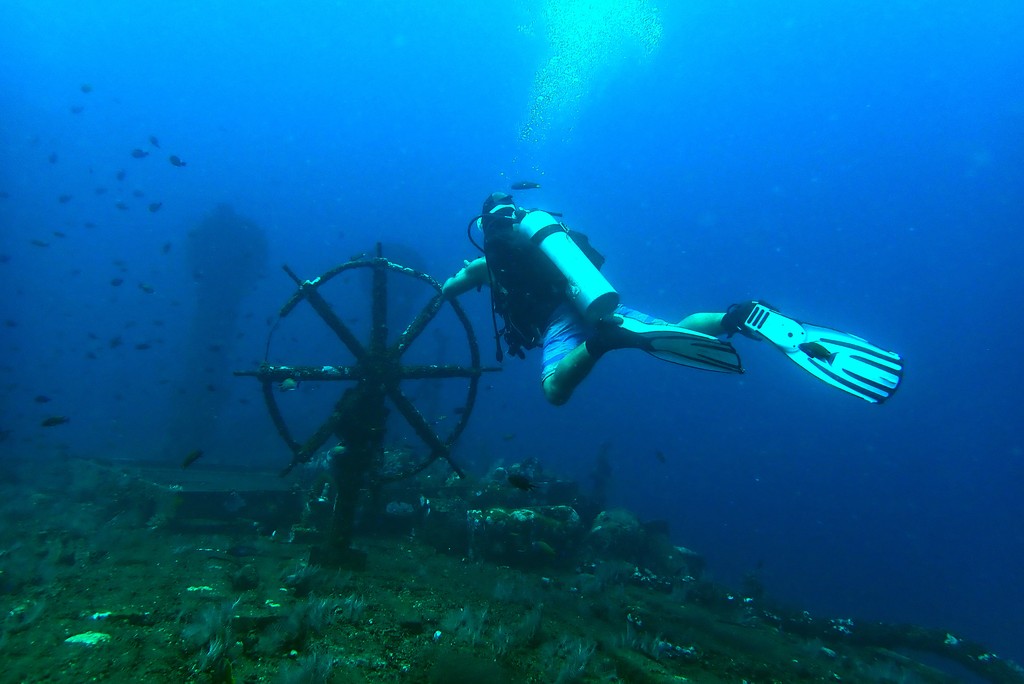
A few minutes north of Tulamben, the Boga is a modern ship scuttled on purpose in 2012 to create a new dive site. Objects have been placed on and around it — including a ship’s wheel on the deck. It lies deeper than the Liberty, roughly 16 to 40 meters, so it is an Advanced dive.
Batu Kelebit and the sites further north
Further up the coast, reached by jukung (traditional outrigger), sites like Batu Kelebit offer deeper boulder slopes with bigger fish and more exposure to current. They are for experienced divers and only with a guide who dives them regularly.
| Site | Depth | Level | Best for |
|---|---|---|---|
| USAT Liberty | 5–30 m | Open Water | The wreck, sunrise dives, night dives |
| Coral Garden | 3–15 m | All levels | Easy second dive, statues, night dive |
| Tulamben Drop Off | 10–30 m+ | Advanced for depth | Sea fans, schooling fish, the jack tornado |
| Seraya Secrets | 5–35 m | Open Water to Advanced | Macro, pygmy seahorses, photography |
| Boga wreck, Kubu | 16–40 m | Advanced | A second, deeper wreck |
What Can You See in Tulamben?
Tulamben’s appeal is the range: a wreck with schooling fish, a wall with big sea fans, and some of the best small-creature diving in Bali, all within a few kilometers.
Macro life
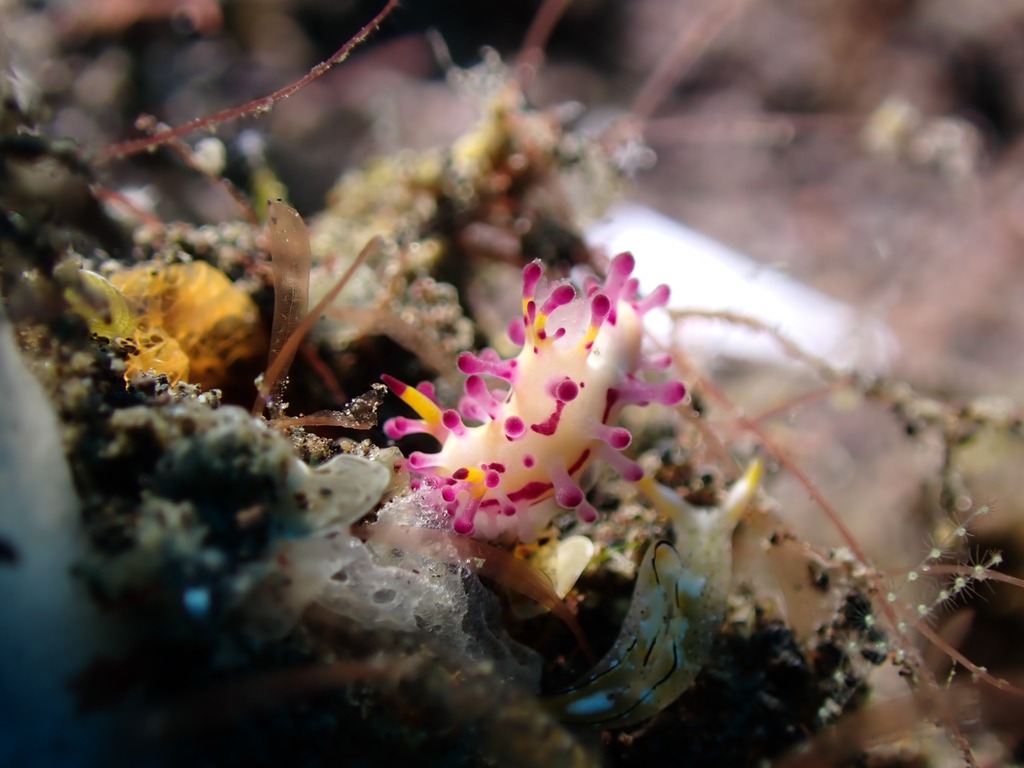
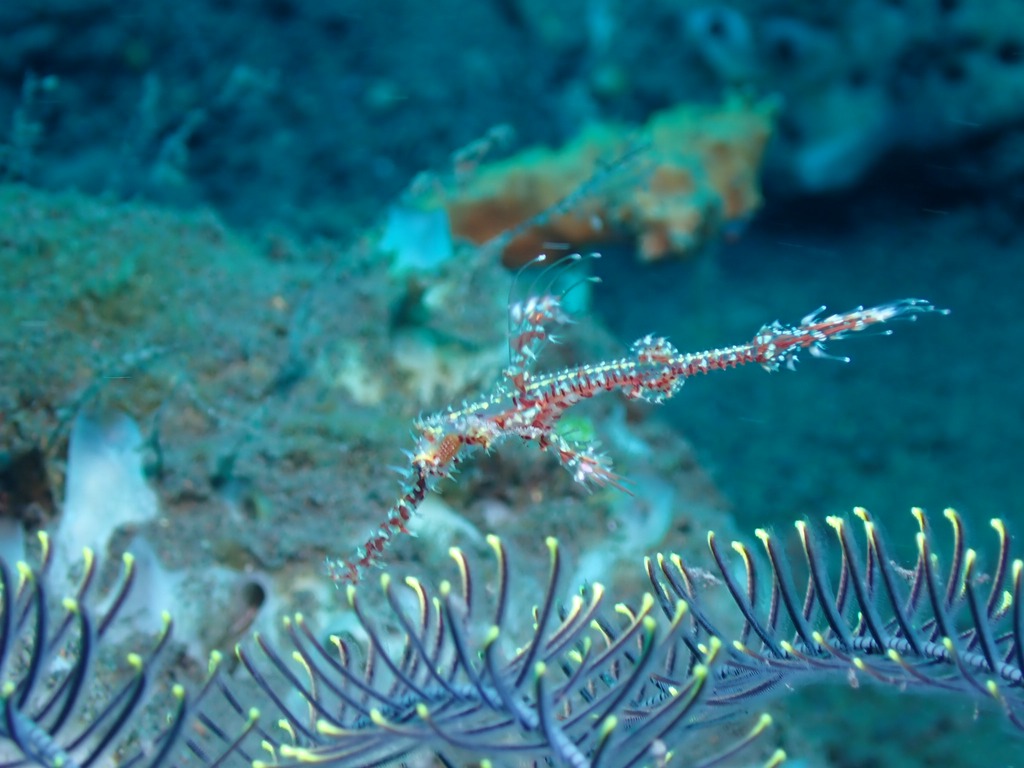
This is where Tulamben is strongest. Pygmy seahorses on the gorgonians, ghost pipefish, frogfish, leaf scorpionfish, a huge variety of nudibranchs, cleaner, coral and harlequin shrimps, and the occasional mimic octopus on the sand. Ask your guide which fans are currently hosting pygmy seahorses — they know, and finding one alone at 30 meters is close to impossible.
Schooling fish
On the wreck and at the Drop Off: jacks, sweetlips, batfish, snappers and fusiliers. The jackfish tornado at the Drop Off is the scene everyone wants on video, and it was the highlight of my third dive in September 2026.
Turtles, sharks and the occasional surprise
Green and hawksbill turtles are regular. White-tip reef sharks can be found resting on the deeper ledges of the Drop Off. Bigger pelagics — a manta, a sunfish — are rare and should never be the reason you book Tulamben. If big animals are the goal, Nusa Penida is the better choice (see the comparison below).
Diving Tulamben Over 10 Years: 2015–2026
I first dived Tulamben in August 2015 with Tauch Terminal. I returned five years later, in August 2020, during the Covid pandemic. I was staying at Mimpi Resort: on August 13 I dived the Boga wreck at Kubu, and on August 14 I spent an extraordinary full day diving the USAT Liberty with virtually nobody else around.
I came back to Tulamben in June 2024, again staying at Mimpi, and returned once more in September 2026 for three dives. This time I brought back enough photos and video to document not only the wreck and marine life, but also how the experience compares with my earlier visits.
Having dived Tulamben at four very different moments over more than a decade gives me an unusual perspective on what has changed — and what hasn’t. A word of caution first: four visits are four snapshots. I can tell you what I saw, not measure how the reef has evolved, and I will not dress up a memory as an ecological trend.
What has changed
The crowds. In August 2020 the wreck was practically empty: international travel had stopped and we had the Liberty almost to ourselves from morning to evening. That was exceptional, not normal, and hopefully it will not happen again. In September 2026 the opposite happened at the Drop Off: so many groups had moved there to avoid the waves at the wreck that the site was saturated and we went to Seraya instead. The waves were the immediate cause that day, but it shows how quickly Tulamben’s few shore entries fill up.
The bumphead parrotfish. For years the Liberty was known for a school of bumphead parrotfish that slept on the wreck and could be seen at first light. The school disappeared around the time of the Covid pandemic. Do not book Tulamben for the bumpheads, and be wary of anyone who still guarantees them.
The jackfish tornado. In the other direction, the tornado of jackfish at the Drop Off is, in my experience, a relatively new feature of the site. It was the high point of my September 2026 dives.
What hasn’t changed
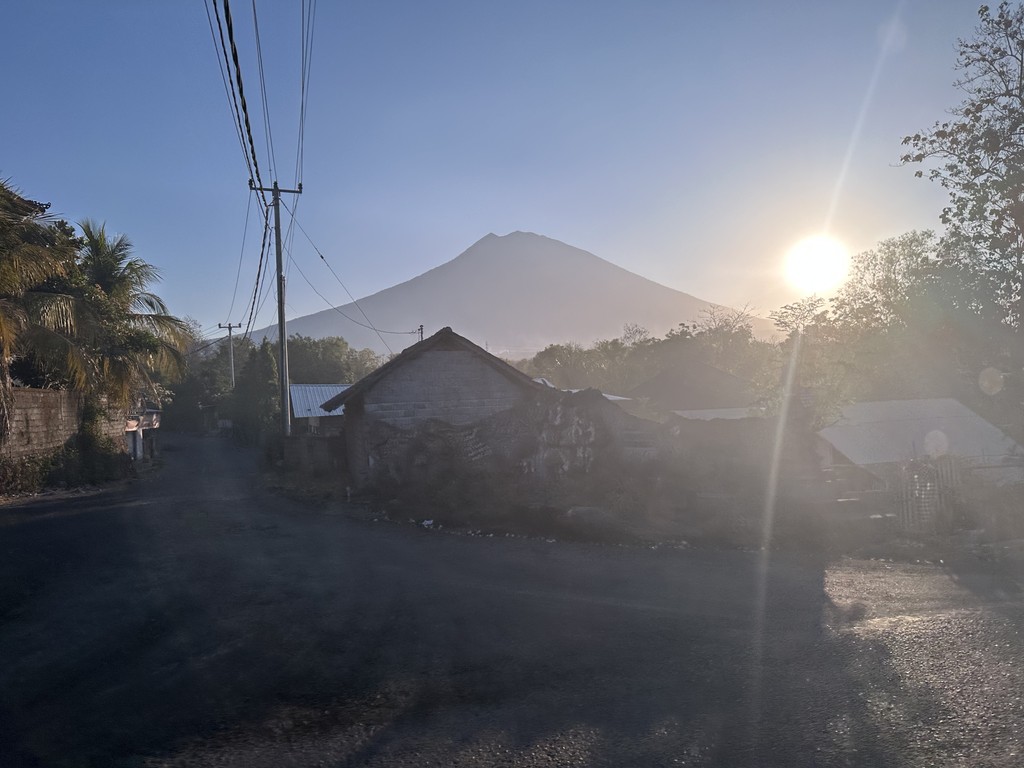
The black pebbles are as unforgiving as ever, the Liberty is still an extraordinary dive, and the morning light on Gunung Agung is still worth getting up for. The basic formula — walk in, swim thirty meters, and you are on a wreck — is exactly the one I discovered in 2015.
My Three Dives in September 2026
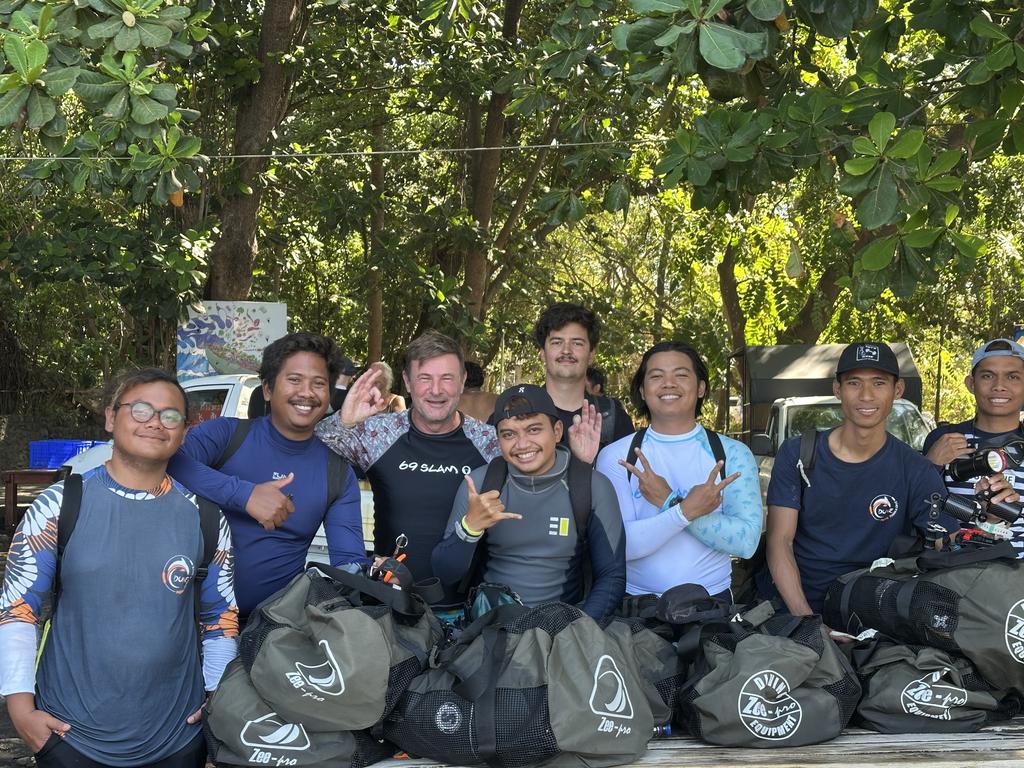
On Sunday September 27, 2026 the island of Nusa Penida observed Nyepi Laut (also called Nyepi Segara), the day of silence for the sea. From 6 AM that morning to 6 AM the next day, no fast boats, fishing, diving or snorkeling are allowed around Nusa Penida, Nusa Lembongan and Nusa Ceningan: the sea is left to rest. With our own dive sites closed, the Dune Penida team — instructors, divemasters and staff — made it a team outing and spent the day diving in Tulamben instead. Three dives, on air, in 28–29 °C water, with long surface intervals of about 2 hours 45 minutes between them.
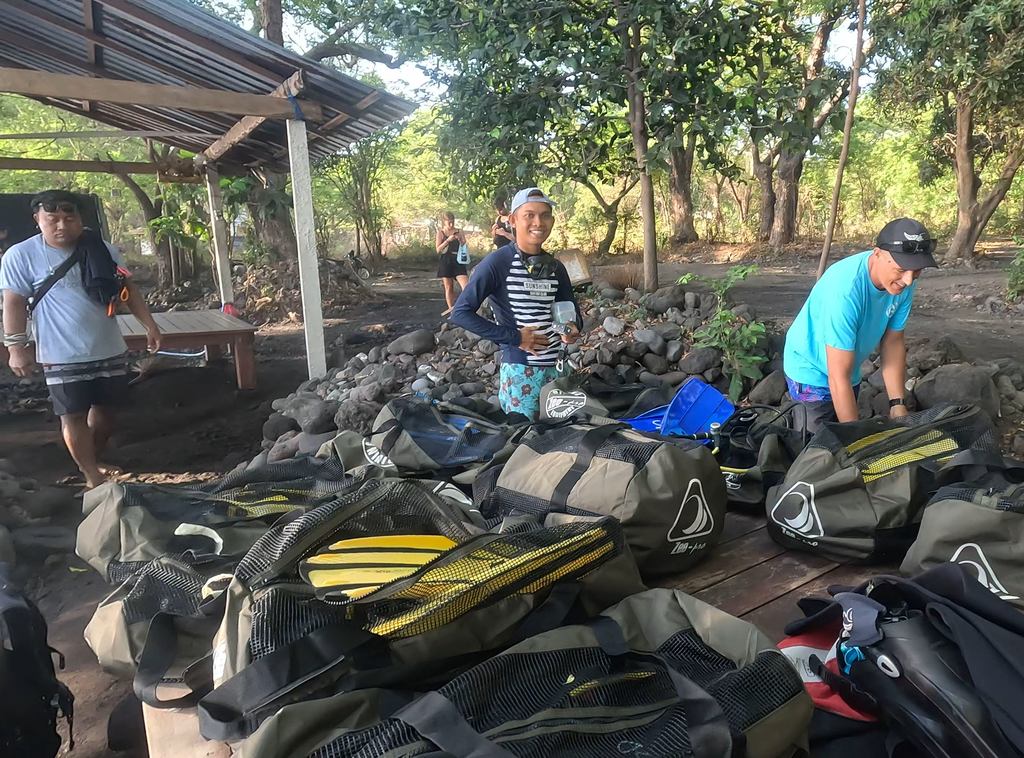
Dive 1 — USAT Liberty, 8:12 AM
We were in the water at 8:12 AM, before the main wave of day-trippers. The problem that morning was not the wreck but the beach: the surf was unusually strong. Getting in through waves on a pebble beach takes a specific technique, and I learned it the hard way. On this first entry I let the waves surprise me and got rolled in the shore break. I came out with a few bruises and a couple of mouthfuls of seawater — nothing serious, but a lesson. The full technique is in the shore diving section below.
Underwater, the waves had stirred up the sand and the visibility was mediocre. It was still a beautiful dive: we swam right around the wreck, went inside the open sections of the hull and spent time at the large circular structure. Fifty minutes, maximum depth 24.9 meters.
Dive 2 — Seraya, 11:46 AM
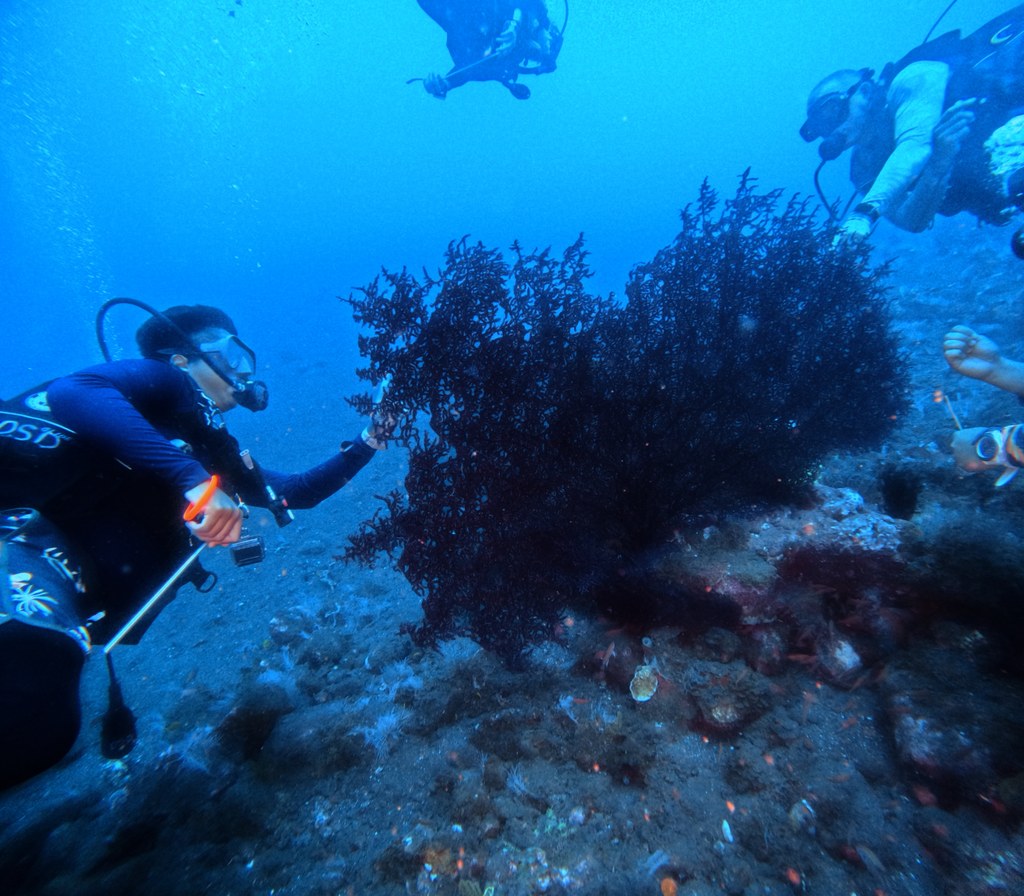
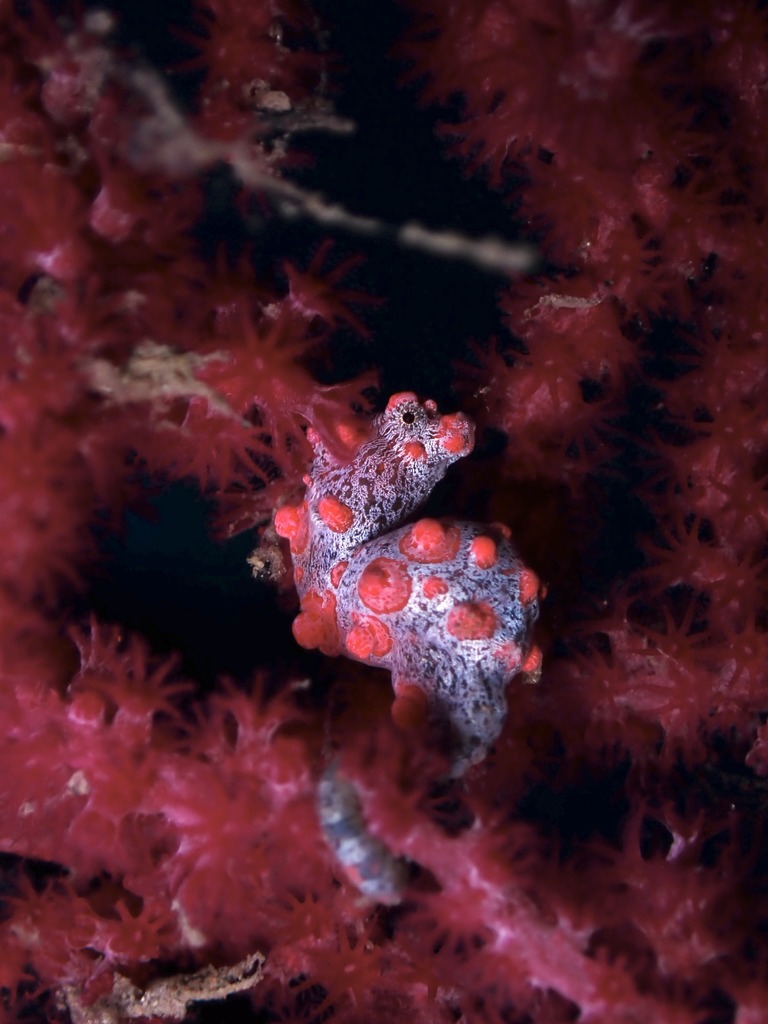
The plan was the Drop Off. But with the wreck entry so rough, many groups had moved there and the site was packed, so we went to Seraya, where far fewer divers were. On the way down to the sea fan, Roy photographed a Pikachu nudibranch (Thecacera) on the black sand — the little yellow-and-black slug every macro photographer in Bali hopes to see. His photo is in my guide to nudibranchs in Bali. At 32 meters, the deepest point of the dive, a large pink sea fan held four pygmy seahorses — pink like the fan itself, which is exactly why they are so hard to spot. The whole team spent several minutes around it — you can see Dharma, one of the Dune Penida guides, in the foreground of one of my photos, looking at a pygmy seahorse that is only a blur on the image. Shallower, the artificial structures colonized by corals were full of fish. Forty-six minutes, 28–29 °C.
Dive 3 — Drop Off, 3:16 PM
By mid-afternoon the crowds had thinned and we finally dived the Drop Off. Of course, that was the moment the SD card of my GoPro jammed, so everything I have from this dive comes from the other divers. Near the end, at around 10 meters just before the safety stop, we swam into a tornado of jackfish. Roy, our instructor, filmed a vertical selfie of the two of us inside it. Fifty-six minutes, maximum 25.8 meters — the best ending I could have asked for.
Best Time to Dive Tulamben
You can dive Tulamben all year. The main dive sites are sheltered from strong currents, and the water stays warm.
Dry season: April to October
The most reliable period for visibility, typically 20–30 meters on good days, and the easiest for travel. It is also the busiest, especially in July and August. Late September gave us 28–29 °C water — warmer than many people expect.
Rainy season: November to March
Rain usually comes in bursts rather than all day. Visibility drops somewhat when run-off reaches the sea, but the water is at its warmest and the sites are quieter. For macro, the rainy season is often excellent.
Waves: check on the day
What decides a Tulamben dive day is less the season than the surf. On September 27, 2026, in the middle of the dry season, the waves were strong enough to make the wreck entry difficult and to push most groups to other sites. Local guides watch the sea every morning; trust their call on where to dive.
Tulamben for Beginners vs Experienced Divers
For beginners and Open Water divers
Tulamben is one of the most accessible big wreck dives in Asia. The Liberty’s shallow stern, the lack of current on most days and the Coral Garden make it a comfortable place to build experience. Discover Scuba divers can see part of the wreck with an instructor. The only real hurdle is the entry: on a day with waves, ask for help and take your time.
For experienced divers
Experienced divers get the Drop Off at depth, the deeper sections of Seraya, the Boga wreck at Kubu, night dives on the Liberty and the sunrise slot — the best reason to sleep in Tulamben. Photographers can spend a week between the wreck and Seraya without running out of subjects.
Snorkeling
Snorkelers can see the shallowest part of the Liberty and the upper Coral Garden from the surface on a calm day. Do not attempt it when the shore break is strong.
Shore Diving and How the Dives Work
Almost everything in Tulamben is a shore dive. That changes the rhythm of the day compared with boat diving — and it makes the entry the one skill you need to master.
The pebble beach
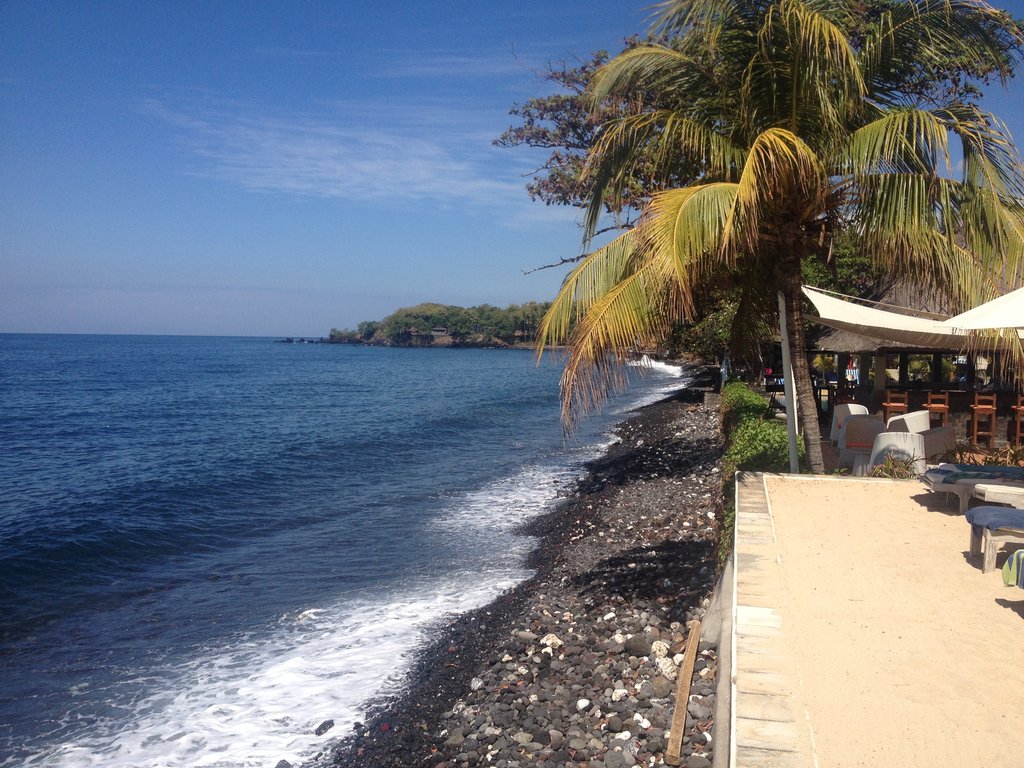
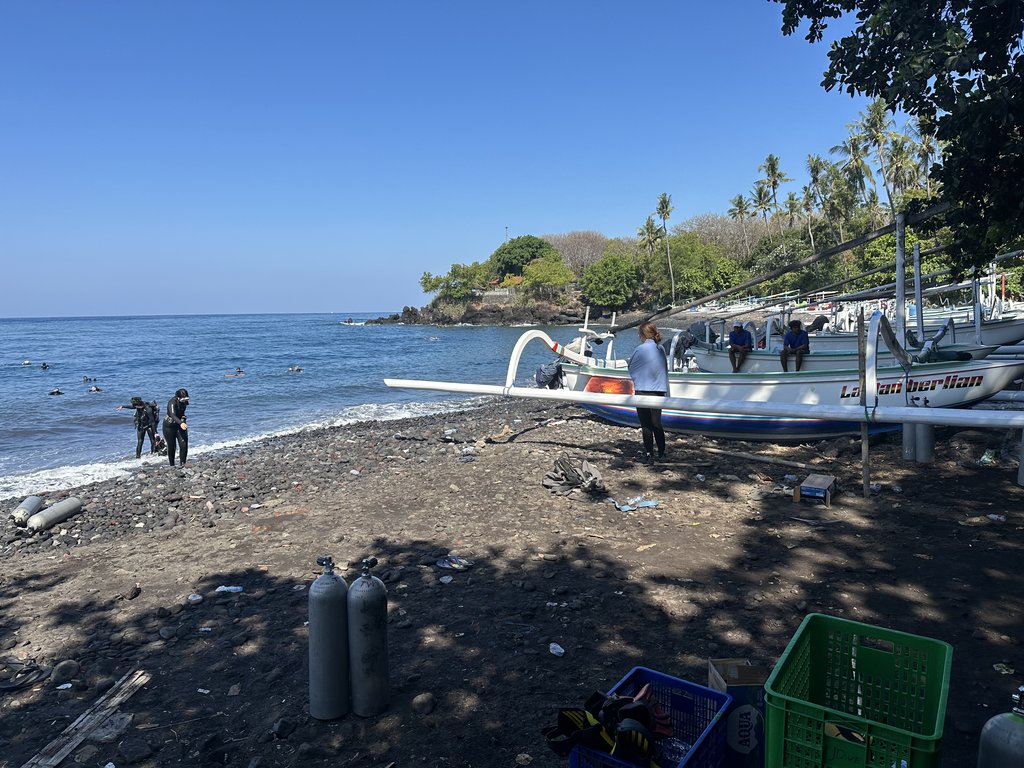
Tulamben’s beach is not sand: it is made of large, rounded volcanic stones that roll under your feet and become slippery when wet. Wear hard-soled booties, not neoprene socks. Porters — traditionally women from the village — can carry your tanks to the water’s edge for a small fee.
How to get in and out through waves
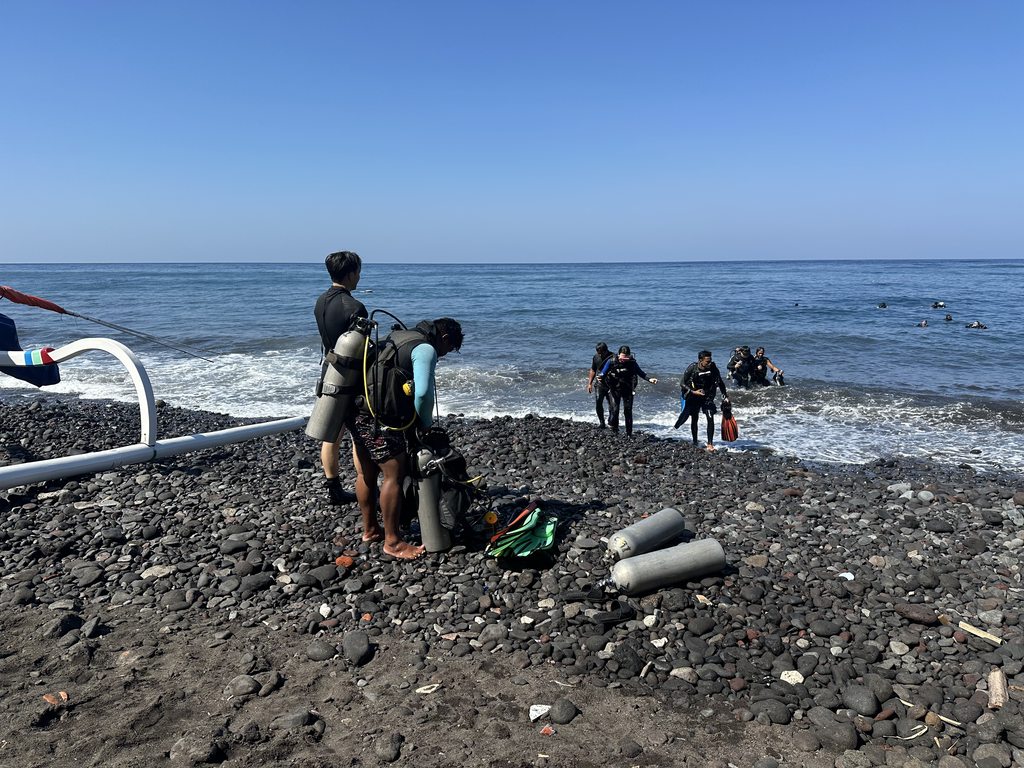
On a calm day you simply walk in. When the waves are up, this is the technique we used — and the one I did not apply properly on my first entry:
- Stand at the water’s edge fully equipped, regulator in your mouth, fins in your hand — ideally with your arm through the fin straps, because the shore break tears fins away very easily.
- Watch the sets. Waves tend to come in cycles — often counted as seven — and there is a calmer moment between them. Wait for it.
- When it comes, go in decisively. Hesitating in the break zone is exactly how you get rolled.
- As soon as you lose your footing, put on the first fin as fast as you can so you can move away from the shore and out of the zone where the waves break.
- Once you are clear of the break, put on the second fin and regroup with your buddy before descending.
- Coming out, reverse the process: wait for a lull, take your fins off in shallow water, and get up the beach quickly.
If you are unsure, say so to your guide. On a day like September 27 they will help you, or choose a more sheltered entry.
A typical day
Most operators run two or three dives a day with long breaks in between. Your guide sets up the gear, you walk or take a short pick-up to the entry point, and you return to the resort between dives. Our base on September 27 was Ocean View Tulamben Dive & Resort, within walking distance of the Liberty, where we had breakfast between the first and second dives and lunch between the second and third; the resort also provided the pick-up to the Drop Off and Seraya.
Where to Stay in Tulamben
On a Tulamben trip, where you sleep is a diving decision. Sleeping here lets you be on the wreck at dawn, before the day-trippers from South Bali arrive, and do three or four dives without spending half the day in a car. These are the places I know first-hand, followed by other options divers often choose.
Places I have stayed or used
Tauch Terminal Resort Tulamben & Spa — my first Tulamben base, in 2015. A beachfront resort with its own dive center, about 100 meters from the wreck entry, which makes an early start easy.
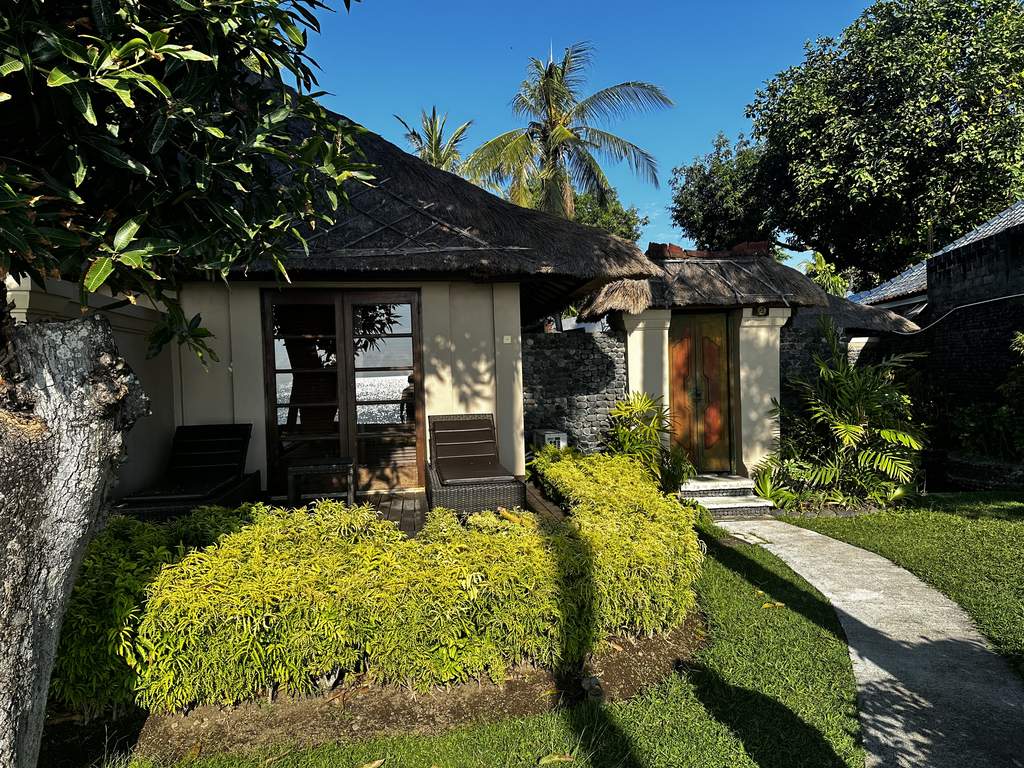
Mimpi Resort Tulamben — where I stayed in 2020 and 2024. Bungalows in a garden, direct beach access, a house reef in front and hot spring pools that feel very welcome after three dives. It is around 400 meters from the Liberty.
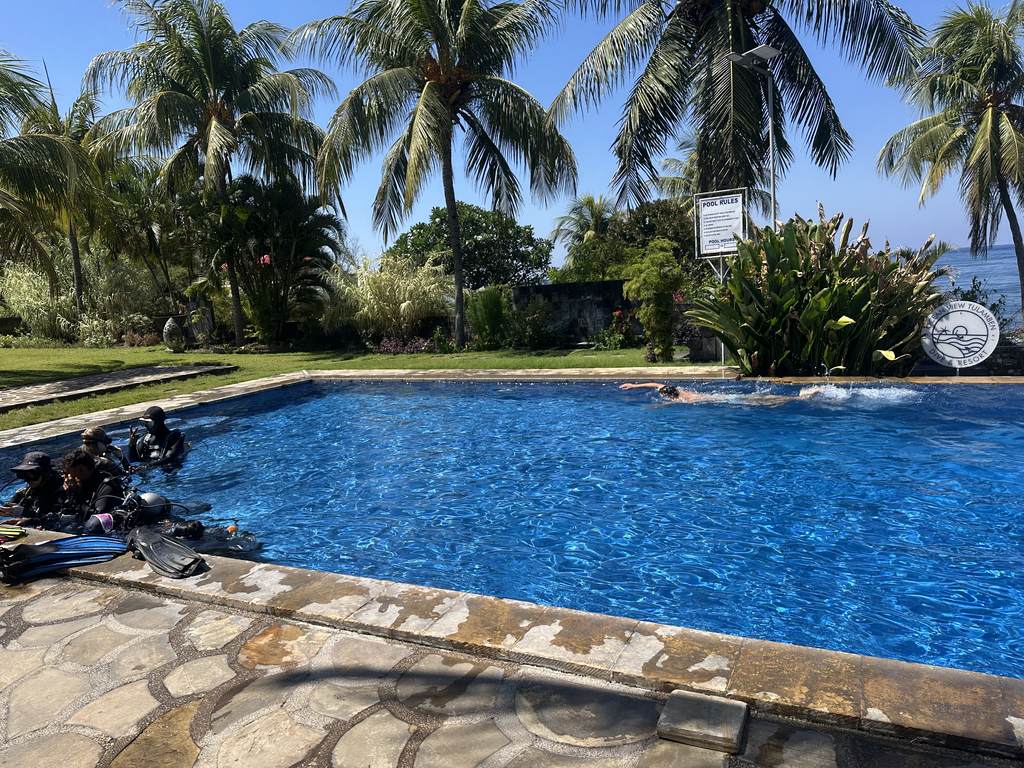
Ocean View Tulamben Dive & Resort — our base on September 27, 2026 for breakfast and lunch between dives. The service was slow, but the location is very practical: within walking distance of the Liberty, with a pick-up to the other sites such as the Drop Off. A pool with a sea view helps the surface intervals pass.
Other good options
Liberty Dive Resort — a few minutes’ walk from the wreck, with its own dive center and nitrox. A good all-round choice.
Siddhartha Oceanfront Resort & Spa Bali — at Kubu, a few minutes north. The comfortable option, with its own dive center and house reef.
Tulamben Dive Resort — a budget option to be first in the water.
If you want to combine Tulamben with Amed, Sidemen and the temples of the east, my guide to Karangasem, East Bali covers the region.
Tulamben vs Nusa Penida: Which Should You Choose?
I live between mainland Bali and Nusa Penida, and I run a dive center on Penida, so take this comparison with that in mind. The two destinations are not competitors: they are completely different kinds of diving.
| Tulamben | Nusa Penida | |
|---|---|---|
| Signature | The USAT Liberty wreck and macro | Manta rays year-round, sunfish (mola mola) in season |
| Access | Shore diving from the beach | Boat diving |
| Current | Slack on most days | Often strong; drift diving on many sites |
| Water temperature | Around 26–29 °C | Warm most of the year, but it can drop far lower at depth in mola season (July–October) |
| Best level | Open Water and up | Beginners at selected sites; Advanced and current experience for the drifts |
| Getting there from South Bali | About 3 hours by road | 30–45 minutes by fast boat from Sanur |
| Best for | Wreck, macro, relaxed shore diving, night dives | Big animals, drift diving |
Choose Tulamben if you want a relaxed shore-diving trip, a famous wreck, macro photography, warm water and no currents to manage.
Choose Nusa Penida if you want manta rays, the chance of a sunfish in season, and the thrill of drift diving. Everything you need to plan it is in my Nusa Penida diving guide and in my list of the 20 best dive sites of Nusa Penida.
Do both if you have a week or more: they complement each other perfectly. Full disclosure: I run Dune Penida, the dive center that organized the Tulamben day described on this page.
Practical Information
Getting to Tulamben
Tulamben is about 98 km from Denpasar airport, roughly 3 hours by road. A private driver costs around IDR 700,000 (~$40 / €34) one way. From Amed it is only 25–30 minutes. See my guides to getting to Bali and getting around Bali for transport options.
Prices in 2026
Booked with a local operator in Tulamben, two guided fun dives cost around IDR 1,000,000 (~$56 / €49). The same dives booked as a day trip from South Bali, transfer included, cost about two to three times more. If you dive more than one day, sleeping in Tulamben pays for itself.
What to bring
- Hard-soled booties for the pebble entry
- A 3 mm wetsuit is enough for most of the year
- Cash in rupiah — card payments often carry a 2–3 % surcharge
- Your certification card and logbook
- A spare SD card and a backup for your camera — as I learned at the Drop Off
Safety
Follow the usual flying-after-diving intervals, and remember that Bali’s mountain roads count as altitude: do not dive Tulamben and drive up to Kintamani or Bedugul the same day. Carry dive insurance that covers evacuation and hyperbaric treatment. In an emergency, DAN Asia-Pacific can be reached on +61-8-8212 9242.
Read More
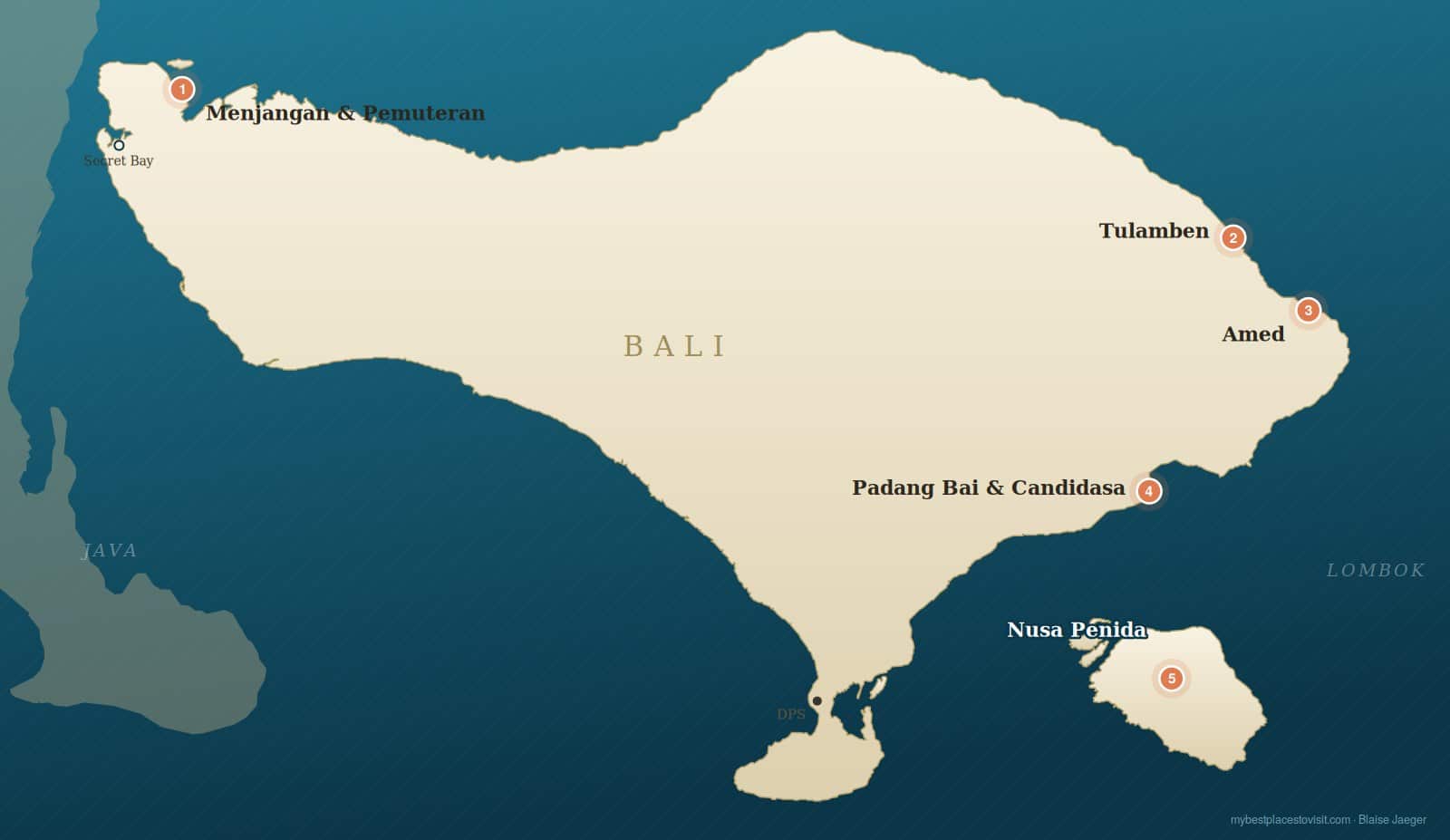
Diving in Bali
The five dive zones of Bali — Tulamben, Amed, Padang Bai, Menjangan and Nusa Penida — with seasons, 2026 prices and where to stay.
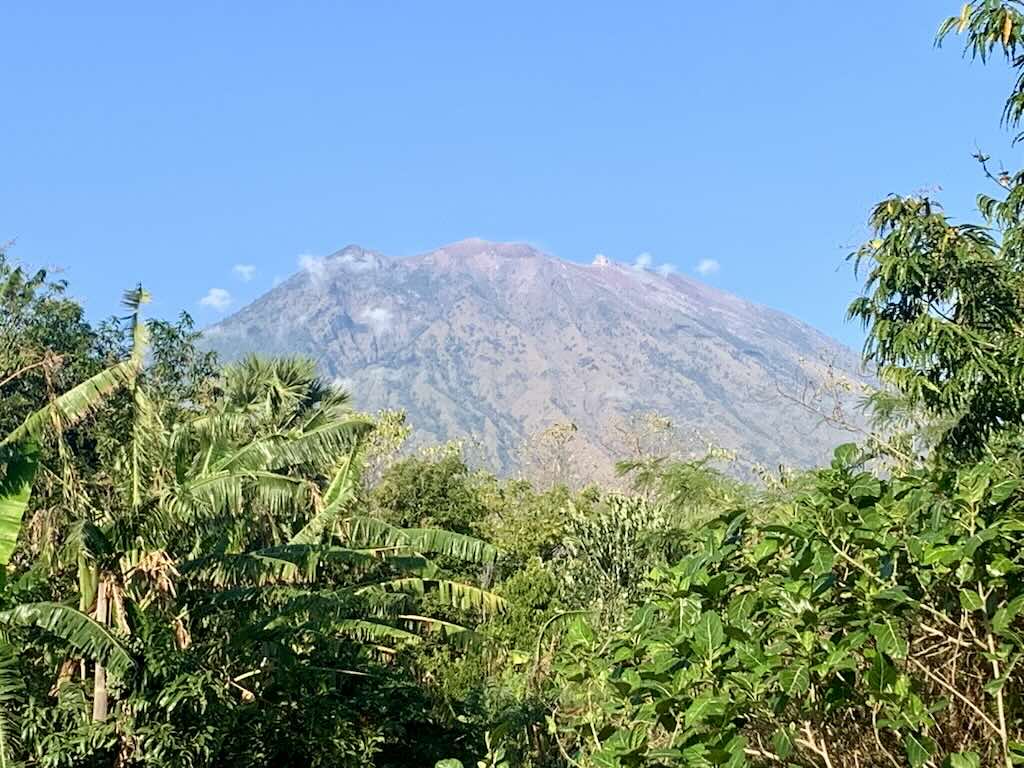
Karangasem, East Bali
Temples, rice terraces, Sidemen, Amed and Tulamben: how to explore Bali’s wild east around your dives.
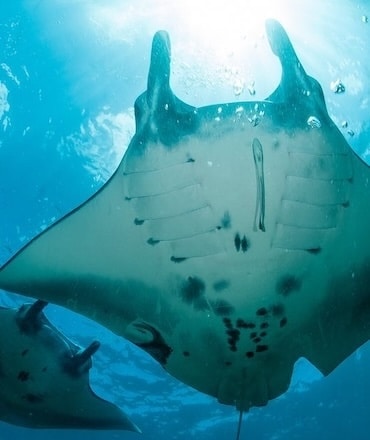
Nusa Penida Diving Guide
Manta Point, Crystal Bay, the mola mola season and the drift sites: the site-by-site guide to diving Nusa Penida.
Frequently Asked Questions About Diving in Tulamben
Is Tulamben good for diving?
Yes. Tulamben is one of the best shore-diving destinations in Asia, thanks to the USAT Liberty wreck, which lies just off the beach, and to excellent macro sites such as Seraya and the Drop Off. Most dives need no boat, and there is little current on most days.
How deep is the USAT Liberty wreck?
The Liberty lies between about 5 and 30 meters. The stern is the shallowest part, the midship section sits at 12–22 meters and the bow drops to around 30 meters. Open Water divers can explore most of the wreck without going below 18 meters.
Can beginners dive the Liberty wreck in Tulamben?
Yes. The Liberty is one of the most beginner-friendly big wrecks in the world: shallow, close to shore and usually without current. The hardest part is the entry over the pebble beach, especially on days with waves.
Can you snorkel the USAT Liberty?
Yes, on calm days. The shallowest parts of the wreck, around 5 meters deep, are visible from the surface. Do not snorkel there when the shore break is strong.
What is the best time to dive in Tulamben?
April to October generally offers the best visibility, but you can dive Tulamben all year. The surf on the day matters more than the season: strong waves can reduce visibility and make the entry difficult.
How much does diving in Tulamben cost?
Around IDR 1,000,000 (about $56 / €49) for two guided dives booked with a local operator in Tulamben in 2026. The same dives booked as a day trip from South Bali cost two to three times more.
How do you enter the water in Tulamben when there are waves?
Wait at the water’s edge fully equipped with your fins in your hand, arm through the straps. Wait for a calm moment between sets, walk in decisively, put on your first fin as soon as you lose your footing, move away from the breaking waves, then put on the second fin.
Can you see pygmy seahorses in Tulamben?
Yes. Pygmy seahorses live on the sea fans at Seraya, the Drop Off and on the Liberty. On my dive at Seraya in September 2026, a single pink sea fan at 32 meters held four of them. You will need a guide to find them.
Are there still bumphead parrotfish on the Liberty?
The school of bumphead parrotfish that used to sleep on the wreck disappeared around the time of the Covid pandemic. Individual fish may still turn up, but no one should promise them to you.
Tulamben or Amed: which is better for diving?
Tulamben for the wreck and deeper macro sites, Amed for easy reefs, learning to dive and freediving. They are only 25–30 minutes apart, so many divers combine them.
Tulamben or Nusa Penida: where should I dive?
Tulamben for a wreck, macro and relaxed shore diving in warm water; Nusa Penida for manta rays, sunfish in season and drift diving. With a week or more, do both.
How many days do you need in Tulamben?
Two to three nights is ideal: enough to dive the Liberty at sunrise, add a night dive, and explore Seraya and the Drop Off.