Old Perithia, Corfu: Ghost Village & Pantokrator Guide
By Blaise Jaeger · Updated July 22, 2026
Why Visit Old Perithia?
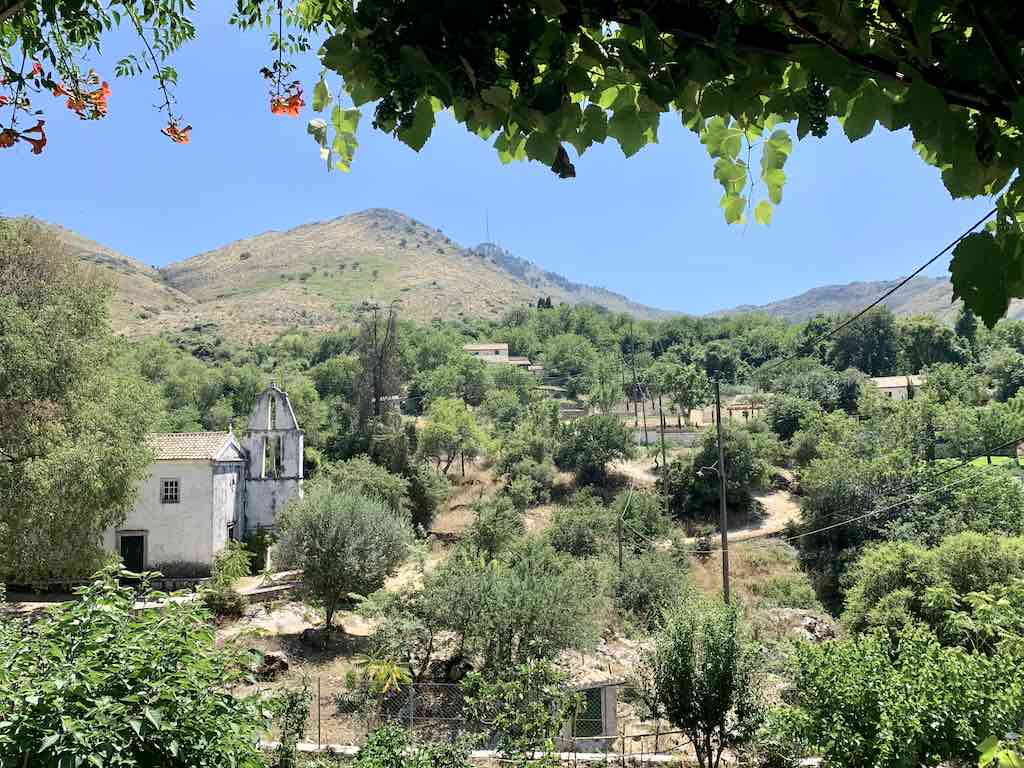
Old Perithia (Palia Perithia) is the oldest village on Corfu, a cluster of Venetian stone houses tucked into a green mountain bowl just below the summit of Mount Pantokrator. Where the rest of the island rushes toward the beach, this place does the opposite: it slows you right down. Cobbled lanes wind between roofless ruins and beautifully restored houses, eight old churches sit half-hidden in the trees, and a handful of family tavernas serve some of the best mountain cooking in northern Corfu.
I’ve been coming to Corfu regularly since 2013, when I started building my villa on the island — almost every month through the construction years up to 2015, and regularly ever since. In that time I’ve driven up to Old Perithia dozens of times for a long lunch, for the hike to the summit, or just to watch the light go gold on the old stones at the end of the day. It’s the one corner of the island I send every visiting friend to, and it’s still gloriously uncrowded compared to the coast. This guide covers everything I’ve learned: the history, what to see, how to hike to Pantokrator from the village, where to eat, where to stay, and exactly how to get there.
Old Perithia at a Glance
- What it is: Corfu’s oldest village, a protected historic settlement (a “ghost village” of Venetian-era houses)
- Where: Northeast Corfu, at about 450 m altitude on the north slopes of Mount Pantokrator
- Founded: First written records date to the 14th century; the settlement is likely older
- Why up here: Built high to escape pirate raids and the malaria of the coastal marshes
- At its peak: Around 1,200 inhabitants, about 130 houses and eight churches
- Today: Just a handful of permanent residents, five family tavernas and several restored guesthouses
- Highlights: Venetian architecture, eight churches, mountain tavernas, and the hike to the Pantokrator summit (906 m)
- How long to spend: Half a day for a walk and lunch; a full day if you add the Pantokrator hike
My Old Perithia: A Local’s Take
The first time I came up here I got the whole thing wrong — I arrived at 1 p.m. in August, couldn’t find a parking spot, and every taverna was full. Now I know better, and that’s exactly the kind of thing I want to pass on. Come mid-morning or late afternoon, out of the peak lunch crush, and Old Perithia turns into one of the most peaceful places on the island.
My ritual is simple. I park at the entrance, walk a slow loop through the lanes to see how the restorations are coming along, then settle in at Ognistra — my favourite of the tavernas. Ask for Nikos and order the kouneli stifado (rabbit stew slow-cooked with onions and sweet spices); it’s the dish I judge every mountain taverna by, and his is the best. If you’ve got the legs for it, do the hike up to Pantokrator first and come back down ravenous — food always tastes better when you’ve earned it.
What keeps pulling me back, though, is the atmosphere at the edges of the day. Late in the afternoon the tour groups have gone, the swifts come out over the rooftops, and the ruined houses glow in the low sun. Stay until dusk and the “ghost village” name suddenly makes sense — it’s silent except for leaves and, if you’re lucky, an owl. It’s genuinely one of my favourite hours anywhere on Corfu, and it costs nothing.
The History of Old Perithia
To understand Old Perithia you have to understand why anyone would build a village up here instead of on the coast a few kilometres away. The answer is survival. For centuries the shoreline of Corfu was dangerous on two fronts: pirate raids from the sea and malaria carried by mosquitoes in the coastal marshes. Building high, out of sight of the water and above the mosquito line, solved both problems at once. Old Perithia’s position at around 450 m — invisible from the sea but with clear views of the approaches — was a deliberate choice.
The first written records of the village date to the 14th century, though people almost certainly farmed these slopes earlier. Through the long Venetian period the village grew rich on what the mountain could give: sheep, olives and, above all, vines. At its height it counted around 1,200 inhabitants, roughly 130 houses and eight churches — one church for about every 150 residents, which tells you how prosperous and devout the community was. Many of the finer houses were built by merchants and were designed to impress, with carved stone doorways and Venetian-style facades you can still read in the ruins today.
The decline was slow rather than dramatic. As early as the 19th century families had begun spending winters down on the coast. Once malaria was brought under control in the 20th century and tourism started to boom along the shoreline, the reason to live high on the mountain simply disappeared. Through the 1950s and 1960s residents drifted down to the sea for work, and the village emptied. In 1996 Old Perithia was declared a protected monument, which froze it in time and saved its architecture from the concrete that reshaped so much of coastal Corfu. The 2021 census recorded just six permanent inhabitants — but a wave of careful restoration, led by returning families and a few outsiders who fell for the place, has quietly brought it back to life.
Things to See in the Village
The Eight Churches
For its size, Old Perithia has an astonishing number of churches — eight in total, scattered through the village and the surrounding fields. The most important is Agios Iakovos o Persis (St James the Persian), the large church you see as you arrive from the road. Built in the 14th century, it holds remarkable frescoes and was expertly restored in 2013–2014. If you like a goal to give a wander some structure, do what I do: try to find and photograph all eight. It takes you into the quieter corners of the village you’d otherwise miss.
Venetian Houses, Gates and the Old School
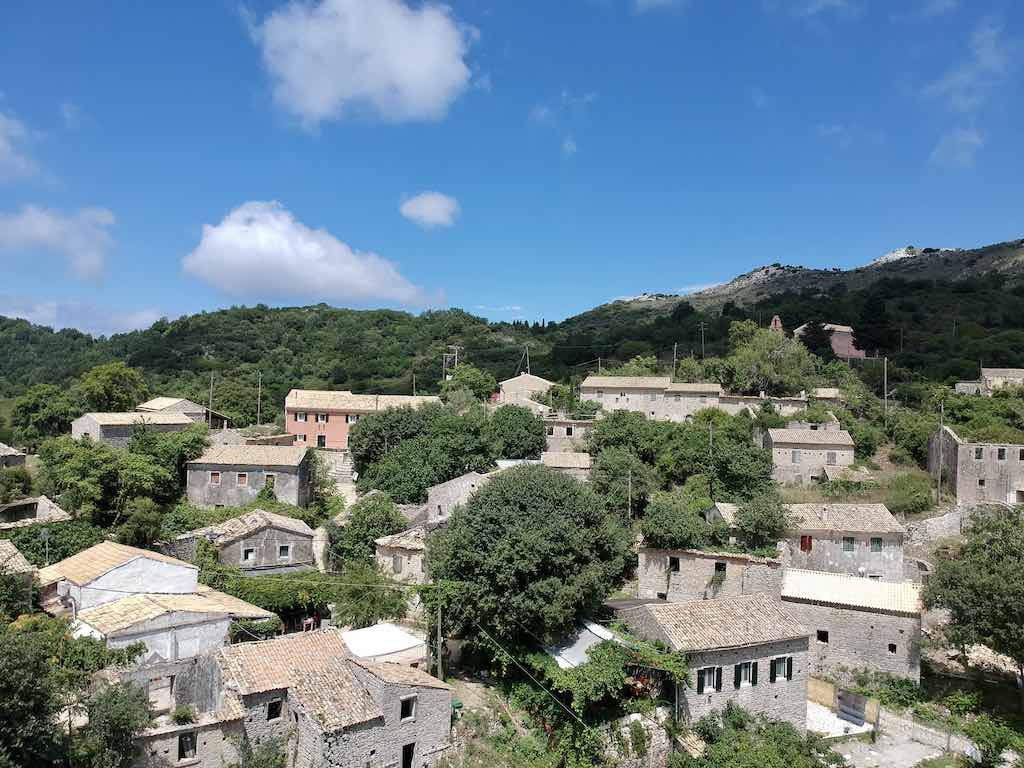
The real pleasure here is simply getting lost among the 130 houses. Most are still ruins, roofless and softened by wildflowers, but that’s exactly what makes them so photogenic. Look for the Venetian-style stone gateways that frame several of the lanes, and the old village school, which closed around the middle of the last century. Interspersed with the ruins you’ll find beautifully restored homes — proof of how lovely the whole village must once have looked, and a hint of where it’s heading.
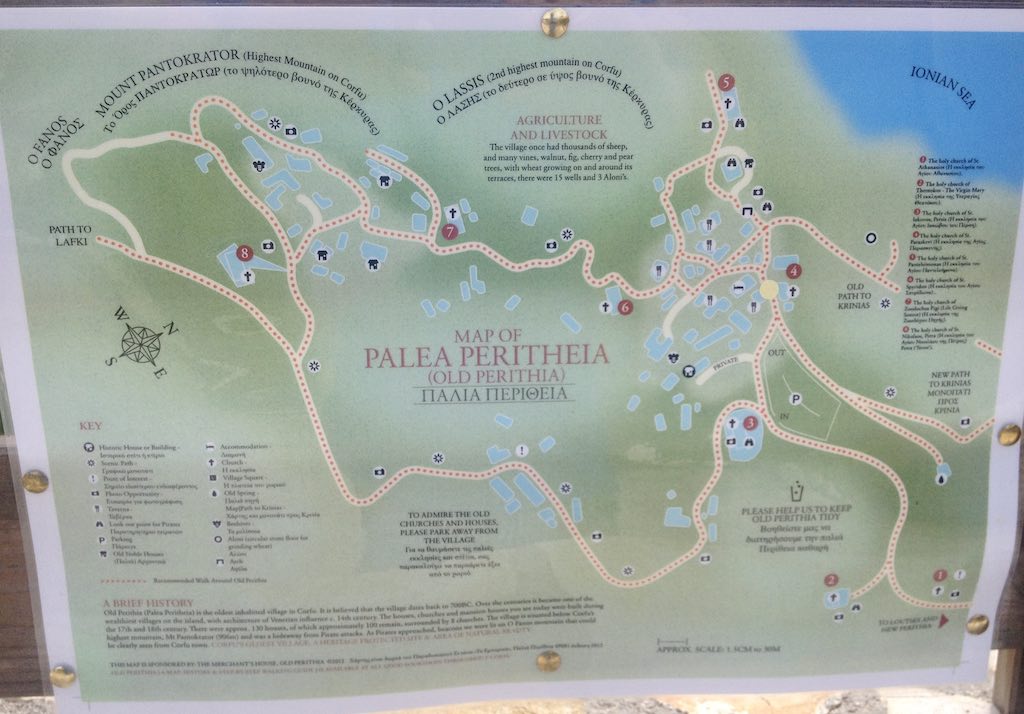
Pick up a village map at the entrance before you start — it marks the churches and the main routes so you don’t miss anything. It’s a small thing, but on your first visit it turns a pretty stroll into a proper little treasure hunt.
Hiking to Mount Pantokrator from Old Perithia
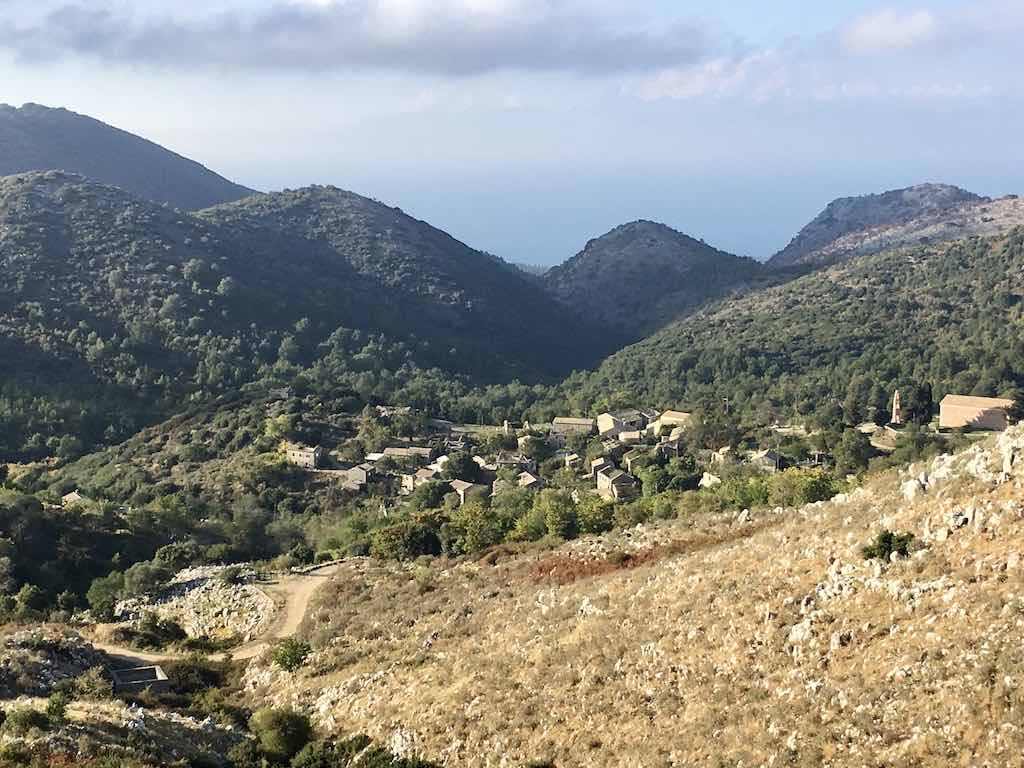
One of the best things about Old Perithia is that it makes a perfect base camp for hiking Mount Pantokrator (906 m / 2,972 ft), the highest peak on Corfu. The village is part of the network of paths that includes the long-distance Corfu Trail (a waymarked route of around 200 km running the length of the island), and the round trip to the summit and back takes roughly two hours.
Here’s the route as I walk it. The path to Pantokrator leaves to the right of the main church as you look at it from the road. Just outside the village, after you pass a concrete cube that serves as a water reservoir, a faint trail branches off to the left — watch for two orange-and-yellow waymarks, which are easy to miss. (If in doubt, staying on the main path is also a lovely walk.) After about half an hour you reach a small kiosk and a dirt road, with a terrific view of Old Perithia and the sea on one side and the far coast on the other. Turn right along the dirt road, and after another half hour you meet an asphalt road that climbs to the summit in a final twenty minutes or so.
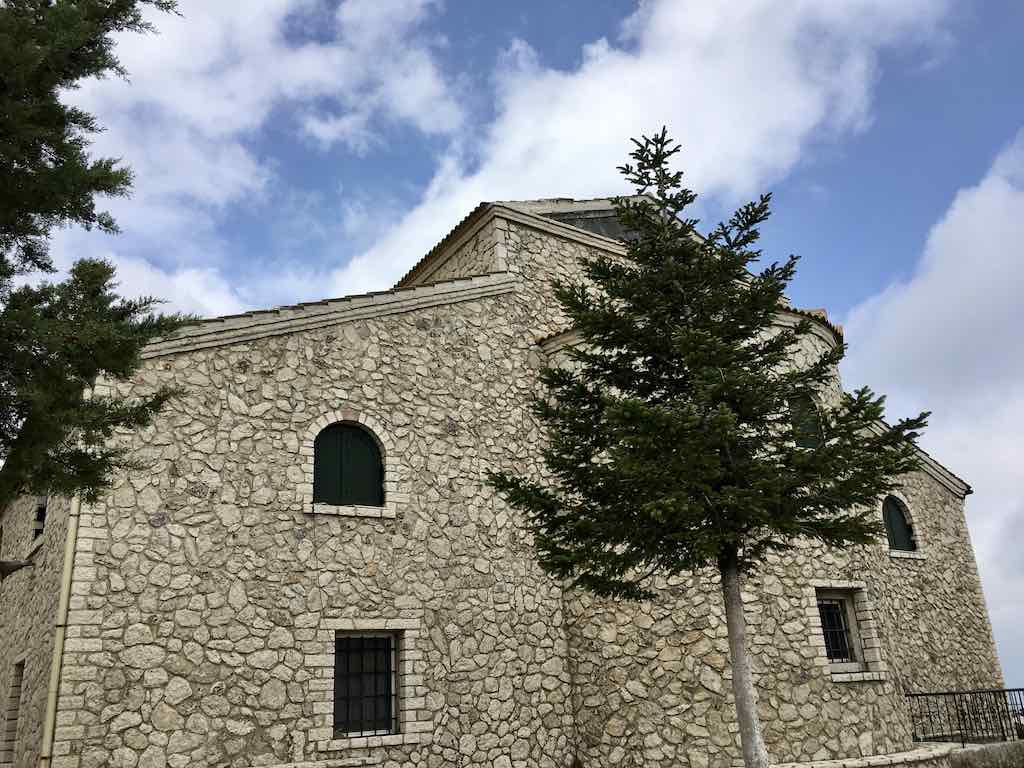
At the top you’ll find the Pantokrator Monastery, dedicated to the Transfiguration of Christ. An Angevin monastery first stood here in 1347; the present church dates from around 1689, with a 19th-century facade, and it shares the summit rather incongruously with a large telecoms tower. There’s a small café where you can refuel. On a clear day the reward is extraordinary: the whole of Corfu laid out below you, Albania just across the strait, and — on the very clearest days — the coast of Italy, some 130 km away. Then it’s back down to Old Perithia for a very well-earned lunch.
💡 Tip: wear proper shoes (the trail is stony in places), carry at least 1.5 litres of water each, and start early in summer — there’s little shade on the upper sections. You can also drive to the summit by the winding road if you’d rather skip the climb.
Other Walks and Cycling from the Village
Pantokrator is the headline hike, but it’s not the only one. Old Perithia works as a trailhead for several gentler routes — a simple loop around the village and its churches, and marked walks out toward the hamlets of Lafki and Krinias through olive groves and open hillside. The tavernas and The Merchant’s House can point you to short self-guided walks, and it’s a genuinely lovely area to just ramble with no fixed plan.
If you’d rather ride than walk, the hills around Old Perithia are prime cycling country. S-bikes Corfu, based down in Acharavi, runs a mountain tour that takes in Old Perithia, so you can combine the village with a proper day out on two wheels. Either way, the reward is the same: quiet lanes, huge views, and hardly another soul once you’re out of the village.
Where to Eat: The Tavernas of Old Perithia
People drive up here for the walk and the history, but plenty come just for lunch — and rightly so. Old Perithia has five family-run tavernas serving hearty, traditional Corfiot mountain food, and the setting, under the plane trees with the ruins all around, is hard to beat. In July and August it’s worth booking ahead, especially for a group or a Sunday.
- Ognistra (Nikos) — my personal favourite, the first taverna you reach after parking. Order the kouneli stifado (rabbit stew).
- The Old Perithia (Alexia, Alkinoos and their mother Diamantina) — down in the village, with a fantastic view of Mount Pantokrator, and also excellent kouneli stifado.
- O Foros (Thomas and Vasso) — a lovely spot for a long, slow lunch of grilled meats and mezze.
- Gabriel’s Steps (brothers Giannis and Kostas) — traditional dishes in an atmospheric corner of the village.
- Evdokia (Dina and Thomas) — a warm, family-run kitchen for home-style Corfiot cooking.
Keep an eye out, too, for Vassilis’ honey shop selling local honey and produce — the surrounding hills are a designated area of natural beauty, full of wildflowers, orchids and bees, and the honey is the taste of the place in a jar.
Best Time to Visit Old Perithia
Because it sits high on the mountain, Old Perithia is noticeably cooler than the coast — a blessing in high summer and something to plan around in the shoulder seasons.
- May–June: my favourite window. Wildflowers everywhere, comfortable walking temperatures, and the tavernas open but quiet.
- July–August: the busiest months. The village is lovely but lunchtimes fill up — arrive before noon or after 3 p.m., and book a table.
- September–October: warm, calm and uncrowded, with soft autumn light. An excellent time to combine lunch with the Pantokrator hike.
- November–April: very quiet and atmospheric, but several tavernas close for winter and the trails can be muddy after rain. Check ahead before driving up.
How to Get to Old Perithia
You really need a car to reach Old Perithia — there’s no practical public transport, and that’s part of why it stays so peaceful. The good news is that the drive is straightforward and beautiful.
- From Kassiopi or Acharavi: about 25 minutes. Follow signs for Loutses, then keep going straight — there’s essentially one road up to the village.
- From Corfu Town: just over an hour, heading up the northeast coast and then inland.
- Parking: there’s a car park at the village entrance. It can fill at peak lunch hours in summer, another reason to come a little early or late.
The village itself is pedestrianised, with uneven cobblestone lanes, so leave the car at the entrance and wear sturdy shoes for wandering.
Where to Stay Near Old Perithia
Spending a night up here — or in the green hills around Loutses — is a completely different experience from the coastal resorts: silence, stars, and the mountain to yourself once the day-trippers leave. Here are the options I’d point you to.
Villa Voukithro (Loutses) — my pick for families and groups
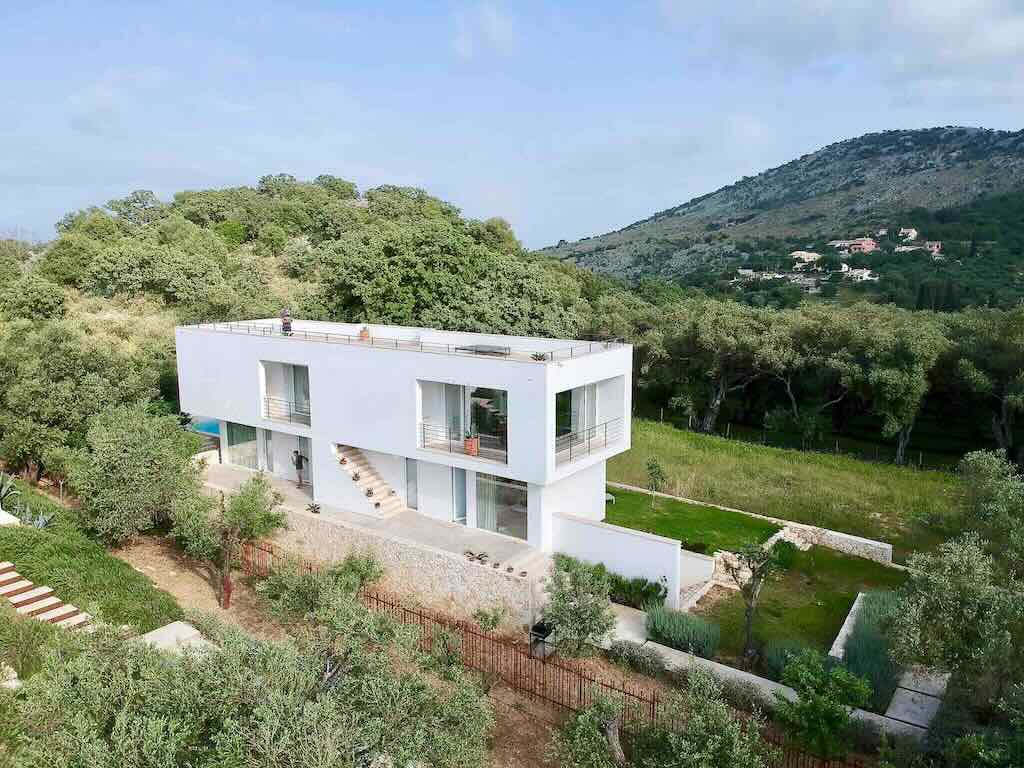
Just down the road from Old Perithia near Loutses, Villa Voukithro is a spacious four-bedroom villa with a private pool, set in the peaceful hills with easy access to both the mountain and the northeast beaches. It’s ideal if you want a base for exploring Old Perithia and Pantokrator by day and a quiet, green retreat at night — perfect for a family or a group of friends sharing.
The Merchant’s House — stay inside the village
For the full ghost-village experience, The Merchant’s House is a beautifully restored heritage guesthouse right in Old Perithia, with six individually styled suites (Gabrieli’s, Goussi’s, The Carpenter’s, The Doctor’s, The Kafeneion and The Weaver’s). Waking up in the village after everyone has gone home, with nothing but birdsong and mountain air, is genuinely special.
Kassiopi and Acharavi — for beaches and choice
If you’d rather be by the sea and drive up for the day, the nearby resorts of Kassiopi and Acharavi offer the widest choice of seafront hotels, studios and apartments, all within about 25 minutes of Old Perithia. For a full rundown of the island’s areas, see our guide to where to stay in Corfu.

Practical Tips for Visiting Old Perithia
- Come off-peak in the day: mid-morning or after 3 p.m. means easy parking and quiet lanes.
- Wear proper shoes: the cobbles are uneven and the trails are stony.
- Book tavernas in July–August, especially for groups or weekends.
- Bring water and sun protection if you plan to hike — shade is limited up high.
- Bring some cash: handy for the smaller tavernas and the honey shop.
- Respect the ruins: some houses are private or fragile — admire, photograph, but don’t climb on the stonework.
- Stay for dusk if you can — the village is at its most magical once the day-trippers leave.
Make a Day of It: Old Perithia and Northeast Corfu
Old Perithia pairs beautifully with the rest of the northeast, so I rarely visit it on its own. Here’s the easy day I usually suggest to friends. Start with a morning hike up to Pantokrator while it’s cool, then come back down for a long lunch at one of the village tavernas. In the afternoon, drop back toward the coast and finish at Kassiopi, the liveliest of the northeast harbours, for a swim at one of its little bays and a drink by the water as the light softens.
With more time, the whole north of the island is within easy reach: the string of beaches around Kassiopi and Acharavi, the dramatic cliffs of the far north, and — over on the west coast — the show-stopping twin bay of Porto Timoni. Old Perithia is the cool, quiet, historic counterpoint to all that coastline, which is exactly why it deserves a place on your itinerary rather than being saved for “if there’s time.”
Discover More of Corfu
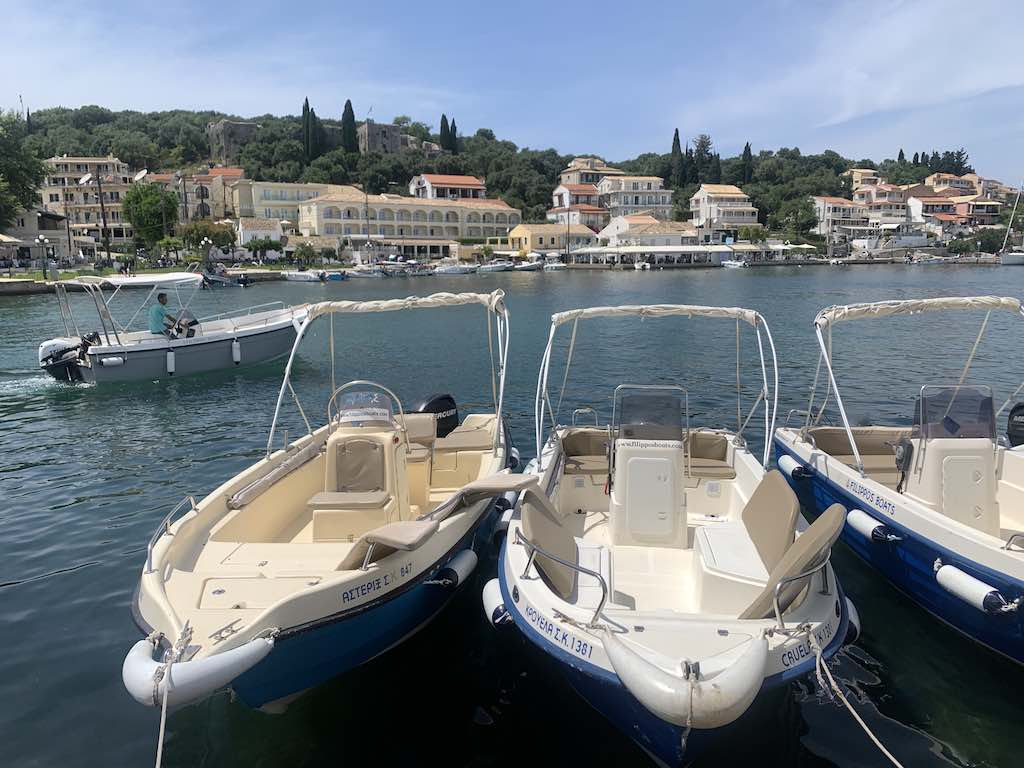
Kassiopi
The lively harbour village on the northeast coast — beaches, tavernas and the closest resort base to Old Perithia. Read more
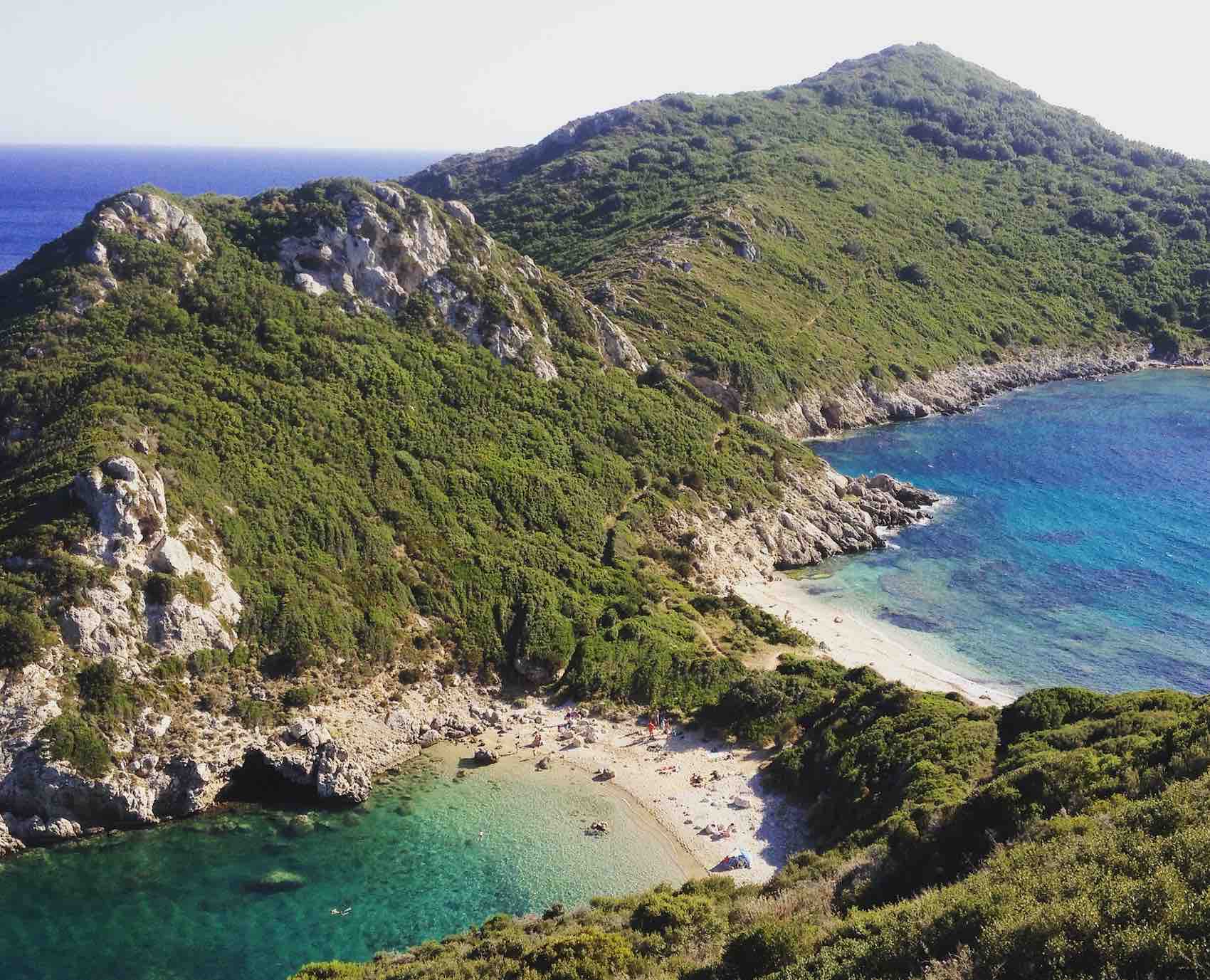
Porto Timoni
Corfu’s iconic twin beach near Afionas — turquoise water and one of the island’s most photographed views. Read more

Paleokastritsa
The “queen” of Corfu’s west coast — six enchanting bays, a Byzantine monastery and crystal-clear water. Read more
👉 Planning your whole trip? See our complete Corfu travel guide and our pick of the best beaches in Corfu.
Frequently Asked Questions About Old Perithia
Is Old Perithia worth visiting?
Yes — it’s one of the most atmospheric places on Corfu. As the island’s oldest village and a protected monument, it offers Venetian architecture, eight historic churches, excellent mountain tavernas and access to the Pantokrator hike, all in a peaceful setting far from the coastal crowds.
Why is Old Perithia a ghost village?
The village was built high on the mountain to escape pirate raids and coastal malaria. Once those threats faded and tourism grew along the coast in the 20th century, residents moved down to the sea for work through the 1950s and 1960s, leaving most of the houses empty. Many are now being carefully restored.
How do you get to Old Perithia?
By car. It’s about 25 minutes from Kassiopi or Acharavi (follow signs for Loutses, then straight on), and just over an hour from Corfu Town. There’s a car park at the village entrance that can fill during peak lunch hours.
Is there anywhere to eat in Old Perithia?
Yes. The village has five family-run tavernas — Ognistra, The Old Perithia, O Foros, Gabriel’s Steps and Evdokia — serving traditional Corfiot mountain food. The local speciality is kouneli stifado (rabbit stew). Book ahead in July and August.
Can you hike to Mount Pantokrator from Old Perithia?
Yes. A marked trail leaves from beside the main church and reaches the 906 m summit in about an hour each way (roughly two hours round trip). At the top there’s a monastery, a café and, on clear days, views to Albania and even Italy. Wear proper shoes and carry water.
How many churches are in Old Perithia?
Eight, dating from the village’s prosperous era. The main one is Agios Iakovos o Persis (St James the Persian), a 14th-century church with notable frescoes, restored in 2013–2014.
How long should I spend in Old Perithia?
Allow half a day for a walk through the village and lunch at a taverna. If you add the hike up to Mount Pantokrator, plan for a full day.
When is the best time to visit Old Perithia?
May–June and September–October are ideal: warm, quiet and perfect for walking. July and August are busiest, so come outside peak lunch hours. In winter several tavernas close, so check before driving up.